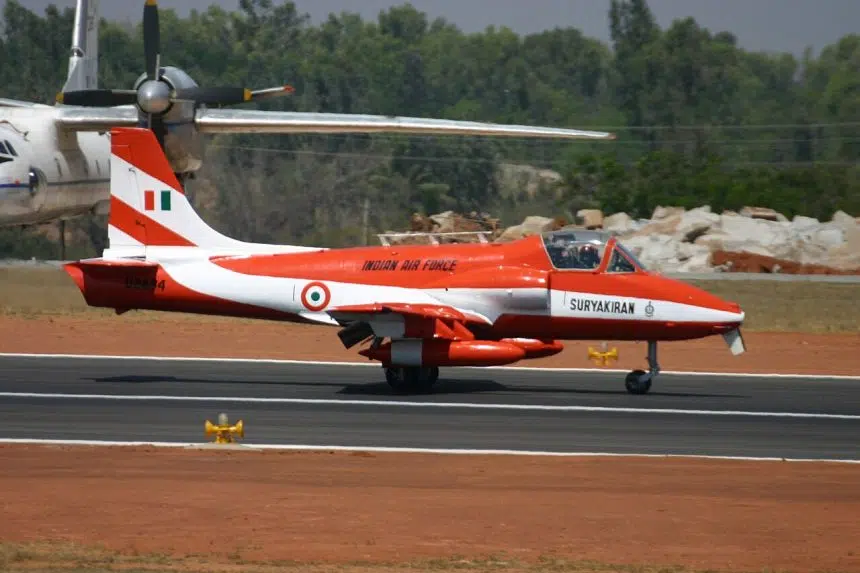

On this day in aviation history, 62 years ago (September 4, 1964), the HAL HJT-16 Kiran took flight for the first time. Designed and manufactured by Hindustan Aeronautics Limited (HAL), the Kiran, meaning “Ray of Light,” was developed as a two-seat intermediate jet trainer for the Indian Air Force. Development of the Kiran began in response to an Indian Air Force requirement for a new aircraft to provide intermediate training between basic trainers and frontline combat aircraft. HAL produced a conventional low-wing design powered by a British Rolls-Royce Viper turbojet. Following the prototype’s successful first flight, pre-production aircraft began reaching the Indian Air Force in March 1968, followed by full-scale production.

The original Kiran I was followed by the Kiran IA, which added two underwing hardpoints for weapons training. HAL later developed the substantially improved Kiran Mk II, powered by a Bristol Siddeley Orpheus turbojet and equipped with four hardpoints and two nose-mounted machine guns. The Kiran served with both the Indian Air Force and Indian Navy and was also flown by their Surya Kiran and Sagar Pawan aerobatic teams. Production ended in 1989 after a lengthy production run. The Kiran IA measured 34 feet 9 inches in length with a wingspan of 35 feet 1 inch and was powered by a single Rolls-Royce Viper 11 turbojet producing 2,500 pounds of thrust. It could reach 432 mph at sea level, had an endurance of approximately one hour and 45 minutes, and a service ceiling of just over 30,000 feet. Its two underwing hardpoints could carry bombs, rocket pods, machine-gun pods, or external fuel tanks.