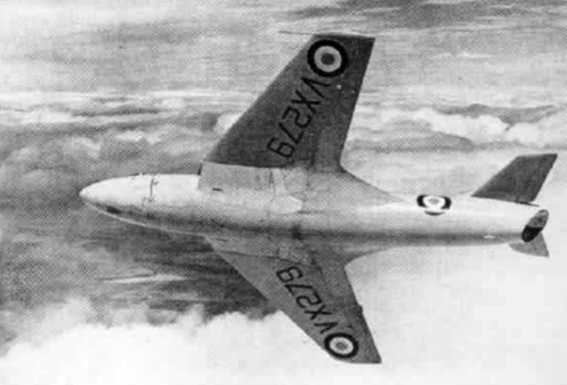
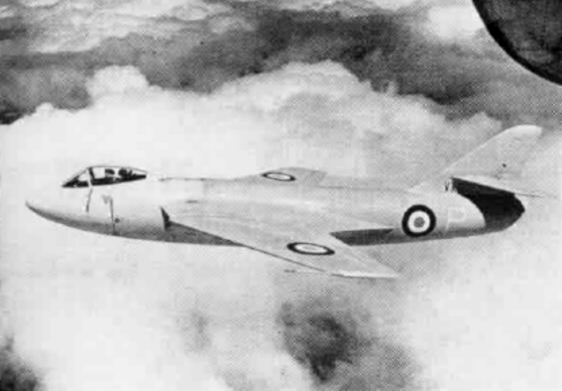


On this day in aviation history, 76 years ago (June 19, 1950), the Hawker P.1081 took flight for the first time. Named the “Australian Fighter,” as the aircraft was intended to be the nation’s new mainline fighter, the P.1081 was designed by British-based aerospace manufacturer Hawker Aircraft. Development of the new fighter began in 1949, when the Royal Australian Air Force initiated a period of assessment for replacing their CAC-built Mustangs and de Havilland Australia Vampires. Hawker submitted a proposal to the RAAF upon receipt of this new specification. Their design featured a swept-wing and tail, and would be powered by a Rolls-Royce Tay engine. The first P.1081 was a modified P.1052, s/n VX279. Ultimately, the Rolls-Royce Nene engine that was originally installed in the P.1052 was retained for the P.1081. However, a single tail-exit pipe exhaust was added to allow for afterburning. After the first flight of the now P.1052 prototype, CAC made plans to build the fighter under the designation CA-24.
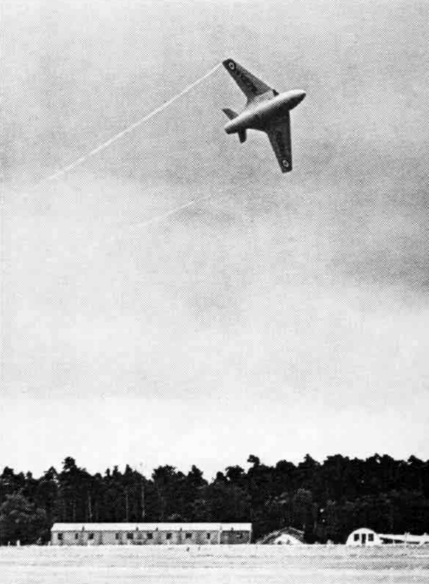
As the Australian CAC Mustangs began to face the reality of going up against MiG-15 jet fighters in the Korean conflict, the RAAF began to seek a more readily available solution as a fighter replacement. In mid-1950, the North American F-86 Sabre was serving with the USAF, but it also held priority on aircraft production. The RAAF opted to order F.8 variants of the Gloster Meteor to solve the jet fighter crisis. Upon the conclusion of the Korean War, CAC would build their own version of the Sabre, powered by the Rolls-Royce Avon engine. Hawker ceased development of the P.1081 in November of 1950. The sole prototype was passed on to the Royal Aircraft Establishment (RAE) for further flight evaluation. Flight tests showed the P.1081 to have the ability to attain Mach 0.95, or 695 mph. An unfortunate accident on April 3, 1951, led to the loss of the P.1081 and its pilot, Squadron Leader T. S. “Wimpy” Wade. Although lost prematurely, the P.1081 flight data provided valuable insights towards the production of the Hawker Hunter fighter-bomber.