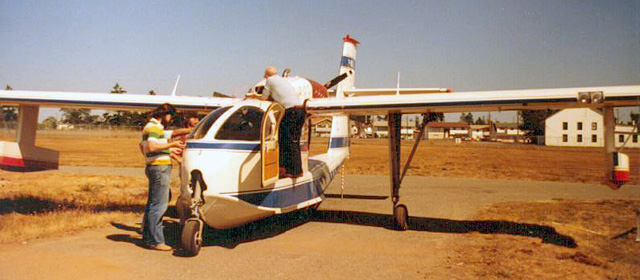


On this day in aviation history, 53 years ago (August 5, 1973), the first flight of the Trident TR-1 Trigull took place. The TR-1 was a further development of the Republic RC-3 Seabee amphibious aircraft, taken on by Canadian manufacturer Trident Aircraft. Trident had planned the TR-1 to be a fully certified amphibious aircraft that built upon the strengths of the Seabee. The Trigull retained the high-wing pusher configuration of the RC-3, while providing space for four to six occupants in the cabin. As opposed to the Seabee’s tail-dragging gear, the Trigull had a tricycle undercarriage, which also retracted as it did in the RC-3. Construction of the TR-1 was primarily of aluminum and fibreglass. Trident was innovative with the TR-1’s floats, designing them to retract into the wingtips, providing additional wing surface area and lift. The retractable nose wheel served double-duty as a bumper for mooring in the water. Trident earned certification for the Trigull from Transport Canada on October 28, 1976, and from the FAA on December 16 of the same year.

Production of the TR-1 was set to begin in the early 1980s, and a total of 43 orders were received for the amphib. Both Canadair and Grumman provided technical support during development of the production Trigull, but despite funding from the Canadian Ministry of Industry, Trident ran out of funds. Trident ceased operations in 1980, and production of the TR-1 ended after three prototypes. The type certificate for the Trigull was next held by Viking Air of Sidney, British Columbia. Viking also owned two of the original prototype TR-1 airframes. In 2024, the type certificate for the Trigull was transferred to de Havilland Canada. The Trident TR-1 was powered by a 285-horsepower Continental Tiara 6-285 six-cylinder engine and was capable of 148 mph in cruise (max airspeed 157 mph). Stall speed for the Trigull was 52 mph, while the aircraft’s range was 450 nautical miles. The TR-1 had a service ceiling of 16,000 feet and a rate of climb of 1,000 feet per minute.