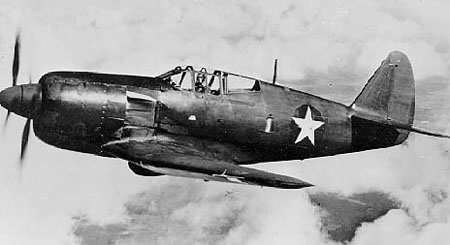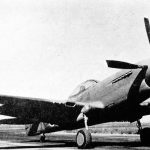
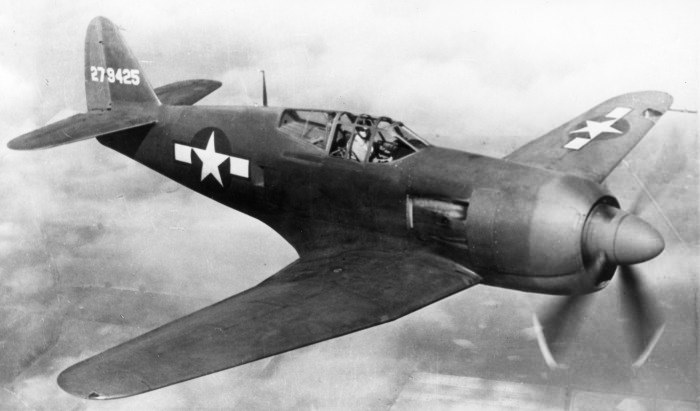


During WWII, Curtiss was developing several new aircraft, as its last successful model, the P-40 Warhawk, was introduced in 1938. In a bid to develop another successful fighter after the rejection of the XP-46, Curtiss proposed its Model 88 to the United States Army Air Corps. The proposal included developing an aircraft that would use the fuselage and tail of the P-40D, along with a low-drag NACA laminar flow wing. It would have the Continental I-1430-3 inverted V-12 engine, which was still under development at the time, and eight machine guns mounted on the wings, firing 12.7 mm ammunition. The proposal was approved, and on October 1, 1940, a contract was issued for two prototypes of the aircraft, which was designated as XP-53. In early 1941, the Army Air Corps requested that Curtiss develop an aircraft with a special wing and a British Rolls-Royce Merlin engine. Curtiss proposed using the XP-53 design and suggested modifying the second prototype while it was being built, which changed the contract, and the new aircraft, known as Model 90, was renamed Curtiss XP-60. Instead of the originally planned engine, a Packard-built V-1650-1 engine (similar to the Merlin Mk XX) was selected, which was also used in the Curtiss XP-40F. The design of the Curtiss XP-60 was adjusted to accommodate the new engine. Additionally, the landing gear changed from a rear-retracting style, as on the P-40, to an inward-retracting style, similar to that used on the XP-46. The design provided a wider wheelbase and a smoother wing surface when the gear was retracted.
Design of Curtiss XP-60
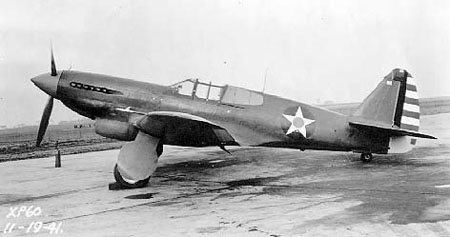
The Curtiss XP-60 made its first flight on September 18, 1941, using a British Merlin 28 engine. Then the XP-53 prototype was converted into a static test airframe for the XP-60. Due to possible delays in the delivery of Packard-built Merlin engines, which were needed for other fighter projects, the team considered using a turbo-supercharged Allison V-1710-75 engine instead, which was expected to reach a speed of 394 mph at 25,000 feet. As a result, on October 31, 1941, a contract was awarded for 1,950 P-60A fighters powered by the Allison engine, and deliveries were expected to start in September 1942. However, the Curtiss XP-60 prototype faced several issues during flight testing. There were problems with the landing gear, and the plane did not reach its expected top speed. This was due to a rough surface finish on the laminar-flow wing, higher drag from the radiator compared to the North American P-51 Mustang, and the engine not producing the required power. Moreover, the P-60A Allison engine was unable to produce the required 1,500 horsepower. After the Japanese attack on Pearl Harbor, the United States focused on finishing existing aircraft designs instead of starting new ones. On December 20, 1941, the Army Air Forces recommended that Curtiss shift its efforts to producing Republic P-47 Thunderbolts. The P-60 project continued, but changes were made. On January 2, 1942, a new order was issued for three experimental aircraft. The first was the XP-60A (Model 95A), which would use the Allison V-1710-75 engine and a General Electric B-14 turbo-supercharger. The second was the XP-60B (Model 95B), also with the Allison V-1710-75 engine but with a Wright SU-504-1 turbo-supercharger. The third was the XP-60C (Model 95C), which featured a powerful 2,500 horsepower Chrysler XIV-2220 16-cylinder V-16 engine. Although the XP-60’s wing would remain the same, the fuselage design was rounder.
The Redesign
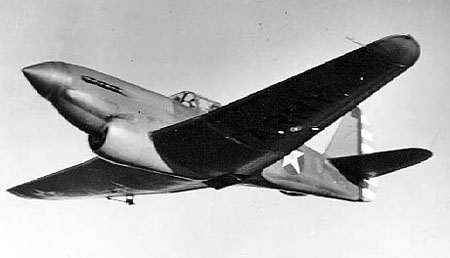
In February 1942, Curtiss was asked to stop making the Curtiss XP-60 to focus on producing an additional 1,400 P-40s and to keep their production lines busy until the P-60 was ready. At that time, there were concerns about the availability of the Chrysler engine. In April, Curtiss mentioned that either they would need to change the fuselage or add several hundred pounds of ballast to the tail of the existing airframe to balance the heavy engine. In September, the company decided to install a Pratt & Whitney R-2800 radial engine in the XP-60C. Meanwhile, Curtiss fitted a Packard V-1650-3 engine, which is similar to the Merlin 61, into the original XP-60, which had a four-bladed propeller and a larger vertical stabilizer, and it was redesignated as the XP-60D. The XP-60A flew for the first time on November 1, 1942. Interest in this aircraft was declining as newer designs emerged. However, the potential for better performance using the R-2800 engine led to a contract for 500 planes, which were officially named P-60A-1. These planes would use the R-2800 engine and contra-rotating propellers, while the first 26 were designated YP-60A and had a single-rotation propeller. However, there were concerns that the contra-rotating propellers would not be ready in time because Pratt & Whitney needed to modify the engine gearing. To gather data, the XP-60B was changed to use the R-2800-10 engine with a turbocharger and a four-bladed propeller. Because of these modifications, it was renamed XP-60E (Model 95D).
The Cancellation
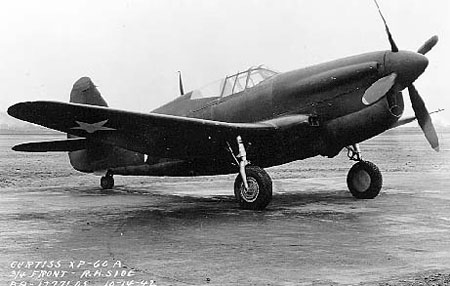
On January 27, 1943, the XP-60C aircraft made its first flight. It was powered by an R-2800-53 engine with contra-rotating propellers. The flying characteristics of the aircraft were mostly satisfactory. The first flight of the XP-60E with a four-bladed propeller was delayed until May 26, 1943, because the new engine’s lighter weight required moving its installation 10 inches forward relative to the XP-60C. In April 1943, the US Army Air Forces decided to evaluate different fighter aircraft in development and use to identify the least effective models. With only four days’ notice, the service asked Curtiss to have the XP-60E participate. Since the XP-60E was not ready, Curtiss quickly repaired the XP-60C for the evaluation at Patterson Field. However, the XP-60C underperformed because of flaking wing paint that disrupted airflow, and the engine produced less power. As a result, the planned production of 500 aircraft was reduced first to 20 YP-60A and then to just two aircraft. On May 6, 1943, the XP-60D crashed during a dive demonstration. In January 1944, pilots tested the XP-60E at Eglin Field. They found that it did not perform as well as other aircraft designs of the time. Despite this, when Curtiss proposed to stop work on the P-60 series, the USAAF insisted on completing at least one of the two aircraft already in production. The first production aircraft was called YP-60A-1-CU, but it was later renamed YP-60E to match the names of earlier prototypes. The YP-60E had a powerful 2,100 hp R-2800-18 engine. It also had a cut-down rear fuselage and a bubble canopy that improved visibility. The aircraft first flew on July 13, 1944, and was sent to Wright Field. However, the government had already canceled the development contract in June 1943, so there was no money for further changes or a final purchase order. As a result, the only completed YP-60E was scrapped on December 22, 1944. The XP-60E survived and was entered in the 1947 National Air Races, but it crashed during a qualifying flight before the event. In the Grounded Dreams series, the Curtiss XP-60 saw many engine upgrades and variants but could never prove itself due to its instability. Read more Grounded Dreams articles HERE.