






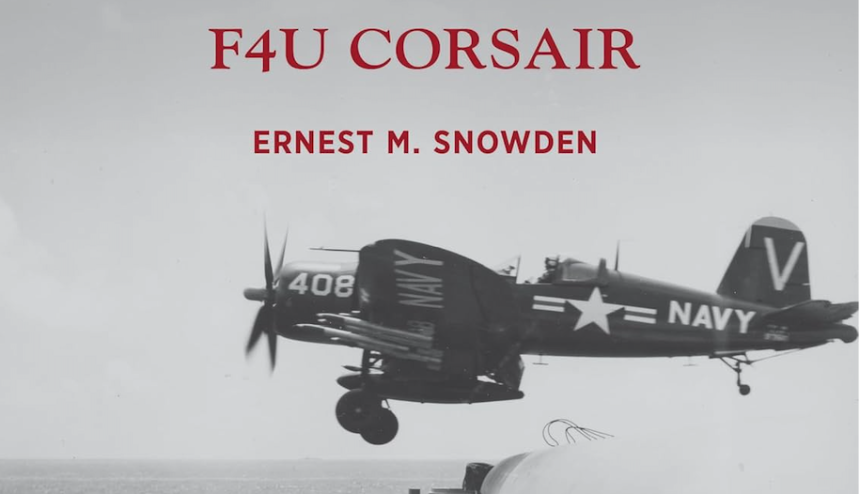

F4U Corsair by Ernest M. Snowden, reviewed by Joe May, available on Amazon.
Snowden’s F4U Corsair follows closely with his F8U Crusader (check HERE) just as notably and enjoyably. It is the story of the U.S. Navy (USN) acquiring an aircraft designed for power as well as for speed to dominate the air battle space. Snowden’s writings insightfully follow Chief Engineer Rex Beisel’s design process to create Vought’s Corsair, a carrier-qualified fighter aircraft on par with land-based fighters, which was unheard of back in the day. A naval fighter as formidable as a land-based fighter has design challenges, with weight being chief among them. Carrier aircraft are built more solidly than their land-based brethren due to a career of structurally stressful carrier landings which are crash-like (unflared) and sharply arrested. Remarkably, the Corsair met these challenges and accomplished being the first single-engine fighter to break 400 mph in level flight. But how?
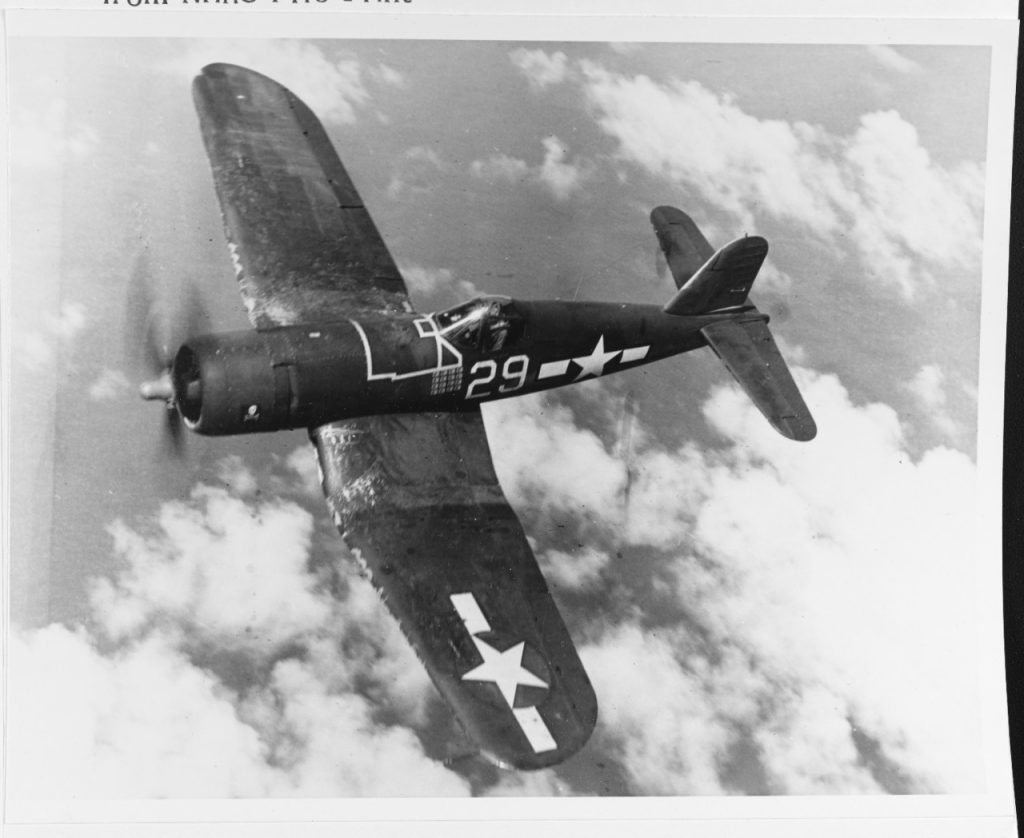
Snowden writes about how clearly Beisel eliminated parasitic drag wherever, whenever possible. A circular fuselage sharply finning from the engine to the tail. An inverted gull wing to allow for the preferred low-mounted wing, for carrier operations, while meeting the fuselage at the optimum right angle to best reduce induced turbulence at the joining, with the benefit of relatively shortened landing gear. Oil coolers recessed deeply within the wings. A semi-recessed cockpit with an absent floor. Vought used the Pratt & Whitney R-2800 Double Wasp and hit the magic threshold of one horsepower to each cubic inch displacement with this engine. Snowden eloquently underscores why the Corsair was designed around this magnificent engine. The frontal area. The immense four-blade propeller. The R-2800 and the F4U were symbiotic…a perfect marriage. Snowden details the Double Wasp’s radial internal combustion engine type with cylinders arranged in two rows of nine, producing greater power while weighing less than its closest competitor. The construction details, like those of the cooling fins and crankshaft, are fascinating, as well. He explains design and construction details such as these, and more, in plain yet insightful language.
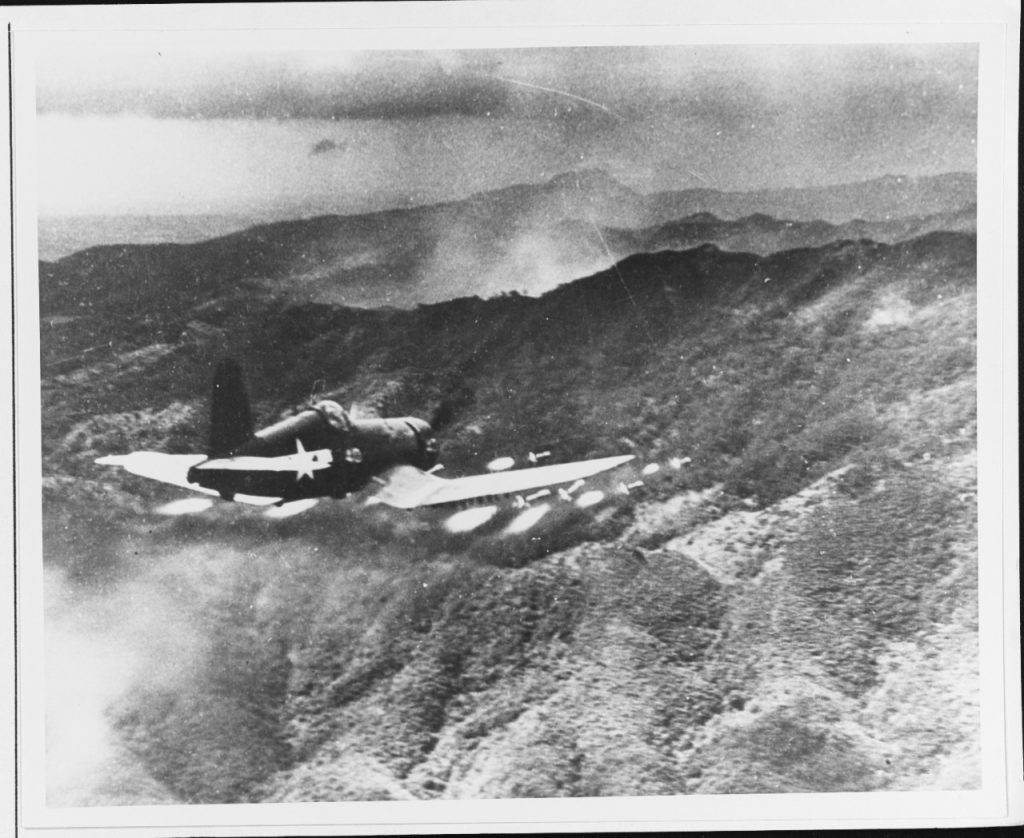
Designed with the looming war on the horizon, WWII, the author describes the Corsair’s evolution of armament in the early design phase. A ventral window for the pilot to aim bombs (to be contained within each wing) onto intruding bomber formations, cowl-mounted machine guns, even a 23mm cannon. All were evaluated and discounted until six wing-mounted 0.50 caliber machine guns were decided upon. Later, wing-mounted 20mm cannon could be substituted, as well as up to 2000 pound bombs could be mounted. Competing aircraft designs during the selection process are discussed and show the breadth of the U.S. aviation industry’s creativity. Bell’s XFL-1 Airabonita (liquid-cooled engine) as well as the Grumman XF5F-1 (twin radial engine) stood out, for example, with each design widely varying from the others. Once in service, the F4U’s intended career went sideways since the long nose didn’t allow for sufficient visibility from the cockpit to conventionally come aboard an aircraft carrier. At the time, finals were from a fair distance astern, straight in, and flight decks are known for narrowness—landing cues for pilots all but had disappeared for too long a time. So the USN sent Corsairs to the Marine Corps as well as the Royal Navy (RN). The Marines employed Corsairs as fighters and bombers from air strips during the Pacific island hopping campaigns of WWII. It was the Fleet Air Arm of the RN that redeemed the F4U, bringing it home to naval aviation aboard aircraft carriers. RN pilots flew a curved left-hand flight path to an extremely short final, a last-minute final, which allowed pilots the visibility needed for carrier landings. The USN adopted the same practice, which brought Corsairs back into the fight on the open ocean, carrier raids, as well as the increasingly imperative need for kamikaze defense. (Editor’s note: The US Navy was performing curved approaches for a few years. They employed the same with the Corsair, and three Navy squadrons were carrier qualified months before the Royal Navy even received their first Corsair.)
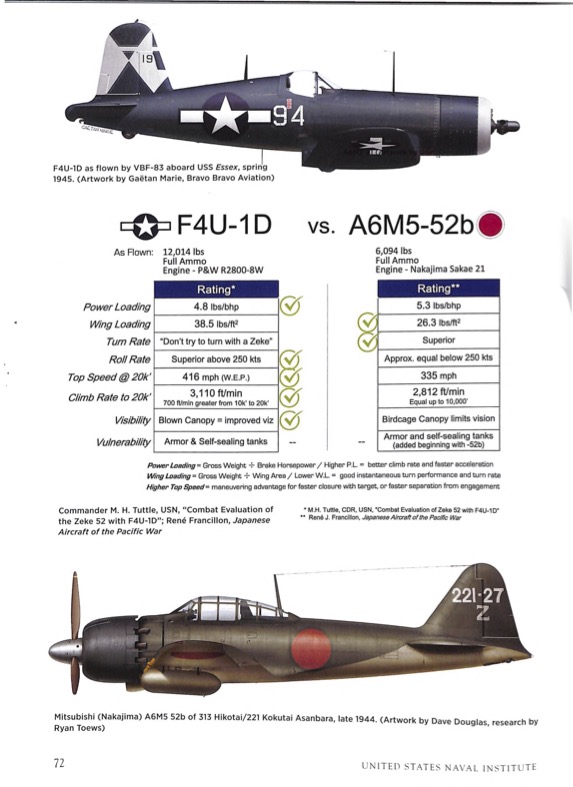
The author addresses the Corsairs ‘ WWII combat well, including a color profile page of the F4U-1 vs. the A6M5-52b (Zero) with comparative tables. Readers will quickly note the Corsair was two times the weight, was 75 mph faster, and had more significant parameters, such as not turning with the Zero. Snowden has a wonderful illustration (by Aldo Spandoni) of the immense area of action involved in the Okinawa campaign of WWII. Among the naval aircraft involved were 200 Corsairs of the USN and RN tasked with kamikaze combat air patrol, Kyushu fighter sweeps, and the strikes which sank the battleship Yamato of the Imperial Japanese Navy. The author does well by detailing the actions of the Fleet Air Arm in concert with the USN, making the history of the Corsair during WW II comprehensive and objective instead of the too easy and lazy fanboy style.
The Corsair also flew combat missions for the USN during the Korean War. Snowden writes of this phase in the Corsair’s career equally as well as before with individual combat stories and the same knowing overview. For example, Snowden observes that Corsairs flew 82% of the close air support missions during the first 10 months of the war—during the most dire of times for the United States and South Korea in the war. He also notes the F4U performance slotted neatly between the ordnance and loiter time of the Douglas Skyraider and the Grumman Panther’s speed in flak suppression. The Corsair also stood well against the MiG-15 (NATO codename: Fagot), the Russian-made jet fighter which surprised the world when it debuted for air combat in the Korean War.
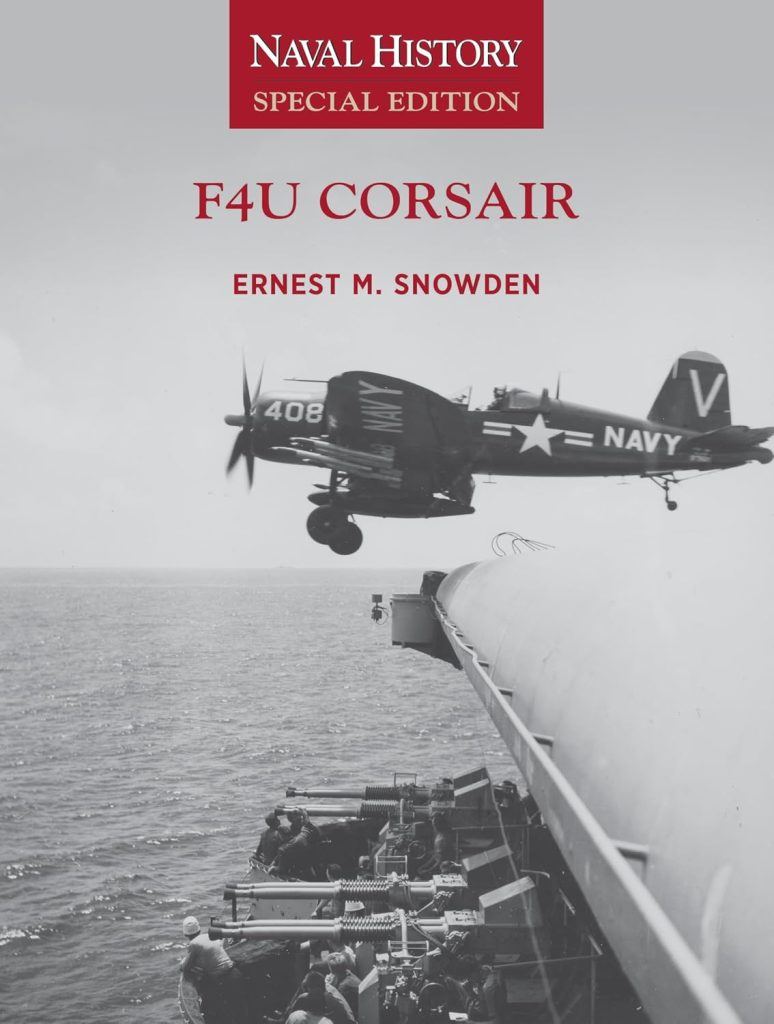
F4U Corsair ends quite well with present-day examples and a full-spread color photo of an F4U Corsair. This book’s hybrid format, between that of a magazine but less than a book, has much to tell in an elegant size. Snowden has expertly worked within this format to give readers intimate and insightful knowledge many authors can miss. He accomplished this with determination and zeal as shown in his writing. Ernest Snowden’s F4U Corsair is a book that is required reading for naval aviation interests as well as the aircraft itself. Consider inserting notes for returning to important passages, or scan the book into a searchable PDF, as there is no index.
| Softcover
Publisher: Naval Institute Press (2025) Size: 11” x 8” Index: X Bibliography: ✔︎ Notes: ✔︎ Photos: ✔︎ Cost: $20 ISBN: 978-1-68247-983-4 Page Count: 123 Available on Amazon |












Snowden is incorrect on the curving approach. The US Navy was performing curved approaches for a few years. They employed the same with the Corsair and three Navy squadrons were carrier qualified months before the Royal Navy even received their first Corsair.
Jerry
Indeed Jerry, we applied an editor’s note in the text.
The Navy never considered adding a 23mm cannon to th Corsair, what so ever! Also, the Royal Navy DID NOT come up with the curved approach to the carrier, it was the US Navy that came up with the curved approach, and the Us Navy didn’t give Corsairs to the Royal Navy, instead, the Royal Navy purchased the fighter through the Lend Lease Act. Please, recheck your information, again.
Based on the author research, the Navy considered adding a 23mm cannon to the Corsair. Even a simple research you can conduct on your own will reveal that. Please, recheck your information, again. As for the curved approach, we applied an editor’s note in the text.