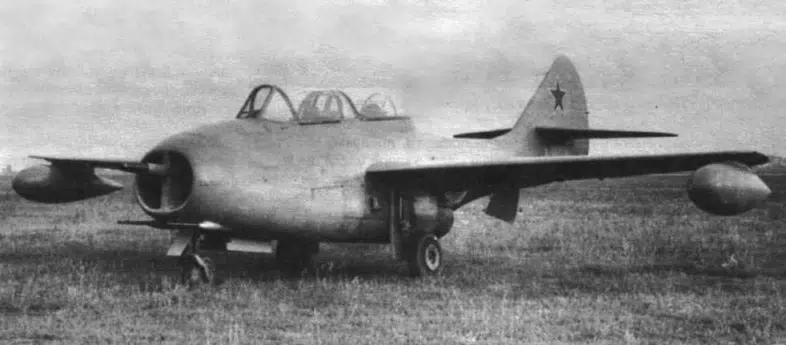

On this day in aviation history, 79 years ago (August 25, 1947), the Mikoyan-Gurevich MiG-9UTI took flight for the first time. Developed from the Soviet Union’s early MiG-9 jet fighter, the MiG-9UTI was a two-seat trainer intended to familiarize pilots with the new generation of jet-powered combat aircraft entering Soviet service following WWII. Development of the trainer began as the MiG-9 entered production and the Soviet Air Forces required a suitable aircraft for transitioning pilots to jets. Mikoyan-Gurevich modified the single-seat fighter by adding a second cockpit in tandem with dual controls. The prototype also incorporated ejection seats influenced by captured German technology. Visibility from the rear instructor’s position proved poor, however, leading to the development of a second prototype with a redesigned rear cockpit.

The MiG-9UTI ultimately did not enter production. By the time development progressed, the rapidly advancing pace of Soviet jet technology was already making the MiG-9 obsolete. Attention instead shifted toward newer designs, most notably the swept-wing MiG-15, which would become one of the most important Soviet fighters of the early Cold War. Only two MiG-9UTI prototypes were constructed. The MiG-9 family measured approximately 32 feet 10 inches in length with a wingspan of 32 feet 3 inches. Power came from two 1,760-pound-thrust Kolesov RD-20 turbojets, Soviet-built versions of the German BMW 003. The single-seat MiG-9 could reach approximately 570 mph, had a range of around 500 miles, and a service ceiling of 42,650 feet. Standard fighter armament consisted of one 37 mm N-37 cannon and two 23 mm NS-23 cannons.