
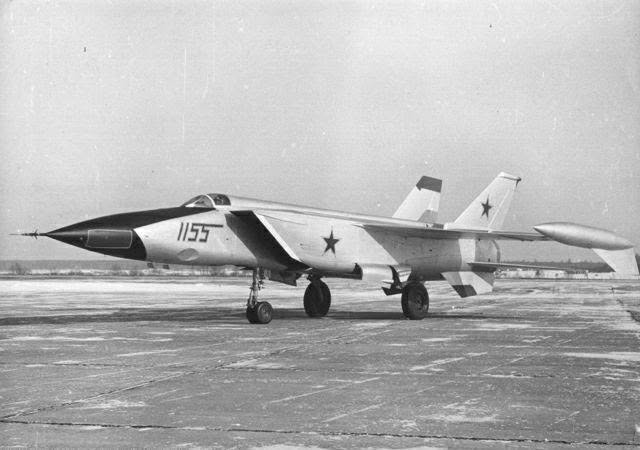


On this day in aviation history, 62 years ago (September 9, 1964), the Mikoyan-Gurevich Ye-155-P1 took flight for the first time. Developed as a high-speed interceptor for the Soviet Air Defence Forces, the Ye-155-P1 was the fighter prototype of the aircraft that would eventually enter service as the MiG-25 Foxbat. Development of the MiG-25 began in 1959 as the Soviet Union sought an interceptor capable of countering increasingly fast and high-flying American reconnaissance aircraft and strategic bombers. Requirements called for speeds approaching 1,860 mph and altitudes of nearly 90,000 feet. Mikoyan ultimately developed a large twin-engine aircraft optimized for tremendous speed and altitude rather than conventional fighter maneuverability.

The reconnaissance Ye-155-R1 became the first prototype of the family to fly in March 1964, followed by the interceptor Ye-155-P1 on September 9. Development continued for several years, with the new aircraft publicly revealed at the 1967 Domodedovo air show. The MiG-25 entered Soviet service in 1970 and became one of the fastest military aircraft ever produced. A total of 1,186 MiG-25s of all variants were eventually constructed. The production MiG-25P measured 78 feet 2 inches in length with a wingspan of 46 feet and was powered by two Tumansky R-15B-300 afterburning turbojets. Although capable of exceeding Mach 3, operational speed was limited to Mach 2.83 to prevent engine damage. The interceptor could operate above 65,000 feet and carried four R-40 long-range air-to-air missiles. Its airframe was constructed primarily from heat-resistant nickel-steel alloy to withstand the extreme temperatures encountered during sustained high-speed flight.