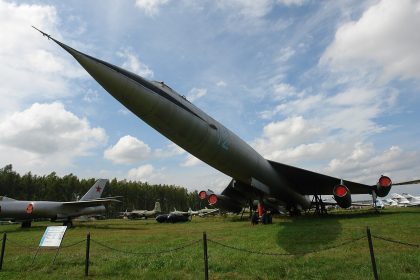
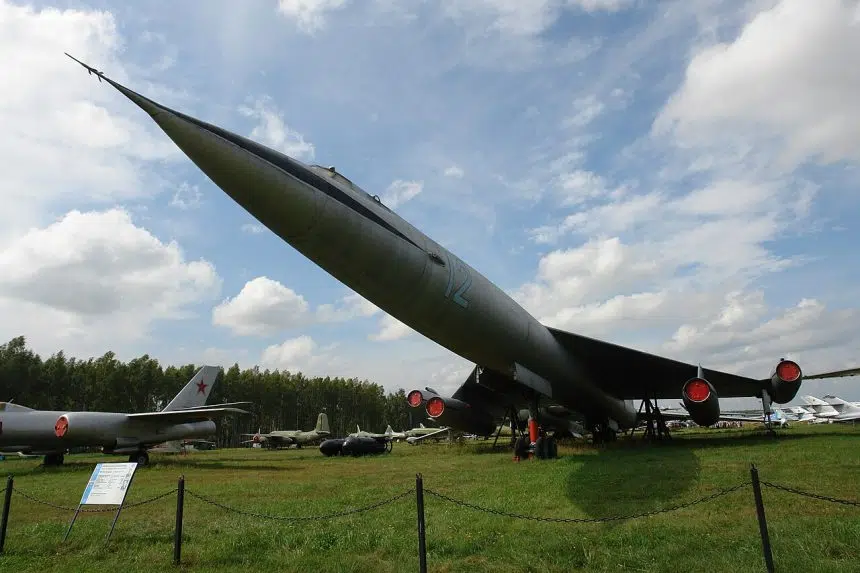


On this day in aviation history, 67 years ago (October 27, 1959), the Myasishchev M-50 took flight for the first time. Known to NATO as the “Bounder,” the enormous four-engine aircraft was developed in the Soviet Union as a supersonic strategic bomber. Only one flightworthy M-50 was completed, becoming one of the most distinctive experimental bombers of the Cold War. Development began during the 1950s as the Soviet Union explored increasingly ambitious methods of delivering nuclear weapons. Myasishchev developed a large, shoulder-wing aircraft with a slender fuselage and four turbojet engines. Two engines were mounted beneath the wings, while another pair was unusually positioned at the wingtips. The bomber was intended to fly supersonically, but development of the powerful engines required to achieve its design performance fell behind schedule.

The M-50 therefore began flight testing with less powerful substitute engines and never achieved its intended supersonic performance. Only a limited number of test flights were completed before the Soviet government cancelled the program in 1960 as ballistic missiles increasingly displaced manned bombers as the country’s strategic priority. The M-50 made its final public appearance at the 1961 Tushino air show and survives today at the Central Air Force Museum at Monino. The M-50 measured approximately 190 feet 7 inches in length with a wingspan of 115 feet 6 inches and had a maximum takeoff weight approaching 440,000 pounds. Power came from four Dobrynin VD-7 turbojets, with afterburning engines eventually fitted to the inner positions. The aircraft was intended to exceed Mach 1, but the prototype remained subsonic during testing. Its planned combat configuration called for a crew of two and the carriage of nuclear weapons.