


(Image credit: VAN)
Seventy-six years ago today (September 24, 1949), the North American Aviation T-28 Trojan took to the skies for the first time. Designed to replace the venerable AT-6 Texan, the XT-28 prototype (North American designation NA-159) represented the next generation of advanced military trainers. The Trojan entered service with both the U.S. Air Force and U.S. Navy, training countless pilots and serving as an essential step for those transitioning to jet fighters. With its low wing, tricycle landing gear, and bubble canopy, the T-28 offered handling characteristics and cockpit visibility similar to the early jets of its era.

In June 1950, the first production T-28s arrived at Eglin Air Force Base’s Air Proving Ground, where they underwent rigorous testing focused on instrument training, gunnery, and transition performance. Between 1950 and 1957, a total of 1,948 aircraft were produced. Beyond its training mission, the T-28 also saw combat. During the Vietnam War, the aircraft was employed as a counter-insurgency platform by the Republic of Vietnam Air Force (RVNAF), flying close-air support missions in defense of ARVN ground troops. In a twist of history, the North Vietnamese Air Force operated a single captured T-28—flown to the North by a defecting pilot—which scored the NVAF’s first aerial victory by downing an RVNAF C-123 Provider on February 15, 1964.
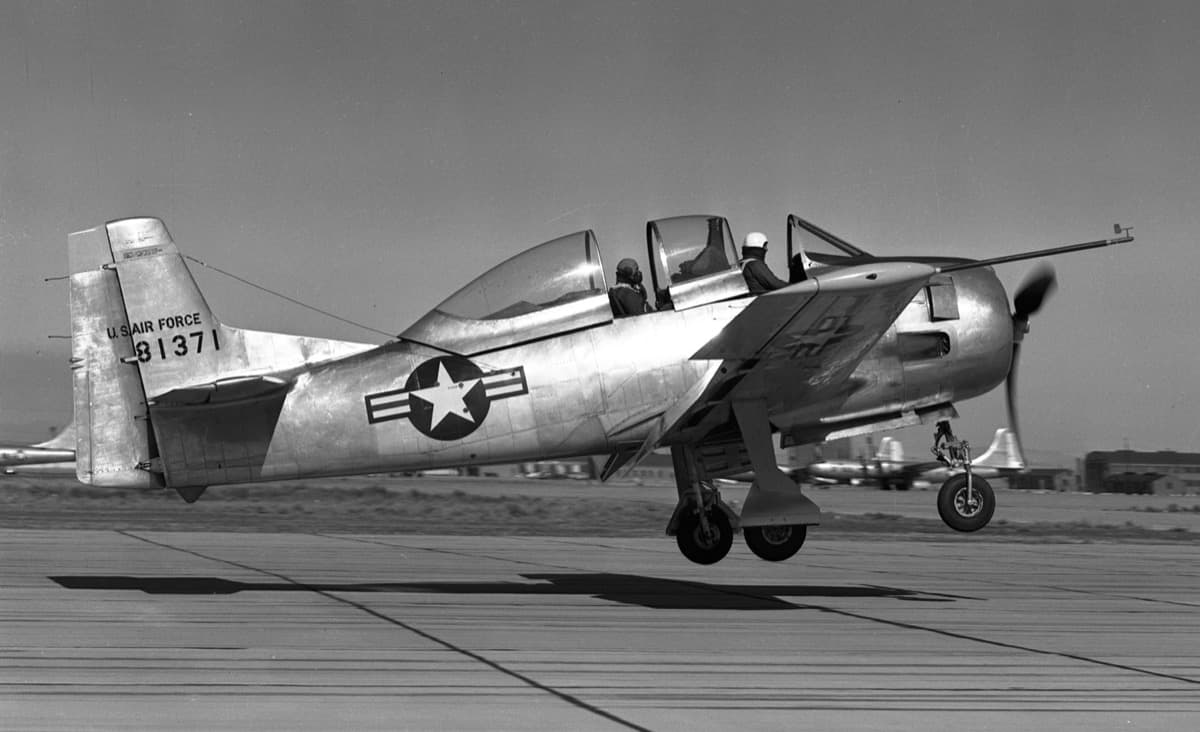
Powered by a 1,425 hp Wright R-1820-86 Cyclone radial engine, the T-28D could reach speeds of 343 mph, fly up to 35,500 feet, and had a range of 1,060 miles. It was armed with six underwing hardpoints capable of carrying up to 1,200 pounds of rockets, bombs, or gun pods. Navy variants were fitted with arrestor hooks for carrier operations. Today, the T-28 remains a beloved warbird, frequently seen at airshows across the United States. Its rugged construction, strong performance, and delightful handling qualities continue to earn admiration from pilots and enthusiasts alike—an enduring testament to North American Aviation’s design.