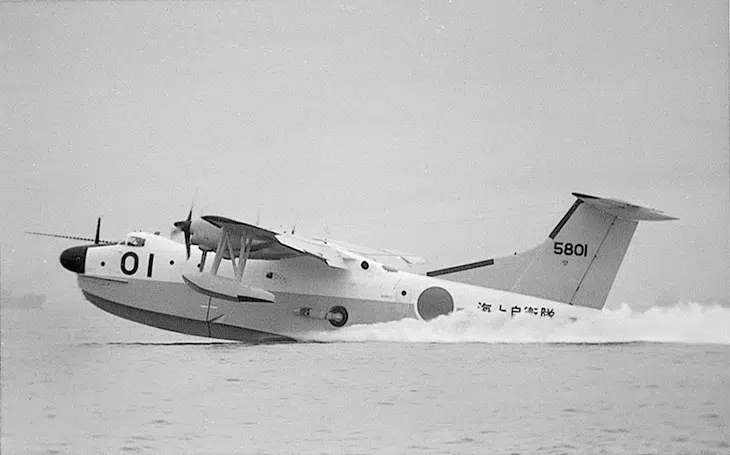


On this day in aviation history, 59 years ago (October 5, 1967), the Shin Meiwa PX-S took flight for the first time. Developed in Japan as a large anti-submarine warfare flying boat, the prototype would lead to the production PS-1 for the Japan Maritime Self-Defense Force. The aircraft was particularly notable for its exceptional short takeoff and landing capabilities and ability to operate in rough seas. Shin Meiwa’s development of a new flying boat began during the 1950s, building upon experience inherited from the Kawanishi Aircraft Company. A heavily modified Grumman HU-16 Albatross, designated UF-XS, was first used to test technologies including a boundary layer control system. In 1966, the JMSDF awarded Shin Meiwa a contract for two prototypes, which ultimately led to a production order for the PS-1.

Twenty-one PS-1 flying boats entered JMSDF service between 1971 and 1978. Designed for anti-submarine warfare, the aircraft could land at sea to deploy its dipping sonar and was capable of operating in waves reaching approximately 10 feet. The PS-1 was eventually replaced in the ASW role by the land-based P-3 Orion, but its design was developed into the US-1A search-and-rescue amphibian and, eventually, today’s ShinMaywa US-2. The later US-1A measured 109 feet 9 inches in length with a wingspan of 108 feet 9 inches and was powered by four 3,493-horsepower Ishikawajima-Harima/General Electric T64 turboprops. It could reach approximately 318 mph, cruise at 265 mph, and had a range of 2,372 miles. Its boundary layer control system contributed to exceptional low-speed performance, allowing the aircraft to operate from relatively short stretches of open water.