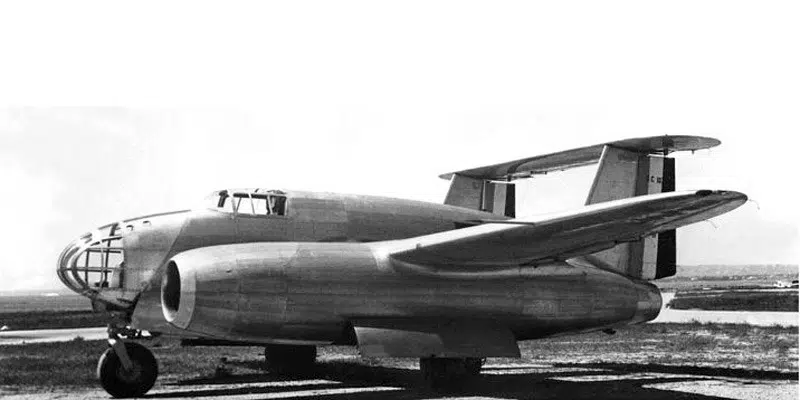

On this day in aviation history, 78 years ago (October 12, 1948), the French SNCAC NC.1071 took flight for the first time. Developed from the piston-powered NC.1070 attack and torpedo bomber, the experimental NC.1071 replaced its predecessor’s radial engines with a pair of Rolls-Royce Nene turbojets. In doing so, it became the first French multi-jet aircraft to fly. The NC.1071 retained the unconventional twin-boom configuration and much of the airframe of the NC.1070. Its two Nene engines were mounted beneath the wings in modified booms, while the original lower horizontal tail was removed and the rudders altered to clear the jet exhaust. The rear gunner’s position was also replaced by an observer’s station. Despite the extensive changes, the NC.1071 retained the same basic dimensions as its piston-powered predecessor.

Flight testing demonstrated a significant improvement in performance, with maximum speed increasing by nearly 40 percent at altitude. The prototype suffered undercarriage damage in April 1949 but returned to flight in 1950. Testing also revealed serious structural distortion, requiring further modifications in 1951. Proposed fighter and attack derivatives designated NC.1072 and NC.1073 were never constructed, and development ended following completion of the NC.1071’s flight tests. The NC.1071 had a wingspan of 65 feet 7 inches and measured 33 feet 6 inches in length. Power came from two Rolls-Royce Nene turbojets producing approximately 5,000 pounds of thrust each. The jet conversion increased its maximum speed to approximately 500 mph at altitude and raised its service ceiling to around 43,000 feet, although range fell to approximately 620 miles.