







On this day in aviation history, 69 years ago (July 16, 1957), Major John H. Glenn successfully completed the first supersonic transcontinental flight. Glenn departed from NAS Los Alamitos, in Southern California, at 6:04 a.m. in a quest for speed and timeliness. In his control was a Chance Vought F8U-1P Crusader, B/N 144608. The flight was named Project Bullet in reference to the 586 mph airspeed that the Crusader was capable of attaining. The previous speed record was held by a Republic F-84 Thunderjet, which had made a crossing in 3 hours and 45 minutes.
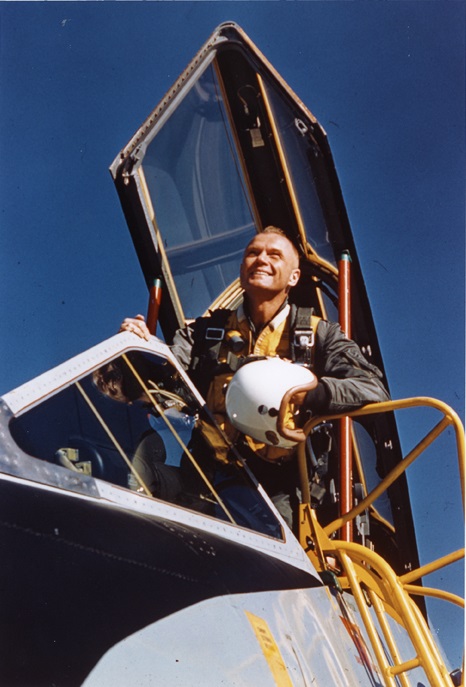
The overall objective of Project Bullet was to “test the sustained capability of the F8U at near maximum power over a long distance.” The F8U’s cruise speed was faster than that of a .45 caliber bullet’s muzzle velocity. The Crusader that Glenn was flying on his record-seeking flight was a photo-recon variant, equipped with cameras rather than armament. Despite having more fuel capacity than the armed variants, Glenn still required three aerial refuels to span the continental United States. After a mere 3 hours, 23 minutes, and 8.4 seconds, Glenn and his Crusader would arrive at Floyd Bennett Field in Brooklyn, New York. Over the course of the 2,360-mile flight, Glenn would achieve an average airspeed of 725.25 mph. Upon completion of the flight, the Crusader’s Pratt & Whitney J57-P-4 engine was torn down by the manufacturer to inspect for any possible issues. Nothing was found, and any limitations previously placed on the J57 were lifted. John Glenn would go on to become one of America’s first astronauts, and the F8U Crusader would carry over into service in the Vietnam War.









Enjoyed the