






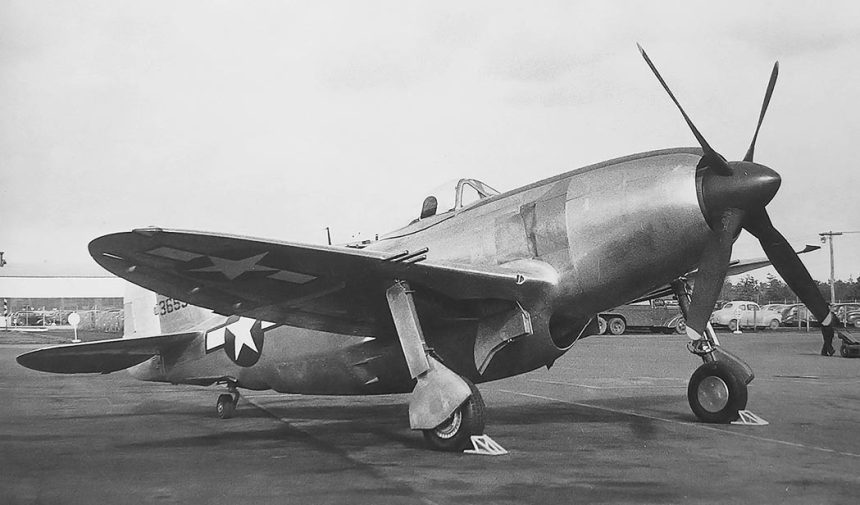


During WWII, the Republic Aviation Corporation began developing an improved version of the successful P-47 Thunderbolt. The initial design phase for the Republic XP-72 began in 1941, and the aircraft was the first fighter to use the large 28-cylinder Pratt & Whitney R-4360-13 Wasp Major engine, the most powerful piston engine produced during WWII. Along with the XP-72, the company was also developing the XP-69. The XP-69 was designed to have an experimental 42-cylinder Wright R-2160 liquid-cooled radial engine in the front, using contra-rotating propellers. It was designed for high-altitude flights and featured a pressurized cockpit. The armament included two 37 mm cannons and four .50 caliber machine guns. However, since the XP-72 showed more potential than the XP-69, the XP-69 was canceled on May 11, 1943. The United States Army Air Forces (USAAF) ordered two Republic XP-72 prototypes on June 18, 1943.
Design of Republic XP-72
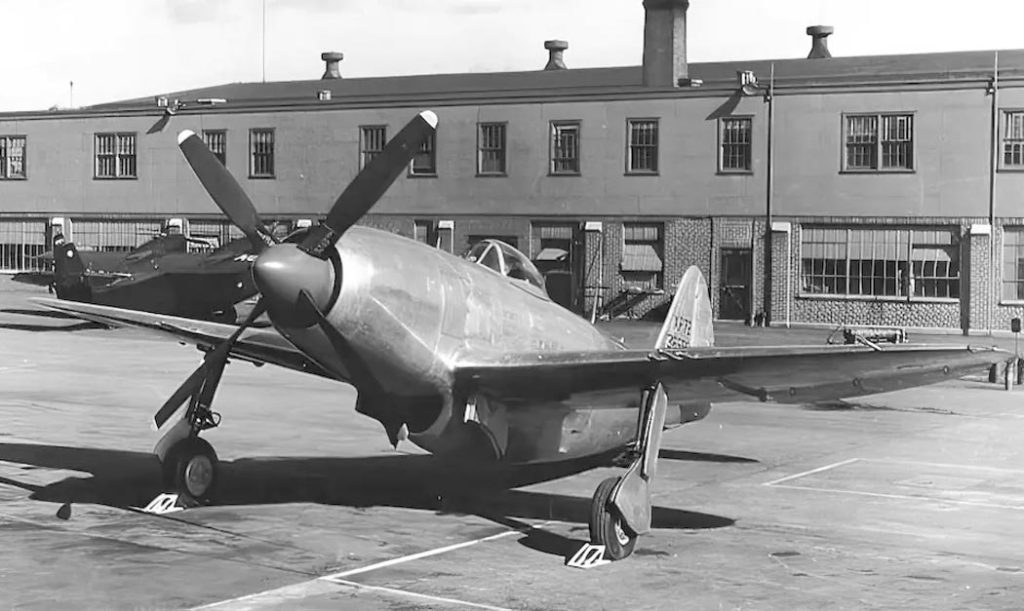
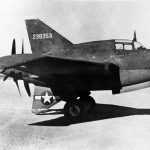
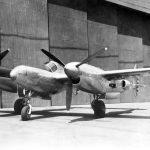
The single-seat Republic XP-72 was 36.7 feet long, 16 feet high, with a wingspan of 40.11 feet and a wing area of 300 square feet. Its empty weight was 11,476 pounds, the gross weight was 14,433 pounds, and the maximum takeoff weight was 17,490 pounds. Its Pratt & Whitney R-4360-13 radial engine produced 3,500 horsepower. The aircraft’s maximum speed was envisioned at 490 mph, depending on altitude, with a range of 1,200 miles, a service ceiling of 42,000 feet, and a rate of climb of 5,280 feet per minute. Three different weapon options were being considered for the Republic XP-72. The first option included six .50-caliber Browning machine guns; the second asked for two 37 mm M4 cannons and four .50-caliber Browning machine guns; and another with four 37 mm cannons and two 1,000-pound bombs. The XP-72 retained the P-47D’s wings and tail, but the airframe was made larger and stronger. The turbosupercharger remained behind the cockpit, like in the P-47. However, the intake for the turbosupercharger was moved to just below the cockpit instead of being at the nose. The lower part of the fuselage was modified to accommodate the larger air intake for the turbosupercharger. The Republic XP-72 was to have a bubble-type canopy, similar to the late P-47D models, and it also had compressibility recovery flaps. The XP-72 had its first flight on February 2, 1944. It was fitted with a four-bladed propeller. The second prototype, completed on June 26, 1944, featured a special Aero-Products contra-rotating propeller.
The Cancellation
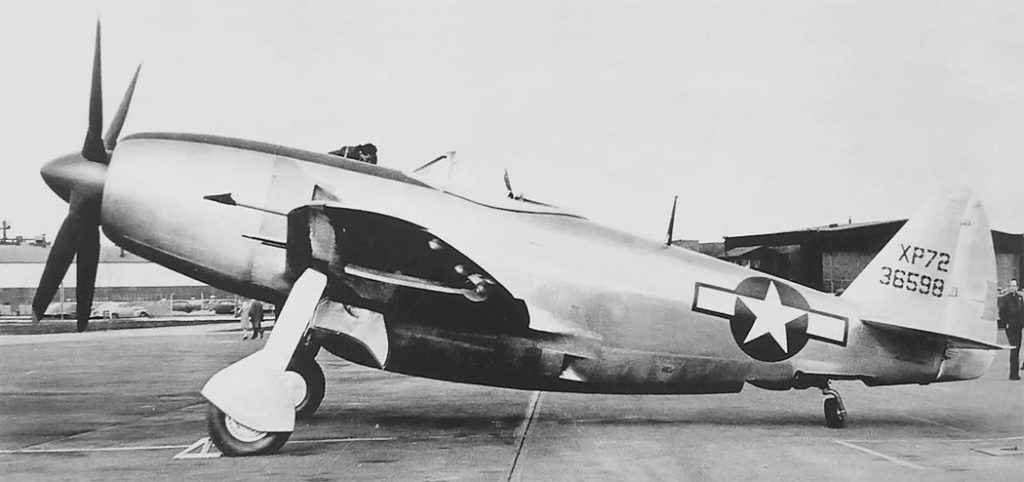
The Republic XP-72 performed very well, reaching a maximum speed of 490 mph in flight tests. However, the second XP-72 was destroyed in a crash during a test flight. Despite this loss, the USAAF was very impressed with the XP-72’s performance and ordered 100 XP-72 production models. These XP-72s were to use the R-4360-19 engine and were expected to reach speeds over 500 mph. Some reports suggest the XP-72 could reach 500 mph with an R-4360-13 engine. But test pilot Tom Bellinger confirmed that he never flew above 500 mph with the Dash 13 (R-4360-13) engine. With the planned Dash 19 (R-4360-19) engine, which was never installed, the plane was expected to reach a top speed of 504 mph at about 25,000 feet. The engine was rated at 3,650 horsepower at that altitude and 3,000 horsepower at military power. Further development of the Dash 19 engine was expected to provide around 4,000 horsepower and could allow the plane to reach speeds of 540 mph at 25,000 feet. But neither engine type had been installed before the project was canceled. At this time in WWII, the focus was shifting from high-speed interceptors to long-range escort fighters. Also, new turbojet-powered interceptors seemed more suited for interceptor roles. As a result, the production order for the Republic XP-72 was canceled. In the Grounded Dreams series, the XP-72 was canceled despite being a good aircraft because turbojet technology rapidly replaced high-performance piston-engine fighters. Read more Grounded Dreams articles HERE.
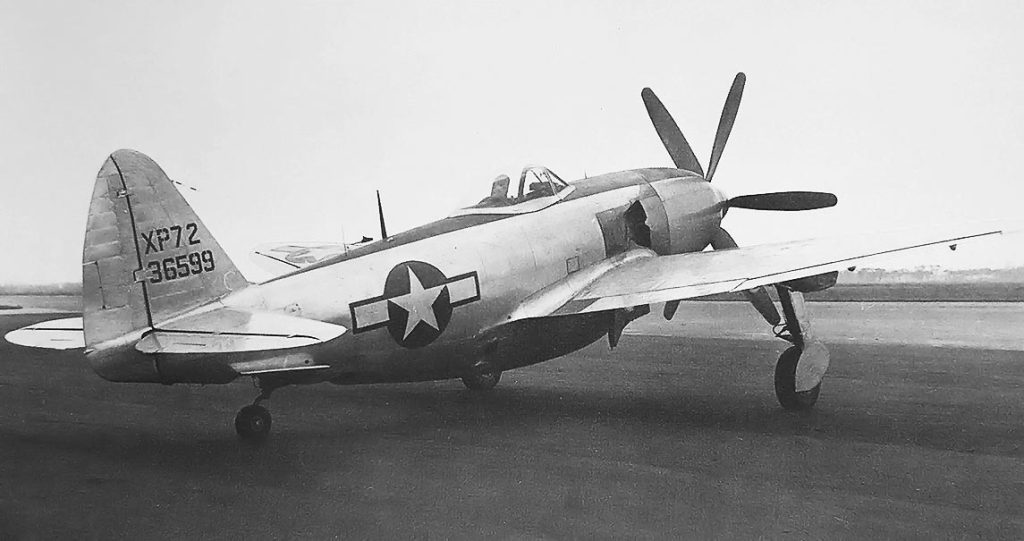




Are there any surviving prototypes?
If the projected P-72 was to hit a top speed of 540 mph, it would’ve needed a highly refined prop mated to the R-4360-19 engine, along with a strengthened airframe.