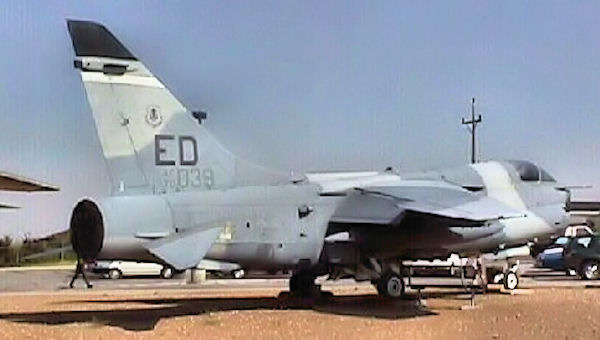
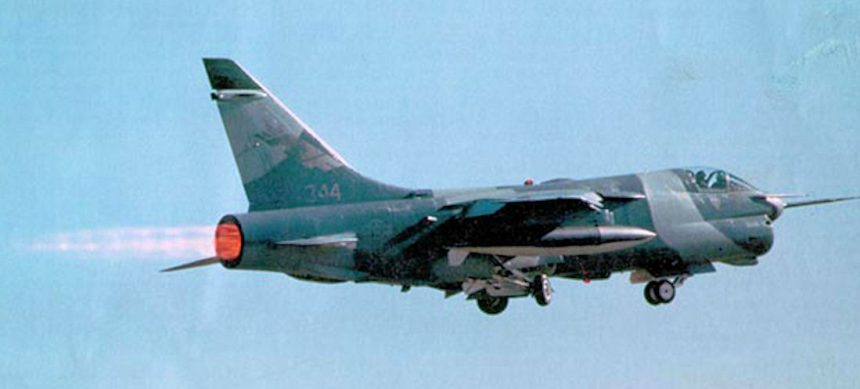


During the Cold War, the US Air Force needed a new aircraft for close air support and ground attacks that was faster. Among the many proposals submitted, one option considered was the Vought YA-7F, a modified version of the subsonic A-7 Corsair II. According to Air Force specifications, the design needed to be powered by either the Pratt & Whitney F100-PW-220 or the General Electric F110-GE-100. The YA-7F used a Pratt & Whitney F100-PW-220 turbofan engine. The company also reportedly tried modifying the afterburner from an F100-PW-220 engine to fit the Allison TF41 engine. The TF41 had a higher bypass ratio, which allowed the afterburner to create 26,000 lbf of thrust, more than the 23,770 lbf from the F100, while still being more fuel-efficient.
Design of Vought YA-7F
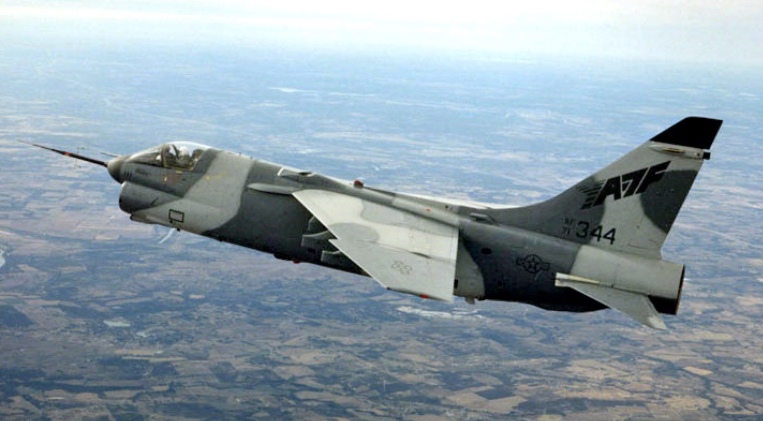
To fit the longer engine, Ling-Temco-Vought extended the fuselage of Vought YA-7F by about 4 feet and added new sections to both the front and back of the fuselage, including a 30-inch section in front of the wing and an 18-inch section behind it. It was done to fit the engine length, to improve aerodynamics, and to balance the weight. The added space helped carry more fuel and provided storage improvements. The company also strengthened the wing and added new flaps, leading-edge extensions, and automatic maneuvering flaps. The vertical stabilizer height was raised by about 10 inches. The horizontal tail was changed from dihedral to anhedral, and the control surfaces were flattened. As a result, the design resembled the supersonic F-8 Crusader, which is the basis for the original subsonic A-7. Many vehicles and mission systems received upgrades, including a Molecular Sieve Oxygen Generating System and improved cockpit displays. Plans and designs for Low Altitude Night Attack Systems, an enhanced heads-up display (HUD), and various software updates for navigation and weapons delivery were developed at Vought Dallas.
The Cancellation
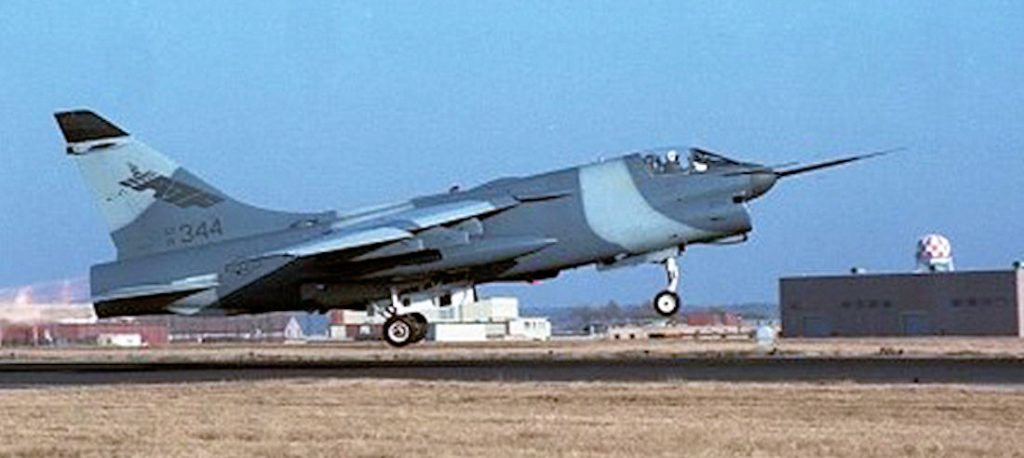
The Vought YA-7F modifications improved the aircraft’s ability to perform 7-g turns and to execute evasive maneuvers at high speeds. It also enhanced its performance at high angles of attack. It made it a suitable close air support and battlefield air interdiction platform for penetrating enemy territory and returning safely. The first Vought YA-7F flew on November 29, 1989, and broke the sound barrier on its second flight. The second prototype took to the air on April 3, 1990. The single-seat aircraft was 50.5 feet long, 16.11 feet high, with a wingspan of 38.9 feet. The empty weight of the aircraft was 23,068 pounds, and the maximum takeoff weight was 46,000 pounds. The maximum speed of the aircraft was Mach 1.2, with a range of 2,302 miles with four 300-US-gallon external tanks and a service ceiling of 55,000 feet. It could be armed with a 20 mm M61 Vulcan rotary cannon and provisions for external hardpoints with a capacity of over 17,000 pounds of bomb load. After the competition, the US Air Force chose the new, faster F-16 Fighting Falcon over the Vought YA-7F. In the Grounded Dreams series, the Vought YA-7F program ended after only two modified aircraft were built because the Air Force decided to invest in the newer F-16 for ground attack missions. Read more Grounded Dreams articles HERE.