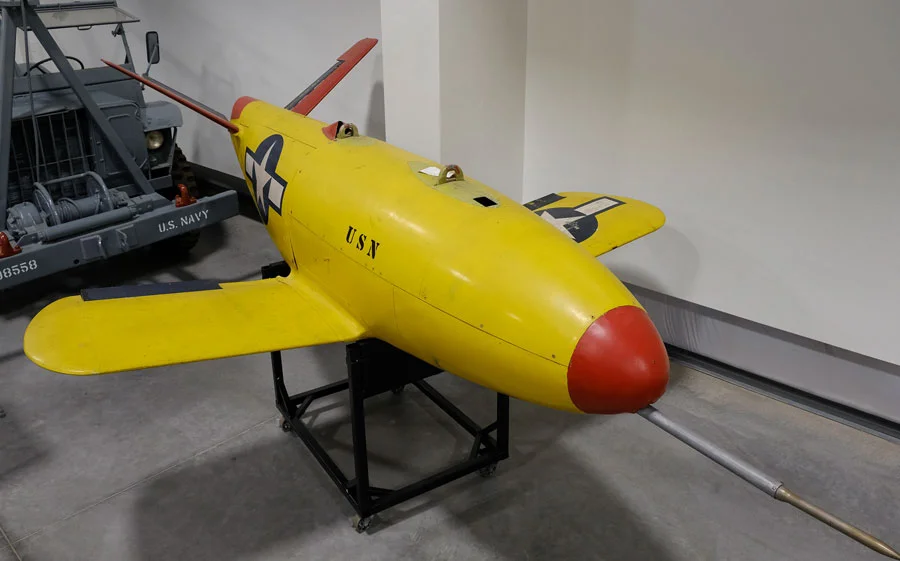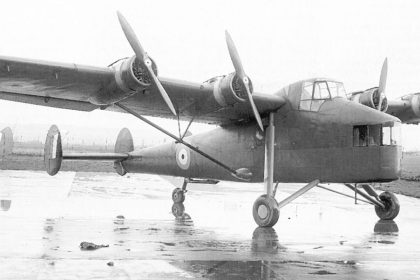
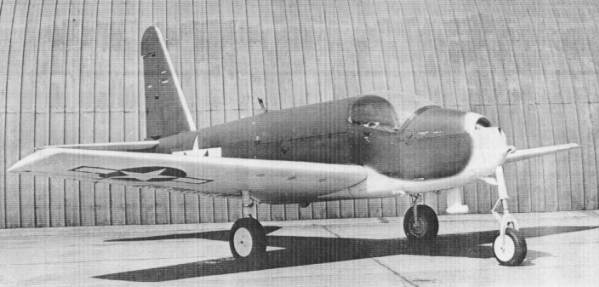

During WWII, the US Navy was looking for gliders that could carry bombs and be remote-controlled to reduce risk to the service’s pilots. The idea was that a glider would be towed to a target area by a carrier-based aircraft. The glider would be released and guided via a TV camera in its nose. This camera would send signals back to the towing aircraft, allowing an operator to use radio controls to steer the glider to its target. The project, known as the “Glomb” for “Glider-Bomb,” was considered feasible and officially began in late spring of 1941. During 1942 and 1943, tests were conducted on the Glomb guidance and operation by converting several training and transport gliders into unmanned versions. The gliders tested included the Taylorcraft XLNT-1, the Piper XLNP-1, the Aeronca XLNR-1, and the Waco XLRW-1. Among these, the XLNT-1 was considered the best fit for the Glomb role. However, to improve the design, the Naval Aircraft Factory created a new airframe with a stronger structure and optimized to withstand slightly higher towing speeds.
Design of Pratt-Read LBE
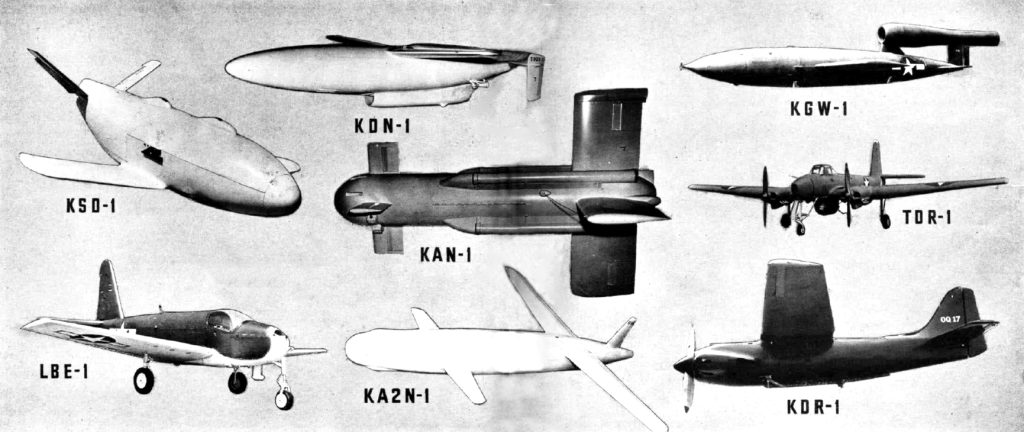
In September 1943, Pratt-Read received a contract to produce this new Glomb design, called the Pratt-Read LBE, which was planned to carry between 2,000 and 4,000 pounds of bombs. At the same time, Piper and Taylorcraft received Glomb production contracts for the LBP-1 and LBT-1, respectively. The LBP-1 was designed to carry 4,000 lb of explosives, while the LBT-1 was to carry a smaller warhead of 2,000 lb. There is conflicting information about the LBT-1’s design. Some sources say it was identical to the Pratt-Read LBE, while others claim that it was based on the original XLNT-1 glider. However, a photo identified as the LBT-1 shows it is similar to the XLNT-1 but with different details. The LBP-1 was similar to the LBE-1, but it had a high wing. The Pratt-Read LBE had a low-wing design and used fixed tricycle landing gear. It also featured dive brakes like those used on dive bombers. In addition to being guided by radio commands, the Pratt-Read LBE could be manually flown by a pilot for training and testing. The LBE-1 was 29.1 feet long, with a wingspan of 32.6 feet and a wing area of 202 square feet. Its gross weight was 7,138 pounds, and the maximum speed was estimated at 300 mph in a dive.
The Cancellation
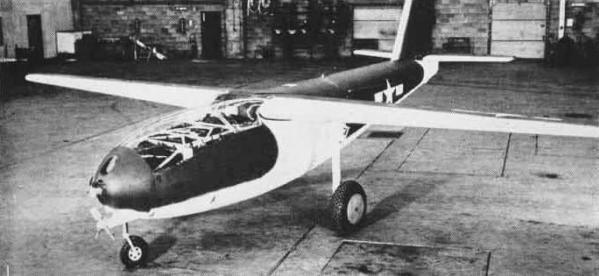
However, trials revealed that the glider performed poorly and experienced technical problems with the television guidance system. The production of the LBT ended in October 1944. Orders for the Pratt-Read LBE and LBP were gradually lowered from 100 each to 35 by February 1945. Ultimately, production plans for the LBP and LBE were canceled in June and August 1945, respectively. In total, only four LBE-1 and 25 LBT-1 Glombs were completed, and none were used in operations. There was one more model in the LB series, the McDonnell LBD-1 Gargoyle. The LBD-1 was an air-dropped glide bomb and is now known as the RTV-N-2. In the Grounded Dreams series, the Pratt-Read LBE failed to perform as expected, and the end of WWII rendered it useless. Read more Grounded Dreams articles HERE.