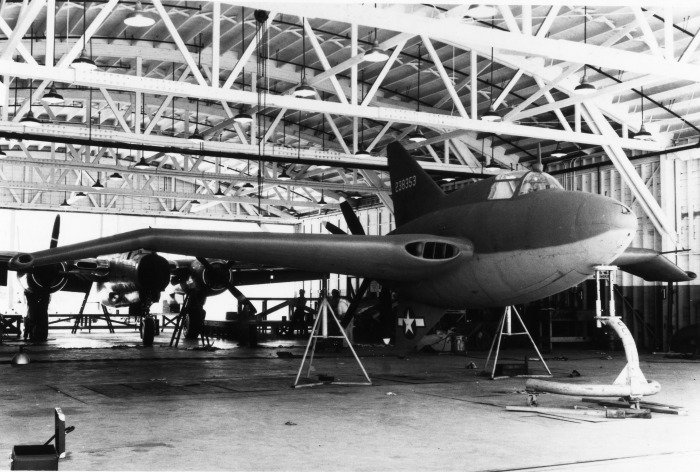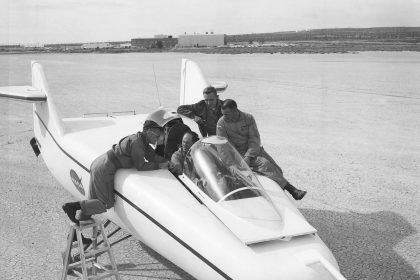
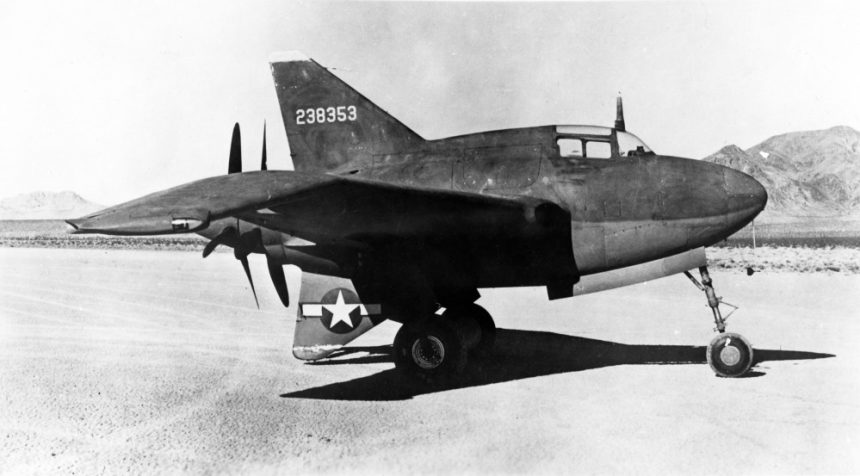


During WWII, Northrop built a unique aircraft called the Northrop XP-56. The aircraft design featured no horizontal tail and included only a small vertical tail. It used an experimental engine and was made from a new metal called magnesium. The goal was to reduce aerodynamic drag compared to traditional airplanes. The concept for the single-seat aircraft began in 1939 with the Northrop N2B. It was designed to use the Pratt & Whitney liquid-cooled X-1800 engine, mounted so that the plane was pushed forward by contra-rotating propellers. The US Army asked Northrop to begin design work on June 22, 1940, and after reviewing the design, the service ordered a prototype on September 26, 1940. However, shortly after design work began, Pratt & Whitney halted development of the X-1800 engine and replaced it with the R-2800. The new engine was more powerful at 2,000 horsepower but was bigger and needed a larger fuselage. It added five months to the program’s timeline, and because of this new engine, the aircraft was expected to be 2,000 pounds heavier and 14 mph slower. To evaluate the tailless design, a test plane, the Model N-1M, was built with a design similar to the XP-56.
Design of Northrop XP-56
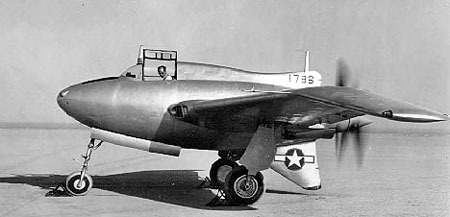
While designing the Northrop XP-56, flight tests with the N-1M confirmed that the basic layout was stable. The N-1M was powered by two small Lycoming engines. After evaluation, the Army ordered a second prototype on February 13, 1942. The first engine tests of the aircraft took place in late March 1943. However, the engine failed because the propeller shaft was too flexible. Pratt & Whitney could not send a replacement engine until August, resulting in a five-month delay. Taxi tests of the Northrop XP-56 began on April 6, 1943, but a yaw problem emerged. Initially, it was believed that uneven wheel brakes were the cause, and as a result, manual hydraulic brakes were added. The aircraft flew for the first time on September 30, 1943, in southern California. Later, the yaw problem was found to be due to aerodynamic instability. To fix this, the upper vertical stabilizer was enlarged to match the ventral unit’s size and shape. The Northrop XP-56 was 27.6 feet long, 11 feet high, with a wingspan of 42.6 feet and a wing area of 306 square feet. Its empty weight was 8,700 pounds, the gross weight was 11,350 pounds, and the maximum takeoff weight was 12,145 pounds. The maximum speed of the aircraft was estimated at 465 mph at 25,000 feet, with a range of 660 miles, and a service ceiling of 33,000 feet. It could be armed with two 20 mm cannons and four 12.7 mm machine guns.
The Cancellation
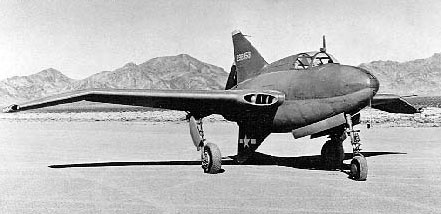
On October 8, 1943, the first Northrop XP-56 was destroyed after the tire on the left landing gear blew out while the plane was taxiing at high speed, around 130 mph, across Muroc Dry Lake. The pilot, John Myers, survived the incident with minor injuries and credited his safety to wearing a polo player’s helmet. Several changes were made to the second prototype, including adjusting the weight distribution to move the center of gravity forward, enlarging the upper vertical tail, and improving the rudder control linkages. The second prototype was finished in January 1944. It flew for the first time on March 23, 1944. The pilot had trouble lifting the nose wheel when going below 160 miles per hour. He also noticed that the Northrop XP-56 was very sensitive to yaw. The first flight lasted less than eight minutes, but later flights were longer. The nose heaviness issue went away when the landing gear was retracted. However, the plane could only reach relatively low speeds. NACA was asked to investigate why the aircraft was not reaching its designed speeds, and further flight tests continued. During the tenth flight, the pilot reported that the tail felt heavy, there was not enough power, and fuel consumption was high. Flight testing was halted due to safety concerns, and the project was canceled after a year of inactivity. By 1946, the US Army Air Forces was working on jet-powered fighters and no longer needed a new propeller-driven fighter. In the Grounded Dreams series, the Northrop XP-56 Black Bullet was a radical aircraft with concepts too unique for its time. Read more Grounded Dreams articles HERE.