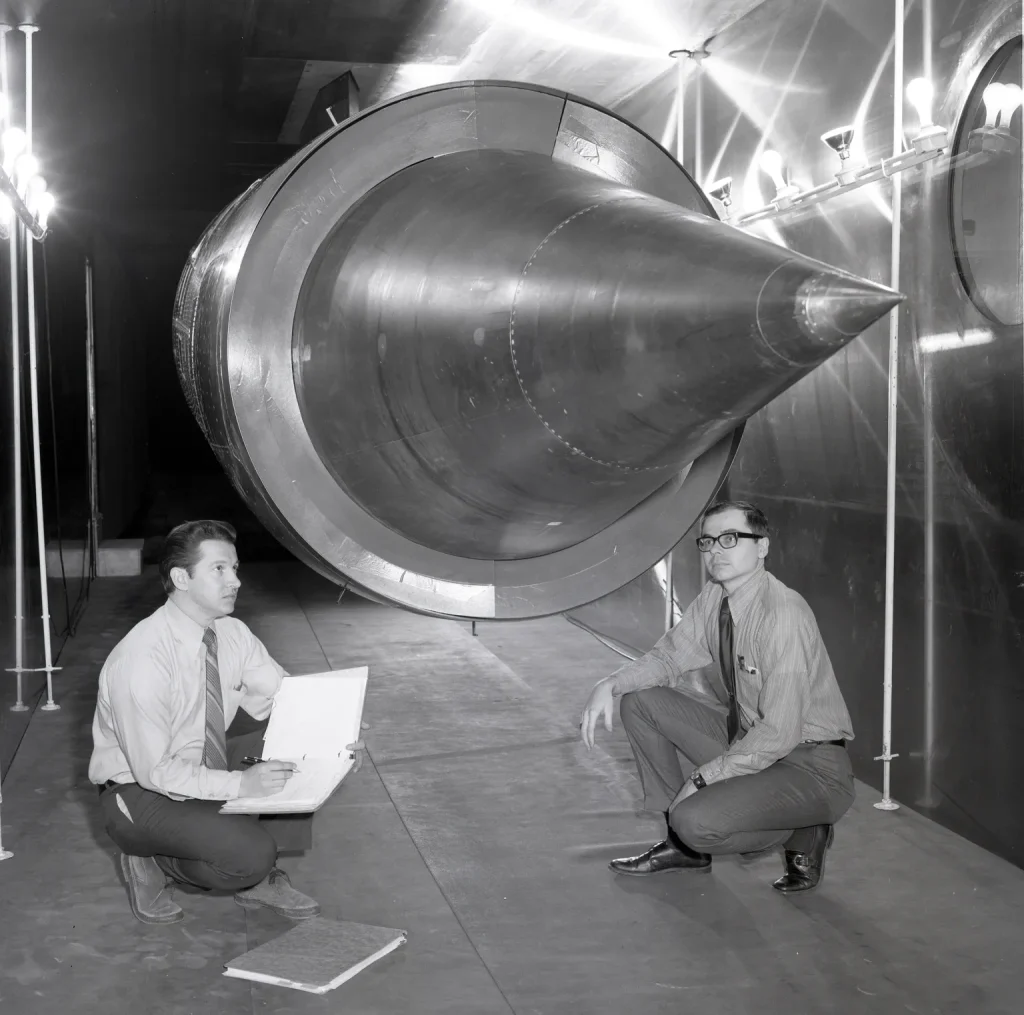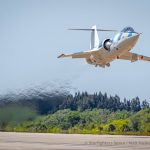
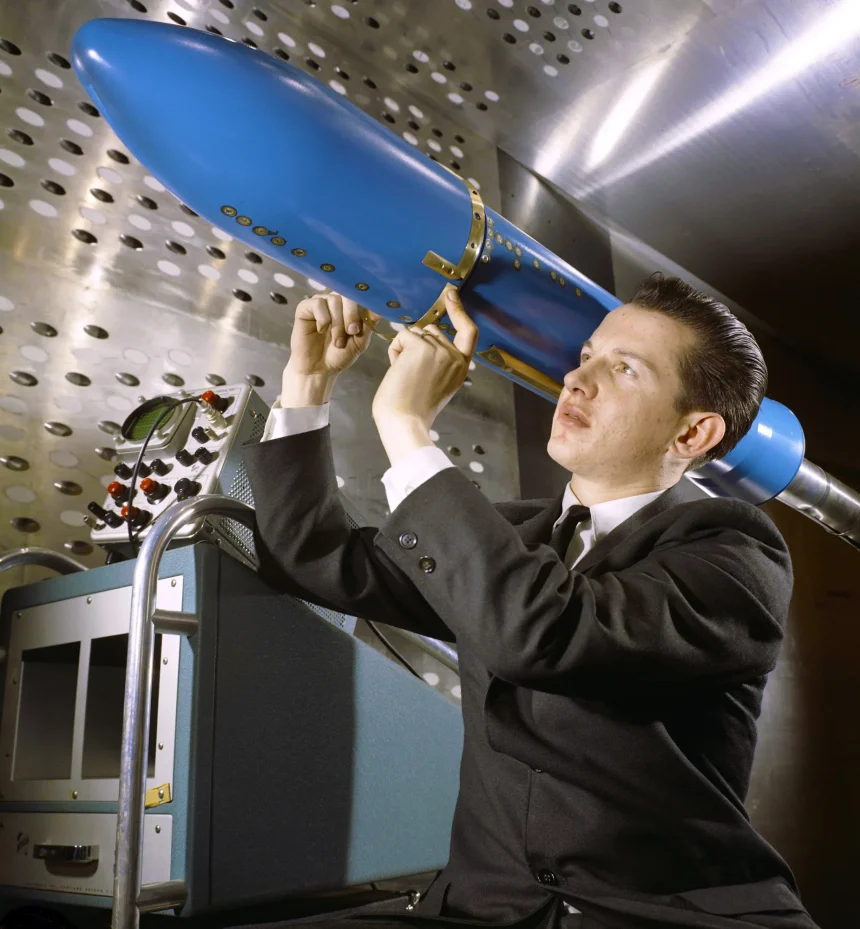

In the second half of the 20th century, an individual at NASA was the primary developer of advanced engine inlet technology and tested many inlets for both military and commercial applications. The individual was Bobby Sanders. He started working at the NASA Lewis Research Center in 1963 at the Advanced Development and Evaluation Division. When he joined, the division was testing space vehicles in the 8-by-6-Foot Supersonic Wind Tunnel (8×6) and the 10-by-10-Foot Supersonic Wind Tunnel (10×10). One of Sanders’ first assignments was to test the aerodynamic shroud for the Mariner-C spacecraft and the Atlas-Agena launch vehicle. These tests checked how well the large shroud and vehicle performed in motion. Sanders then compared the results with similar tests of the Agena/Lunar Orbiter shroud. He also conducted wind tunnel tests on the Apollo Service Module and its escape tower. These tests measured how the escape tower’s control flaps affected its overall aerodynamic stability. In the mid-1960s, the center reorganized to strengthen its aeronautical research. Bobby Sanders joined the Inlets Section in the new Wind Tunnels and Flight Division. His team focused on problems related to supersonic transport engines. Sanders later helped prepare the center’s F-106 Delta Dart for this research. During this time, Bobby Sanders developed and tested various inlet-bleed designs and airflow-control strategies in the center’s wind tunnels. The goal was to expand stable airflow in supersonic mixed-compression inlets.
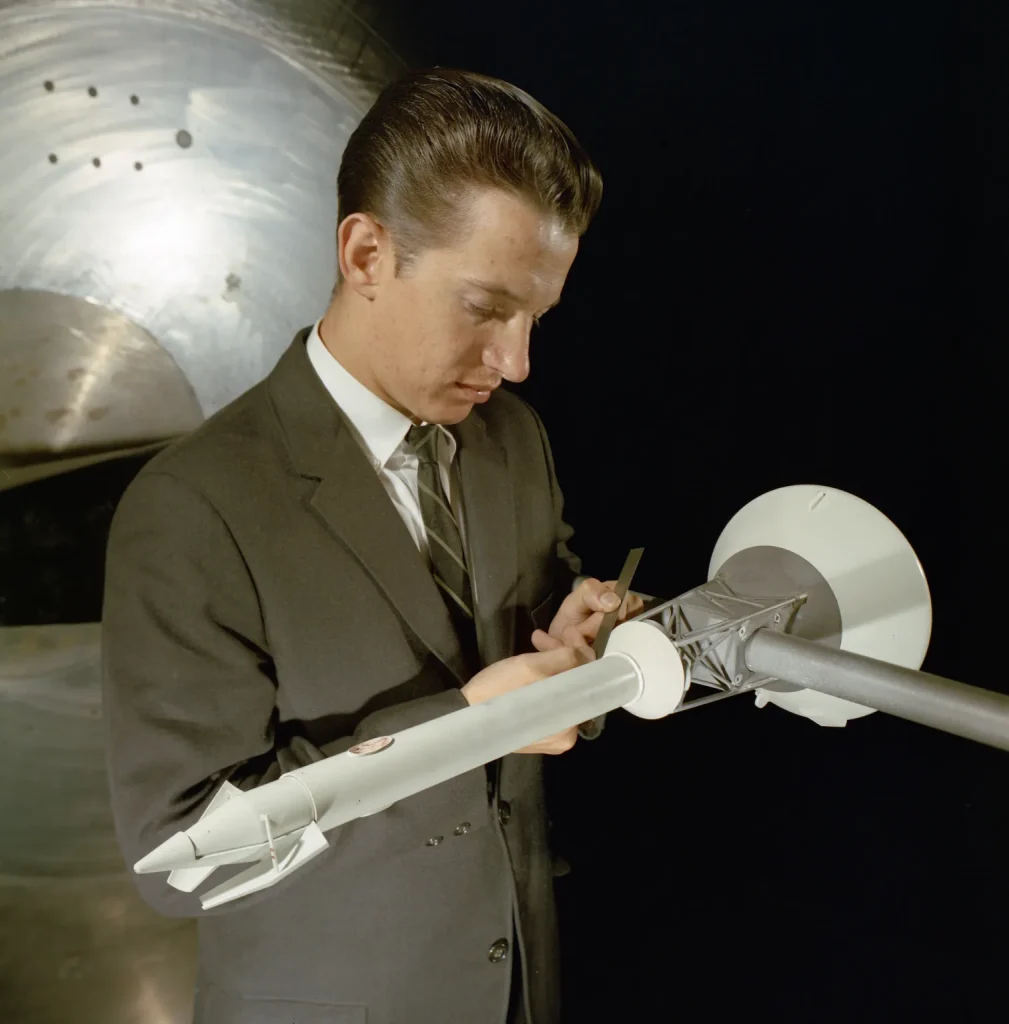
His work led to improved bleed systems for supersonic inlets, which enhanced performance and stability. The inlet bleed system drew small amounts of air from the inlet surfaces to help stabilize the supersonic shock wave for maximum performance and to reduce disturbances in both the incoming and engine airflow. This minimized flow through the compressor, preventing stall and choking. In 1971, Bobby Sanders and Glenn Mitchell patented a passive-bleed airflow control system. Testing of the passive-bleed control system on an SR–71 aircraft inlet in the 10×10 wind tunnel showed that it strongly improved inlet stability. Sanders’ research on inlet bleed stability has been essential for developing many high-speed inlet designs. In 1983, the center reorganized, and Bobby Sanders joined the Aerodynamics and Engine Systems Division. He led a team from NASA and industry that worked on a supersonic cruise demonstrator aircraft, focusing on technological challenges in the Mach 3-6 range that had received little attention before. Several agencies used data from testing the vehicle’s ramjet engine inlet to validate computational fluid dynamics (CFD) predictions. It was the first successful demonstration of a large, high-performance inlet for Mach 5 cruise. In 1986, Sanders became the deputy chief of the Hypersonic Technology Branch in the Propulsion Systems Division. This branch tested and analyzed hypersonic inlets, nozzles, and combustors to help the National Aerospace Plane (NASP) program. Sanders set the guidelines for the NASP inlet and combustor combination. Bobby Sanders also led research tests that provided clear information on how the inlet performed and interacted with other parts. In addition, Sanders initiated a study on a variable-diameter centerbody (VDC) inlet for supersonic propulsion at the center.
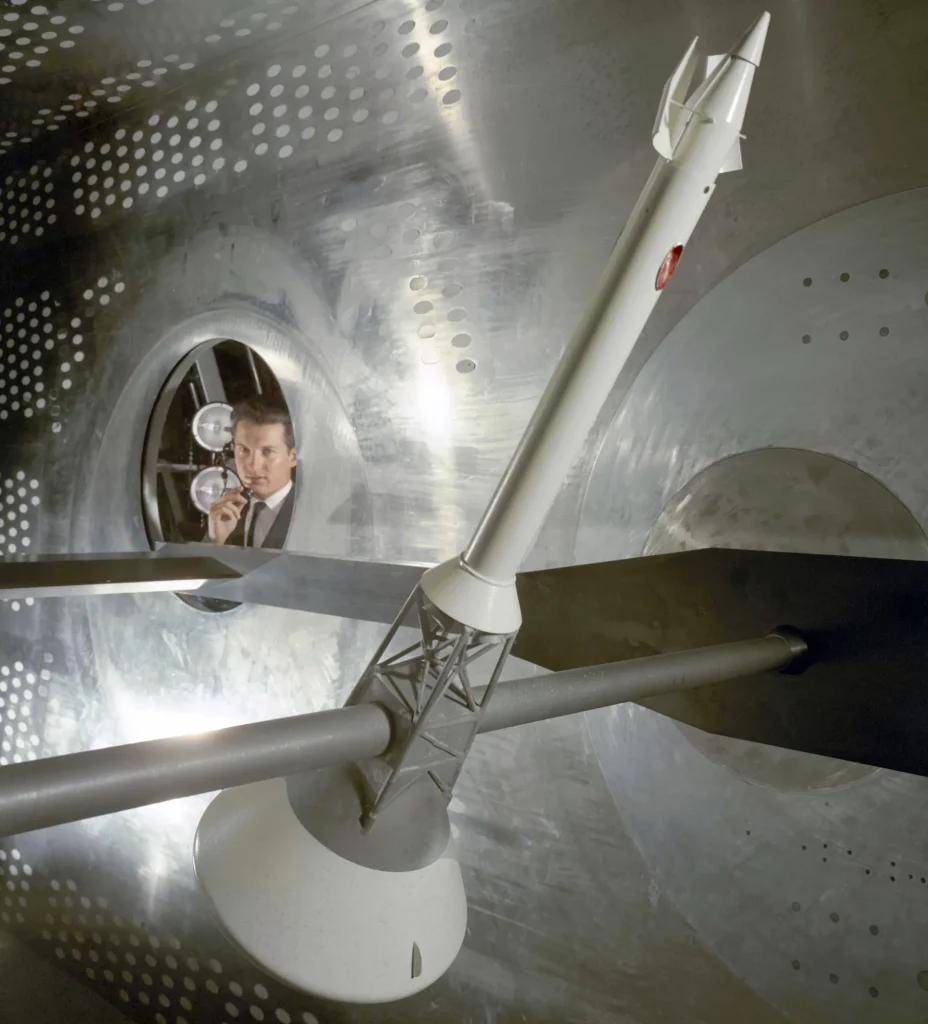
Bobby Sanders later designed an inlet diffuser with a folding-leaf mechanism, which improved performance and stability. The new system allowed changing the area while keeping the inlet bleed free of leakage and maintaining good aerodynamics in the diffuser. The inlet performed well in wind-tunnel tests as part of the High-Speed Research program. Sanders made contributions to the VDC inlet, the Mach 5 inlet, and the NASP program, and he received several awards for his work. In 1991, NASA gave him the Exceptional Service Award to recognize his hard work, engineering skills, and leadership in high-speed inlet research. In 1996, Bobby Sanders became the chief of the Inlet & Propulsion Airframe Integration Technology Branch and retired later that year after 33 years at NASA. However, Sanders continued his work with inlets by founding TechLand Research Inc. Bobby Sanders worked there for another 20 years, collaborating with NASA, the military, and industry. At TechLand, he developed several new designs. These included a supersonic inlet that externally compresses air, a flexible inlet for supersonic flight, a valve to control airflow in a pulse detonation engine, and a dual-flow hypersonic inlet with an over-under configuration. He also patented three additional inlet designs, a bleed valve, and the valve for the pulse detonation engine while at TechLand. In 2005, he received NASA’s Steven Szabo Engineering Excellence Award, and in 2009, he earned the Distinguished Publication Award. Sanders passed away at the age of 81 in 2020. As one of the Pioneers of Aeronautical Engineering, Bobby Sanders left a 50-year legacy of more than 60 publications, 8 patents, and mentoring two generations of engineers at the center. Read more such articles HERE.