






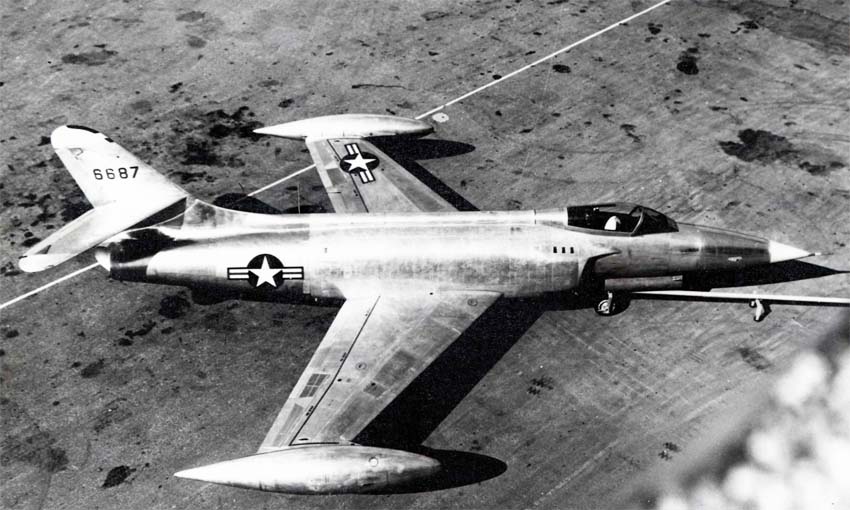


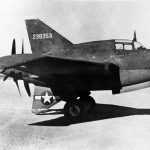
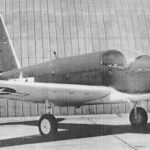
In 1946, the US Army Air Forces wanted a jet-powered long-range penetration fighter to replace the wartime P-51 Mustang. In response to the Army Air Forces’ requirement, Lockheed proposed a jet, designated Lockheed XF-90, powered by a Lockheed L-1000 turbojet and later by a General Electric J35 engine. The company further made design improvements to use two Westinghouse J34 engines with afterburners. However, data showed that a delta-wing design would not work well. The final design of Lockheed XF-90 was modeled after the P-80 Shooting Star and had a similar intake and low-wing layout. It had 35° swept wings, a pointed nose, and twin Westinghouse J34-WE-11 turbojet engines, with a thrust rating of 4,100 pounds each. The engines were mounted side-by-side in the rear fuselage and were fed air through side-mounted intakes.
Design of Lockheed XF-90
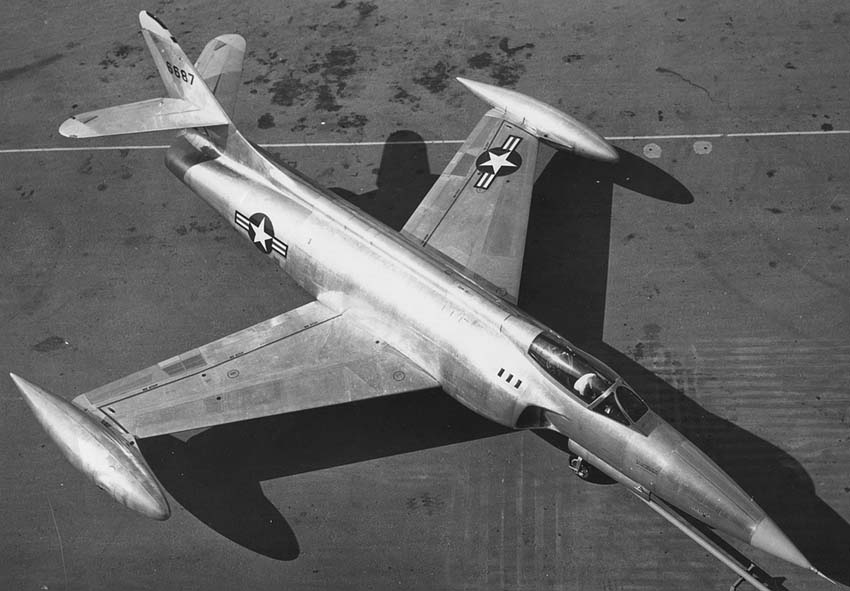
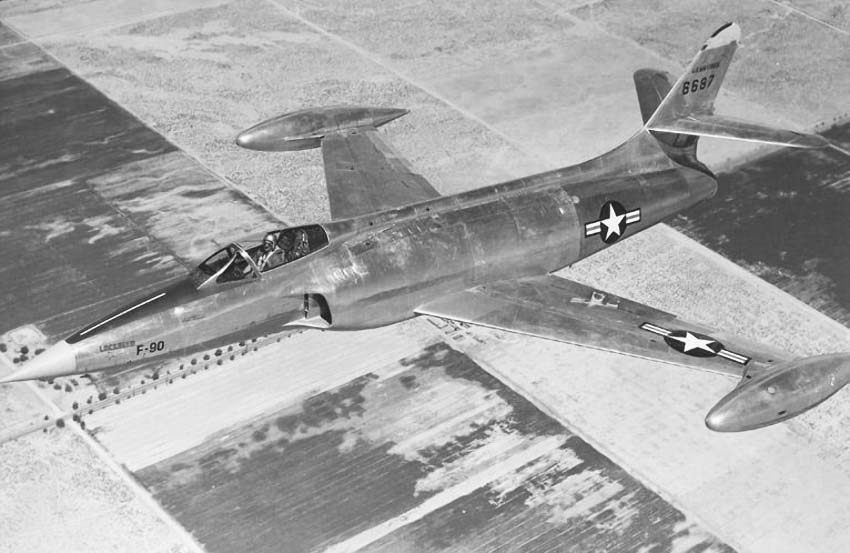
The wings featured leading-edge slats, Fowler flaps, and ailerons on the trailing edge. The cockpit was pressurized and equipped with an ejection seat and a bubble canopy. The Lockheed XF-90 used a stronger aluminum alloy, 75ST, instead of the common 24ST alloy, and included heavy forgings and machined parts, resulting in a sturdy airframe. These improvements made the aircraft about 50% heavier than its competitors. The aircraft flew for the first time on June 3, 1949. The single-seat aircraft was 56.2 feet long, 15.9 feet high, with a wingspan of 40 feet and a wing area of 345 square feet. The empty weight of the Lockheed XF-90 was 18,050 pounds, the gross weight was 27,200 pounds, and the maximum takeoff weight was 31,060 pounds. The maximum speed of the aircraft was envisioned at 665 mph, with a range of 2,300 miles, a service ceiling of 39,000 feet, and a rate of climb of 5,555 feet per minute. It could be armed with six 20 mm cannons, eight 127 mm HVAR rockets, and up to 2,000 pounds of bombs. The first Lockheed XF-90 used J34 engines without afterburners, which did not provide enough thrust for normal takeoffs. As a result, rocket-assisted takeoff (RATO) was needed for most of its early flights, unless the plane had very little fuel.
The Cancellation
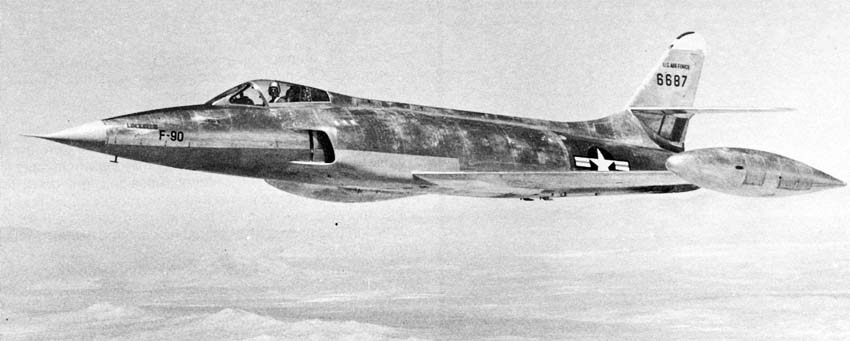
The second prototype, the XF-90A, had afterburners tested on an F-80. And with that, the XF-90 became the first jet in the US Air Force to have an afterburner and also the first Lockheed jet to fly faster than the speed of sound, but only when diving. The aircraft had a unique vertical tail that could move forward and backward to adjust the horizontal stabilizer. However, Lockheed’s design was underpowered, so it finished second to McDonnell’s XF-88, which won the production contract in September 1950. After that, the penetration fighter project was abandoned. After Lockheed lost the production contract, the two prototypes were repurposed for other testing roles. The first Lockheed XF-90 was sent to the NACA Laboratory in Ohio in 1953 for structural tests. It could no longer fly, and its strong airframe was tested until it broke. The second prototype (46-688) survived three atomic blasts at Frenchman Flat in the Nevada Test Site in 1952. In the Grounded Dreams series, the Lockheed XF-90 was not a bad aircraft, but its engine choice became a point of contention, as it never provided enough power despite trying many options. Read more Grounded Dreams articles HERE.








It should be noted that the XF-90 that was used in atomic testing at Frenchman’s Flats has been recovered by the USAFM and is to be displayed in the condition in which it was found. It is reported to still be slightly radioactive. Considering how dark the Museum is now, it might be the first “glow in the dark” display.
The F-90 was flown by the Blackhawks, an air force team in the comics. Very cool at that time.
When Lockheed pitched their design for the AAF’s Penetration Fighter Requirement, in 1946, it didn’t have an Official AAF Designation, in it’s first form. The next submission was designated as the XP-90, which became XF-90 in June 1948.