






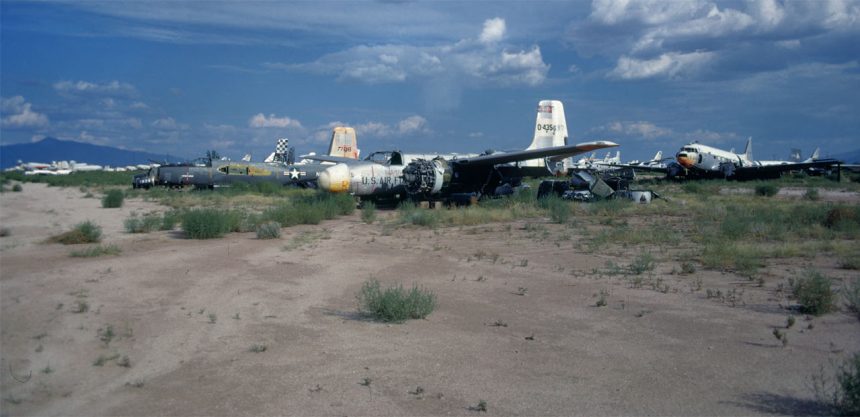

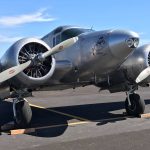
As we continue the Boneyard Files series, which showcases some of the retired aircraft resting at Davis-Monthan Air Force Base in Tucson, Arizona, in the late 1960s, today’s story features the Douglas A-26 Invader through the lens of Neil Aird’s “Monthan Memories” photos. The Douglas A-26 Invader was one of the most successful twin-engine medium attack bombers used by the US in World War II. It was originally designed to replace the B-25 Mitchell and the Martin B-26 Marauder. The Douglas XA-26 prototype flew for the first time on July 10, 1942. The production model, called the A-26B, was delivered starting in August 1943. Douglas A-26 Invaders reached England in September 1944, where they were assigned to the 9th Air Force. They entered combat on November 19, two months later. In January 1945, the Douglas A-26 Invaders entered the Pacific Theater and proved very effective for the rest of the war. The Invader became one of the finest aircraft developed during WWII.
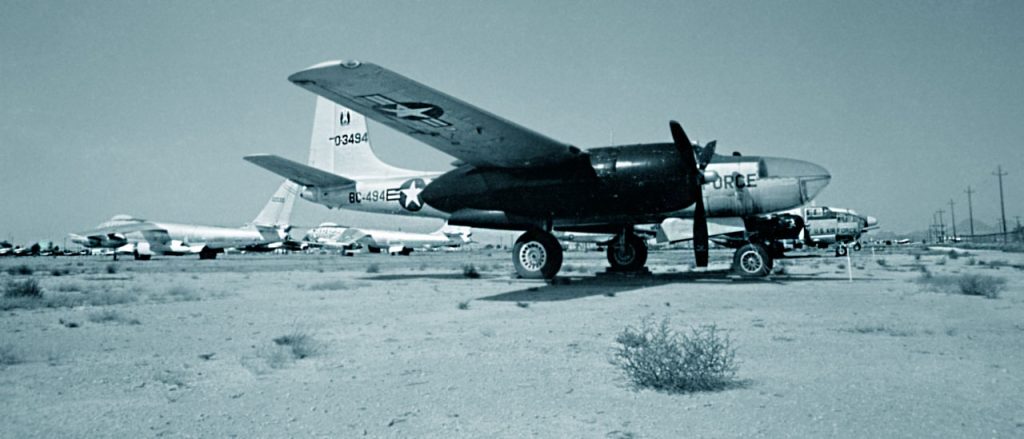
The A-26B, a modified variant of the Douglas A-26 Invader, was a fast attack aircraft capable of speeds up to 355 mph. It had six guns in the nose, four side guns on the fuselage, and eight guns in four optional underwing pods, for a total of 22 guns with 6,000 rounds of ammunition. It could carry up to 4,000 pounds of bombs internally. On missions up to 1,100 miles, it could also carry an extra 2,000 pounds of bombs on hardpoints under the wings. Additionally, it could be equipped with eight rockets and 165-gallon drop tanks to increase its range by 300 miles, or it could carry eight more rockets instead of the drop tanks for shorter missions. The A-26C variant, a medium bomber, had a glassed-in nose and only six guns, two in the nose and two in each turret. Its top speed increased to 370 mph, and it had a co-pilot/bombardier as a fourth crew member. In 1948, the A-26 Invader was redesignated to B-26 after the Martin B-26 was taken out of service. In 1962, President Kennedy ordered the Air Force to help South Vietnam resist North Vietnam. A team of air commandos from Hurlburt Field, called FARMGATE, arrived in November at Bien Hoa. Their mission was to train the Vietnamese Air Force in offensive air operations. They used four RB-26, four SC-47, and eight T-28 planes for this mission. The B-26, previously known as the Douglas A-26 Invader, along with the C-46, C-47, and P-51 planes, were now taking part in their third war.
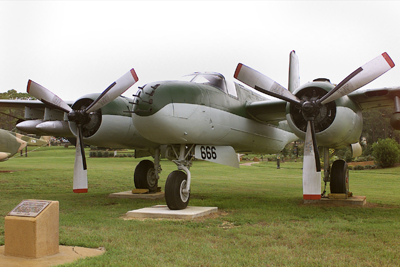
In 1963, the Air Force modified the B-26 because a suitable replacement was not expected for three to five years. The service added features such as anti-skid brakes, new engines with water injection, reversing propellers, modified wing flaps, wingtip tanks, external pylons for carrying 4,000 pounds on each wing, stringer wings, a larger rudder, and interchangeable noses for either glass or eight guns. The B-26 planes used by air commandos for counterinsurgency operations arrived at Hurlburt Field as part of the force reactivation in 1961. The last two B-26s from Hurlburt left for Davis-Monthan Air Force Base in Arizona on June 2, 1964, to go to the Air Force storage facility commonly known as the Boneyard. However, other B-26s replaced them at Hurlburt when the 1st Air Commando Wing reorganized on October 1, 1964. After five more years of service, these planes flew into retirement at the Boneyard on October 23, 1969, marking 25 years since they first saw combat in WWII. On July 4, 1970, US Congressman Robert Sikes took part in the dedication ceremony to honor everyone who flew and serviced the Douglas A-26 Invaders. Read more Boneyard Files Articles HERE.
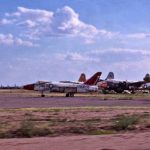
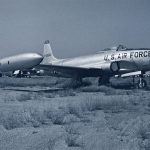
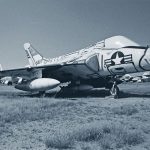
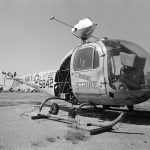








Representing the less “romantic” (if you will) Era: Hard edged lines, All silver, no camo….Boring. Invader, Mustang, B29….meh
B52 has been in every conflict since Korea… just saying
The only? What about the B-52, the Vietnam War, Gulf War, NATO bombing of Yugoslavia, Iraq War, war against the Islamic State, war in Afghanistan, and 2026 Iran war.
My father was one of the original founders of the Pima Air Museum and the majority of the earlier pictures I can almost guarantee came from my dad. I have an awesome picture of the B26 with my Willys Jeep in front of it dating back to 1980. Great article!
Great article! My father was one of the original founders of the Pima Air Museum where that B26 I assume still resides today. The majority of the earlier pictures out of the Pima Air Museum were compliments of my father. One of my favorite pictures of the B26 was from 1980 with my old Willys Jeep parked in front of it. Thanks for the memories…
My grandfather was a pilot in WW1, firstly with the Royal Navel Air Service and then transfered into the RAF in the 1st of April 1918. He would have flown on this aircraft as he did many WW1 aircraft. After WW1 he was based in many places including RAF Cranwel he was a friend with Frank
Whittle, T.E. Lawrence –
in addition to de la Bère
himself – and later Douglas
Bader was an associate.