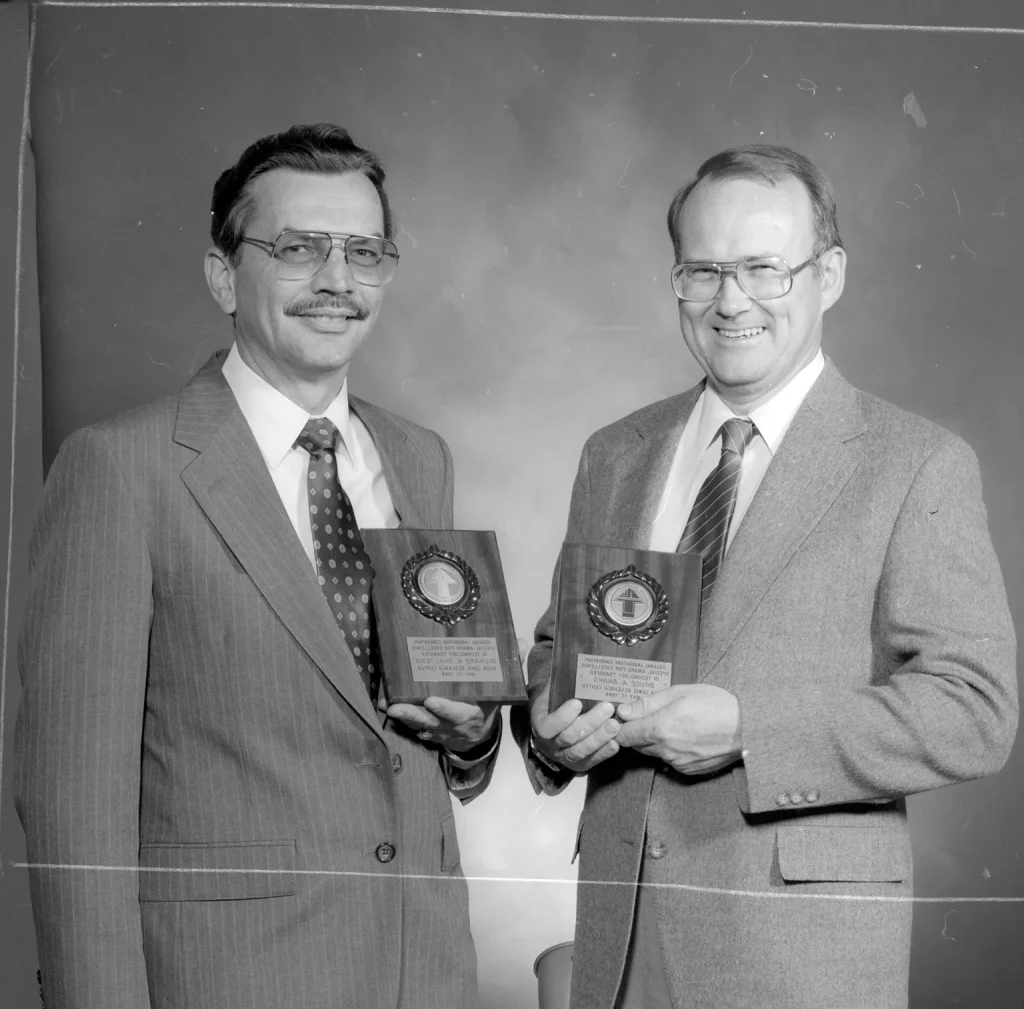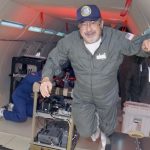
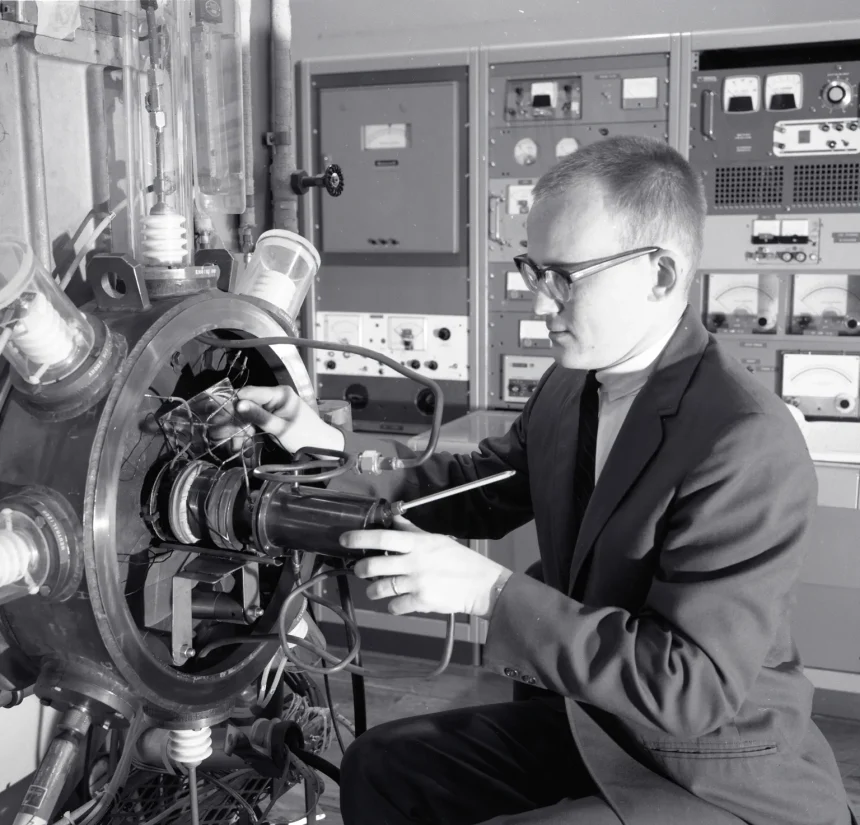

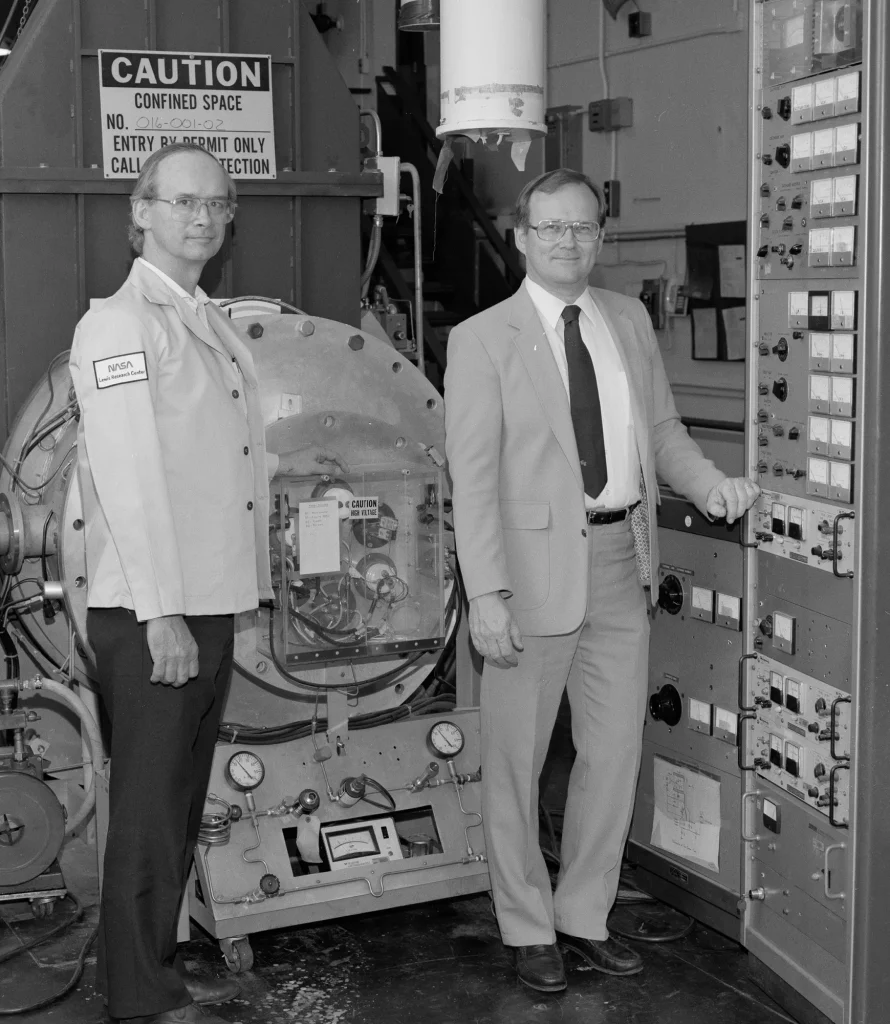
One person made important contributions to NASA’s work on electric propulsion, thin-film coatings, surface texturing, and protection from atomic oxygen. He was Bruce Banks, who also found many alternative uses for these technologies in private companies. Banks grew up in Rocky River, Ohio, where he was very curious about how things worked. He earned a Bachelor of Science in physics in 1964 from Case Institute of Technology and a Master of Science in physics from the University of Missouri-Rolla in 1966. After working briefly as a developmental physicist at General Electric, Banks joined NASA’s Lewis Research Center (later called Glenn Research Center) in June 1966. After a brief assignment with the Centaur Program, Banks started working on ion thrusters in the Electromagnetic Propulsion Division. He studied the glass-coated accelerator grids of these thrusters and created a new method called hydroforming. The method enabled him to produce closely spaced, large grids, which increased thrust for deep-space ion propulsion systems. In 1971, Bruce Banks received four patents for his work on electric propulsion and later earned a Space Act Award for his hydroforming grids. In 1972, Banks became the head of the Small Thruster Section. He and his team studied how to use ion thrusters to help keep satellites in their orbits. He invented a device that measured the flow of liquid metal by sending it through an electric field.
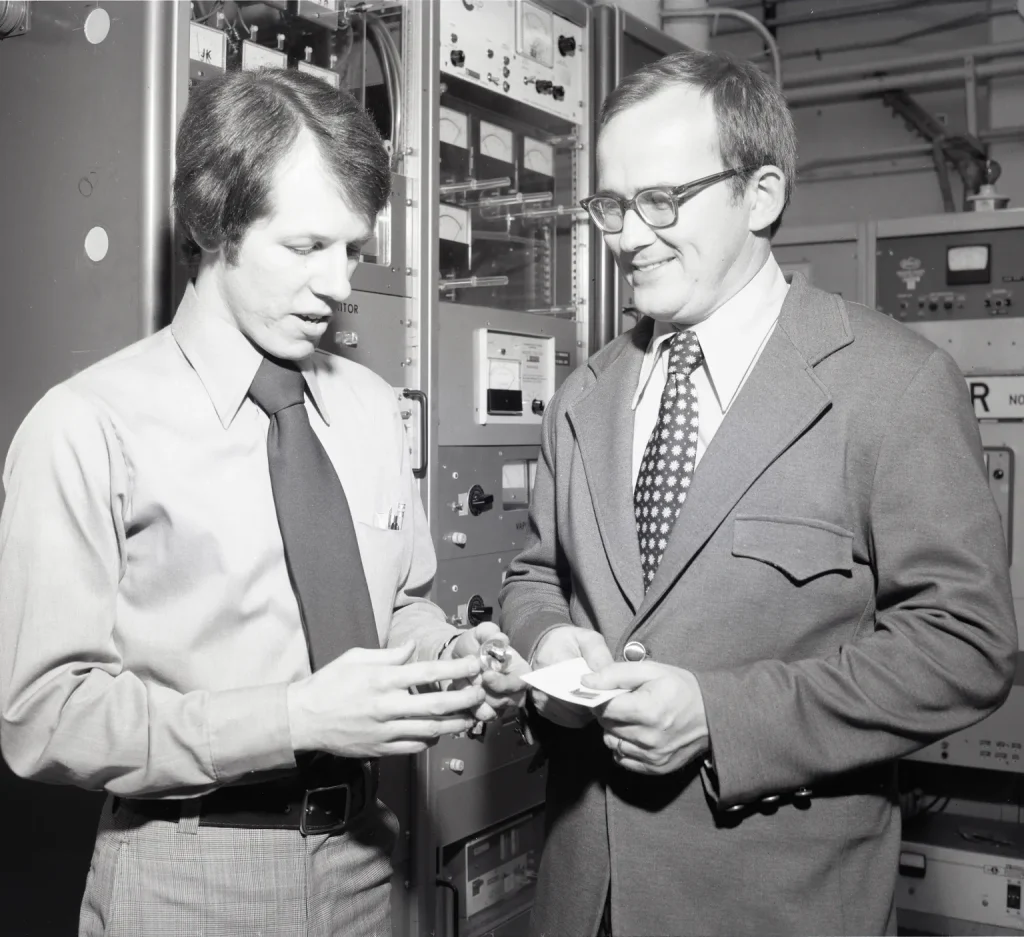
While working on electric propulsion, Bruce Banks found that ion beams could be used to modify surfaces and coat materials. In 1976, he became the head of the Ion Beam Applications Section, which focused on non-propulsion uses of ion thrusters. Banks worked with medical professionals to explore how ion beams could create specialized textures on materials used in prostheses and surgical implants. Their research showed that the body accepted these modified devices better. He also used ion beams to create diamond-like carbon films for sunglasses, strain gauges, and star trackers. For his work in applying space technology to medical devices, Bruce Banks received the 1980 Arthur S. Flemming Award. In 1985, Banks became the Chief of the Electro-Physics Branch. His team worked on developing new materials for space power applications. Banks also focused on transferring technology to other industries. In 1988, he received national recognition for identifying commercial applications for intercalated graphite composites and for transferring that technology to businesses. In the 1980s, Banks and James Sovey created protective coatings for polymers used in thermal blankets for spacecraft. In the 1990s, Banks’ Electro-Physics Branch built on this work by developing a thin silicon dioxide coating. The coating successfully protected the solar arrays on the space station and avoided the expensive need to replace the blankets. NASA estimated that replacing the blankets would have cost more than $15 billion. In 2001, Bruce Banks, Sovey, and their colleagues, Sharon Miller and Michael Mirtich, were awarded a $40,000 Space Act Award for their contributions. Banks’ team studied coatings for the Hubble Space Telescope.
In 1992, they quickly tested different coatings for the telescope’s thermal shields before the first servicing mission. They conducted similar studies in four additional servicing missions and played an important role in the 1997 investigation into a failure in Hubble’s insulation. In the early 1990s, Bruce Banks and Miller explored how to use the harmful effects of atomic oxygen for useful purposes on Earth. They found that atomic oxygen could help sterilize medical implants, decontaminate aircraft parts, and improve seals. They also discovered it could clean soot and other dirt from artwork without damaging the colors. In 2002, Bruce Banks and Miller received an R&D 100 Award and the R&D 100 Editor’s Choice Award for their work on using atomic oxygen for art restoration. Banks conducted many experiments on the space shuttle and the space station over the years. Since 2001, he has led or co-led over 20 Materials International Space Station Experiment (MISSE) projects that tested materials on the outside of the International Space Station. Banks retired from NASA in 2007 after 41 years but continued his work as a contractor. In 2009, Bruce Banks and Miller were awarded the Federal Laboratory Consortium’s Excellence in Technology Transfer Award. Banks has published 258 technical papers and 34 technical briefs. He has received over 120 awards for inventions and outstanding performance from NASA and other organizations. He holds 39 patents, the most ever issued to an individual at the center. As one of the Pioneers of Aeronautical Engineering, Bruce Banks made many important technical contributions and also mentored many researchers during his career. His influence continues through the engineers and scientists whose careers he helped develop. Read more such stories HERE.