







On this day in aviation history, 74 years ago (August 9, 1952), a British Royal Navy Hawker Sea Fury shot down a Mikoyan-Gurevich MiG-15, the only air-to-air sortie from a British pilot in a native aircraft during the Korean War. Commander Peter Carmichael (OBE, DSC) of the Royal Navy’s 802 Squadron is the pilot who is credited with the feat. Some dispute exists as to the accuracy of the claim, with arguments that Carmichael’s squadmate Brian ‘Schmoo‘ Ellis was the pilot who downed the MiG. Regardless of the exact details, the story remains profound and inspiring.

Carmichael and 802 Squadron were deployed to Korea in early 1952. On the day of the MiG-15 tally, 802 was tasked with attacking railway facilities between Manchon and Pyongyang. Carmichael and his squad were over Chinnampo when formation #2, Sub-Lieutenant Carl Haines, warned of MiGs coming in from above and behind, to their right. Carmichael reported the following about the dogfight to follow: “Eight MiGs came at us out of the sun. I did not see them at first, and my No. 4, ‘Smoo’ Ellis, gave a break when he noticed tracer streaming past his fuselage. We all turned towards the MiGs and commenced a ‘scissors’. It soon became apparent that four MiGs were after each section of two Furies, but by continuing our break turns, we presented impossible targets. They made no attempt to bracket us. One MiG came at me head-on. I saw his heavy tracer shells. I fired a burst, then he flashed past me. I believe Carl got some hits on him too. This aircraft then broke away, and went head-on to my Nos 3 and 4, Lieutenant Pete Davies and ‘Smoo’ Ellis. They were seen to get good hits on one who broke away with smoke coming from him.”


Some claims exist pointing to a second MiG-15 being downed during this sortie, although nothing has been proven or confirmed. Although Carmichael was the only British pilot to accomplish the feat of aerial combat in a British aircraft during the Korean Conflict, other Brits would claim no fewer than 7 kills while flying USAF aircraft, while serving on exchange. For his actions on August 9, 1952, Carmichael was awarded the Distinguished Service Cross.









An alternative account is given on the Royal Aeronautical Society website; as told to Paul Beaver FRAeS by Brian Schmoo Ellis in January 2018.
This is worth a read.
Thanks! I’ll check it out. I find it interesting how stories change over time as more information becomes available.
I was a surprised recipient of a bequest: a print of Robert Taylor’s Sea Fury — M.I.G Encounter (1981). It is signed by Lt. Hoagy Carmichael. The print was left to me Tommy Hoare, who at one point during the previous war was Johnny Johnson’s wingman. Tommy was a Canadian, & flew all 4 British fighters: Hurricane, Spitfire, Typhoon & Tempest. He was an old man when I met him, & did him a small service for which this print was a reward when he passed. It’s on my wall.
Hi
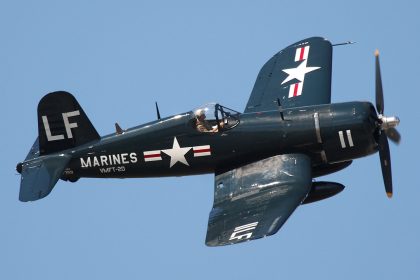
I have a section of “nose art” and parts from the flight control panels “Bomb release”, “Gun camera” etc from a Corsair F4U-1, (WW2) which I came across in Lemakot, south of Kavieng province New Ireland, PNG in 1986. Note, I was a young teenager at the time, and therefore did not fully appreciate the aircraft & the history behind it.
Heard that the pilot ran out of fuel & bailed out, before aircraft crashed into the jungle below. I remember finding live ammunition around the wreckage.