






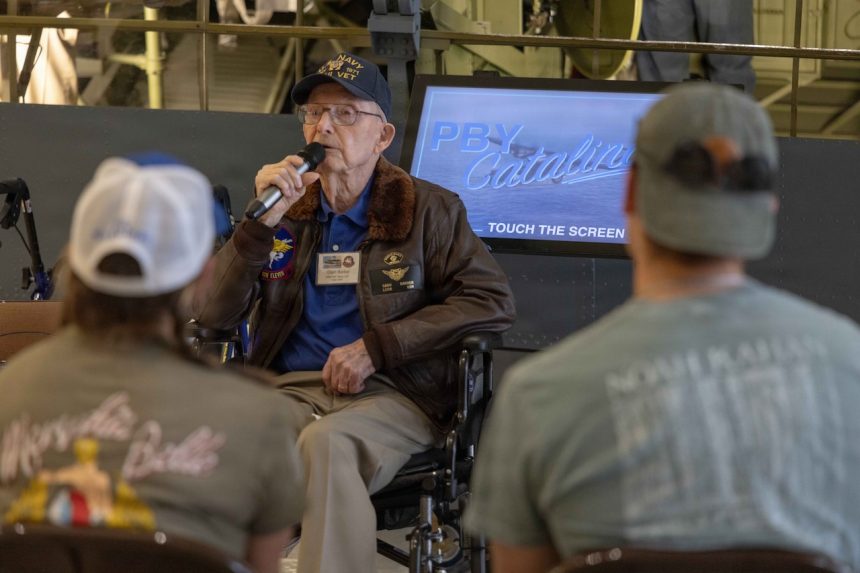

By Ens. Trent Prince, Naval Air Station Pensacola
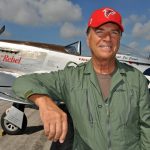
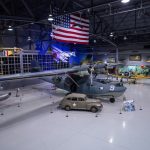
Retired U.S. Navy Lt. Cmdr. Clyde “Cash” Barber celebrated his 102nd birthday on May 5 at the National Naval Aviation Museum (NNAM) aboard Naval Air Station (NAS) Pensacola. “It’s been a long journey, and it’s been a blessed journey,” Barber said. “I’m proud to have this many people here to celebrate with me. I’m very honored.” A veteran of WWII, Korea, and Vietnam, Barber has volunteered at the museum for more than a decade. Every Tuesday, he shares his experiences with visitors while stationed beside a Consolidated PBY-5 Catalina—the same aircraft type he served aboard during WWII.
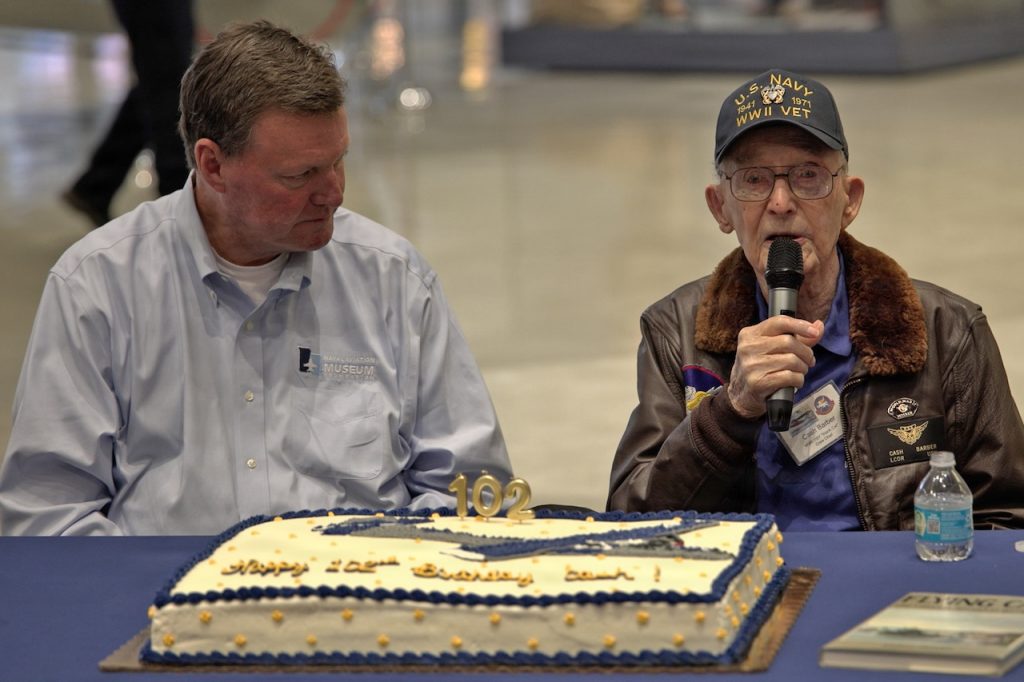
“What a blessing this place is; it’s really my second home,” Barber said. “I’ve been coming out here for 12 years now, and I hope I never miss any days.” Barber enlisted in the U.S. Navy in May 1941 at just 17 years old. During WWII, he served as a flight engineer aboard Catalina patrol bombers in the Pacific Theater, flying missions from Midway to the Philippines. He remained in the Navy after the war and retired in 1971 with the rank of lieutenant commander.
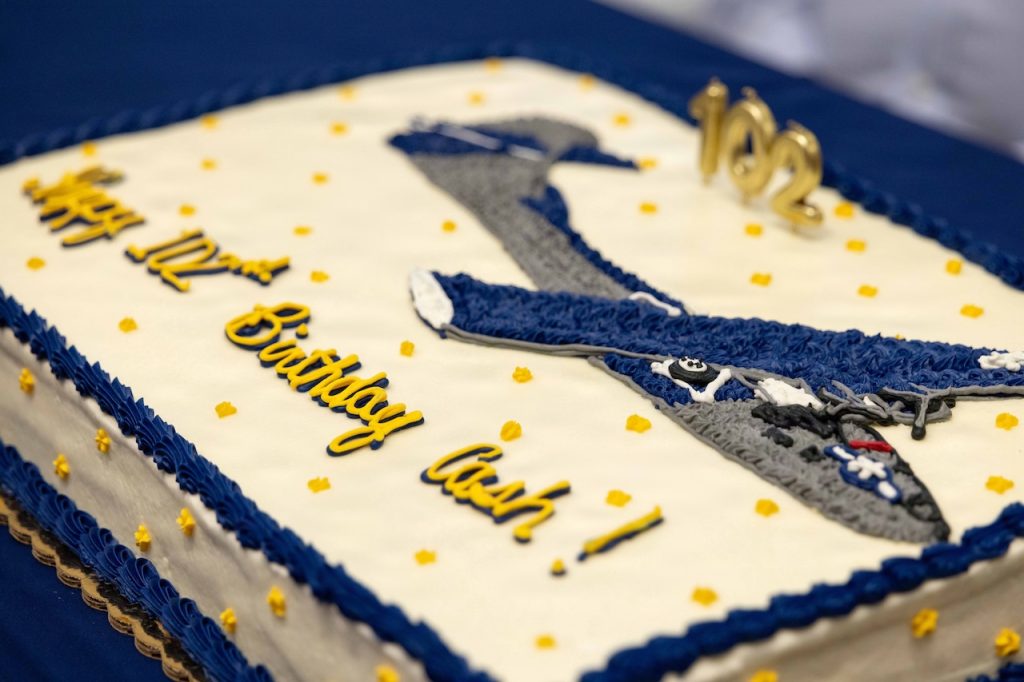
The birthday celebration took place on the museum’s Cabot Flight Deck, attended by family, friends, museum staff, and visitors. National Naval Aviation Museum Foundation President and CEO, retired Rear Adm. Kyle Cozad, praised Barber’s continued dedication to preserving naval aviation history. “Cash has been a dear friend for many years,” Cozad said. “It has been an opportunity to celebrate what I often talk about: common people who do uncommon things. He is the reason people flock to this museum. It’s not just to see the beautifully restored airplanes, but to hear the stories of the heroes who helped shape this nation and our Navy.”
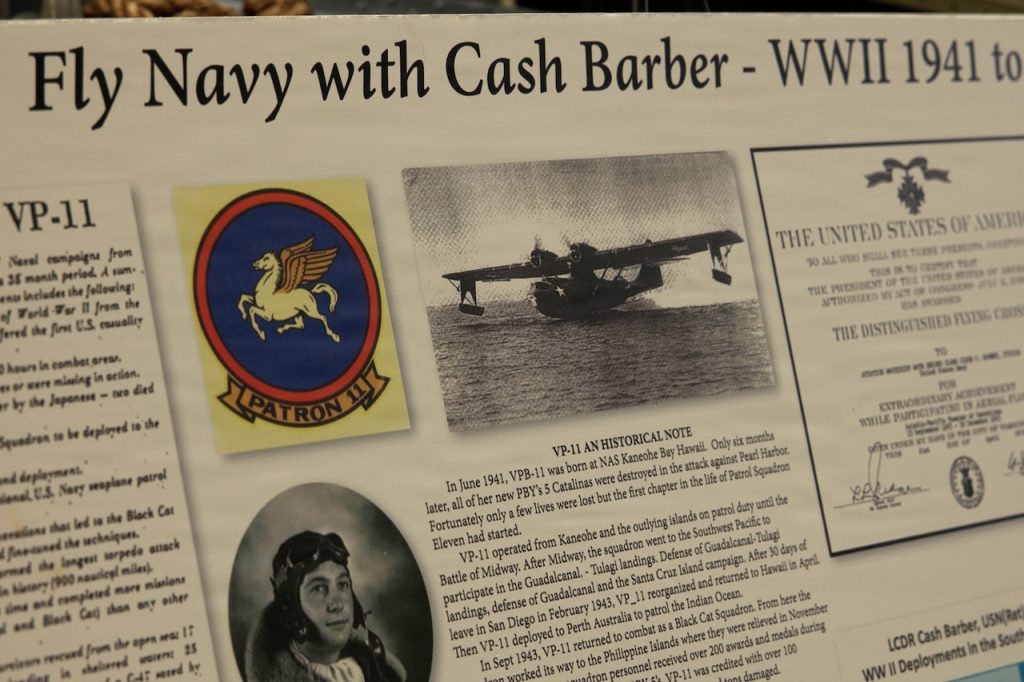
Located aboard historic NAS Pensacola, the National Naval Aviation Museum is among the world’s largest aviation museums. Dedicated to preserving and displaying artifacts related to the history of Naval Aviation, the museum is open daily from 9 a.m. to 3 p.m. Known as the “Cradle of Naval Aviation,” NAS Pensacola has served the Gulf Coast community for more than 200 years. In addition to supporting aviation and cyber warfare training, the installation maintains an operational airfield and deepwater port that continue to support U.S. military readiness. For more information about the National Naval Aviation Museum, visit www.navalaviationmuseum.org.
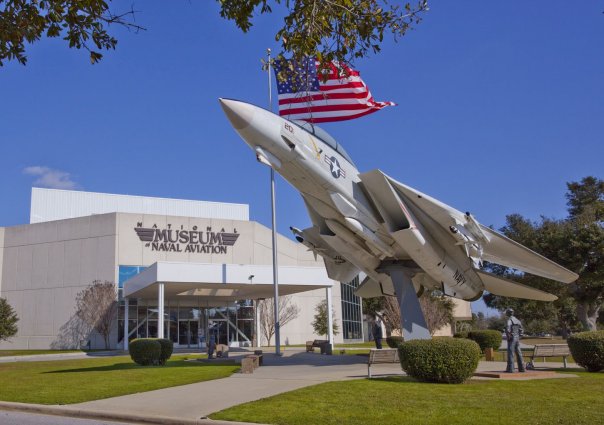
(Image credit: National Naval Aviation Museum)



Wonderful to see a Combat Veteran still telling history; would that we still had others of Our Golden Generation around, and not Gone to Glory.
At least we have Their Words, Writings and footage, to remind us, and the generations to come, of their Courage and Dedication.
To All Our Grateful Thanks, for Service, Sacrifice and Selfless Dedication to the Cause of Freedom.
As U.S. Navy Lt. Cmdr. Clyde “Cash” Barber (Retired) flew in the Catalina’s Aircrew this may be of interest …
Excerpt from Wiki:
”Leonard B. “Tuck” Smith (October 29, 1915 in Mayview, Missouri – May 16, 2006 in Friday Harbor, Washington) was an American pilot who spotted the German battleship Bismarck, prior to its being sunk by British naval and air forces.
Smith was the first American to participate in a World War II naval victory and is sometimes considered the first American to be directly involved in World War II for his actions.*
A number of US pilots, who had ferried Catalinas across to the UK and were supposed to familiarize the RAF crews with the plane, were unofficially used as Co-Pilots on Operations (“unofficially” because the USA was not at war with Germany at that time). Smith was acting as Co-Pilot of AH545 – Squadron Code Letters ‘WQ-Z’ of No. 209 Squadron RAF, which had been specifically assigned a search area after contact was lost with the Bismarck, shortly after the Battle of the Denmark Strait [and the loss of HMS Hood]
They flew out of RAF Castle Archdale, which was a flying boat base on Lough Erne, and through the Donegal Corridor. The plane was primarily [Officially] piloted by British Flying Officer Dennis Briggs, but Smith was at the controls when the battleship was spotted around at 10:10 on 26 May 1941, heading for Brest.”
* Not entirely accurate … Did you know that, in the May of 1940, as the remains of the B.E.F were evacuating the Beaches at Dunkirk, the Government was organising the … ‘Local Defence Volunteers’, to back-up the returning and reforming Army; Incase of a following German Invasion.
The LDV was very soon renamed … ‘The Home Guard’ or, to we Brit.s … ‘Dad’s Army’; you may remember the British TV Comedy Series.
What You May Not Know Is That Two Of Those 1940 Units Were ….. American.
Except From: ‘usmilawards.uk’
”1st American Eagle Squadron Home Guard.
…. I Didn’t know anything about this until I saw a badge for sale on the internet for the 1st American eagle squadron of the home Guard in Britain. Authorised by a special order by King George VI the squadron was incorporated into the home guard September 1940 and comprised of US citizens living in Britain. There were approx 80 men and they were attached to the London HQ with Americans working for the US embassy and also press correspondents. Founded by General Wade H Hays (who I also believe subsequently founded the RAF Eagle squadrons) felt that he couldn’t just sit by and do nothing whilst Britain was under attack, and would have felt ashamed had the Americans living in Britain done nothing to help.”
Thank you America, Very, Very Much; though I still need to know their Names, and find if those Brave Souls were Officially Honoured, after December 7th, 1941. (when America Declared War on Germany)
We do have Names, and War History for the Volunteer Squadron Members of the Two ‘Eagle Squadrons’ – R.A.F, who fought through ‘The Battle of Britain’ and beyond – some transferring later into the 8th Airforce.
And … Lastly, But Very Not Leastly … Let Us Not Forget those American Reporters Who Braved The Blitz to report back home the War Events; especially, In 1940, notable American reporters in Britain included Edward R. Murrow, who provided Live Broadcasts from London during the Blitz**, and William L. Shirer, known for his coverage of the war’s early events.
** Standing On Roof Tops, Microphone In Hand, As The Bombs And Shrapnel Rained Down.