
In the movie “The Dictator,” Aladdin was satirically seen asking a bomb designer to make it pointy rather than round-nosed. He believed that the bomb’s round tip would “put a smile on the enemy’s face.” But who knew that a similar instance had happened in the Soviet aviation industry, where an aircraft was canceled because its appearance didn’t impress a leader. After WWII ended in 1945, Joseph Stalin ordered the Soviet Navy to expand to compete with US naval forces. He wanted to build various warships, including battleships and other heavy ships, but not aircraft carriers. However, Admiral Nikolai Kuznetsov, then the head of the Soviet Navy, wanted to develop aircraft carriers. In 1952, Kuznetsov tried to convince Stalin to support aircraft carriers, but Stalin could not decide before he died in 1953. After Stalin’s death, Kuznetsov began preliminary design work on the Project 85 light aircraft carrier and its aircraft. However, the ship was never built, existing only as a design on paper. But it allowed the Tupolev Design Bureau to focus on creating a single-engine turboprop aircraft that would meet the needs of Soviet Naval Aviation. The Soviet Navy wanted a long-range strike aircraft capable of attacking targets with bombs or torpedoes. As a result, the bureau initiated development of the aircraft, designated Tupolev Tu-91. After Stalin’s death, the Soviet Union’s new leaders also rejected proposals for aircraft carriers. But, on April 29, 1953, the Council of Ministers approved the proposal for a land-based bomber powered by a Kuznetsov TV-2 turboprop engine for the Soviet Navy. The bomber needed to conduct level-bombing and dive-bombing missions, attack with bombs, torpedoes, rockets, and naval mines, and conduct coastal reconnaissance.
Design of Tupolev Tu-91
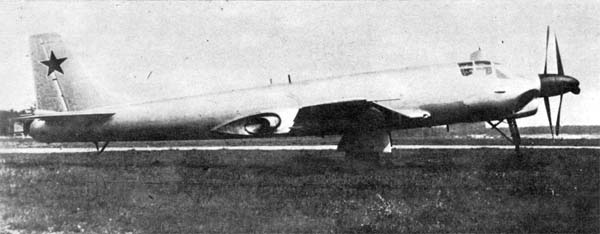
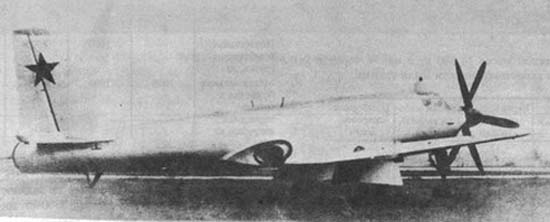
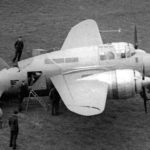
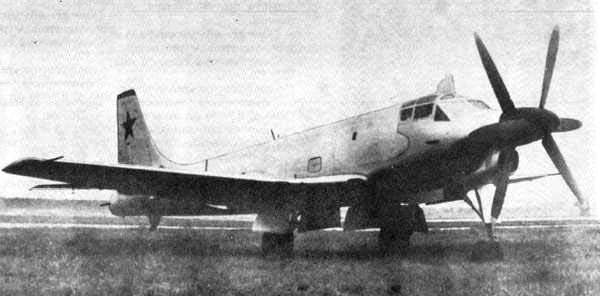
As a result, the design bureau revised the Tupolev Tu-91’s design, removing the wing-folding mechanism, arresting gear, and other carrier-related equipment from the second prototype. The Tupolev Tu-91 took its first flight on May 17, 1955. That’s when the manufacturer started testing it. The Tupolev Tu-91 was a low-winged monoplane made of duralumin, with dihedral wings and three spars. The wing included two outer panels and a center section that held four fuel tanks and the tricycle landing gear. The outer panels had control surfaces, including manually tabbed ailerons and slotted flaps. The aircraft featured a conventional tail with vertical and horizontal stabilizers. The engine was located mid-fuselage, above the wing spars, and it drove an 18.8-foot-diameter six-bladed contra-rotating propeller in the nose through a long shaft that went through the cockpit. With a crew of two, including a pilot and observer, the Tupolev Tu-91 was 58.1 feet long, 16.7 feet high, with a wingspan of 53.10 feet and a wing area of 511 square feet. The empty weight of the aircraft was 17,637 pounds, and the maximum takeoff weight was 31,747 pounds. Its Kuznetsov TV-2M turboprop engine produced 7,656 horsepower. The maximum speed of the Tupolev Tu-91 was 500 mph, with a cruise speed of 160-190 mph, a range of 1,460 miles, and a service ceiling of 36,000 feet. The aircraft was armed with two 23 mm NR-23 cannon with 100 rounds each in the wing roots and two similar ones with 150 rounds each in the tail turret. It also had provisions for carrying up to 3,300 pounds of bombs, rockets, or a single torpedo.
The Cancellation
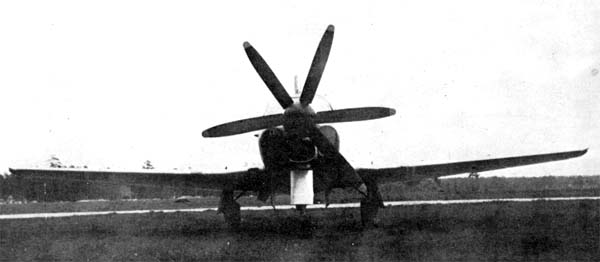
During testing, the test pilots concluded that the Tupolev Tu-91 was very maneuverable but recommended banning barrel rolls. The aircraft also passed state trials, and the design bureau started preparing for production at Factory No. 31 in Tbilisi, Georgia. The Soviet Navy also approved the production of the Tupolev Tu-91 after finding its performance satisfactory. The Tu-91 was shown to the Soviet leadership in mid-1956 as part of a display of new military aircraft. It was one of the few propeller-driven planes present in the convoy. When the newly elected General Secretary Khrushchev sought information about the aircraft, a Navy officer mistakenly said it could perform a heavy cruiser role. Khrushchev responded, “But nobody needs heavy cruisers anymore,” and commented on how ridiculous it looked. This ridiculous comment led to the cancellation of the program, perfectly showing how some leaders judged an aircraft by its appearance. In the Grounded Dreams series, the Tupolev Tu-91 stands as a perfect aircraft with great design and maneuverability, but it was canceled because its appearance didn’t suit a leader. Read more Grounded Dreams articles HERE.