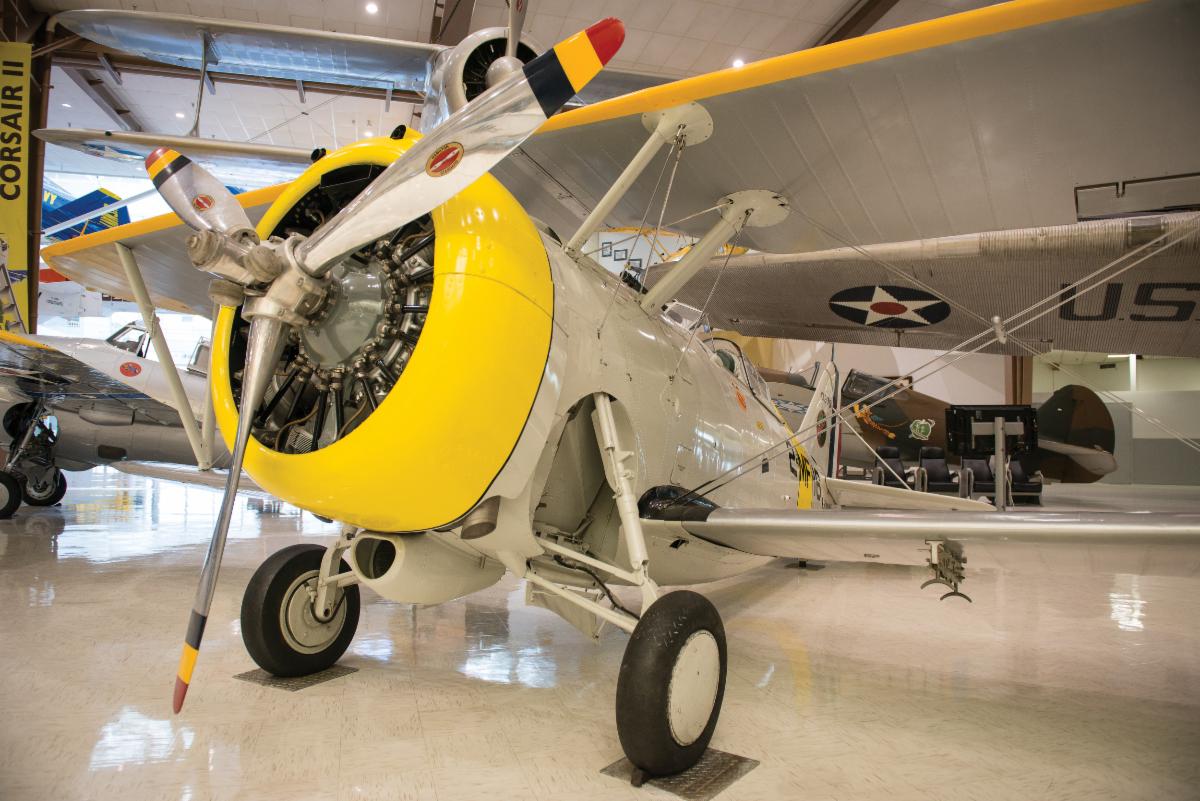

August 29, 1940: A young Marine aviator is on a training flight off the coast of Del Mar, California, just north of the U.S. Navy’s base at San Diego. Ahead of him is the aircraft carrier USS Saratoga (CV-3), which is preparing for him to land aboard the wooden flight deck. In the cockpit of his Grumman F3F-2 biplane fighter, 1st Lieutenant Robert E. Galer lowers the manually cranked landing gear and activates a switch on the instrument panel for the fuel pumps to switch from the primary tank to the reserve tank. Suddenly, the Wright R-1820 Cyclone radial engine sputters and coughs as its power begins to bleed off. Just 300 yards from the Saratoga, with the aircraft already at a low altitude, the only thing Lt. Galer has time for now is for him to keep the controls steady and brace for impact with the Pacific Ocean. Soon after hitting the water, Galer escapes from the cockpit of his F3F fighter with a few bruises and swims away from the aircraft, while the destroyer USS Chandler (DD-206) was dispatched to pick up the young Marine. Despite the aircraft being equipped with flotation devices for eventual recovery, the yellow and grey biplane slips beneath the waves. No one aboard the Saratoga could know this at the time, but some 50 years later, this very aircraft will be raised from the depths and restored to its former glory to be displayed in one of the nation’s most prominent military museums.
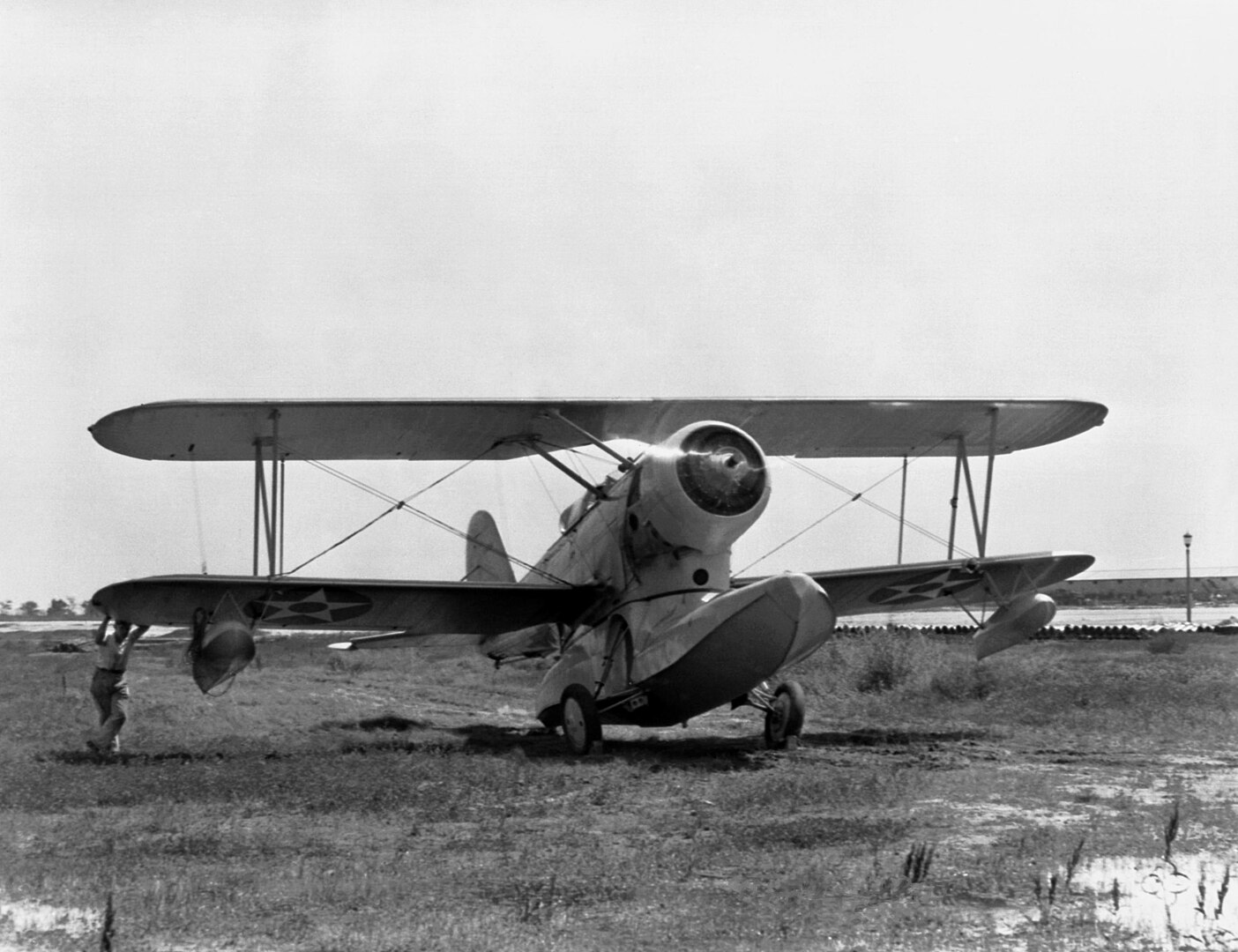
This past year, we covered the story of a Grumman F6F Hellcat raised from off the coast of San Diego (see this article HERE), but four years before that aircraft was lost in 1944, another Grumman naval aircraft ended up at the bottom of the Pacific Ocean and was deemed worthy of recovery. Like the Hellcat of our earlier tale, the story of this aircraft began on the opposite side of the United States from San Diego. In 1929, former naval aviator, test pilot, and aeronautical engineer Leroy Grumman established a new aviation company, the Grumman Aircraft Engineering Corporation, on New York’s Long Island. Grumman’s practical experience with the unique challenges associated with naval aviation led to focus on building aircraft suited to the specific needs of the US Navy, and by 1933, had gained success with a succession of biplane fighters such as the FF-1 two-seat fighter (known as the “Fifi”) and the JF Duck amphibious seaplane, followed by the F2F single-seat biplane fighter. Despite the U.S. military’s small budget during the Great Depression and the mindset of maintaining a defensive, isolationist policy, the Navy recognized that given rapid advances in the field of aviation, a new version of the F3F would be needed, even as the F2F had only just entered operational service but had revealed issues with stability and spin recovery. The result was the Grumman F3F, the last biplane fighter developed for the U.S. military.
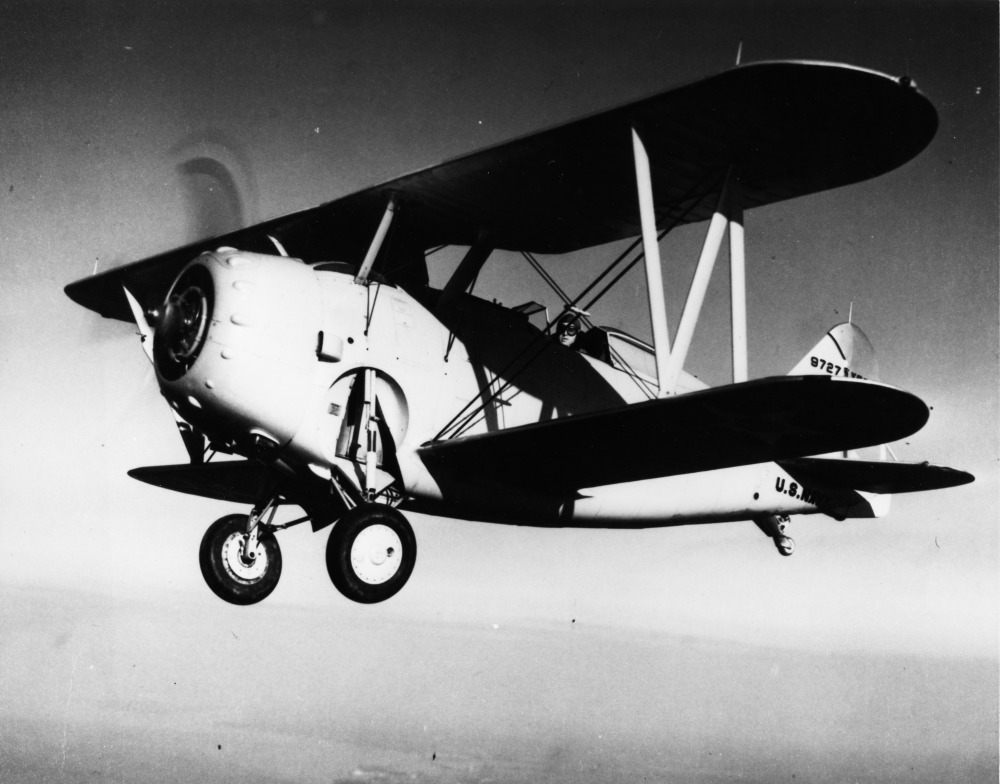
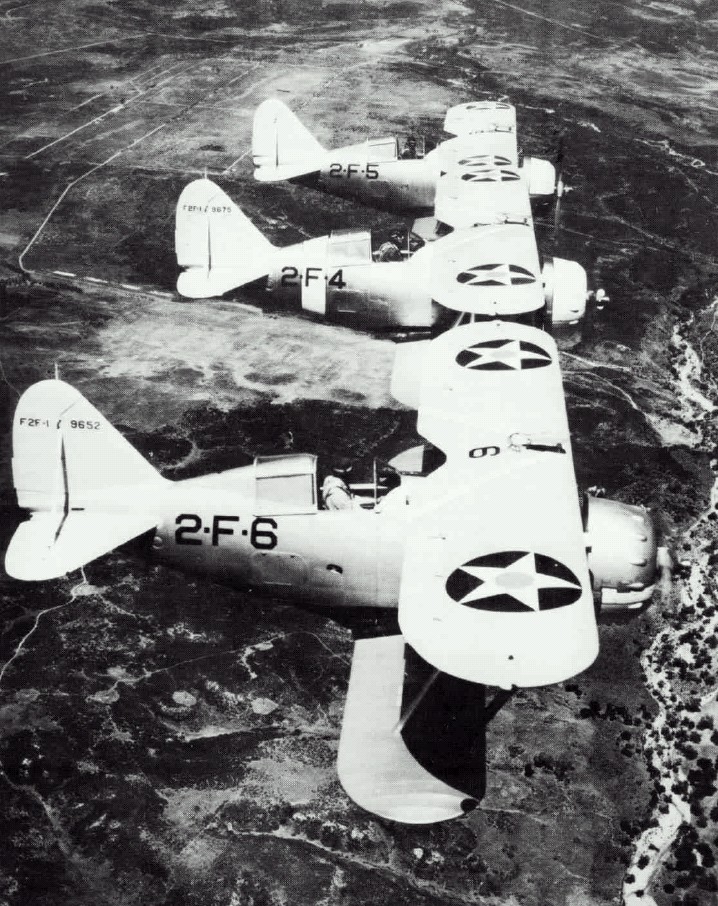
The F2F and the F3F were similar in terms of their general appearance, but the Pratt & Whitney R-1535 Twin Wasp Junior engine on the F2F and on the F3F-1 variant was replaced by the Wright R-1820 Cyclone on the F3F-2. The F3F also featured an armament of one Browning M1919 .30 caliber machine gun and one Browning M2 .50 caliber machine gun compared to the two .30 calibers on the F2F, and the F3F’s bottom wings were strengthened to carry a pair of 116 lb. (53 kg) bombs on external racks. Due to the shape of its fuselage, the F3F also earned the nickname the Flying Barrel. However, the F3F was ultimately a stop-gap solution for the US Navy and Marine Corps’ fighter squadrons, as monoplane designs in fighter aircraft were being widely adopted around the world, and plans from Grumman to create an improved biplane fighter were revised to create the company’s first monoplane fighter, which was to become the legendary Grumman F4F Wildcat, the first of the Grumman Cats. Nevertheless, as production orders for the F4F and the competing Brewster F2A Buffalo monoplane fighters took longer than expected, the F2Fs and F3Fs would remain in service, with the F3Fs staying in frontline service until 1941, but were relegated to reserve and training squadrons by the time of the Japanese attack on Pearl Harbor. Indeed, following the United States’ formal entry into WWII, the remaining F2Fs and F3Fs were largely sent to stateside training units to instruct both newly minted Naval and Marine aviators as well as crew chiefs and mechanics well into 1943, but once they were deemed obsolete for even these roles, they were by and large scrapped. In all, 55 Grumman F2Fs and 147 Grumman F3Fs were built.
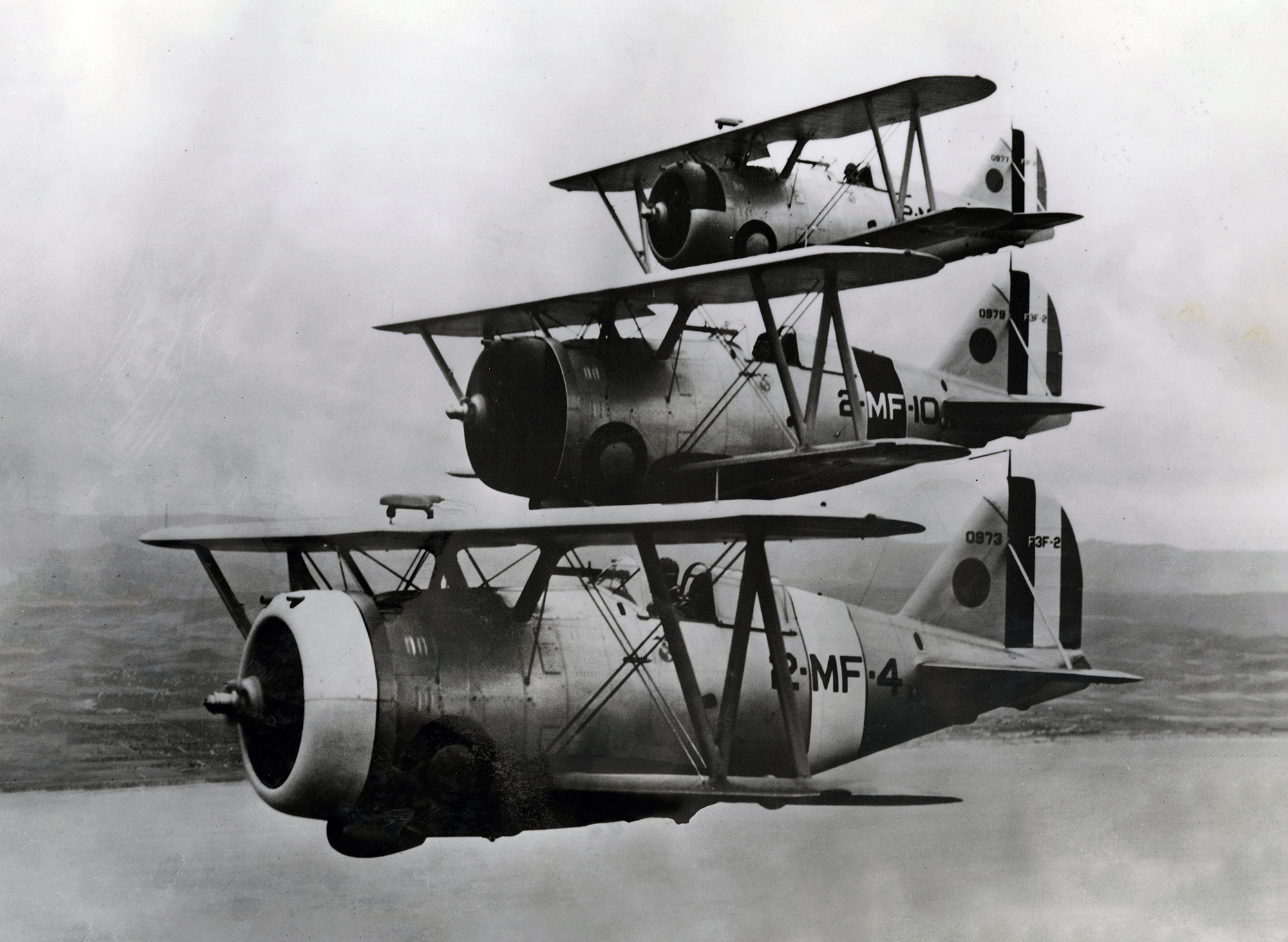
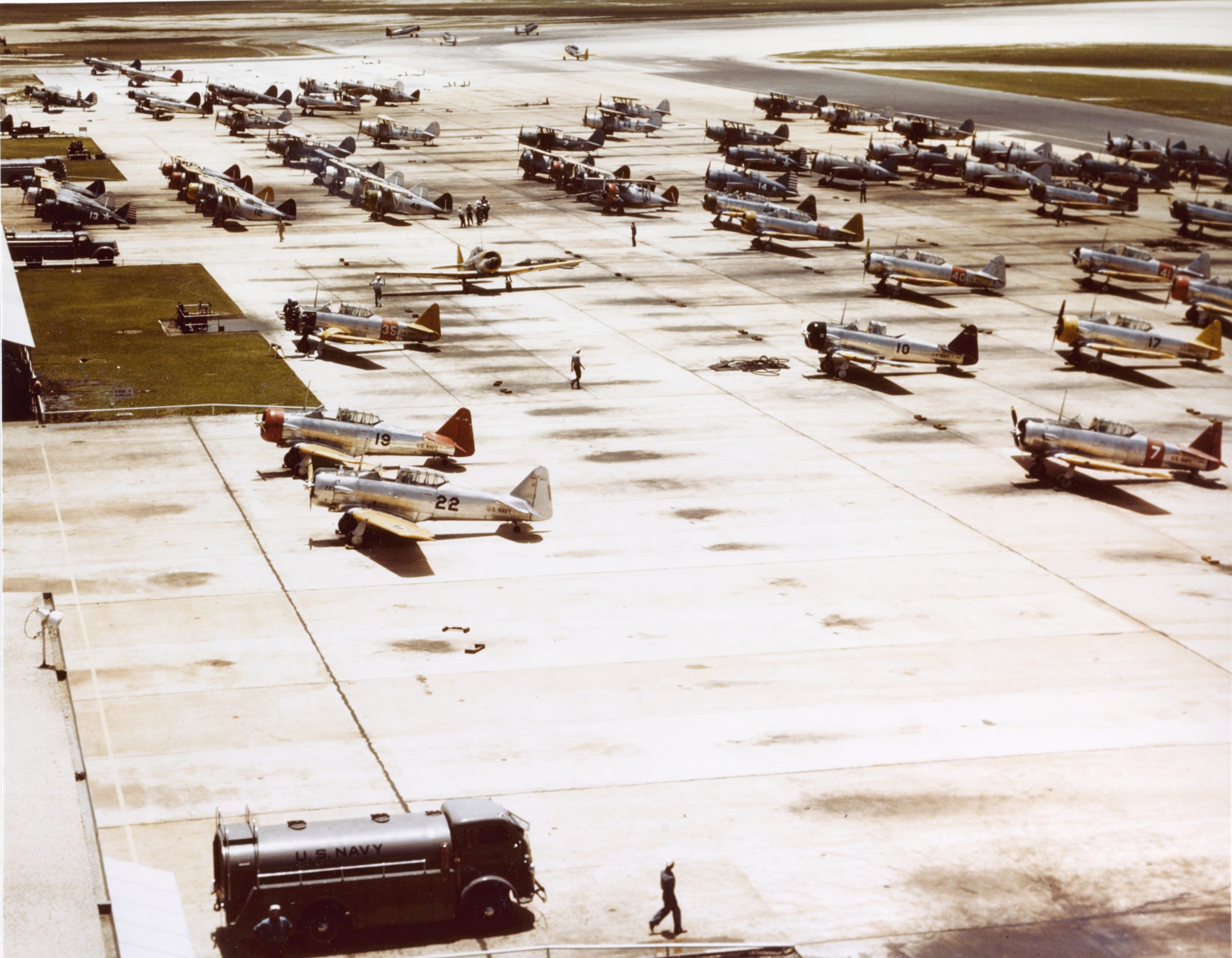
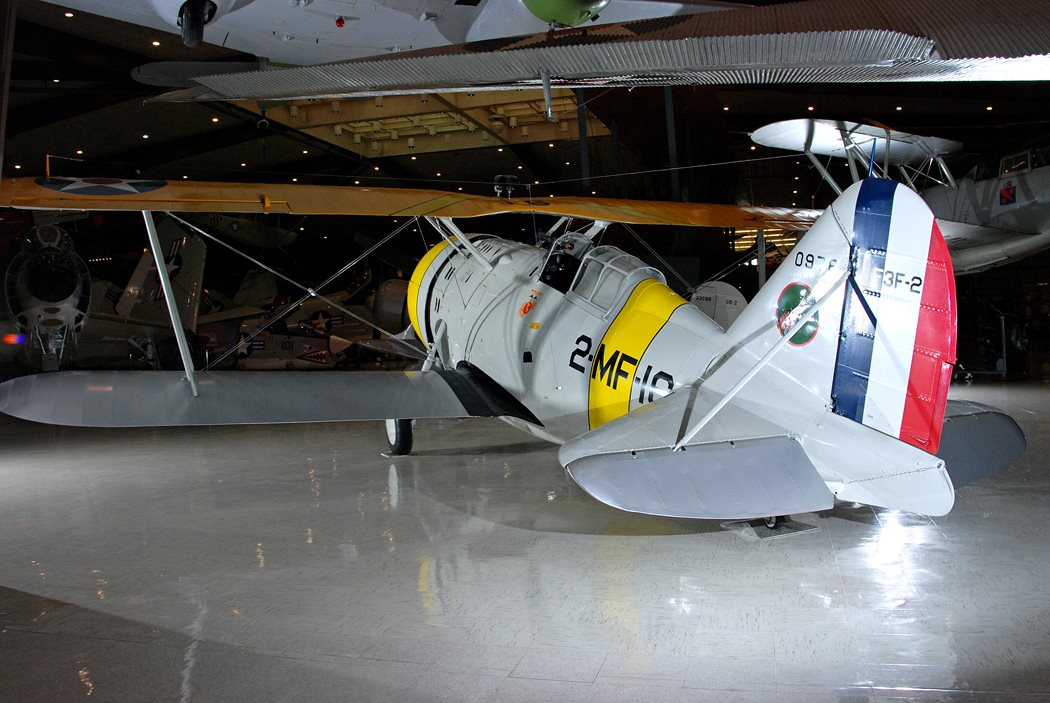
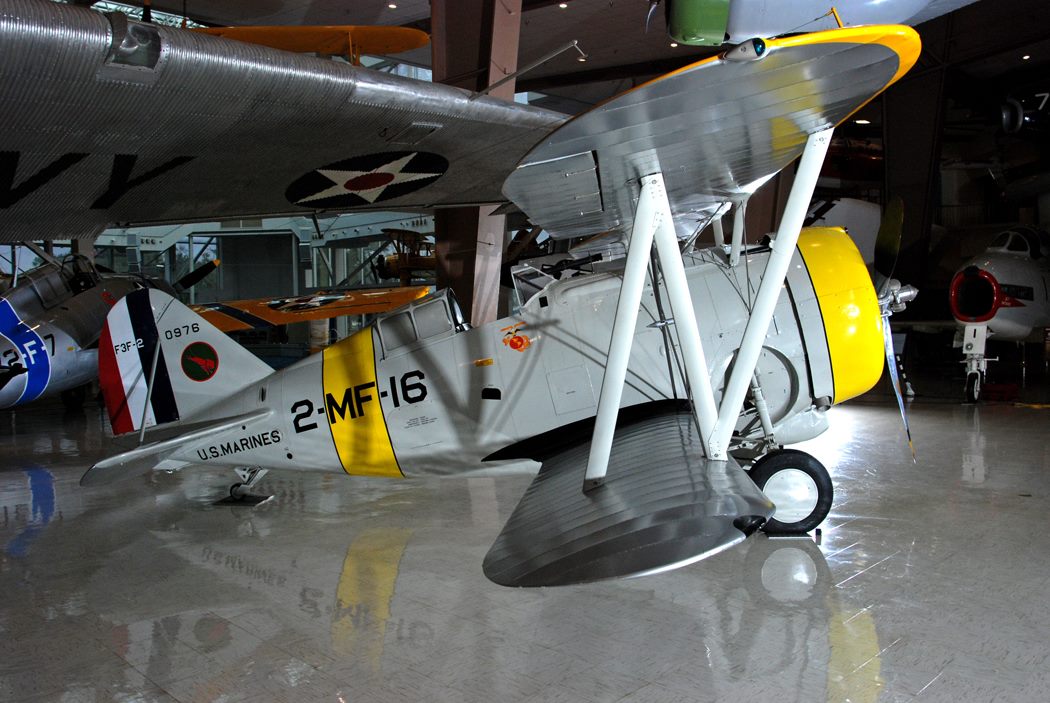
The subject of our story was originally constructed in 1937 at the Grumman Aircraft plant in Bethpage, New York as construction number 374 and was given the Bureau Number 0976 by the U.S. Navy’s Bureau of Aeronautics. On December 21, 1937, BuNo 0976 was assigned to the Fleet Marine Force’s Aircraft One detachment stationed at Quantico, Virginia, but one month later, on January 17, 1938, F3F-2 BuNo 0976 was transferred to Fleet Marine Forces’ Aircraft Two detachment in San Diego, California, and was assigned the same day to Marine Fighting Squadron 2 (VMF-2), stationed at Naval Air Station San Diego (now NAS North Island). Originally established as Marine Fighting Squadron 4 (VF-4M) on January 1, 1937, before being redesignated VMF-2 on July 1, 1937, VMF-2 would partake in combined Navy/Marine operations and training exercises off the southern coast of California. Accidents, however, were not uncommon, and on August 31, 1938, the aircraft was recorded in squadron records as being involved in a forced landing in Santa Ana, California, but was later repaired and returned to flight duty. For the early part of its career with VMF-2, BuNo 0976 was given the fuselage code 2-MF-7, and Marine aircraft such as F3F-2 BuNo 0976 has the Marine’s Eagle Globe and Anchor (EGA) emblem painted on the sides of the cockpit’s exterior.
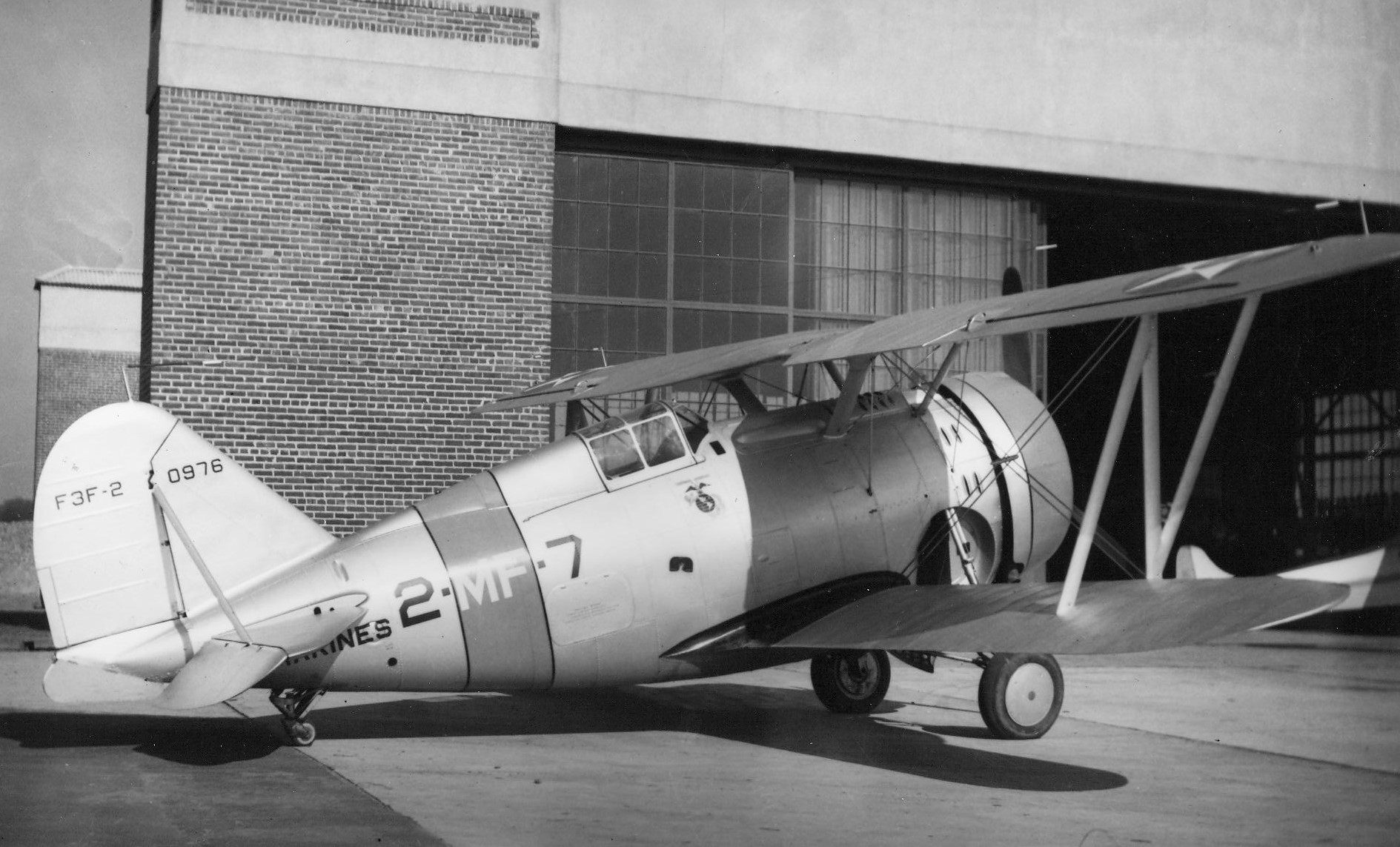
For F3F-2 BuNo 0976, 1939 represented more routine flights and periods of maintenance. On January 12, 1940, the aircraft underwent a major overhaul at NAS San Diego before returning to operational service, which included carrier qualification training for Marine aviators. It was also in 1940 that the Navy and Marine aviation unit in San Diego worked with Hollywood in the production of the movie Flight Command, starring Robert Taylor, though it is unknown if 0976 was involved in any of the flight sequences shot for the film. On August 9, 1940, the aircraft was involved in a landing mishap while practicing for carrier landings at Imperial Beach, just south of San Diego. The aircraft was soon repaired, but later that month, F3F-2 BuNo 0976 would set out on its final flight on August 29, 1940. By this point, F3F-2 BuNo 0976, now coded as 2-MF-16, was typically assigned within VMF-2 to 1st Lieutenant Milo Haines, but on August 29, it would be his friend and squadron mate 1st Lieutenant Robert E. Galer would be flying 0976 to earn his carrier qualification.
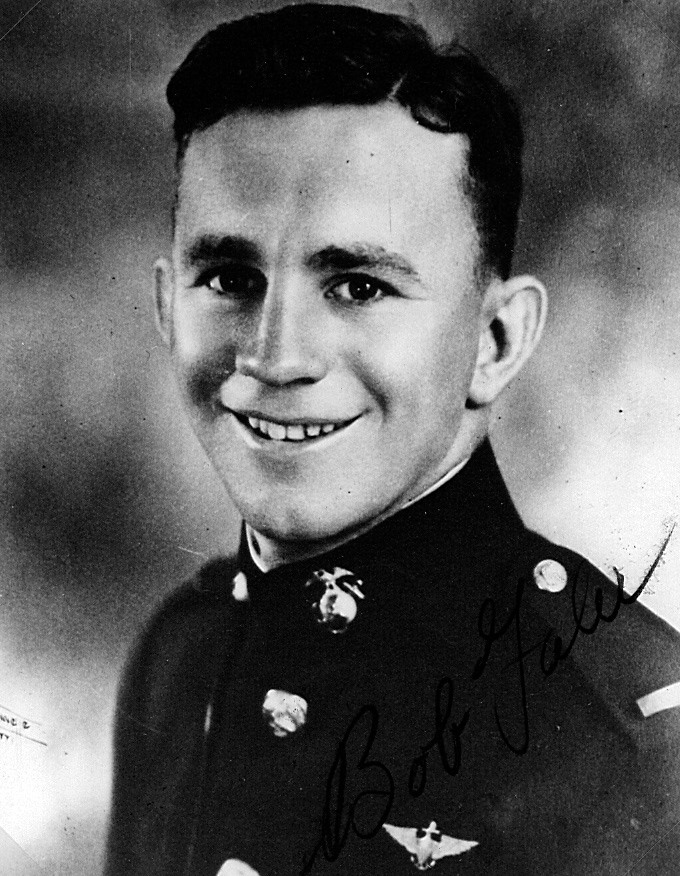
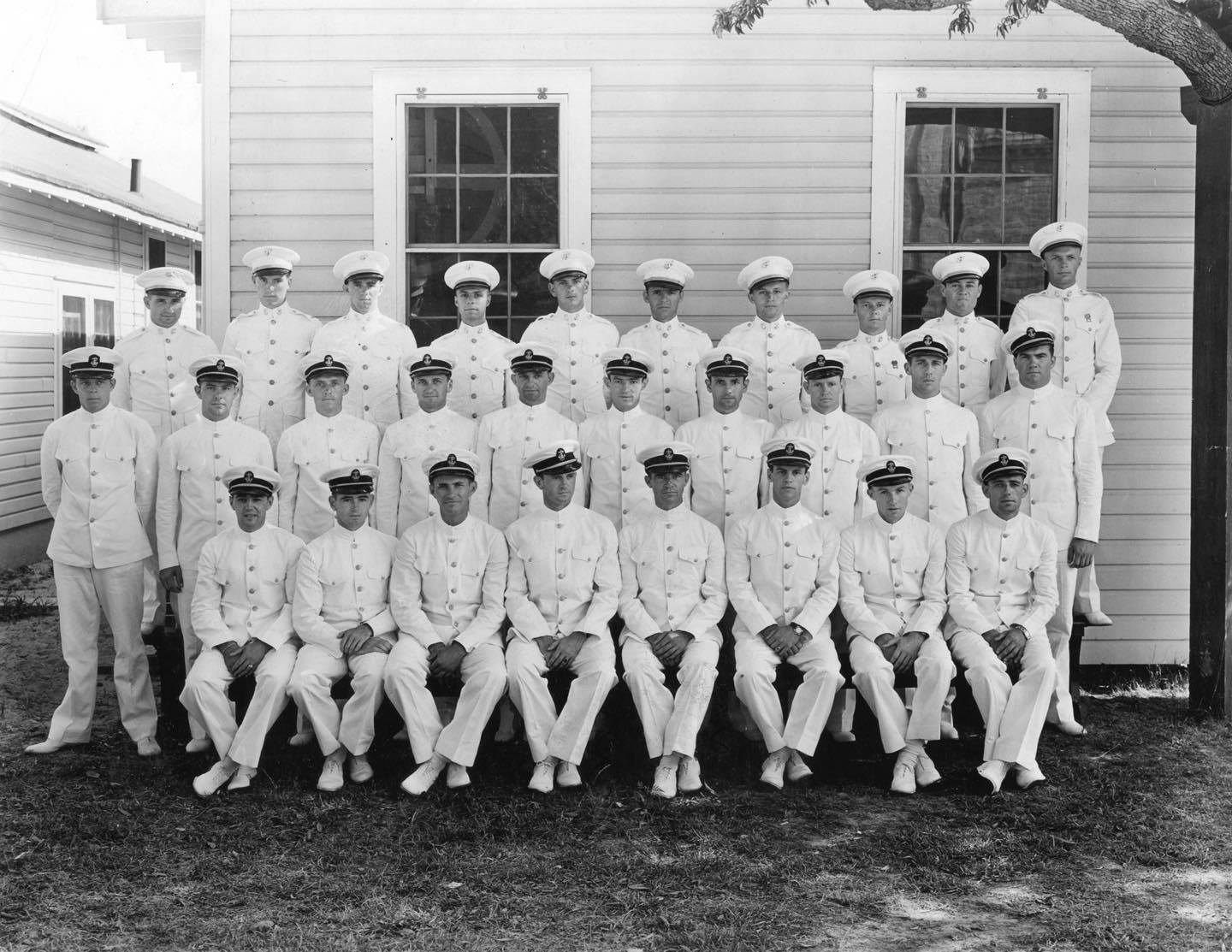
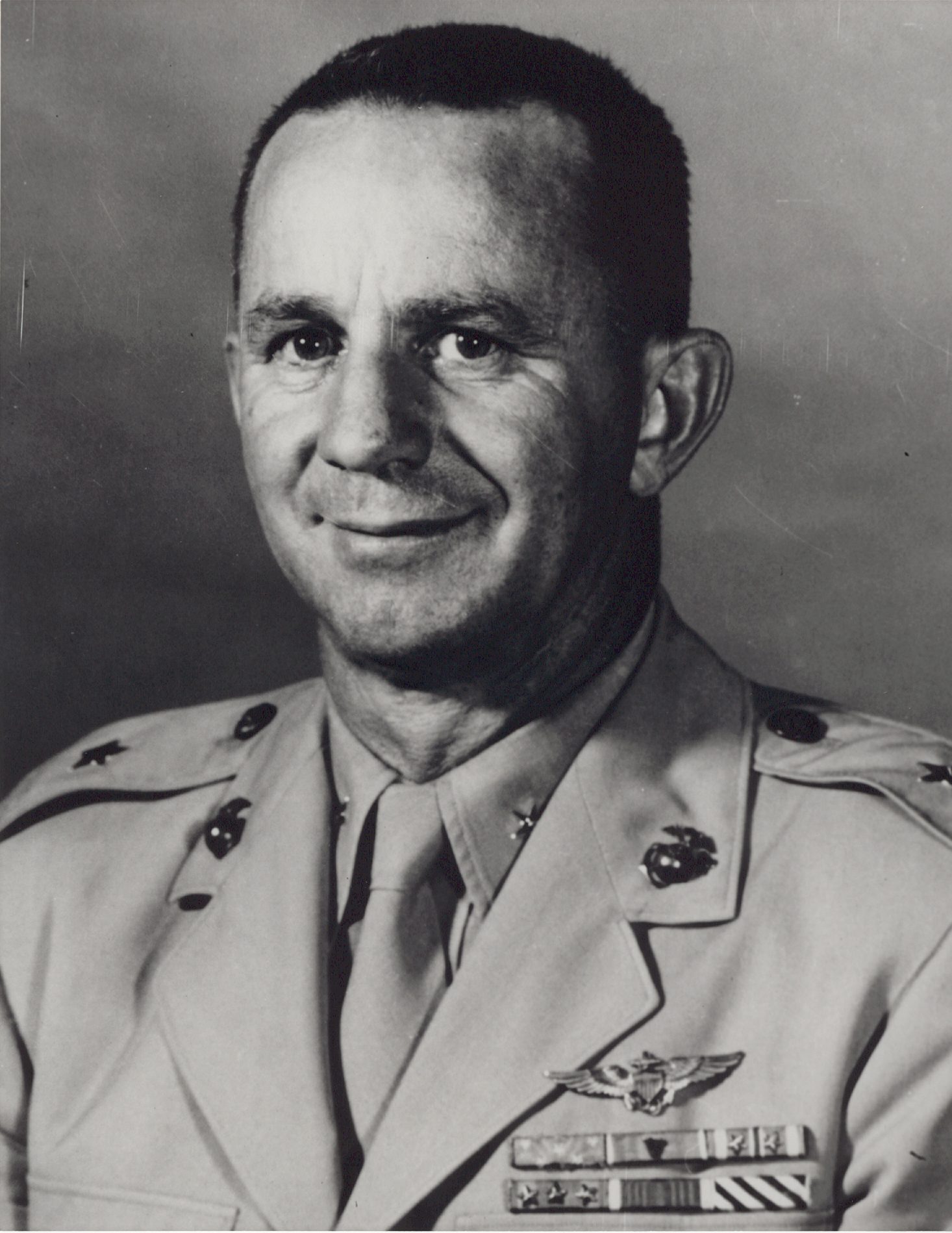
Born in Seattle in 1913, Galer joined the Marines in 1935 after graduating from the University of Washington with an ROTC commission, and graduated from flight training at Naval Air Station Pensacola, Florida, in 1937, along with fellow Marine and University of Washington graduate Gregory Boyington, later to be known as “Pappy”. After graduation, Galer would serve at Quantico, receive further instruction from The Basic School in Philadelphia, and serve as a scout pilot with Marine Scouting Squadron 3 (VMS-3), known as the “Devilbirds”, stationed at Bourne Field (now Cyril E. King Airport), St. Thomas, Virgin Islands, from 1938 to 1940. In June 1940, Lt. Galer was transferred to VMF-2 at San Diego. Now, he was on approach to land on the flight deck of USS Saratoga (CV-3), one of the three aircraft carriers assigned to the US Navy’s Pacific Fleet. As was mentioned at the start of the article, when Galer switched to the F3F’s reserve fuel tank to prepare for landing, the engine on his aircraft suddenly lost power. Despite using his hand-cranked wobble pump to attempt to pump more fuel into the engine, Galer was already in the downwind leg for landing on the Saratoga, and the engine never regained full power before he ended up in the water. At this time, many US carrier aircraft were fitted with watertight flotation compartments to keep the plane on the surface until being recovered to be salvaged and repaired in the event of a ditching. The aircraft settled into a nose-down attitude and sank within five minutes.
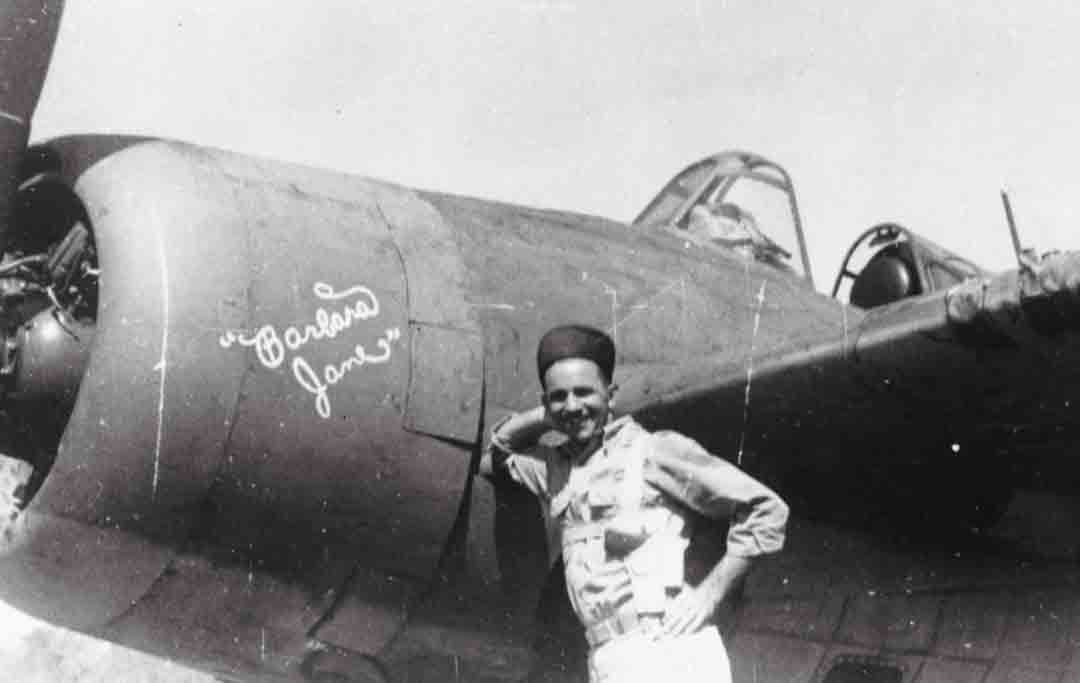
Despite the loss of F3F-2 BuNo 0976, Lt. Robert E. Galer would go on to have a distinguished record in the Pacific Theater of WWII. On July 1, 1941, VMF-2 was redesignated Marine Fighting Squadron 211 (VMF-211) and while a forward echelon was sent to Wake Island, and would be at the center of the island’s defense against a Japanese invasion in December 1941, Galer was with the rear echelon of VMF-211 at MCAS Ewa, just southwest of Pearl Harbor, and was there when Ewa came under attack along with other military installations on Oahu on December 7, 1941. In May 1942, Galer became the commanding officer of Marine Fighting Squadron 224 (VMF-224), which was deployed to the island of Guadalcanal in August 1942, where the squadron became part of the legendary Cactus Air Force, fighting the Japanese for control of the Solomon Islands. While in command of VMF-224, Major Galer was credited with 13 confirmed aerial victories (11 of these within a 29-day span) and four probable victories, while he himself survived being shot down three times.
His leadership of the squadron resulted in him being awarded the Medal of Honor, which was presented to him at White House by President Franklin D. Roosevelt on March 24, 1943. These same actions also earned him the British Distinguished Flying Cross. By war’s end, Robert Galer had been promoted to Lt. Colonel and was largely assigned to groundwork, instructing observers for close-air support missions, as the U.S. military did not want to lose a Medal of Honor recipient in further air-to-air combat. After the war, Lt. Colonel Galer remained in the Marines and flew further combat missions during the Korean War while serving as the commanding officer of Marine Aircraft Group 12 (MAG-12), surviving another shoot down on August 5, 1952, and being rescued by a Sikorsky HO3S-1 helicopter. In 1957, Galer retired from the Marine Corps, and was promoted to Brigadier General in recognition of his effectiveness in combat. After his 22-year career in the Marines came to an end, Robert Galer would serve as vice president of Ling-Temco-Vought (LTV).
By the end of World War II, the Grumman F3F “Flying Barrel” was way behind yesterday’s news. No examples of the F2F and the F3F were set aside for historical preservation, and as such, only two civilian aircraft based on the Grumman biplane fighters remained in existence. One was the Grumman G-22 “Gulfhawk II”, flown in numerous airshows of the 1930s by former naval test/racing pilot Alford “Al” Williams in his capacity as manager of Gulf Oil Corporation’s Aviation Department, which was donated to the Smithsonian’s National Air Museum (later National Air and Space Museum) in 1948, and the other was the Grumman G-32A, a two-seat variant of the F3F built as a company demonstrator aircraft that was impressed into service with the US Army Air Force during WWII, then sold to several private pilots before it was lost in a crash at Oshkosh, Wisconsin on August 7, 1971, with the remains later being bought by collector Doug Champlin and later rebuilt by Herb Tischler and his Texas Aircraft Factory in Fort Worth, Texas between 1988 and 1993, alongside the wrecks of three F3F-2s of VMF-2/VMF-211 recovered from the slopes of Mount Haleakalá on the Hawaiian island of Maui (more on that story HERE). In June 1988, the Navy Deep-submergence vehicle (DSV) Turtle (DSV-3) was exploring the depths of the Pacific six miles off the coast of Del Mar, California, in search of a downed Bell UH-1H Huey helicopter. During their search for the missing Huey, the crew inside the Turtle instead discovered Grumman F3F-2 BuNo 0976 resting 1,800 feet below the surface, still surprisingly intact after 48 years underwater. The crew inside the Turtle made notes on the condition of the aircraft, while the submersible’s on-board cameras recorded footage of the wreckage. The aircraft was in a near-vertical position, its engine and cowling buried in the ocean floor. The wings had slight damage, but the fabric was still largely intact, as was the fuselage of BuNo 0976. In a phone call with Robert Rasmussen, director of the National Naval Aviation Museum, Ed McKellar, director of the San Diego Aerospace Museum (now the San Diego Air and Space Museum) said of relating the footage of the F3F “It’s for real, and it’s pretty much intact in good shape. There is only one little problem, and that is the 1,800 feet of salt water that sits on top of the aircraft.” On reviewing the records of the accident from 1940, McKellar contacted General Rober E. Galer. When McKellar told General Galer that his airplane had been discovered, the old Marine asked, “Which one?” Despite enthusiasm from the San Diego Aerospace Museum and the National Museum of Naval Aviation, recovering an old biplane was not high on the Navy’s immediate priority list, and efforts stalled on the recovery effort. Then, in 1990, Vice Admiral Jack Fetterman, Commander, U.S. Naval Air Forces Pacific, agreed to help the two museums if they would tag along on the expedition to retrieve the missing Huey after they would raise enough funds and get approval from the Navy’s Superintendent of Salvage. After its recovery, the Grumman F3F’s condition would be stabilized at NAS North Island. They would have the SDAM restore General Galer’s Grumman F3F to static display condition, and it would ultimately be shipped from San Diego to the National Naval Aviation Museum in Pensacola, Florida, for permanent display.
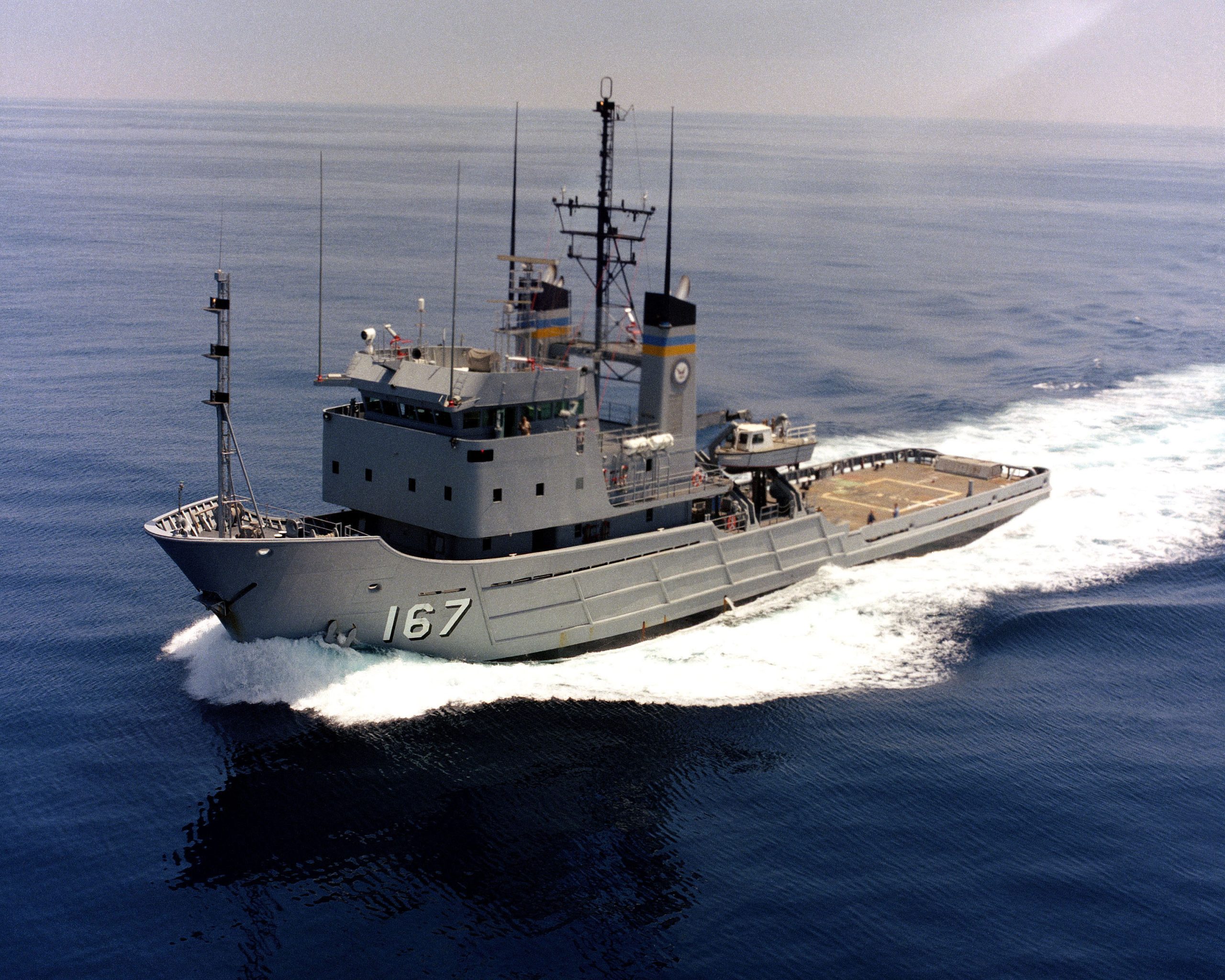
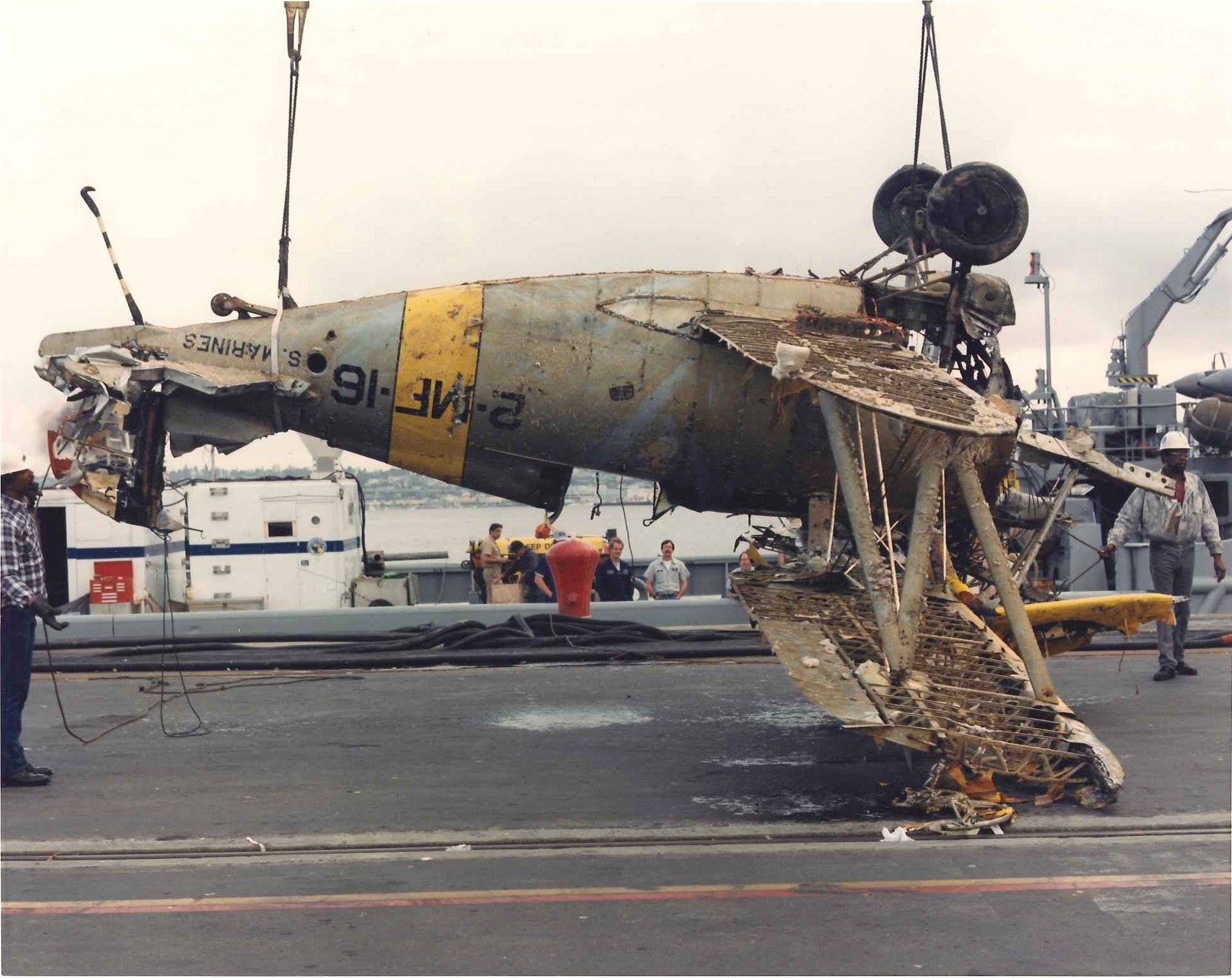
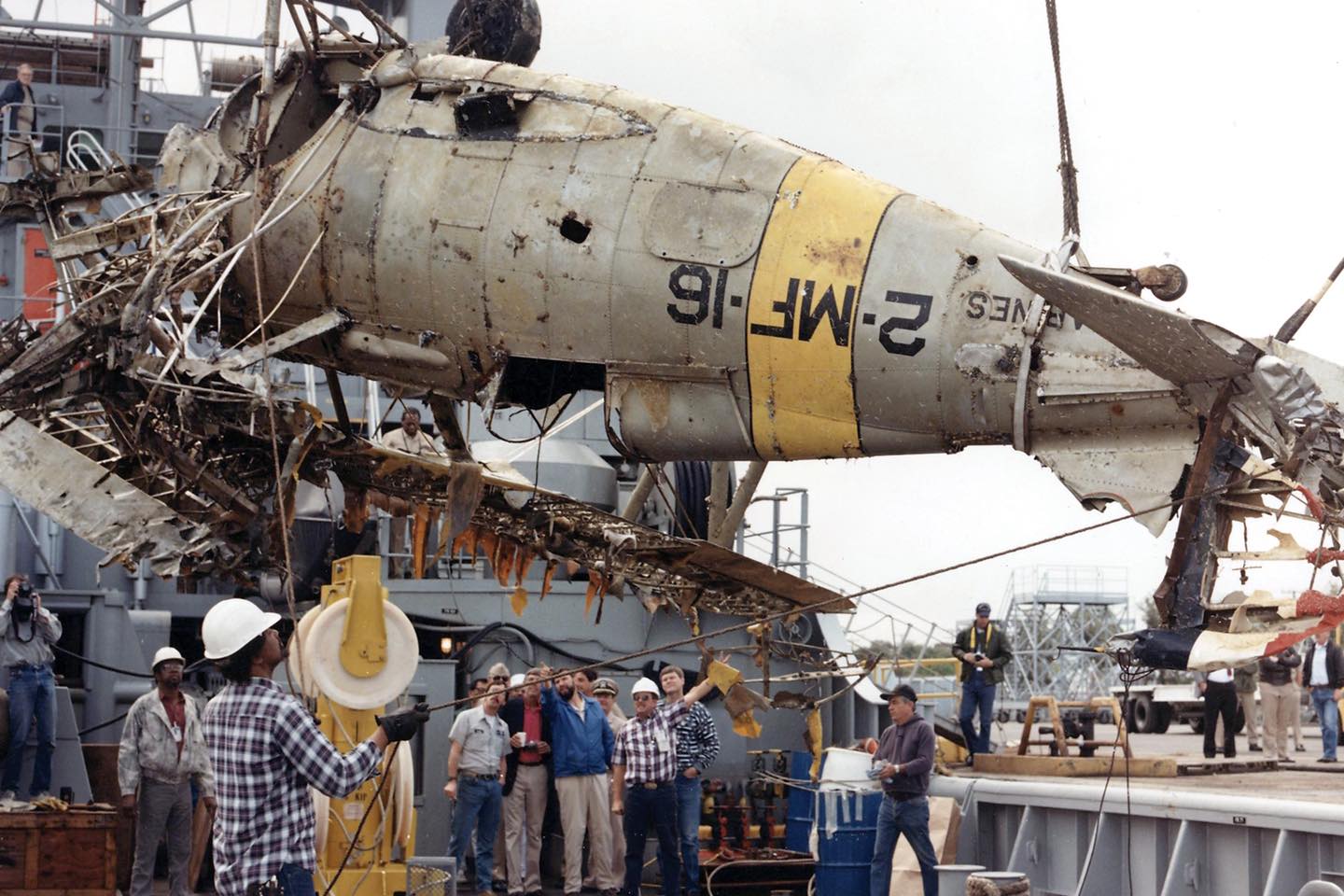
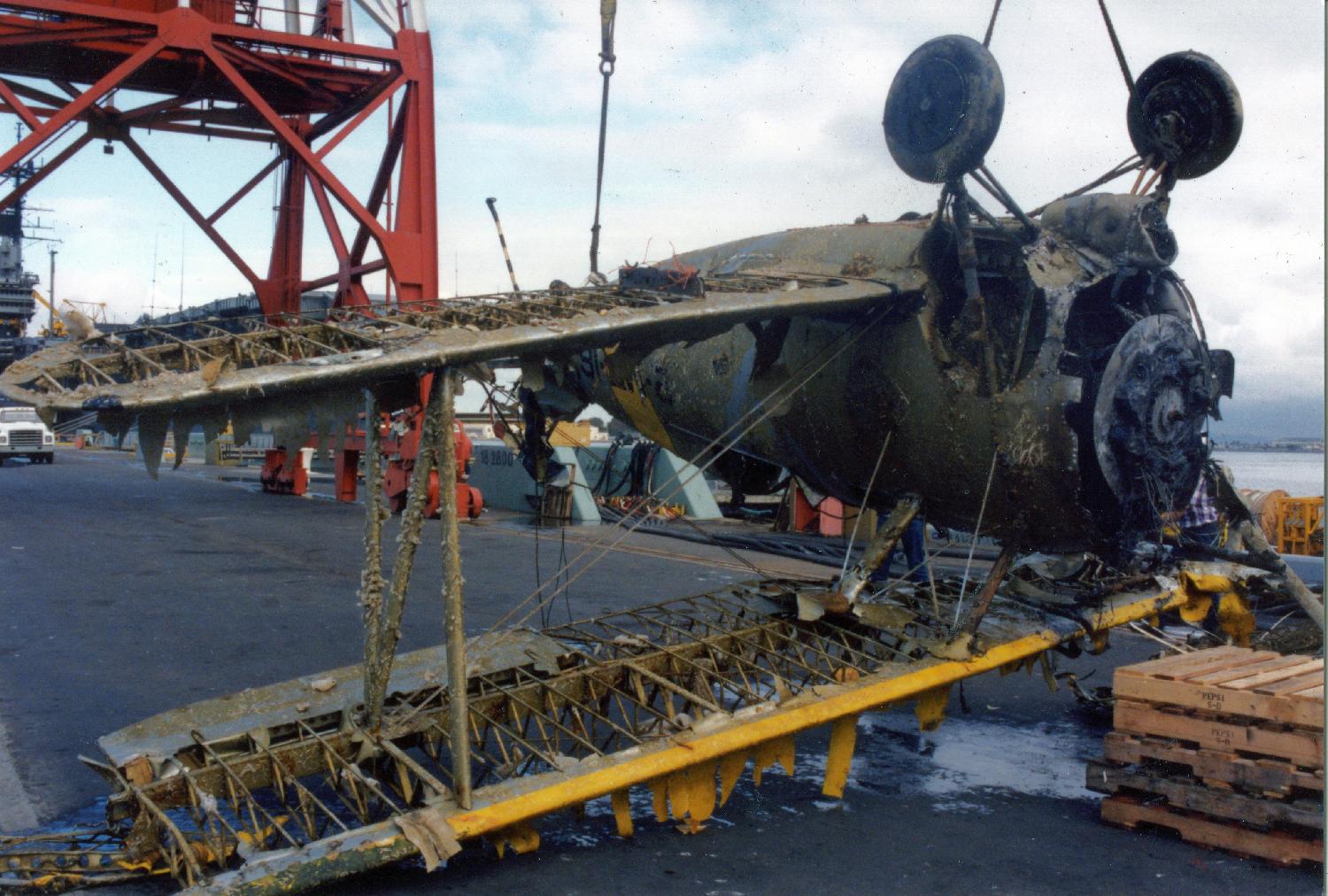
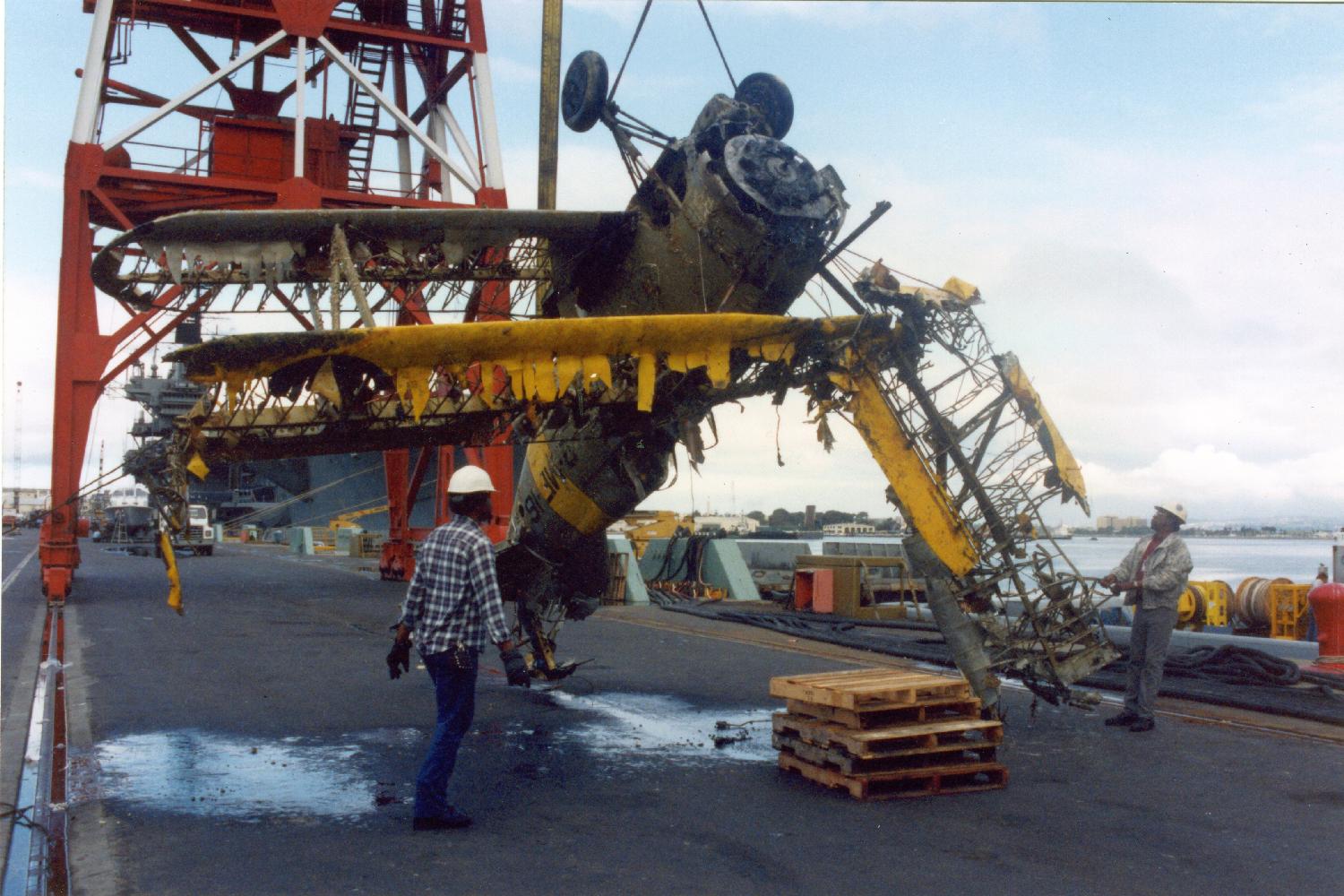
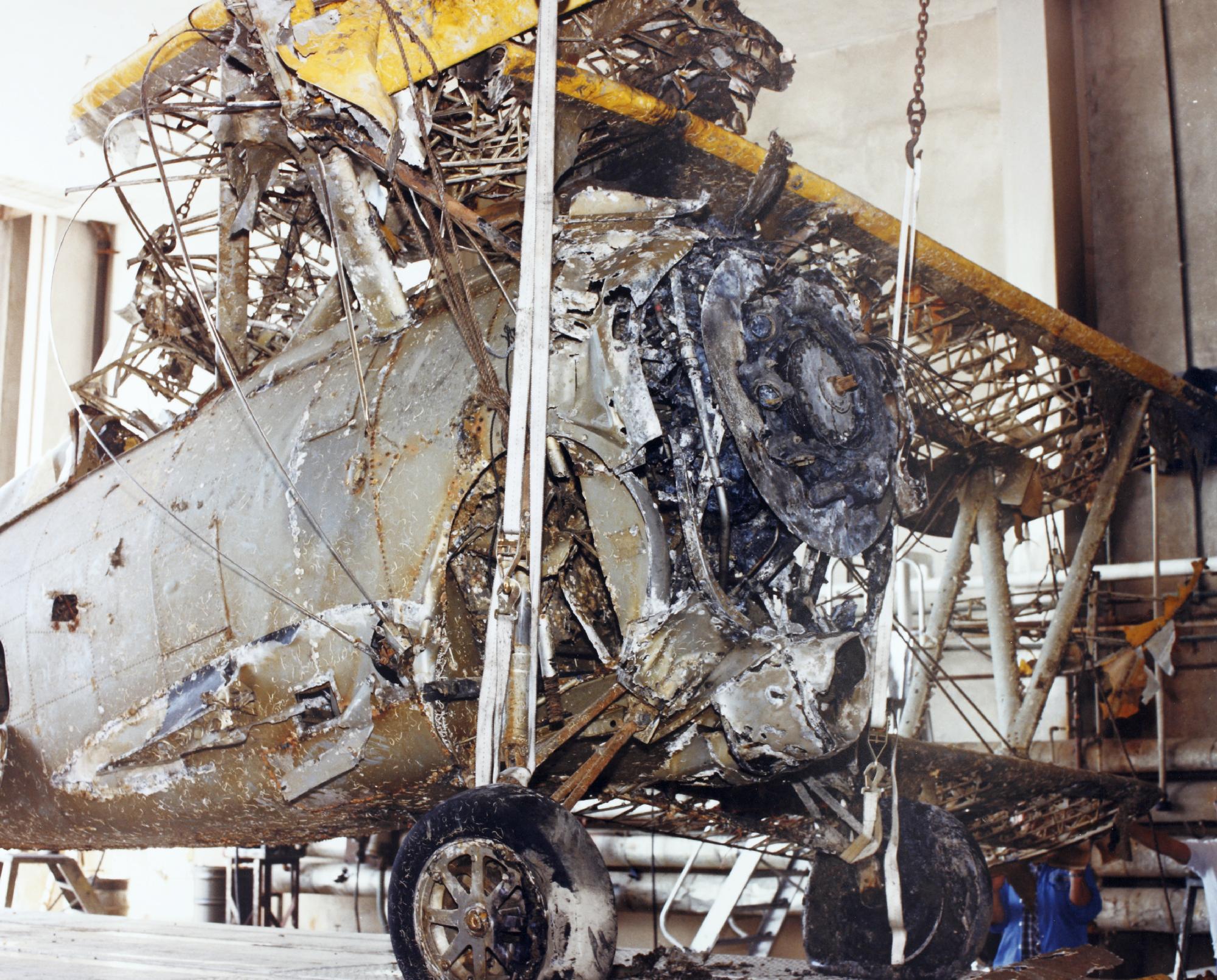
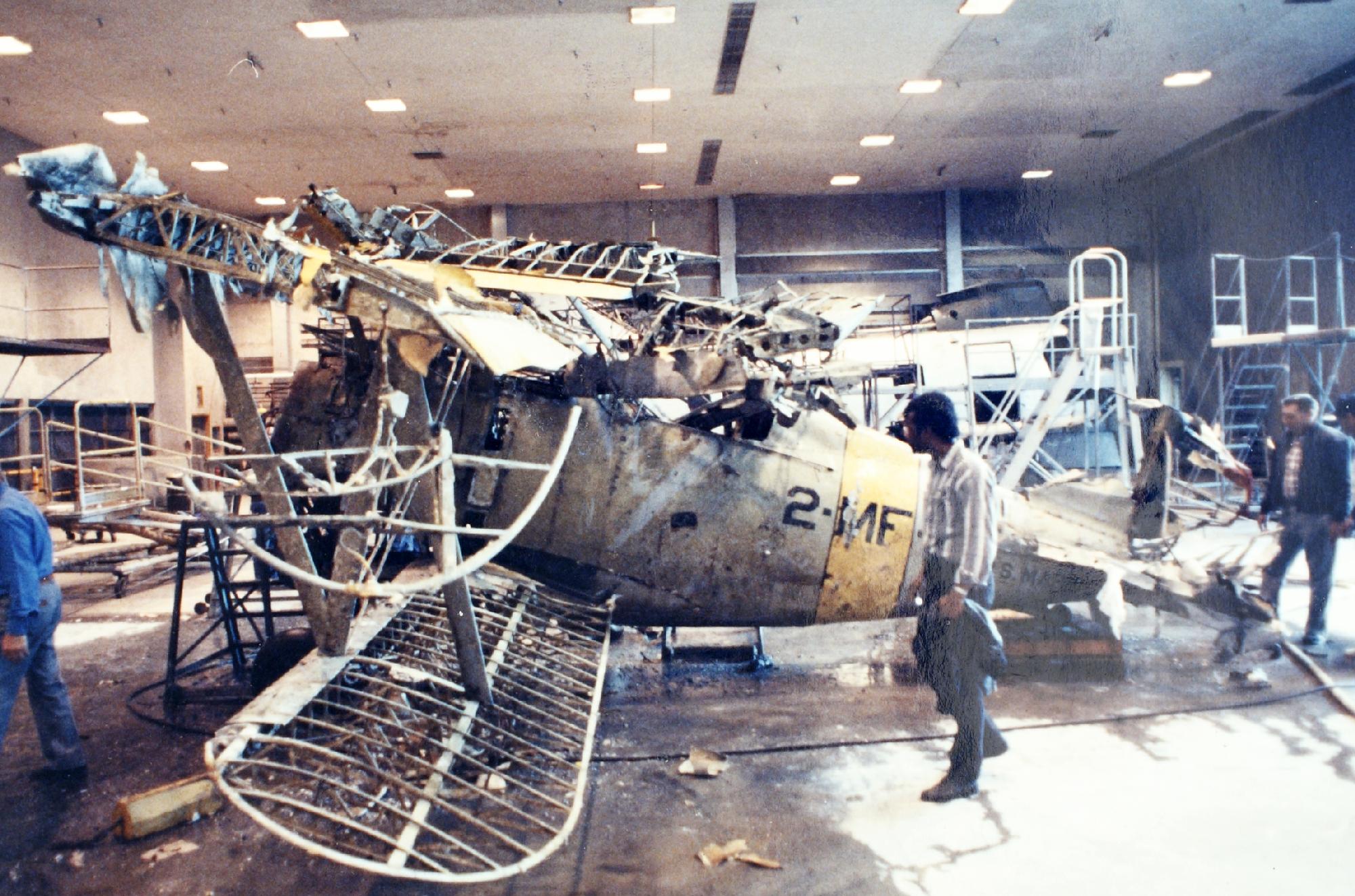
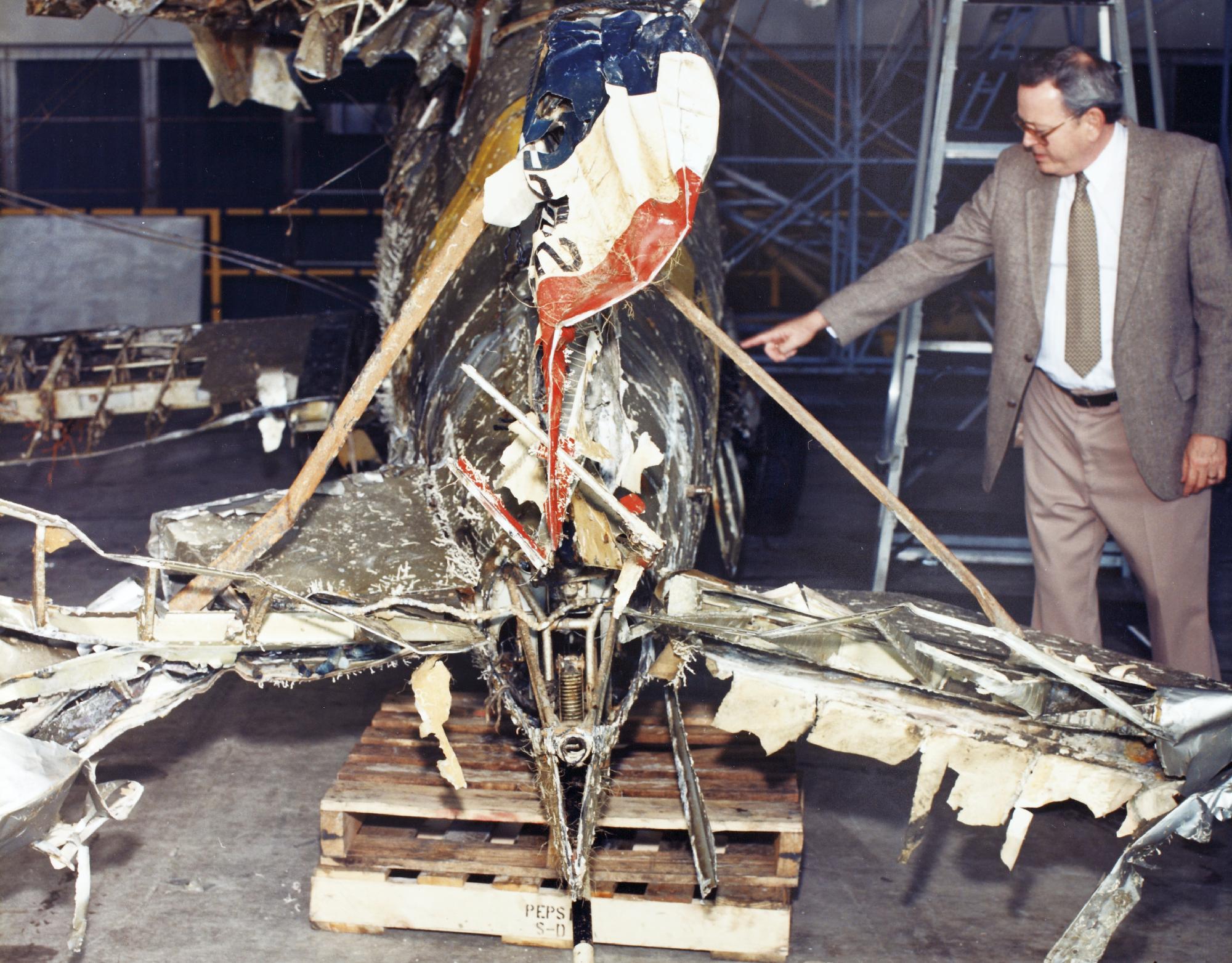
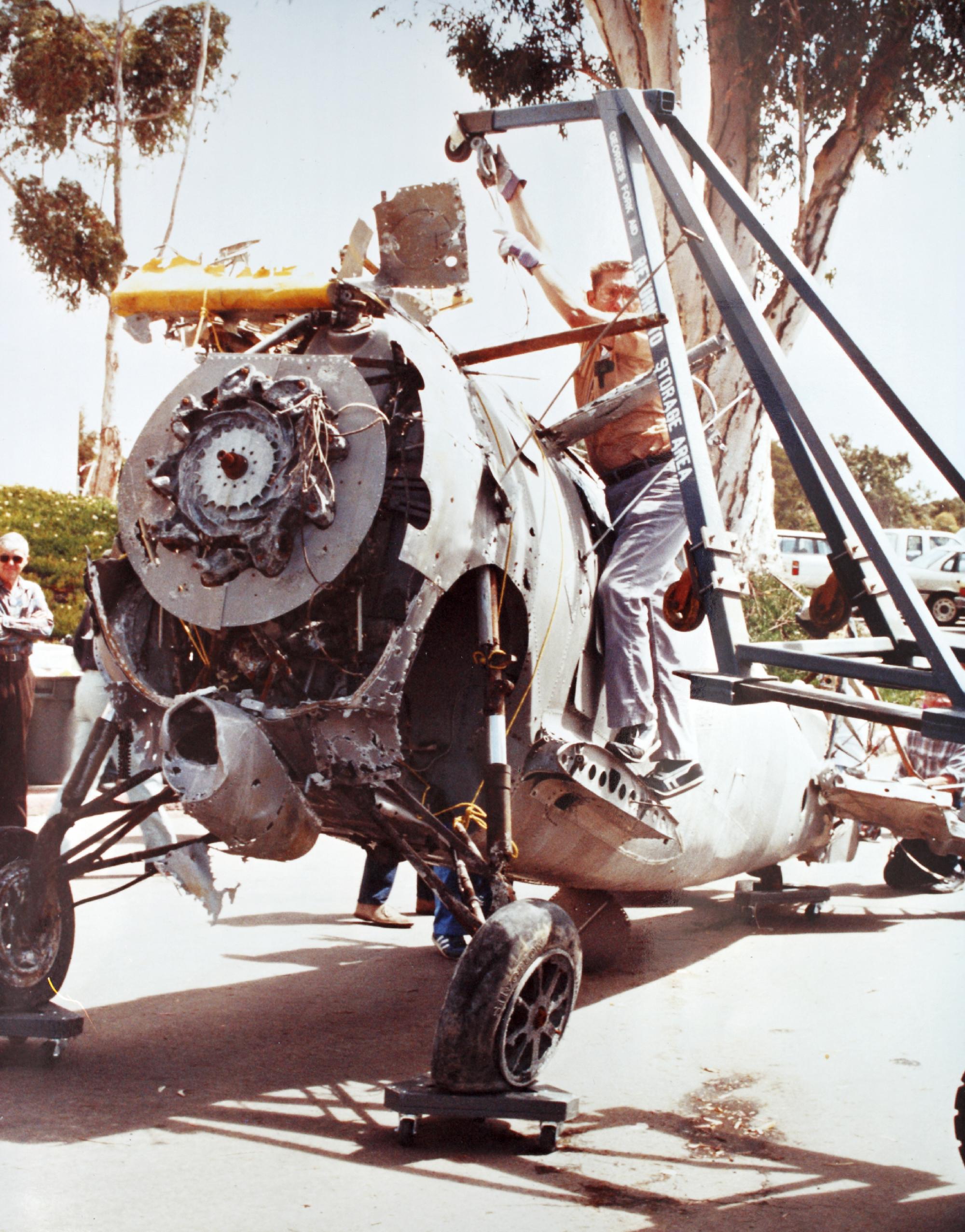
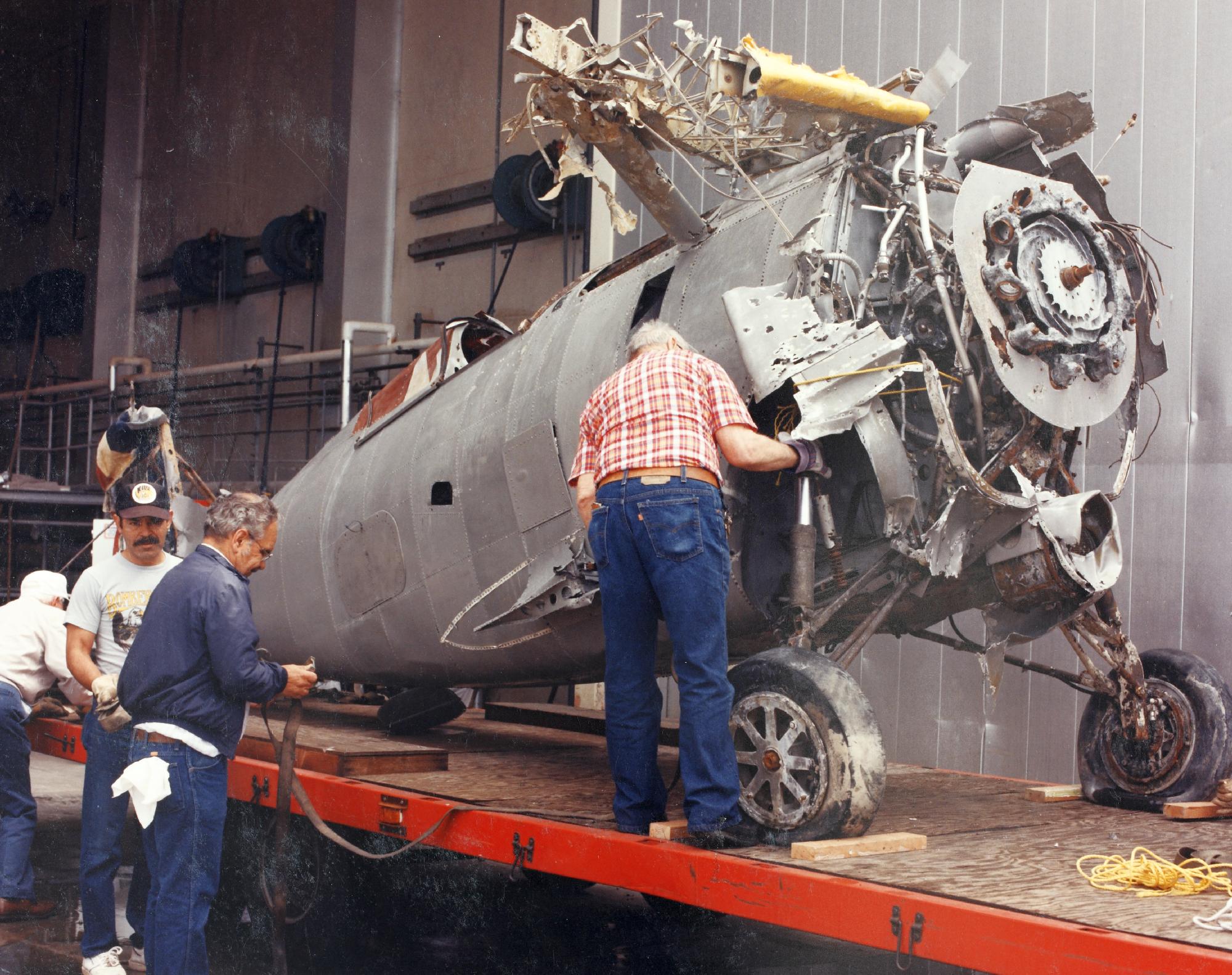
On April 2, 1990, the Powhatan-class fleet ocean tugboat USNS Narragansett (T-ATF-167) set sail from San Diego to the location of General Galer’s Grumman F3F. However, when the Narragansett arrived at the coordinates and sent down a remote-operated vehicle (ROV) to find the aircraft, F3F-2 BuNo 0976 was nowhere to be found. Navy salvager Lee Wolford was confused by this, but there was a small trench and scattered debris leading away from the site. The following day, April 3, yielded similar results, and it was not until April 4 that the aircraft was found once again. Unfortunately, in the period between the initial discovery in 1988 and the recovery effort, a fishing trawler’s line had snagged on the aircraft, dragging it about 800 feet along the ocean floor. The result was the engine and starboard wings being severed from the aircraft, the canopy being lost, and extensive damage to the aircraft’s empennage. Despite having to make alterations to the initial plan, which was to recover an intact aircraft, the recovery effort went ahead. Now, the only hard point accessible for the ROV to secure a single line from the Narragansett was the F3F-2’s left main landing gear. The team above on the surface could only hope that the landing gear leg was strong enough to bear the aircraft’s weight as the technicians operating the Narragansett’s ROV worked for four hours to hook the aircraft up, like threading a string through the eye of a needle nearly 2,000 feet away.
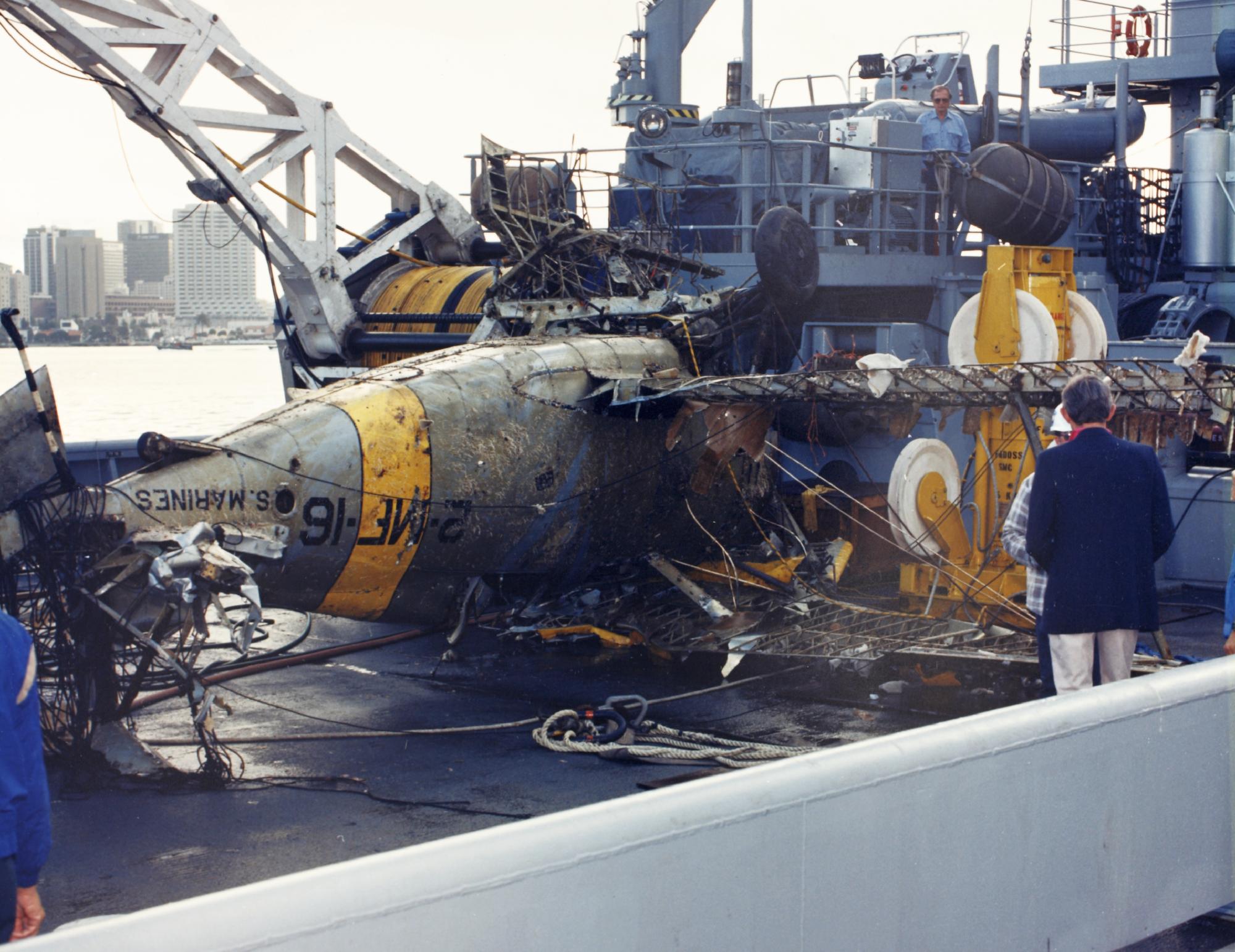
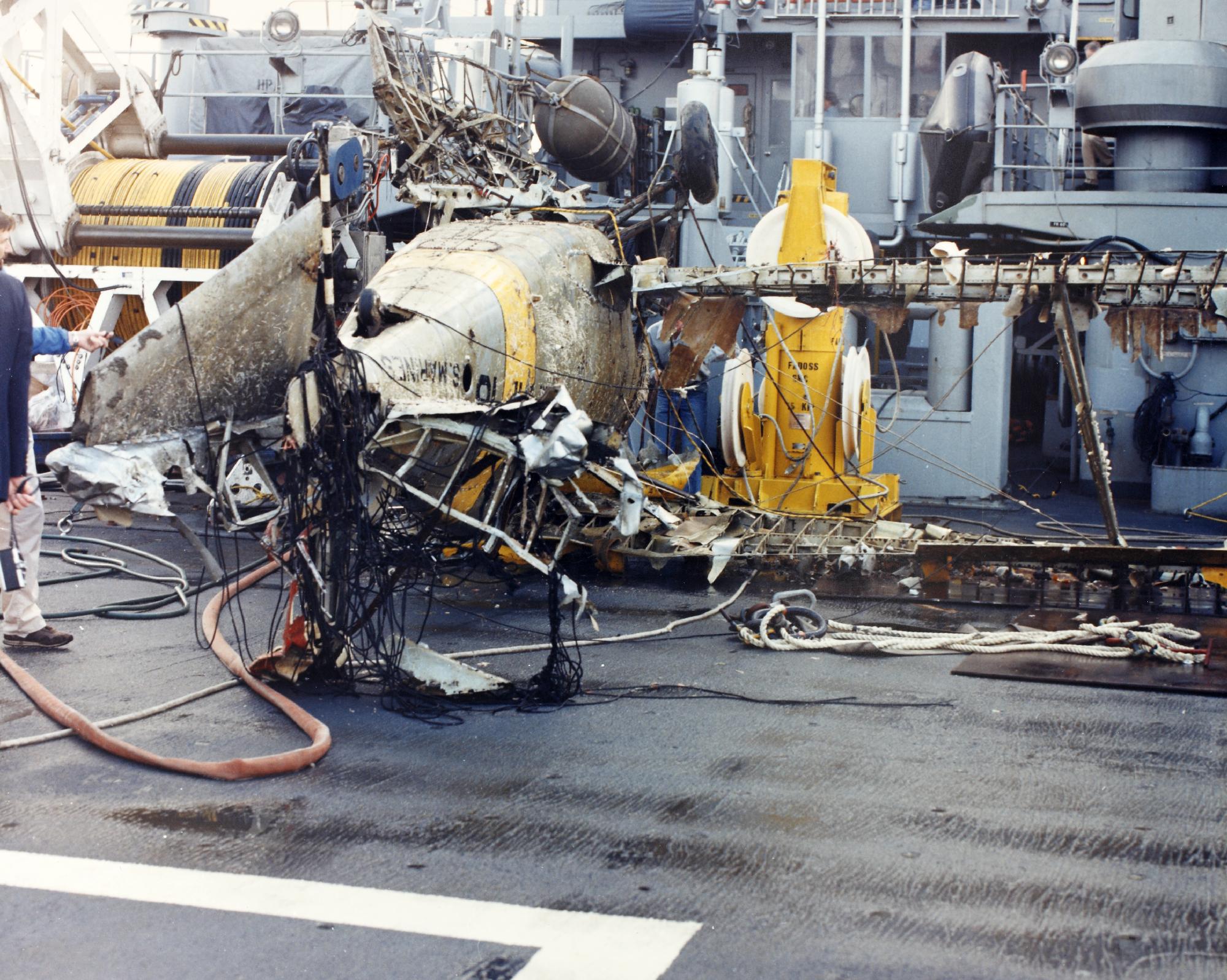
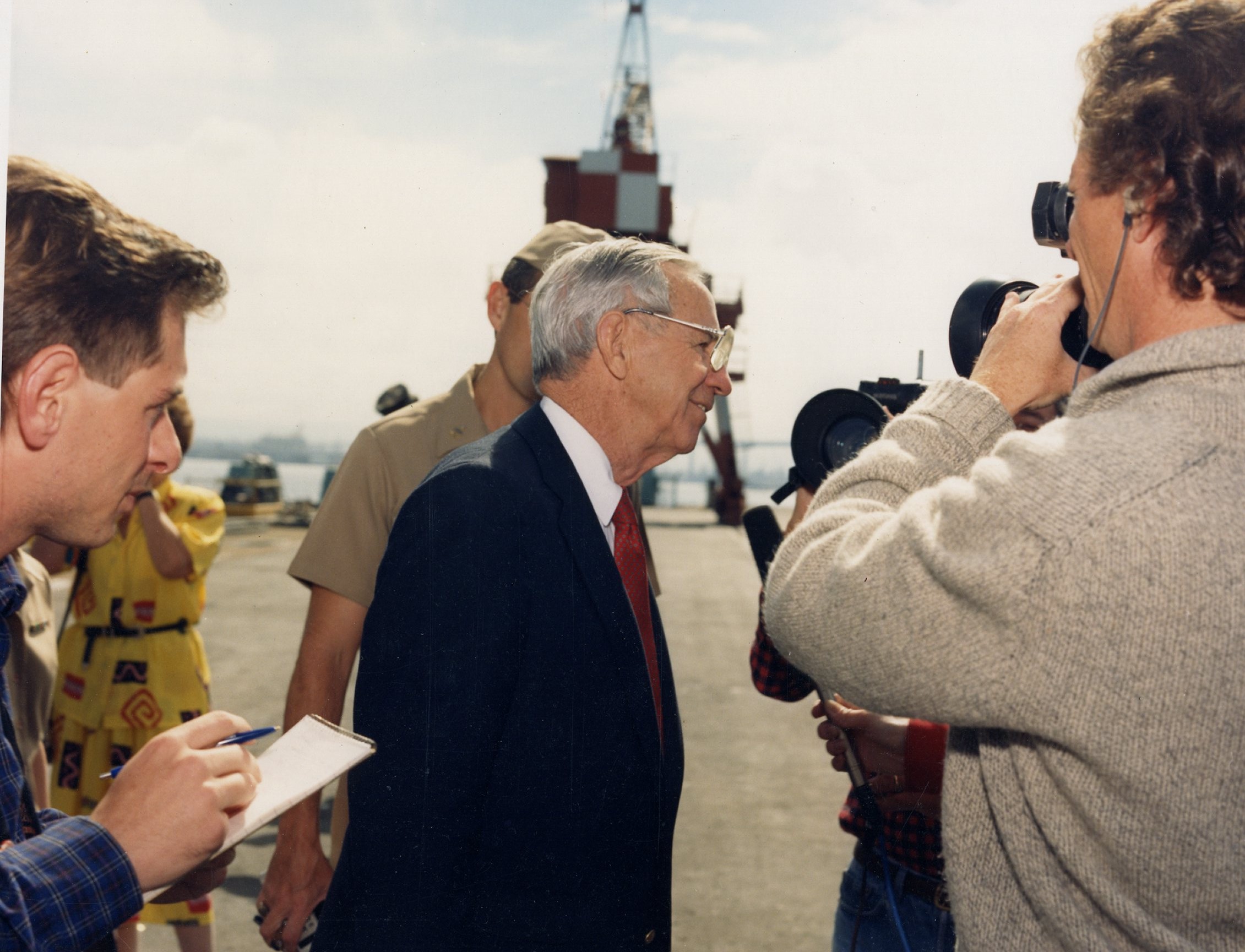
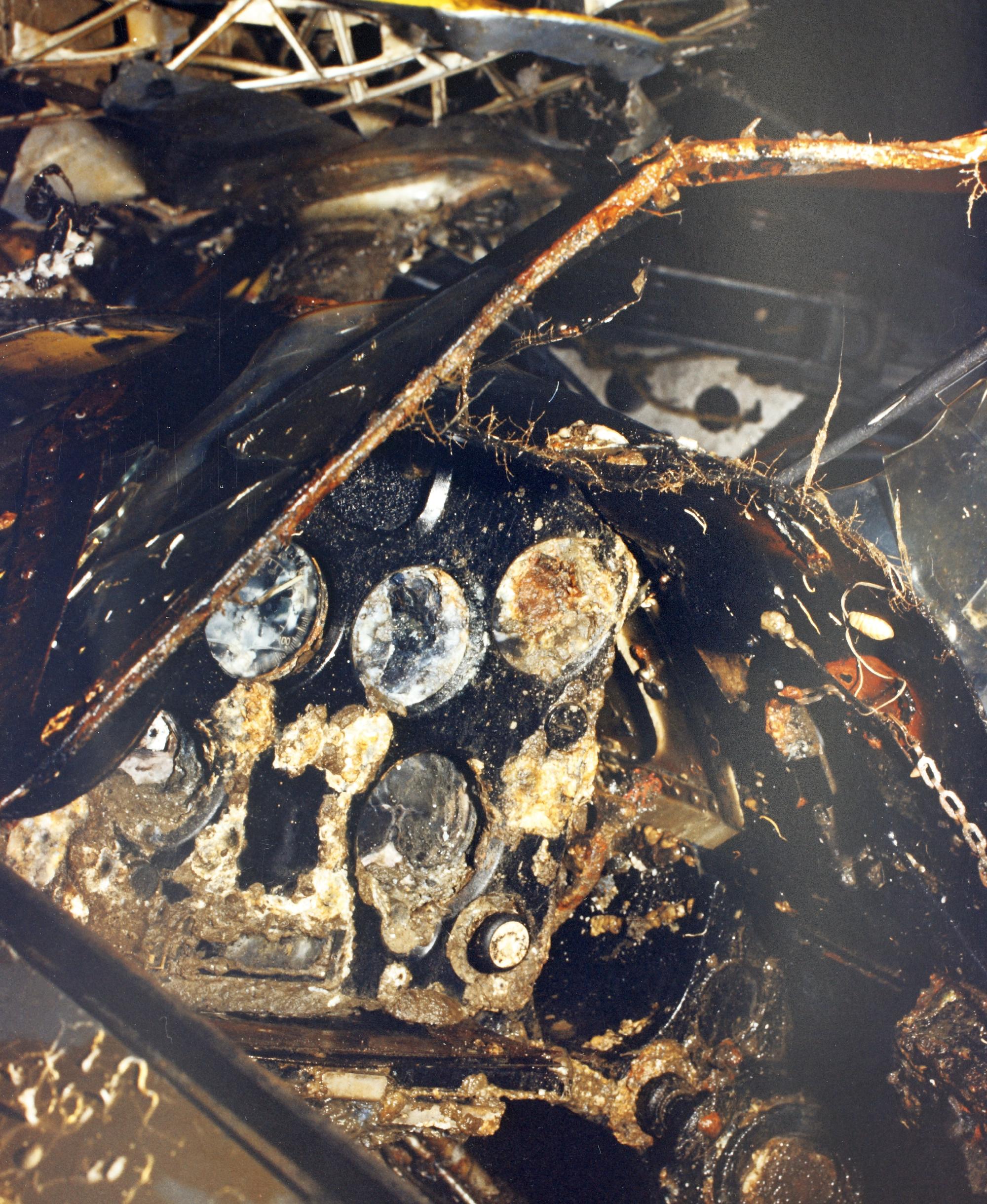
On April 5, 1990, Grumman F3F-2 BuNo 0976 was rigged up for recovery. For over an hour, the crew aboard USNS Narragansett anxiously waited to see what the line would pull up as the sun set in the evening on the surface. Finally, at 9:00pm local time, the aircraft was raised from the Pacific Ocean as the tug’s bright spotlights shone brightly on the battered aircraft, which was gently placed aboard the deck of the Narragansett. On setting a course back to San Diego, the Narragansett brought Grumman F3F-2 BuNo 0976 back to NAS North Island for the first time in 50 years. Among the crowd of reporters, Navy personnel, and museum officials in attendance was none other than retired Brigadier General Robert E. Galer, who commented that the experience was “like seeing an old friend”. When the base commander asked General Galer if he had departed from North Island that day in 1940, Galer replied in the affirmative, with the base commander joking: “After all these years I guess we can finally close out your flight plan.” While the aircraft was in worse shape than when it was initially rediscovered, several parts were still in remarkable condition, as the rubber tires on the main landing gear were still intact, as was a tool kit and a life raft kept in a storage compartment on the aircraft. The recovery of the aircraft also helped purge a blight on General Galer’s record, as when he was forced to ditch the aircraft on August 29, 1940, he was blamed for switching to an empty fuel tank. As it turned out, though, restoration volunteers from the San Diego Aerospace Museum discovered that there was still fuel in the reserve tank that Galer had switched to 50 years prior, but a faulty valve in the fuel selector system had prevented the engine on BuNo 0976 from receiving further fuel during the approach to land on the USS Saratoga half a century earlier.
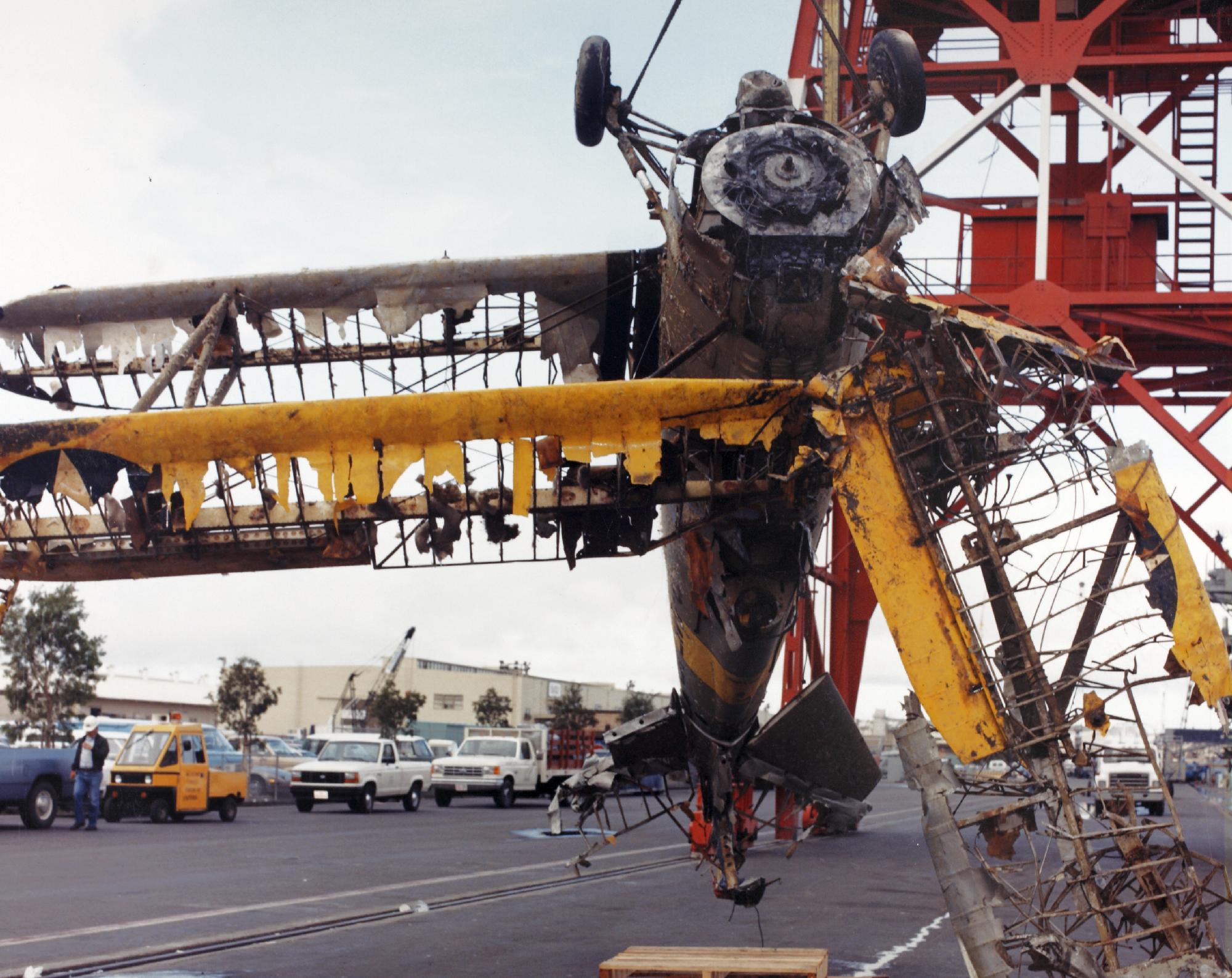
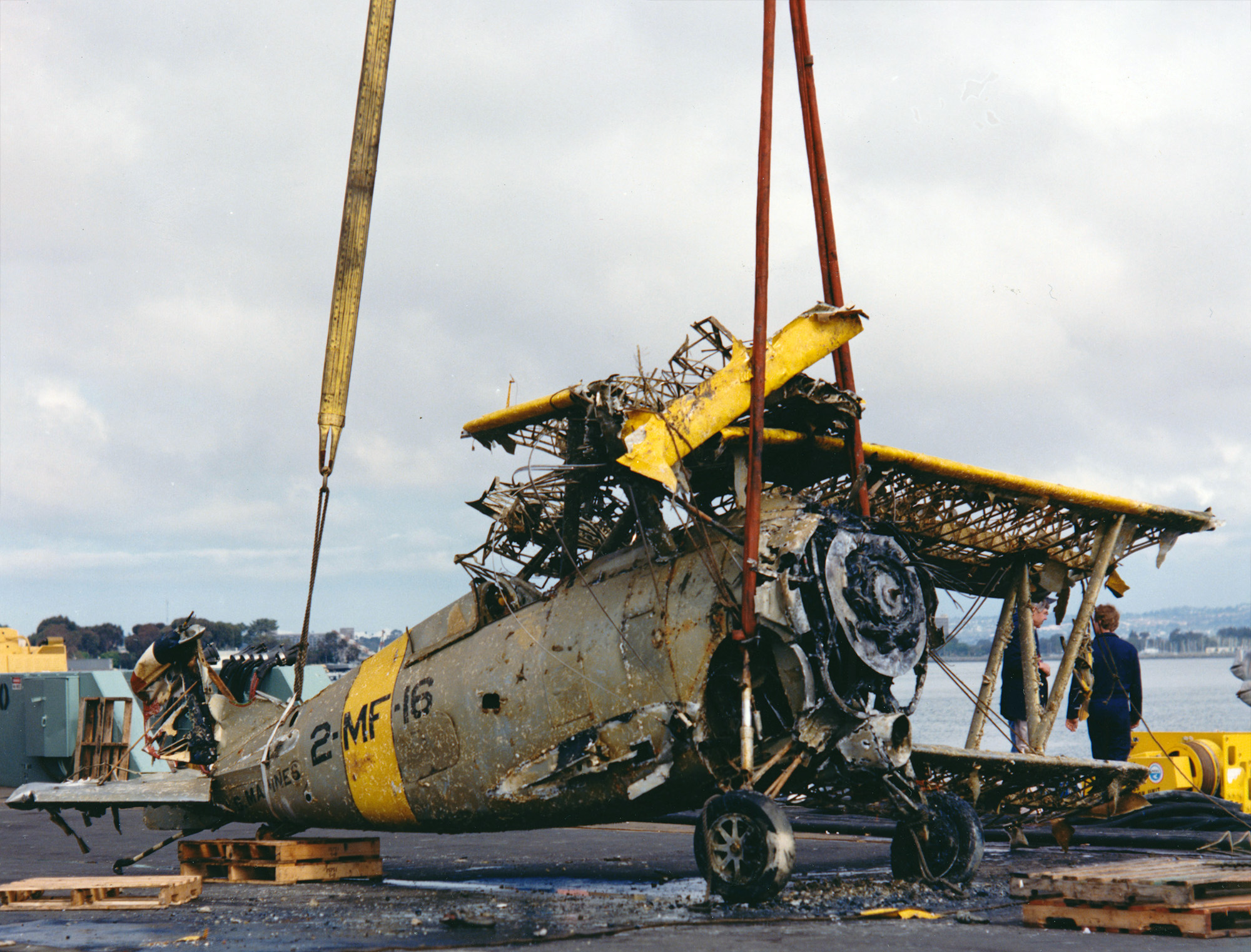
After its recovery, F3F-2 BuNo 0976 was kept at the Naval Aviation Depot at NAS North Island for cleaning and to stabilize the aircraft’s condition after half a century of being soaked in saltwater. When it was deemed ready for transport, the aircraft was trucked to the San Diego Aerospace Museum in San Diego’s Balboa Park, where restoration volunteers consisting of retired pilots and aerospace engineers worked on the Grumman biplane in the museum’s basement workshop. During this time, Grumman F3F-2 BuNo 0976 was the subject of intensive restoration work, as 60% of the sheet metal skin had to be replaced due to saltwater corrosion.
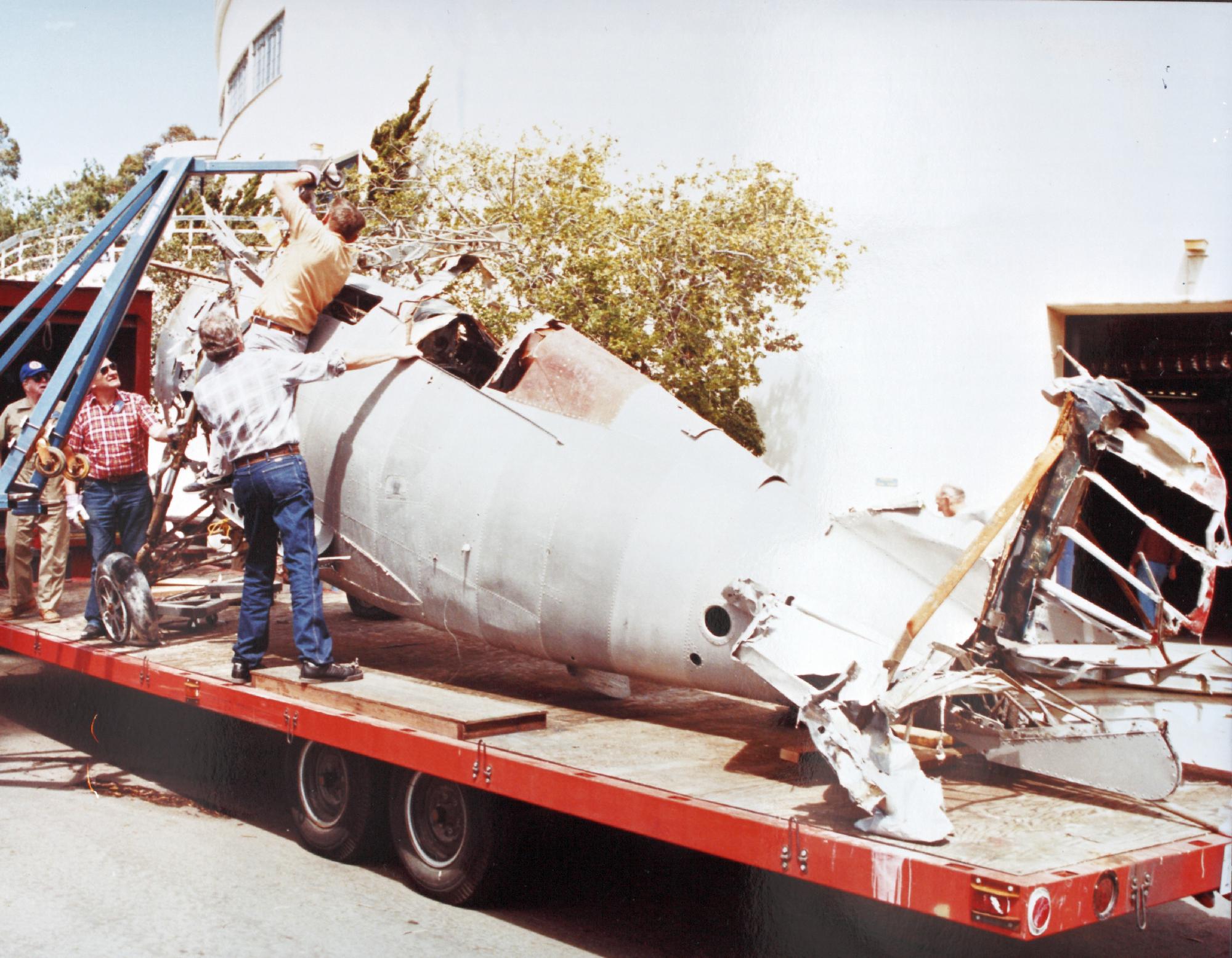
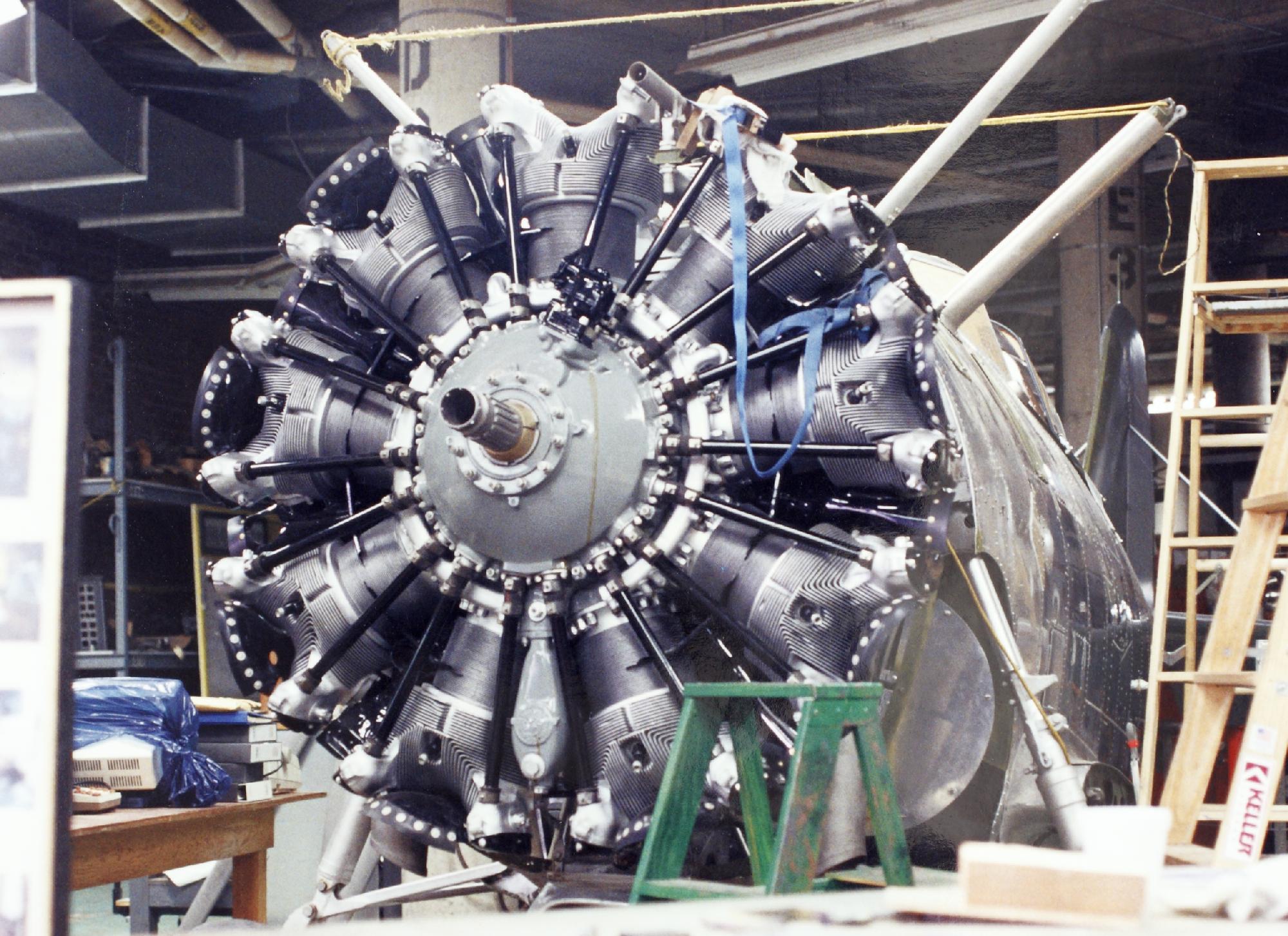
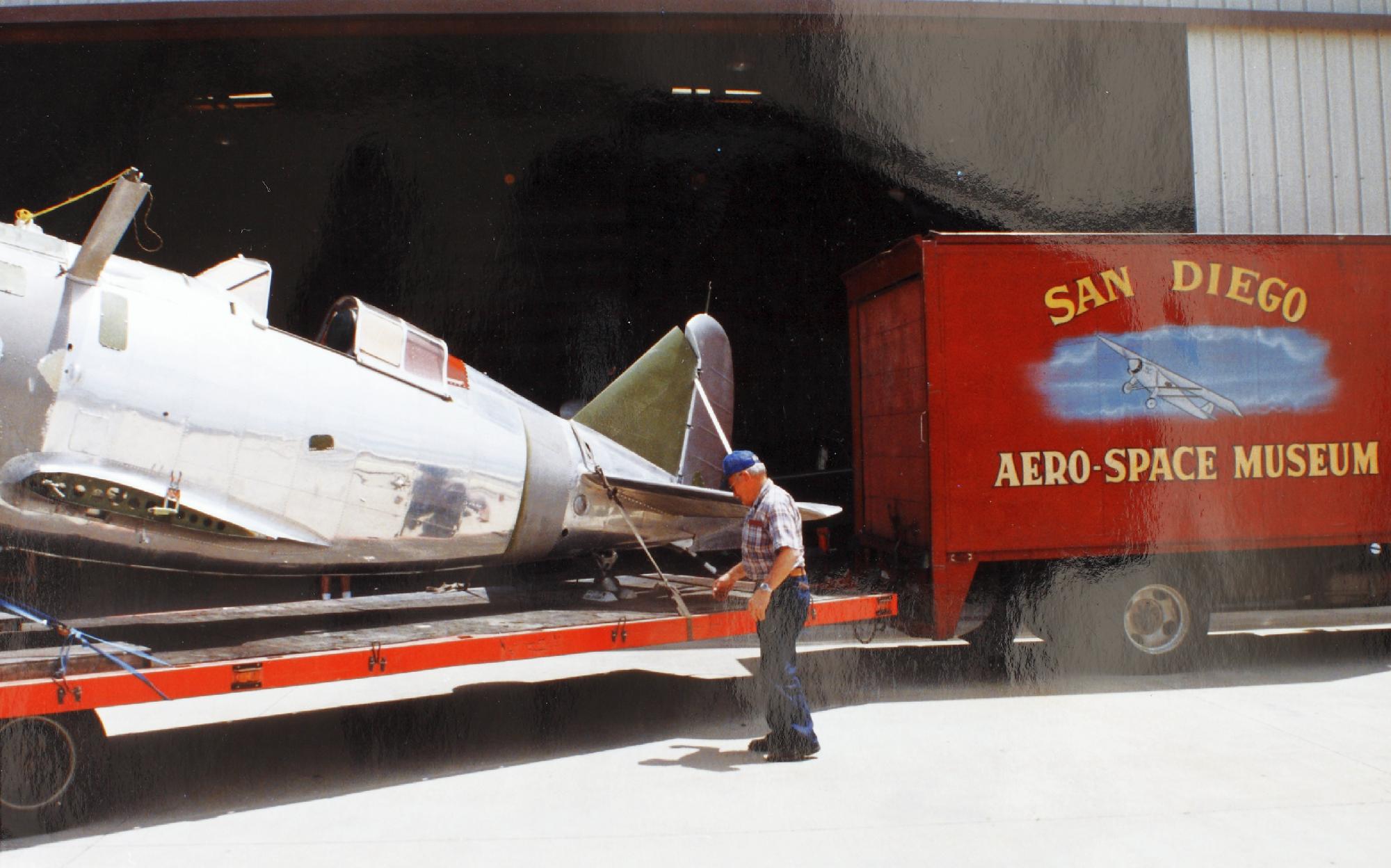
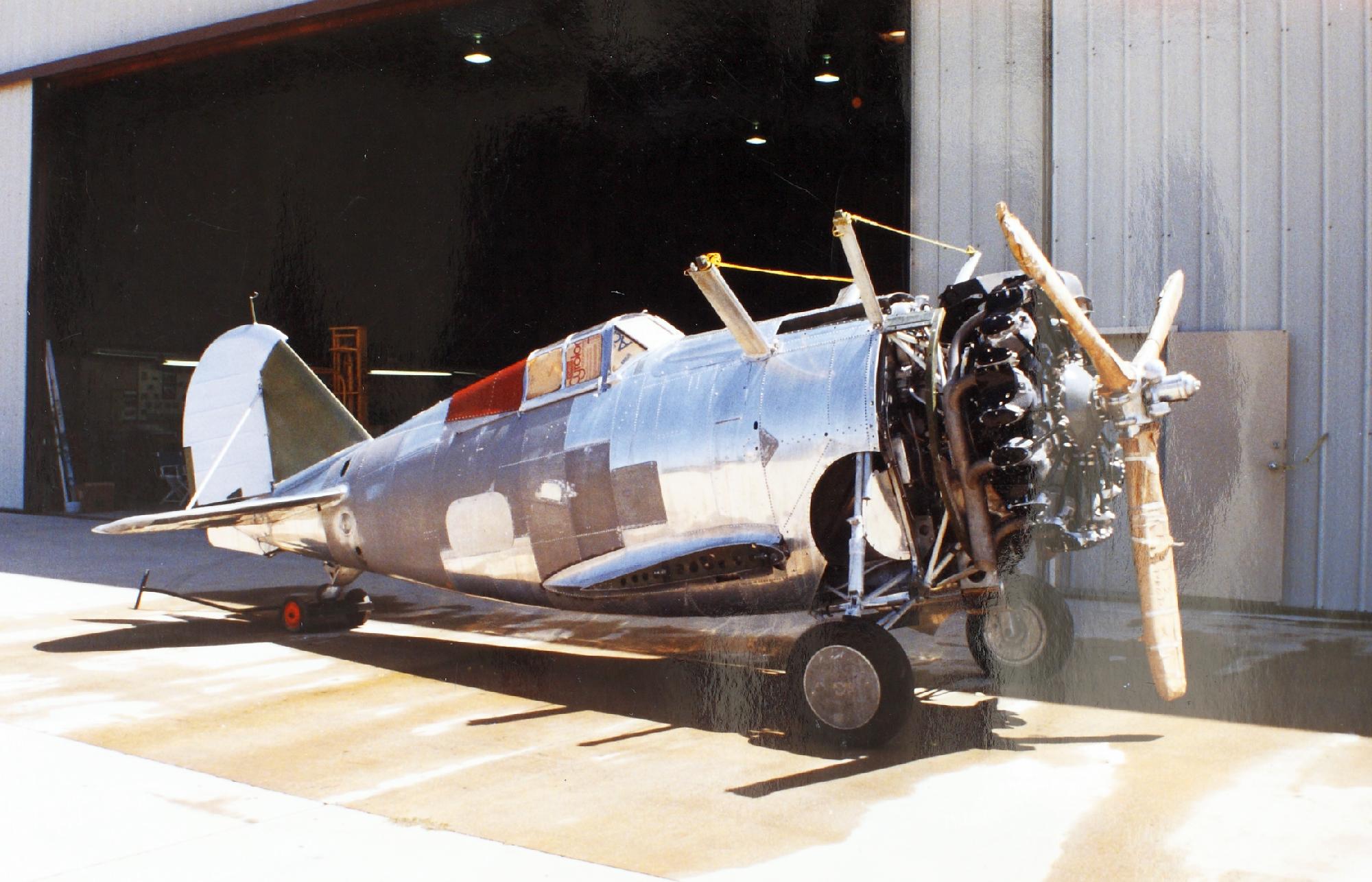
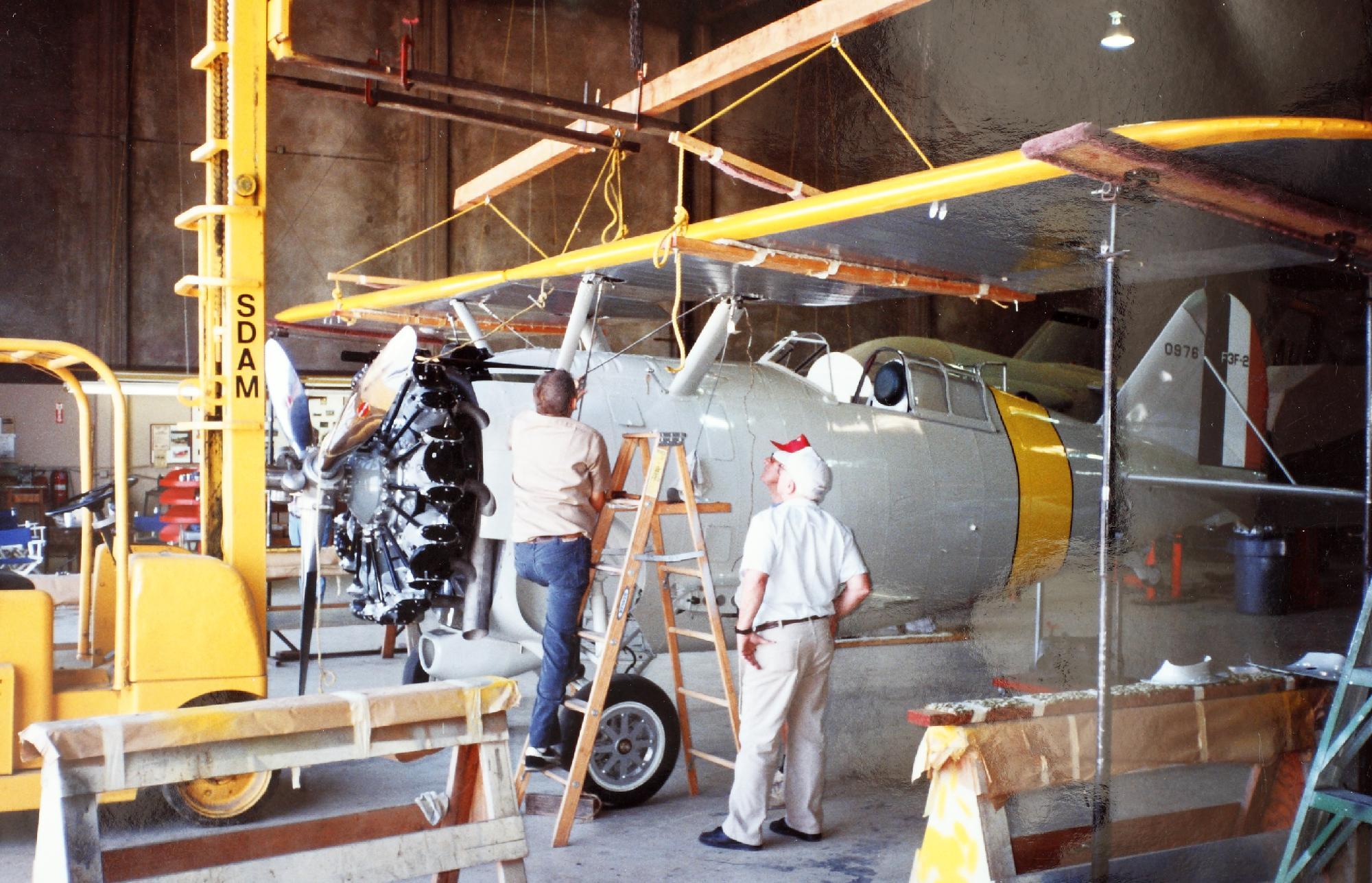
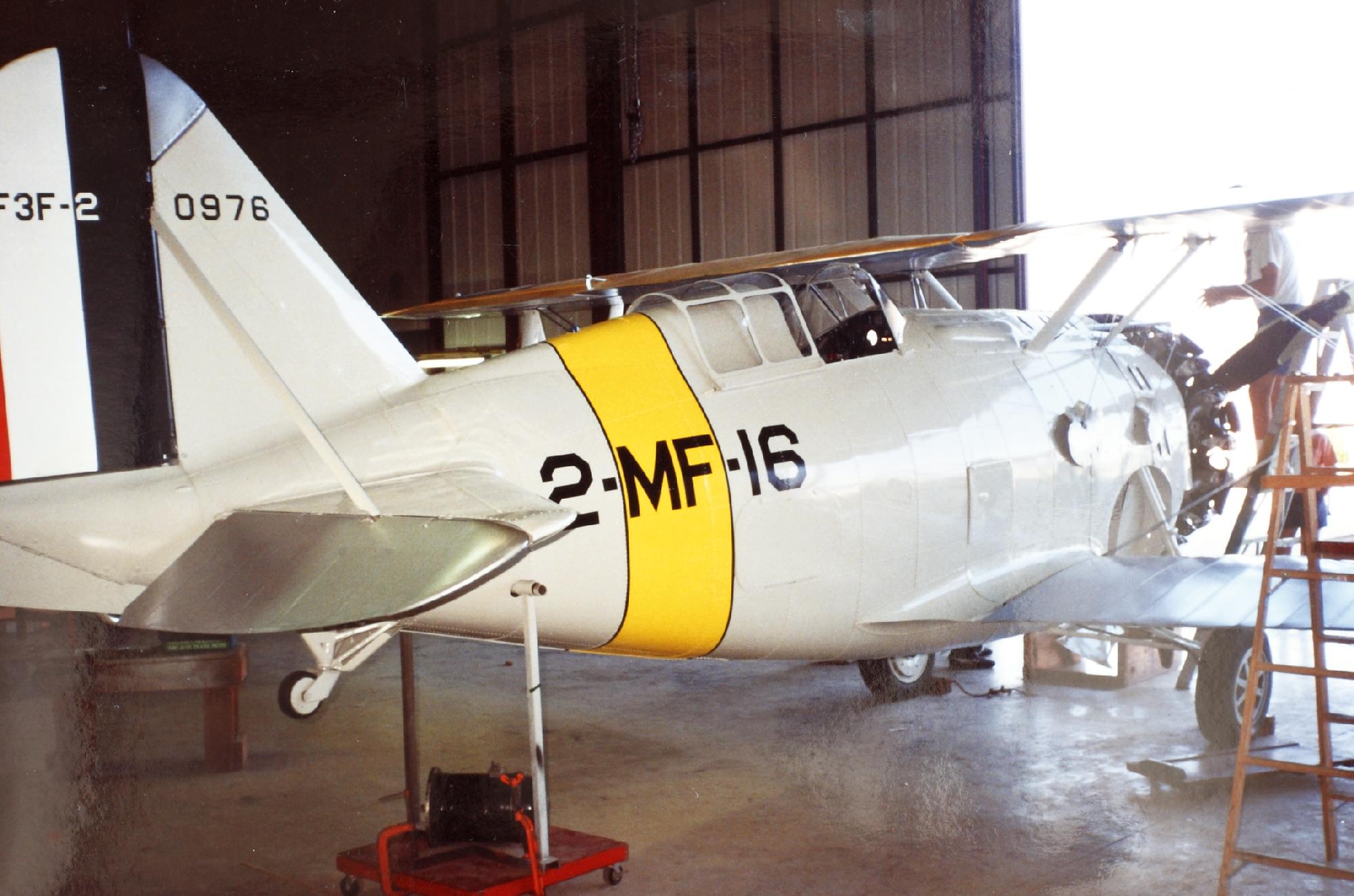
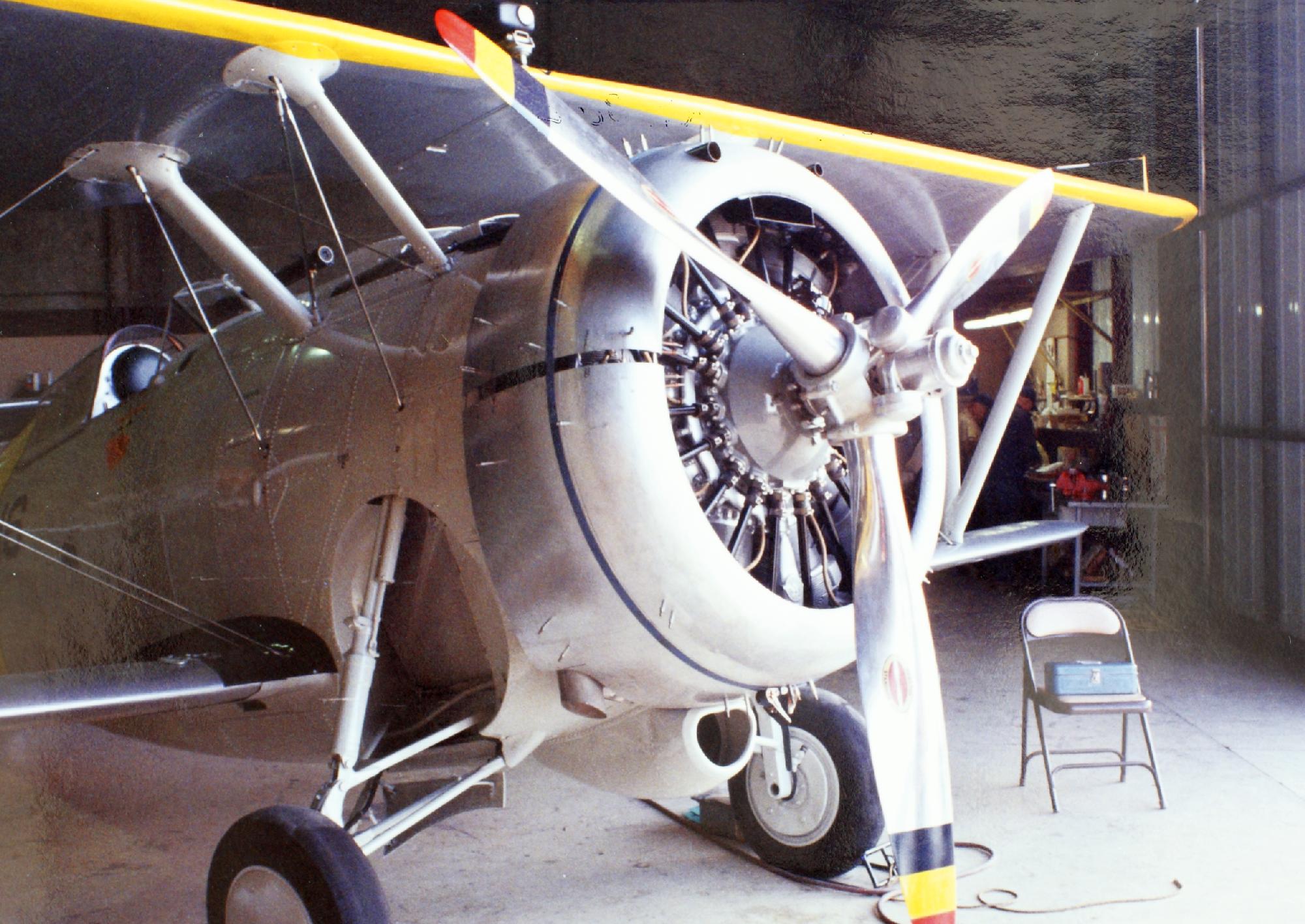
When the aircraft was given new sheet metal and a replacement for its original Wright R-1820 Cyclone was fitted to the airframe, the partially restored Grumman F3F was trucked from the basement workshop in Balboa Park to the San Diego Air and Space Museum’s Gillespie Field Annex at Gillespie Field in El Cajon, about 12 miles northeast of Balboa Park. Further work on the aircraft included the fabrication of the empennage and starboard wing, applying new doped fabric on the structure of the wings, the installation of a new canopy, and work on refurbishing the cockpit, using as many original components as possible. After four years of dedicated restoration, Grumman F3F-2 BuNo 0976 had been returned to its former glory, wearing the same paint scheme that it wore when it was lost in 1940. General Galer also kept up with the latest progress and made the occasional visit to see how his old F3F was coming along, and by the start of 1994, the aircraft was at last completed following three and a half years of work.
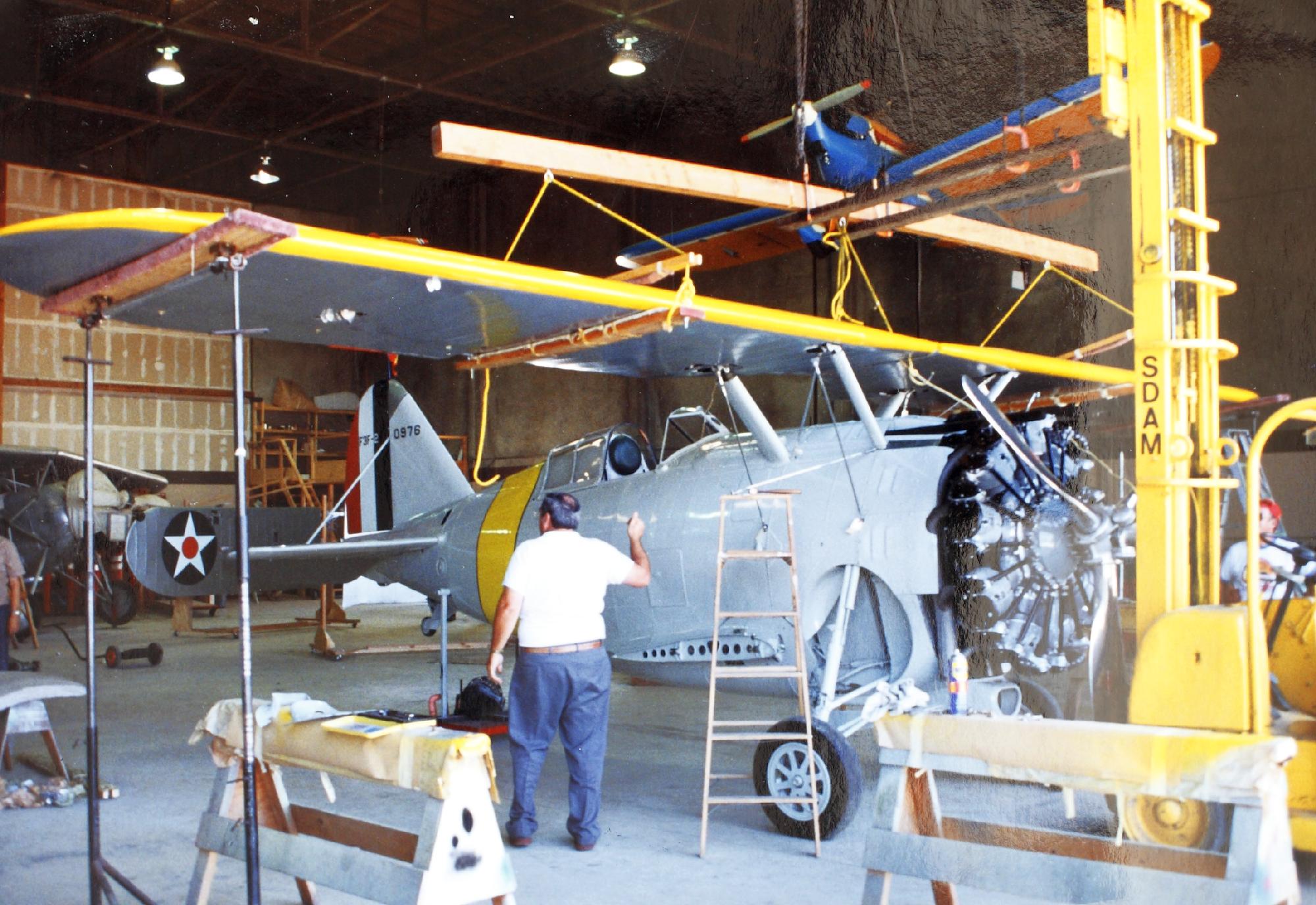
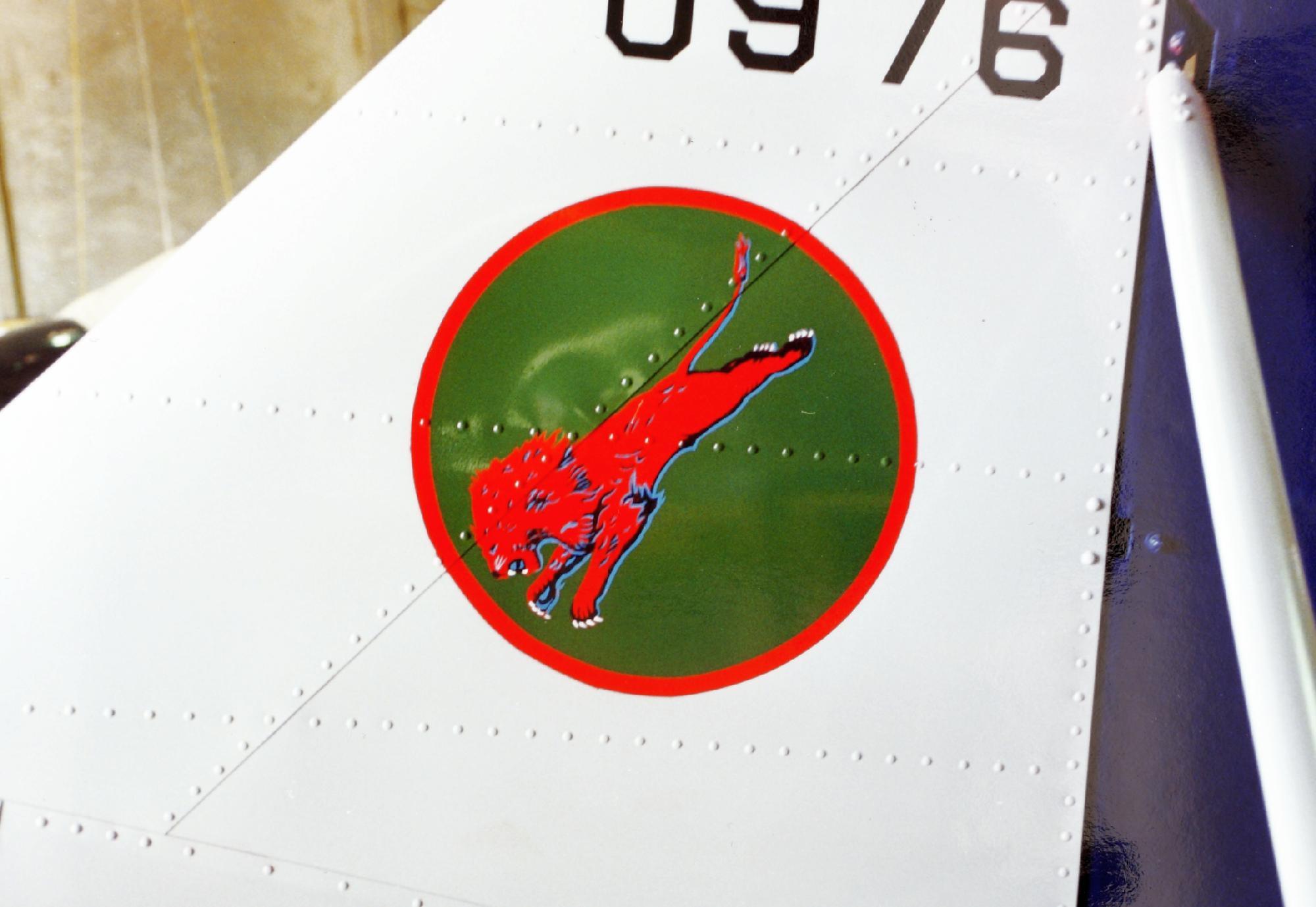
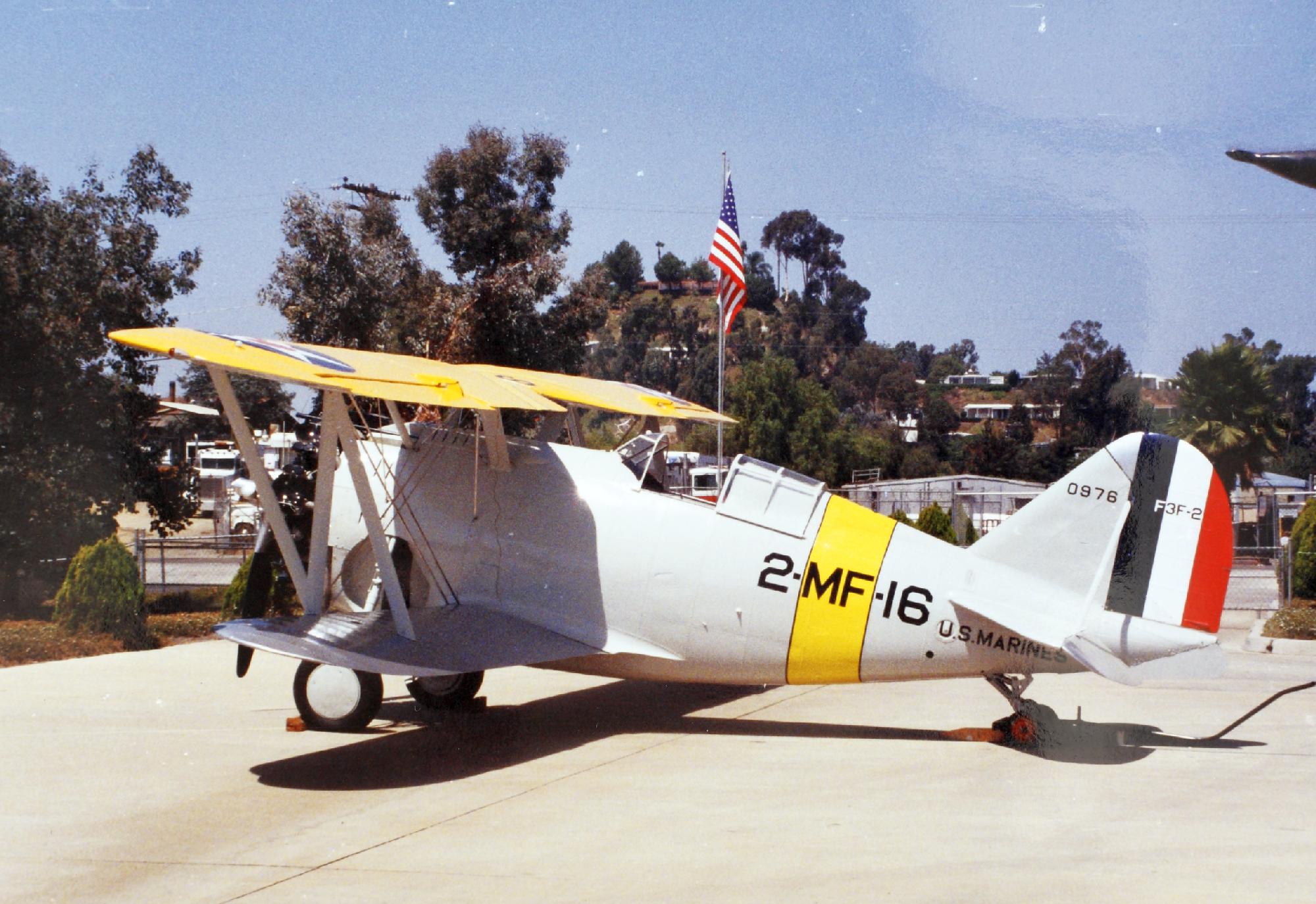
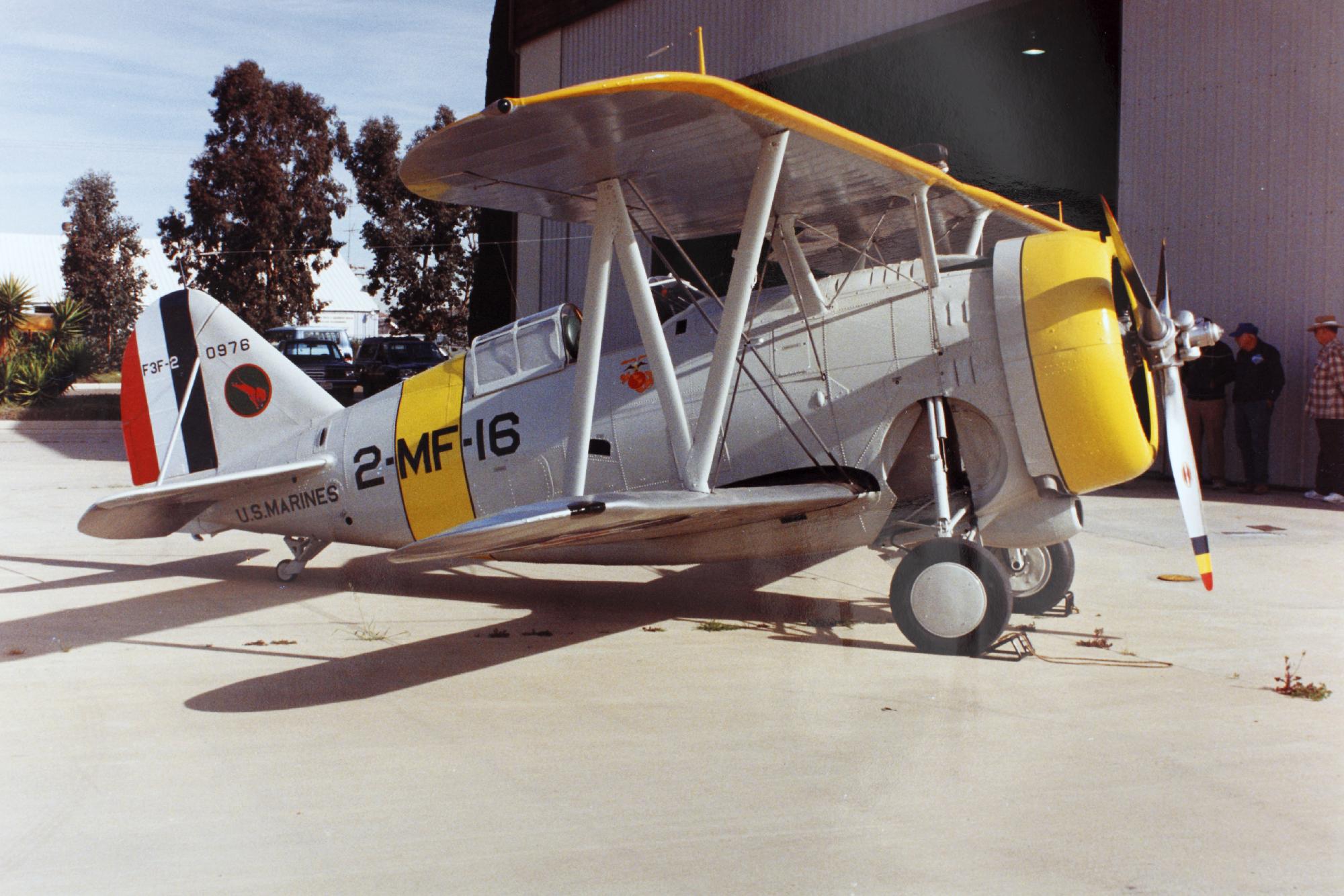
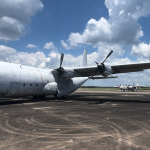
On February 13, 1994, Robert Galer’s Grumman F3F would make one final flight. F3F-2 BuNo 0976 was carefully disassembled and loaded into the cargo bay of the Blue Angels’ KC-130F Hercules “Fat Albert” transport, and flown to Naval Air Station Pensacola, which serves as both the home of the Navy Flight Demonstration Squadron and the location of the National Naval Aviation Museum. The following day, on February 14, museum director Bob Rasmussen formally dedicated the display of Grumman F3F-2 BuNo 0976, where it remains on display at the museum to this day. Brigadier General Robert E. Galer would live to see the Grumman F3F biplane fighter he once flew on display in Pensacola, and on June 27, 2005, he would pass away at the age of 91 and was buried with full honors at the Texas State Cemetery in Austin. Around the same time as BuNo 0976 going on display, Herb Tischler and his Texas Aircraft Factory in Fort Worth, Texas rebuilt the remains of the Grumman G-32A (currently held in storage at the Planes of Fame Air Museum’s storage facility in Valle, Arizona), as well as the wrecks of the three F3F-2s recovered from the slopes of Mount Haleakalá (Bureau Numbers 0972, 1028, and 1033), which are now maintained in airworthy condition by Lewis Air Legends of San Antonio, Texas, Kermit Weeks/Fantasy of Flight in Polk City, Florida, and the National Museum of WWII Aviation in Colorado Springs, Colorado, respectively.
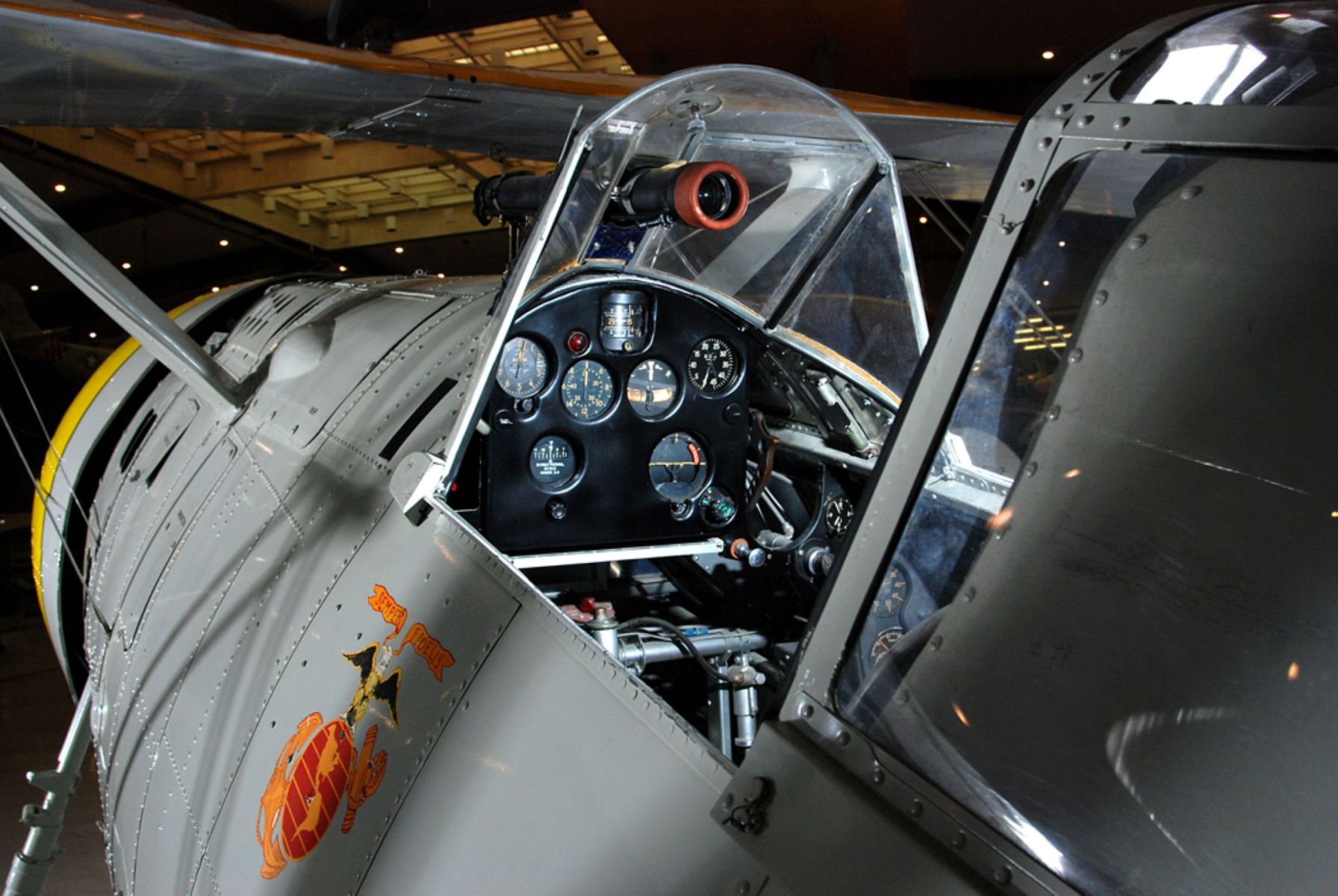
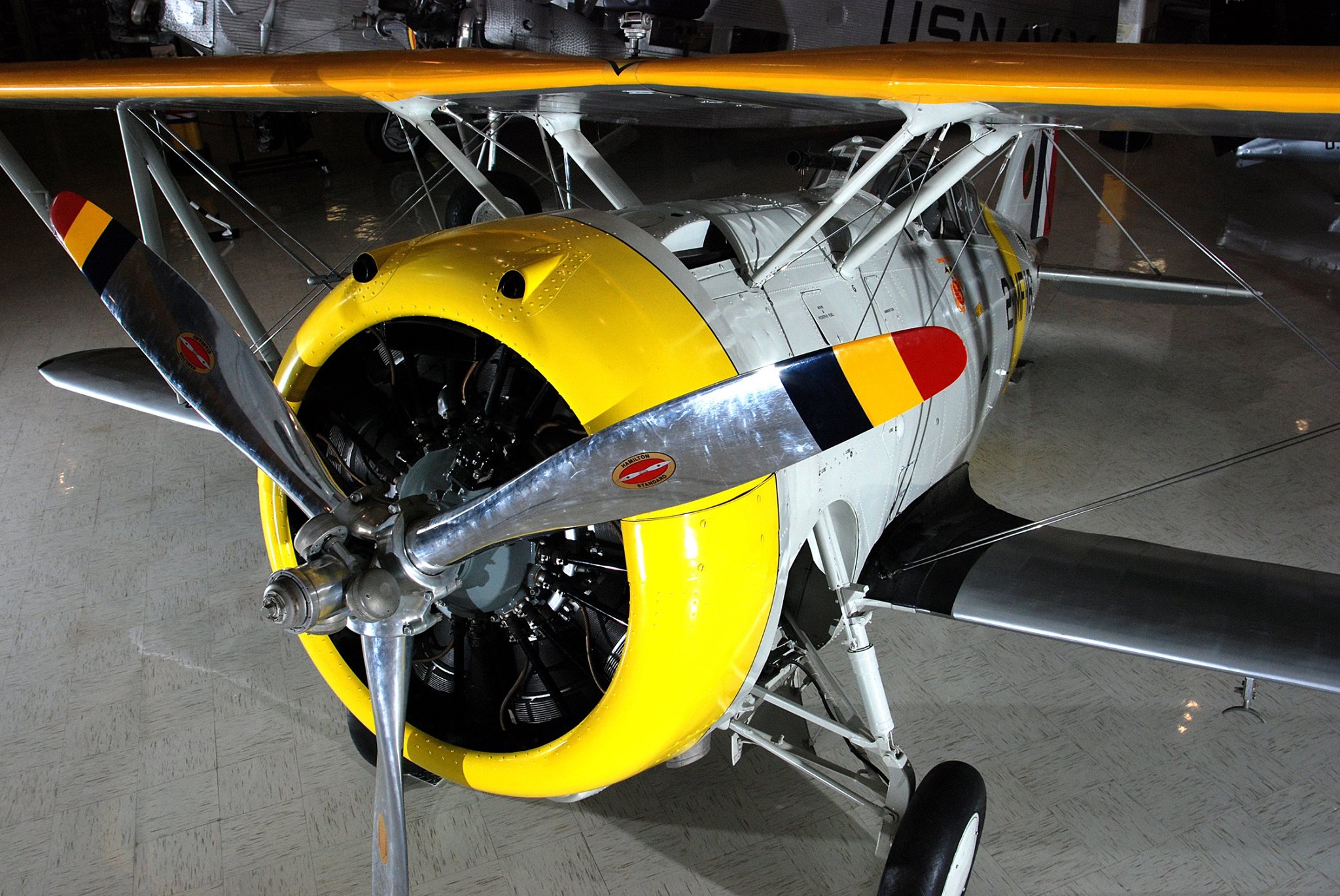
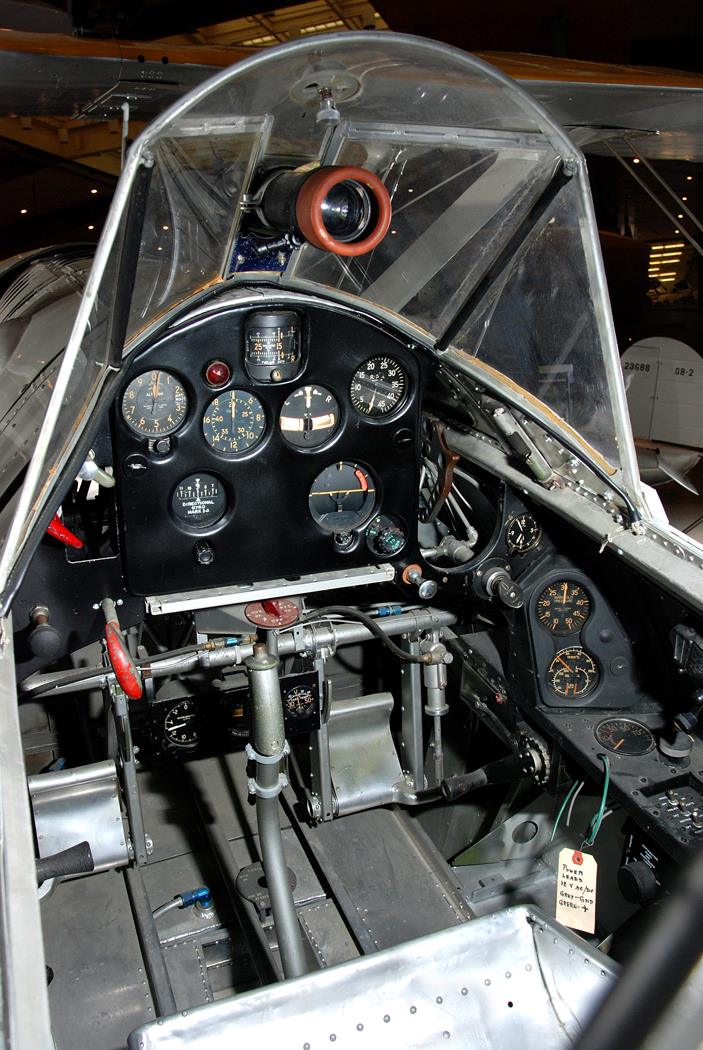
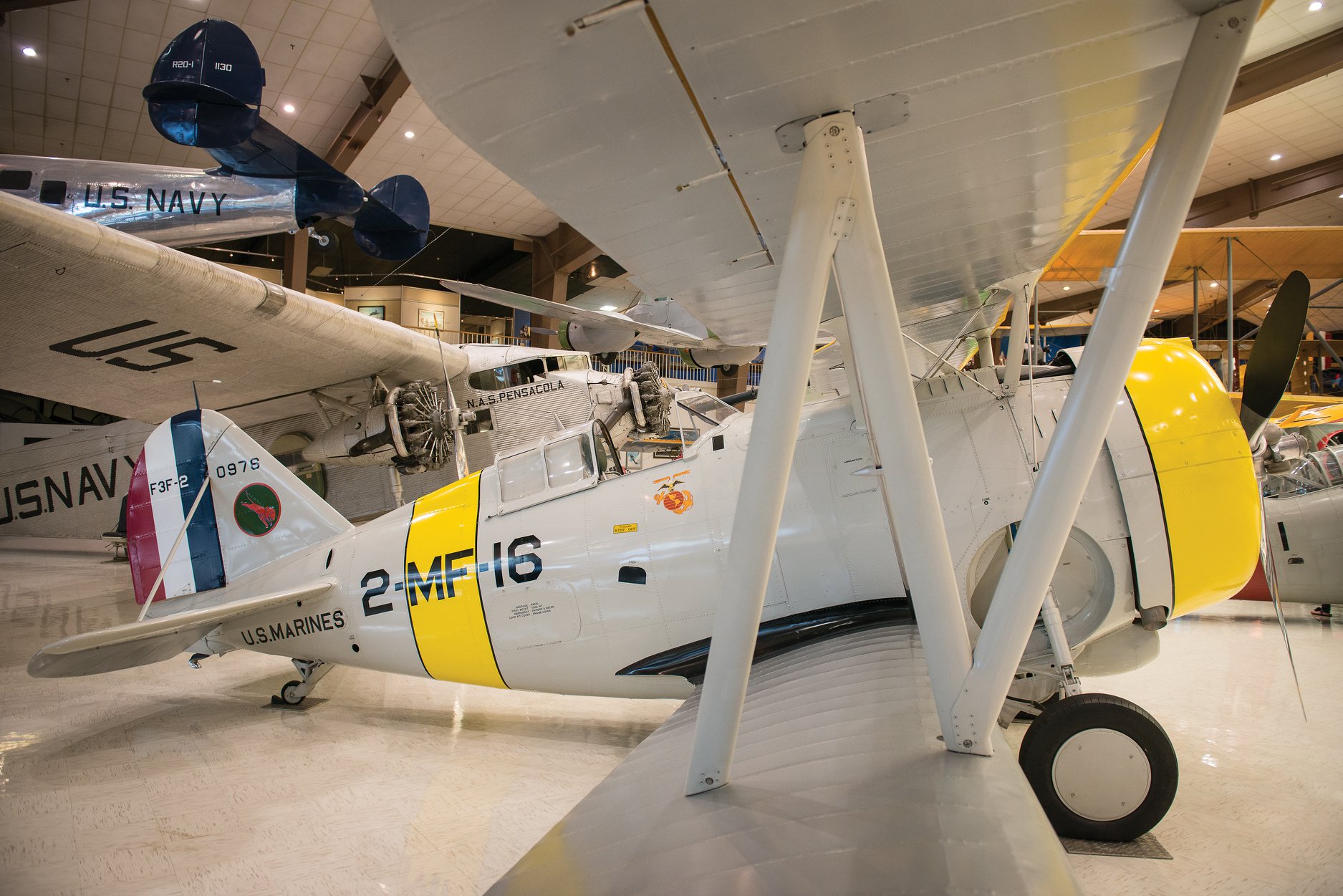
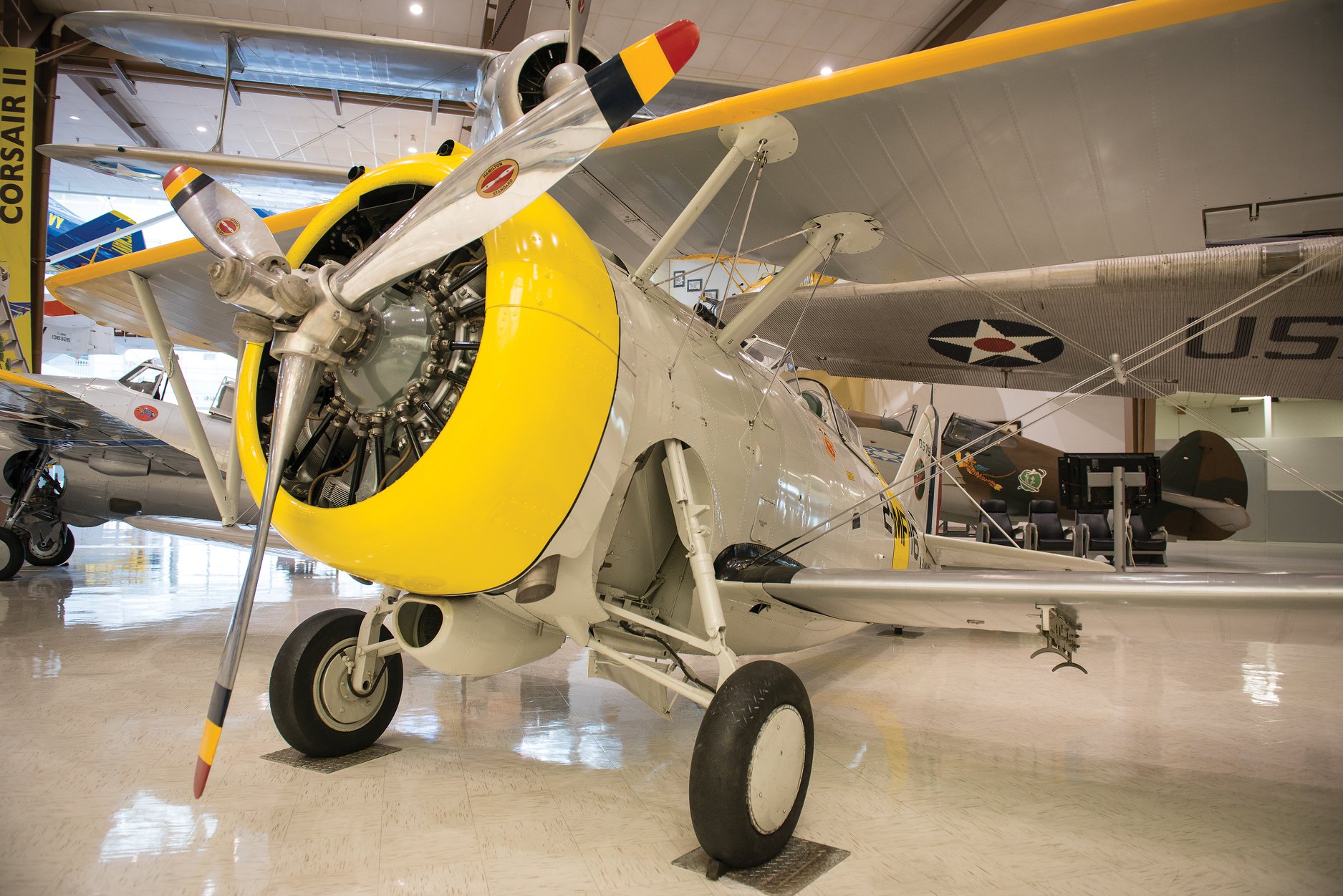
Today, Grumman F3F-2 Bureau Number 0976 remains one of the most popular exhibits at the National Naval Aviation Museum, being found in the museum’s South Wing. It stands today as a reminder of a period of transition in the annals of U.S. naval aviation, representing the ultimate expression of the carrier-based biplane fighters, and the contrast between it and the successive monoplane designs that helped win the Second World War, and the early carrier-based jets of the 1950s demonstrates the rapid advances in U.S. naval aviation within just a 20-year span. For more information, visit the National Naval Aviation Museum’s website HERE.