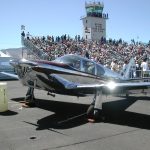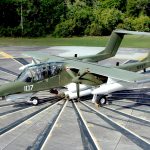
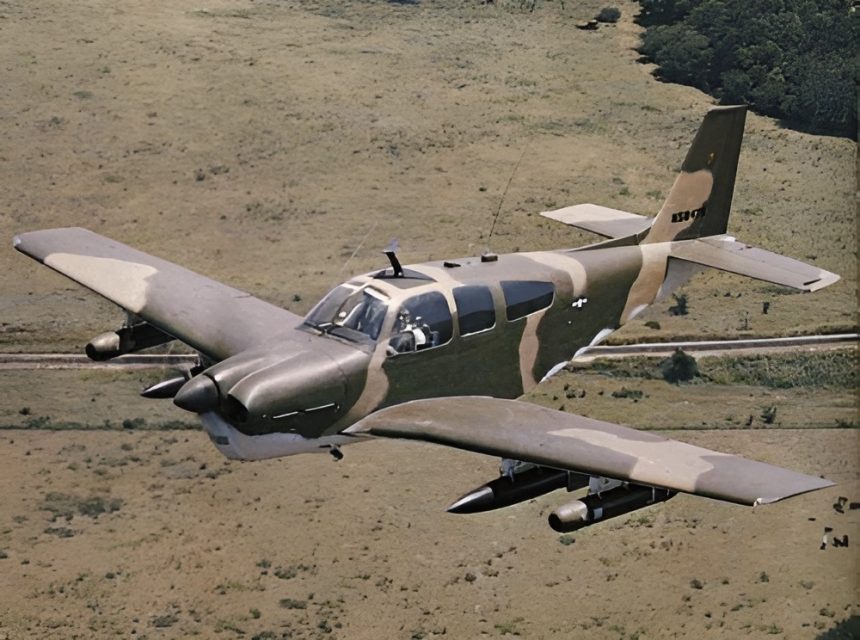

The Beechcraft Bonanza is one of the most successful airplanes in general aviation. It first flew in 1947 and was in production until late 2025. Unlike its original version, which had a distinctive V-tail, the Bonanza now has a conventional tail. It is very much liked in the aviation community and is often called the Cadillac of single-engine light planes. Its eight-decade-old history included many models and versions. One such model was the Beech YAU-22A, which was developed during the Vietnam War. During the Vietnam War, the US Air Force needed better close air support. As a result, in the late 1960s, to meet its needs, the service initiated the Pave COIN program. The program aimed to develop a lightweight, low-cost close-air-support aircraft. Four aircraft manufacturers competed for the project, including Beechcraft, Fairchild, Helio, and Piper. The US Air Force selected Beechcraft’s design, called the Beech YAU-22A, over the Fairchild AU-23A, the Helio AU-24 Stallion, and the Piper PA-48 Enforcer.
Design of Beech YAU-22A
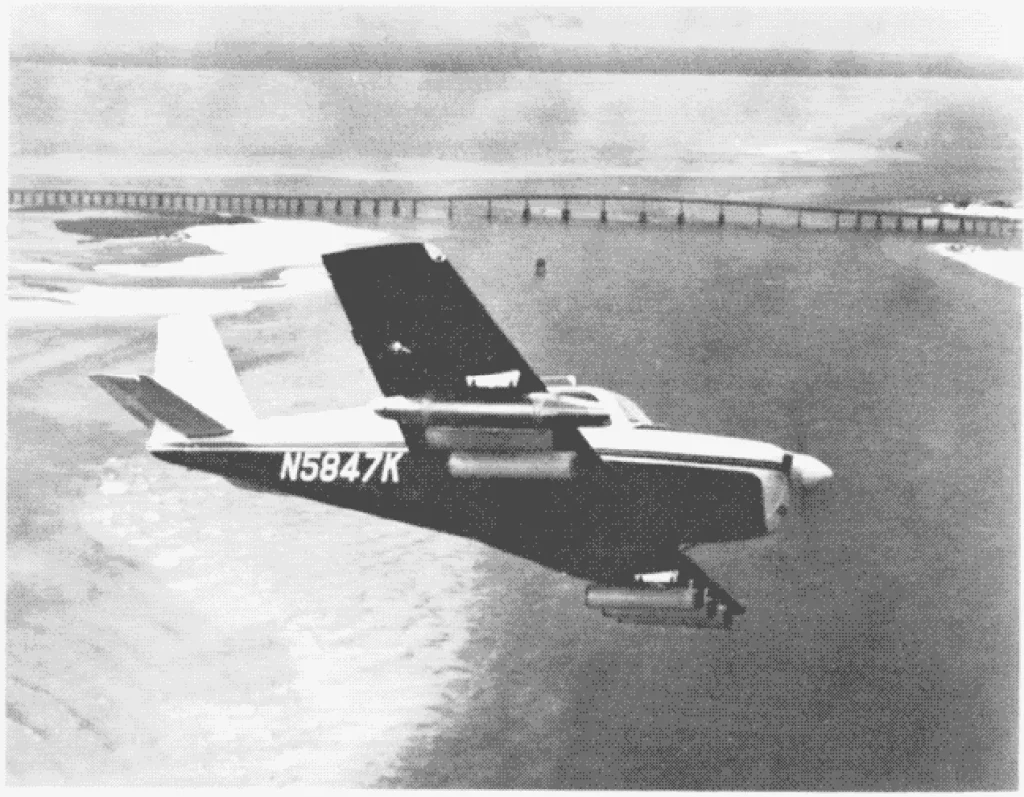
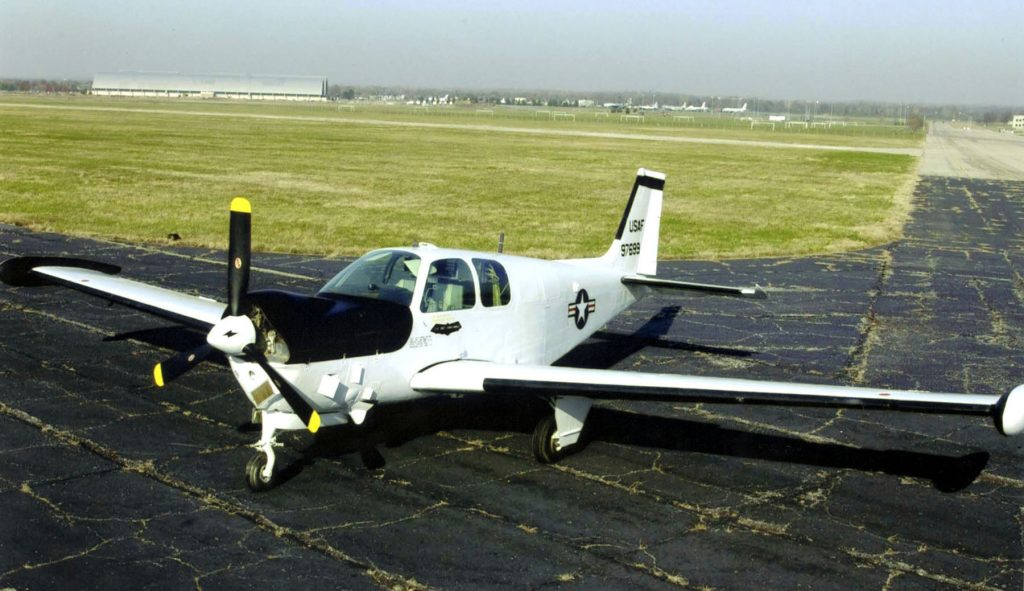
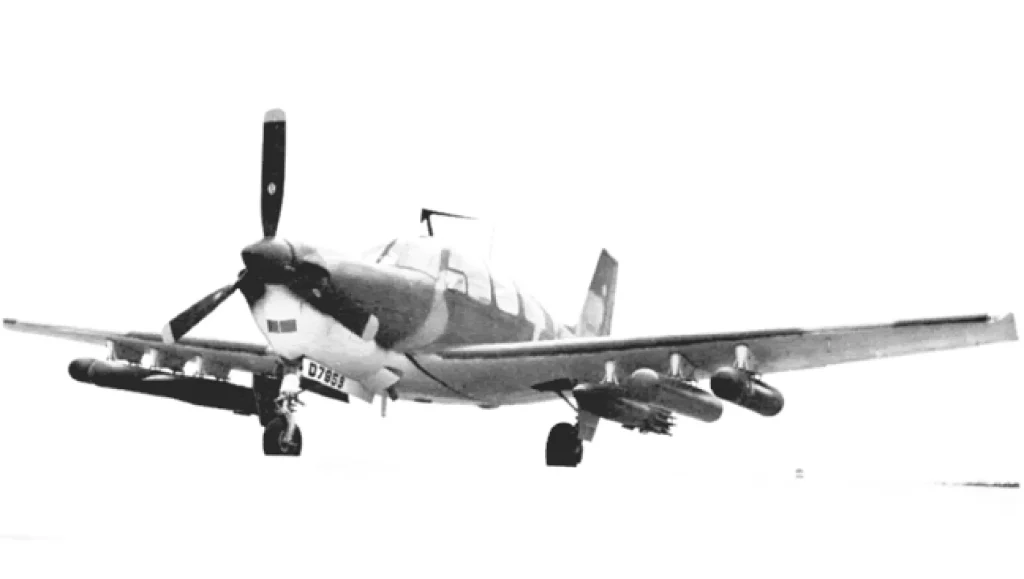
In 1970, the first prototype of the aircraft was developed using a modified civilian Beech D33 Debonair. The Beech YAU-22A prototype, designated PD.249 by its manufacturer, was built from a Beech A36 Bonanza fuselage and Beech B55 Baron wings, and was powered by a Continental GTSIO-520 piston engine producing 350 horsepower. The YAU-22A had six hardpoints, which allowed it to carry 7.62 mm machine gun pods, rocket pods, and parachute-braked bombs. It was commonly called the “Armed Bonanza.” It was painted in “jungle fighter” camouflage. The US Air Force tested the modified aircraft in June and July of 1971 at Eglin Air Force Base in Florida. However, the Bonanza airframe was mainly built for civilian use, not for carrying military weapons. Adding heavy equipment/guns under the wings affected the Beech YAU-22A’s flying capabilities. As a result, the Beech YAU-22A was underpowered to provide close combat support and could not safely carry weapons and fuel, leading to the program’s cancellation in 1972 after the construction of only one prototype. During the Vietnam War, the US Air Force also developed the QU-22B. The unmanned aircraft was designed to help with the Igloo White operation. Igloo White aimed to deploy sensors along the Ho Chi Minh Trail to monitor enemy supply movements.
The Cancellation
The US Air Force received 27 modified QU-22B drones, which were based on the civilian Beech Model 36 Bonanza. The QU-22B had a large generator above the engine to power its electronic equipment, and extra fuel in the wingtip tanks to extend its range. It could be flown by an onboard pilot or operated as an unmanned drone using remote control equipment. In 1970, a group from the 553rd Reconnaissance Wing, later known as the 554th Reconnaissance Squadron and the “Vampires,” conducted the first operational flights of the QU-22B. During a typical mission, the QU-22B flew near the Ho Chi Minh Trail. It picked up signals from ground units called Igloo White sensors that detected sounds and vibrations. The QU-22B then sent this information to the Information Surveillance Center, also known as “Task Force Alpha,” at Nakhon Phanom Royal Thai Air Force Base. The QU-22B performed well as a signal relay, but all flights in Southeast Asia required a pilot due to reliability issues with the equipment. In 1972, after losing several aircraft, the USAF ended the QU-22 program. In the Grounded Dreams series, the Beechcraft Bonanza stands as a successful aircraft, one of the most iconic, but its models, such as the Beech YAU-22A and QU-22B, did not perform as expected. Read more Grounded Dreams articles HERE.