
In the early part of the 20th century, Soviet shipbuilders were facing a problem in increasing ship speed. The fastest speed for displacement vessels was limited by wave resistance. For river vessels, this speed was 15-20 mph, and for sea vessels, it was 30-35 mph. To solve this problem, a Soviet engineer, Rostislav Evgenievich Alekseev, began working on hydrofoils and ground-effect vehicles in the late 1930s. Alekseev always wanted to be a shipbuilder, and after graduating from the Gorky Industrial Institute, he worked at the Krasnoye Sormovo plant. There, he became the supervisor for T-34 tank production. Alekseev impressed his bosses with his design for a hydrofoil boat capable of searching for and destroying enemy submarines. At the time, Hydrofoil designs had been under development around the world for many years. However, the first practical hydrofoil vessels were designed by Alekseev. His hydrofoils were used for both military and civilian purposes, and Alekseev’s design bureau made successful torpedo boats and passenger vessels. The hydrofoils increased the vessels’ speed to 60-75 mph. However, Alekseev was not satisfied with this speed as his experiments showed that the hydrofoil could not go faster than 60-75 mph. But he faced a problem called cavitation, a phenomenon in which fast-moving liquid forms many bubbles. These bubbles hit the hydrofoils and, upon collapse, they caused damage. To eradicate the negative effect, it was necessary to completely remove the vessel’s contact with water while it was moving.
Birth of Alekseev SM-1
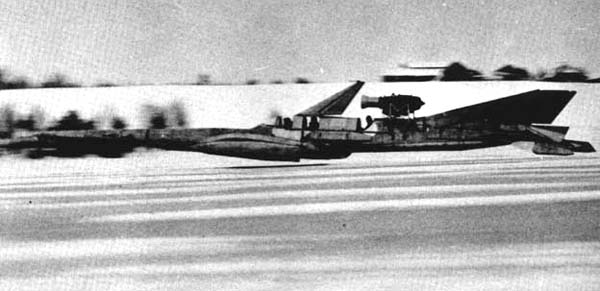
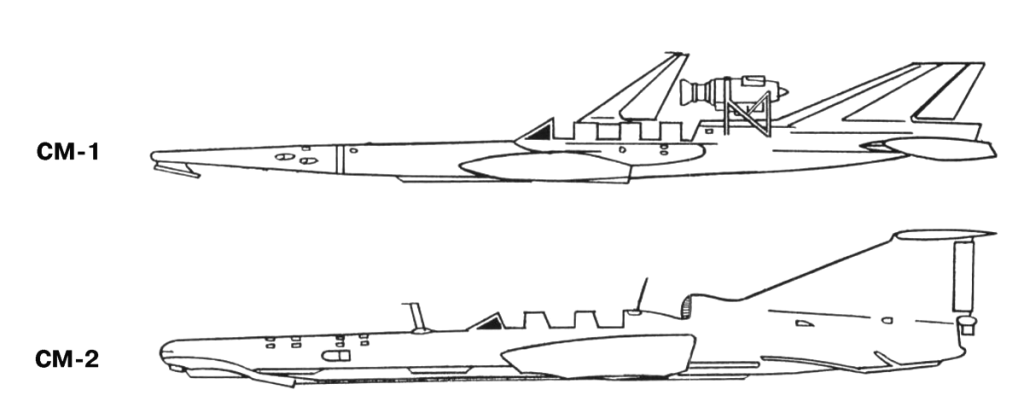
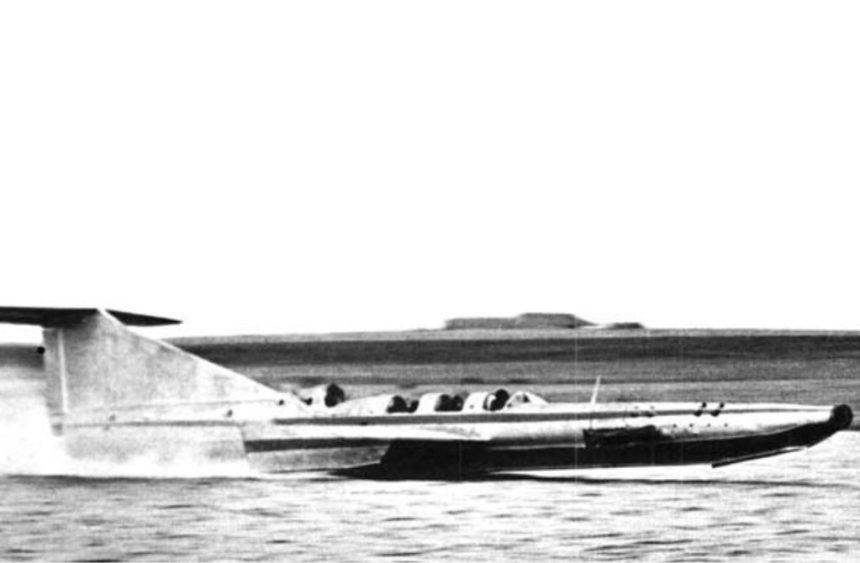
While trying to solve this issue, Alekseev noticed a phenomenon that aircraft manufacturers and pilots faced in the early 20th century, in the early age of aviation. When an airplane took off or landed close to the ground, it created much more lift than when flying at higher altitudes. The extra lift caused the airplane to suddenly rise or skim just above the ground, making it hard to land. Since aircraft performance, particularly their stability, was not designed for this effect, many accidents occurred during takeoff and landing. The issue, which harmed aviation in its early days, is known as the “screen effect.” When a wing moves over land or water, it pushes the air below it. It creates high pressure under the wing and provides extra lift. The force helped design the ship-aircraft hybrid developed by Alekseev, and called the “ekranoplan.” Unlike a hovercraft, which needed constant air pressure under its hull, the ekranoplan stayed afloat by redistributing air pressure. The bottom of the wing received more pressure because of the incoming airflow, while the air above the upper surface became less dense. The wing of the ekranoplan generated more lift and less drag, allowing it to reach high speeds using less jet power. In 1958, Alekseev began the development of practical ekranoplan prototypes for the Soviet Navy. In 1961, the first self-propelled ekranoplan model, designated the Alekseev SM-1, was developed. On July 22, 1961, it completed its first flight, with Alekseev piloting the SM-1. By the fall of 1961, the flying techniques for the ekranoplan had been practiced, and it was found to be reliable. Alekseev began inviting guests from Moscow to see demonstration flights. The Alekseev SM-1 was shown to several important guests, who were impressed and wanted to ride the ekranoplan under Alekseev’s supervision. During testing, the Alekseev SM-1 reached speeds of about 125 mph.
The Cancellation and Legacy
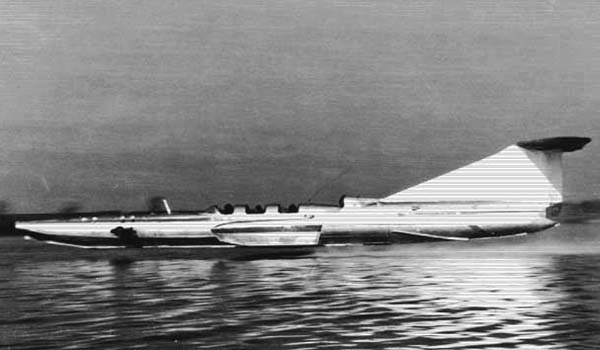
The aerohydrodynamic configuration of the Alekseev SM-1 was improved, and a self-propelled SM-2 model was built in 1962. It was the first to use an engine-assisted underwing boost to improve takeoff and landing performance. However, many tests were required to develop practical guidelines for selecting the right boosting system. The SM-2’s design later served as the basis for the first Russian ekranoplanes. In early May 1962, a demonstration of the SM-2 ekranoplan took place for N.S. Khrushchev, the First Secretary of the Communist Party of the Soviet Union, and other government officials. Although the SM-2 did not perform as expected during the demonstration flights, it still impressed Khrushchev. As a result, the state soon adopted a program to develop new ekranoplans. The program included the development of combat ekranoplans for the Navy and other military branches, as well as the construction of a full-scale experimental ekranoplan called KM. Subsequently, the experimental models SM-2P, SM-3, SM-4, SM-5, SM-6, SM-2P7, SM-8, and SM-9 were developed using the design of Alekseev SM-1 and SM-2. The SM-5 and SM-8 were prototypes for the larger KM ekranoplan. The SM originally meant “Ship-Mockup,” and the KM “Caspian Monster.” Later, the KM became the heaviest aircraft in the world until 1988, when the Soviet Union built the An-225 Mriya. The KM was launched in October 1966 in Chkalovsk, tested over the Caspian Sea, and reached a top speed of 310 mph. The KM was successful, but it all began with the Alekseev SM-1. In the Grounded Dreams series, the Alekseev SM-1 might have been canceled due to various issues, but it provided the aviation world with a new vision, and its further development led to the rise of ekranoplans. Read more Grounded Dreams articles HERE.