
Photos and story by Gary Daniels
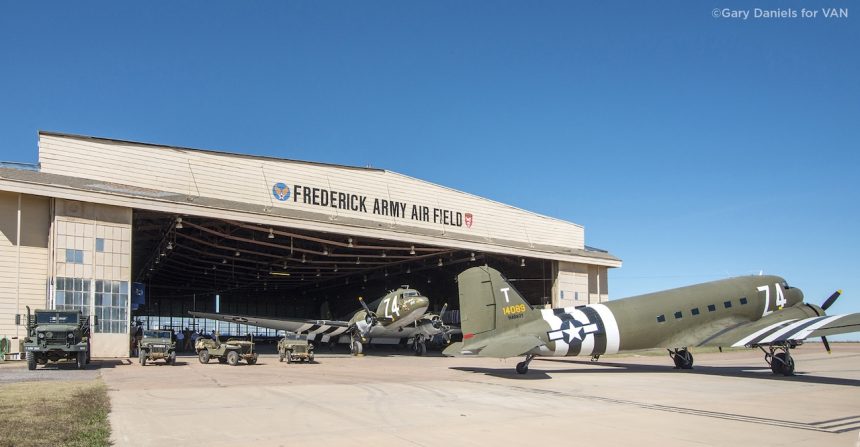
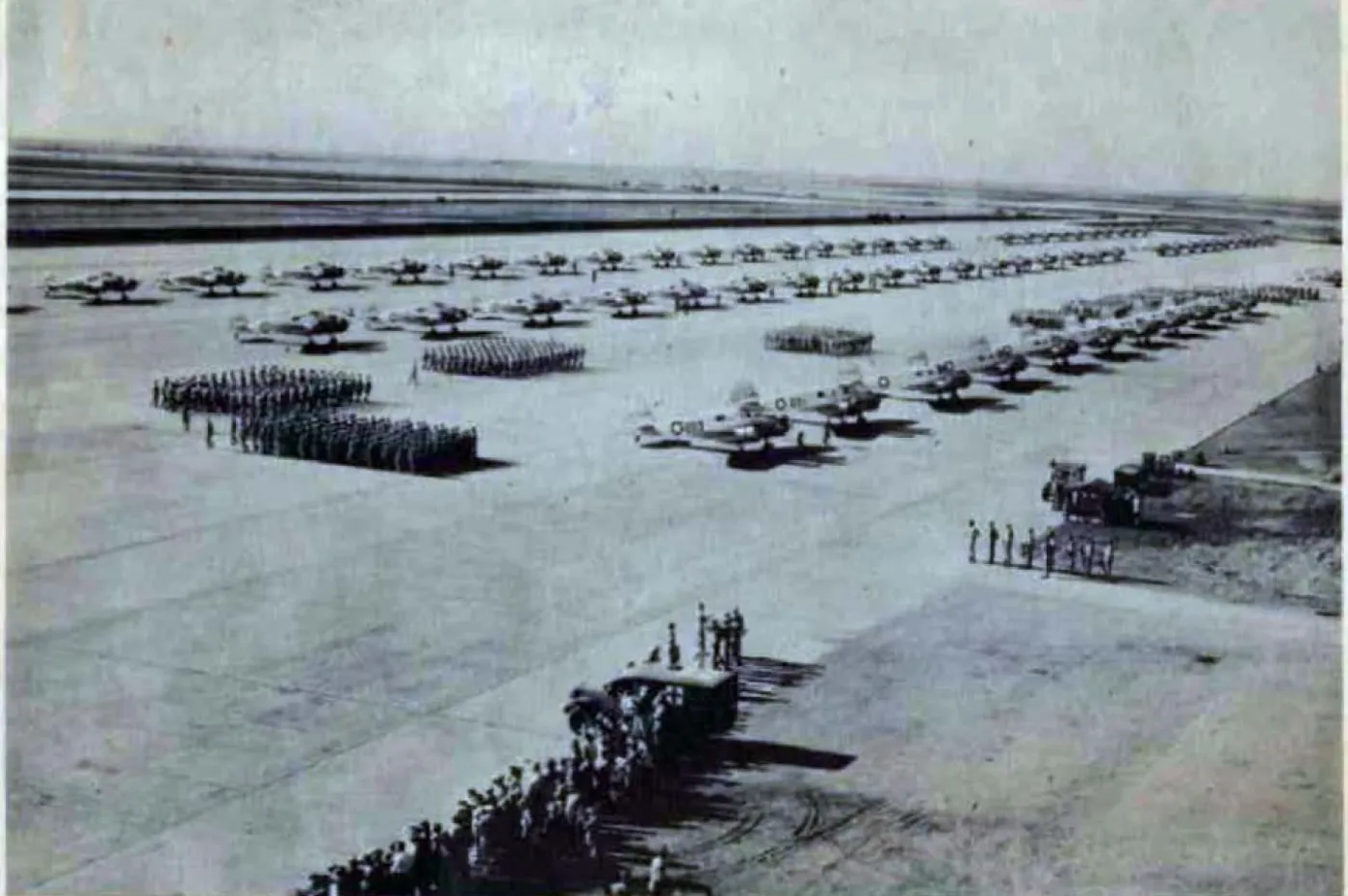
In the opening months of 1942, the War Department chose a spot on the prairie just south of Frederick, Oklahoma, to build a huge airfield complex for advanced multi-engine and navigation training for thousands of young aviators preparing for war. Frederick Army Air Field (FAAF) became operational in September 1942. More than 300 buildings, including three large main hangars, four runways, and acres of tarmac, were constructed. For the next three years, the skies above southwestern Oklahoma were crowded with AT-9 Jeep, AT-11 Kansan, T-50 Bobcat, and TB-25 Mitchell trainers teaching those young aircrew the art of aerial warfare. Then, with victory and the end of World War II, change for FAAF came as quickly as its building, with its deactivation in October 1945. The training base was turned over to the City of Frederick. Over the next six decades, all the buildings were dismantled or demolished except for the largest main hangar and an attached smaller hangar at the north end of the airfield. In 2005, these two structures were scheduled to be burned down in a county-wide fire training exercise.
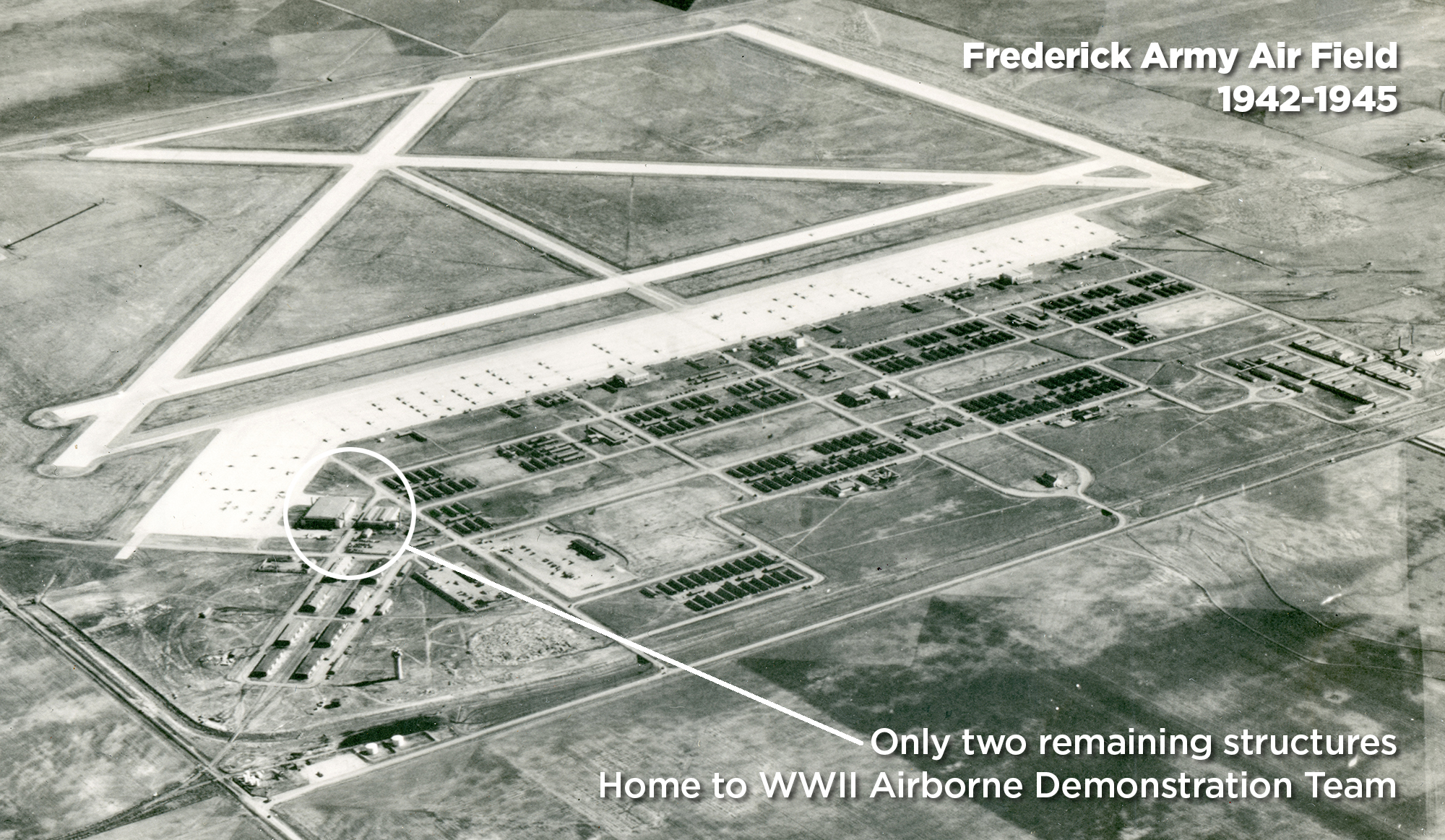
The WWII Airborne Demonstration Team (ADT) was founded in 1996 with the mission of honoring veterans and educating new generations by keeping the stories of the exciting airborne heritage of WWII alive. In the early years of the team, there was no central location to call home. That all changed in 2005 when ADT heard of the plans to burn the remaining FAAF hangars and rushed to meet with the City of Frederick with a plan to save the structures. Their proposal: lease the hangars to ADT, and they would move to Frederick to conduct airborne training and operations and maintain the historic facility. The city approved, and after extensive work and considerable cost to bring the largest hangar up to minimal standards, ADT moved into their new home. The hangars are the perfect facility for ADT, undergoing constant repair and renovation, and treated with the reverence these historic buildings deserve.
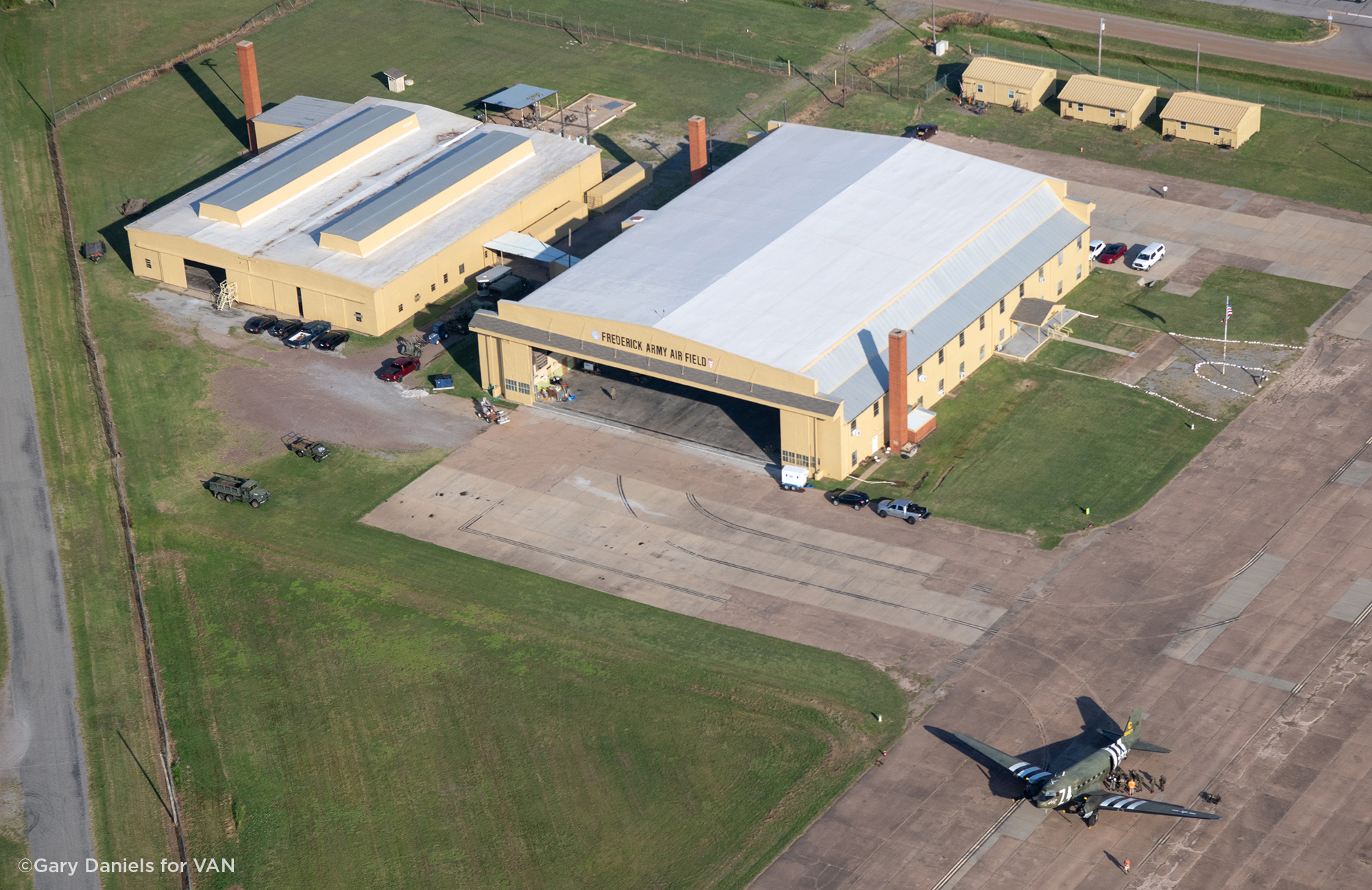
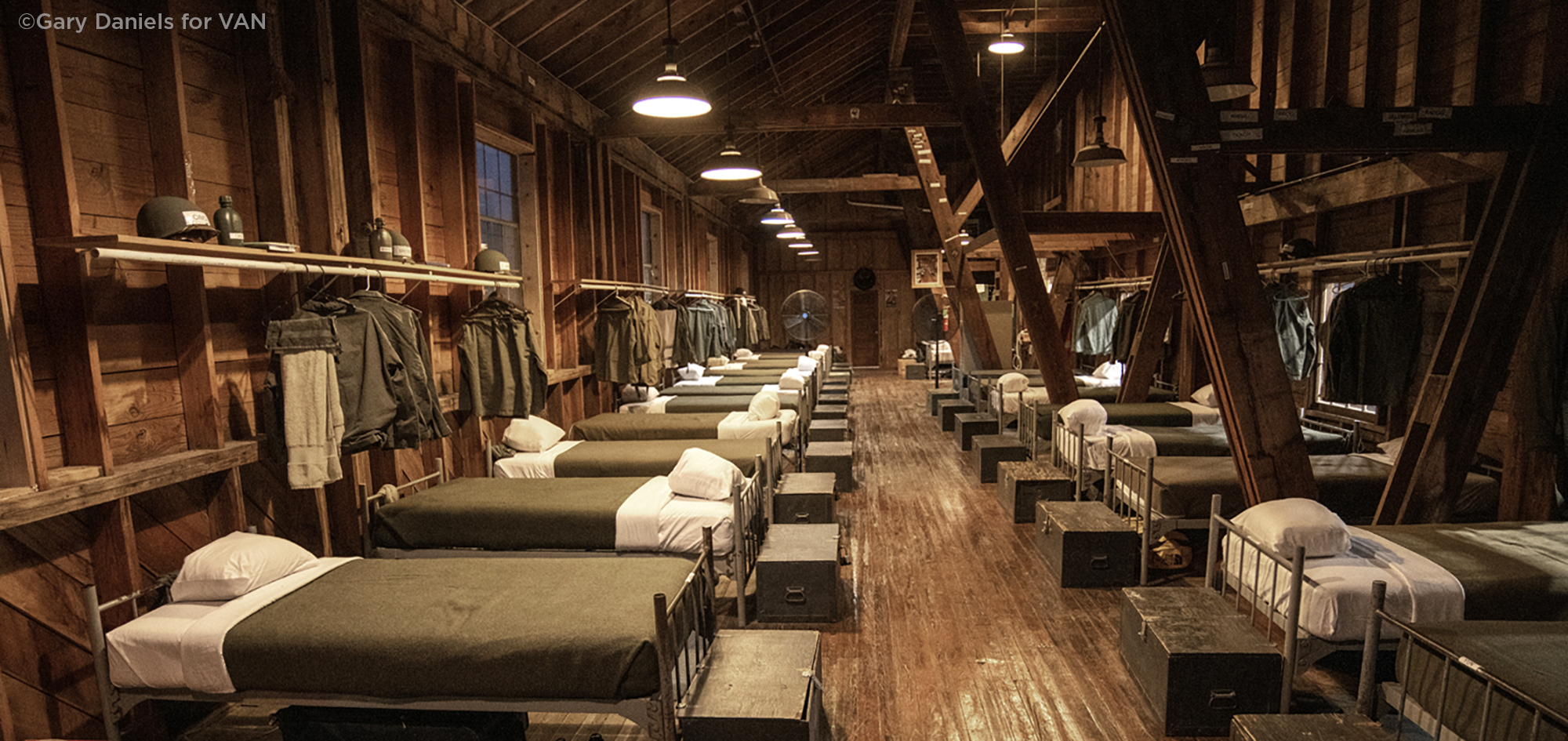
Moving to Frederick began a new chapter for ADT. Being housed in authentic WWII hangars is truly unique and completes the ADT mission. The main hangar includes a student barracks that has been restored to its WWII glory days. Entering the barracks is like stepping back 84 years in time. When students arrive for training, they are struck by the feeling of reporting to ‘basic training’ in a setting that is right out of 1942. The two hangars include a mess hall, classrooms, areas for airborne ground school, a mock-door trainer, a parachute landing training area, a parachute rigger section for repair and storage of parachutes, a large area for parachute folding and packing, aircraft storage and maintenance spaces, storage areas for the large amount of aircraft parts and service equipment, motor pool housing, student and member barracks, a male restroom with showers, and a barracks with restroom and showers for female students and members. Outbuildings provide additional barracks and classroom spaces.
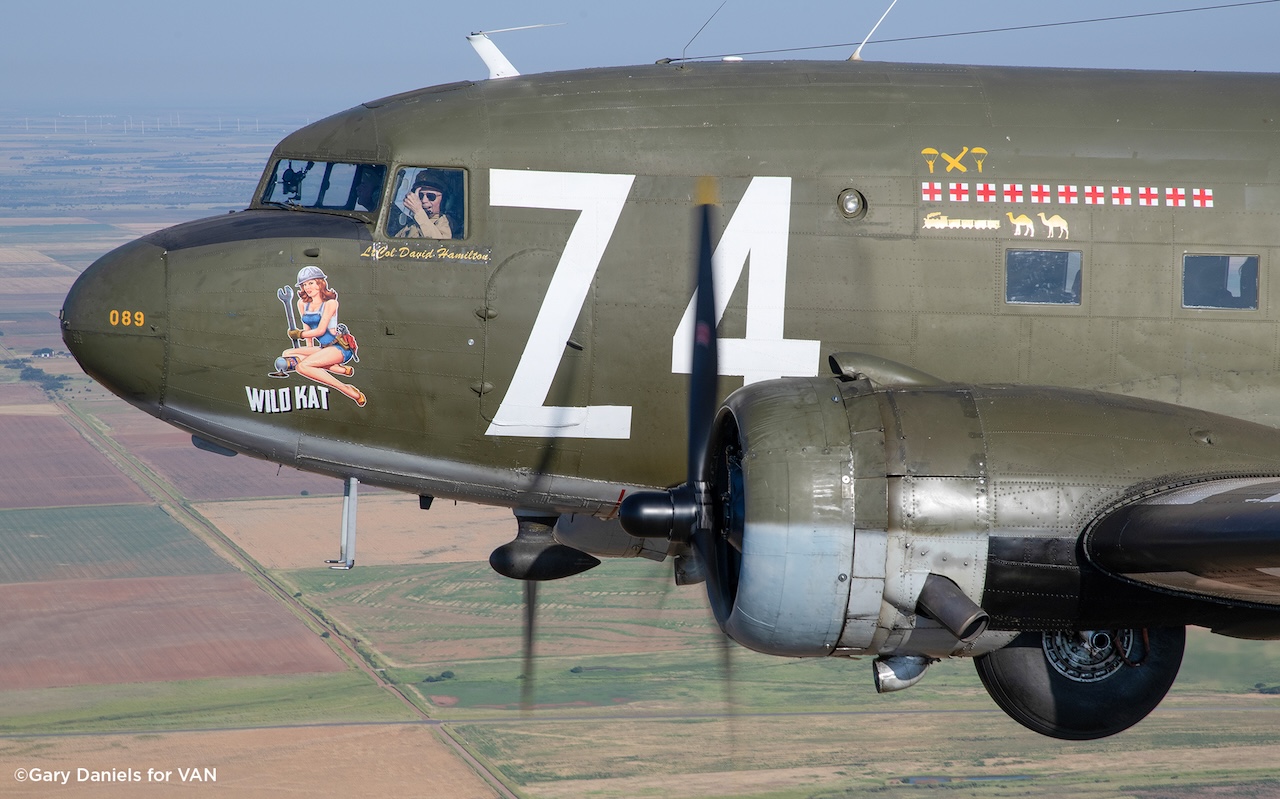
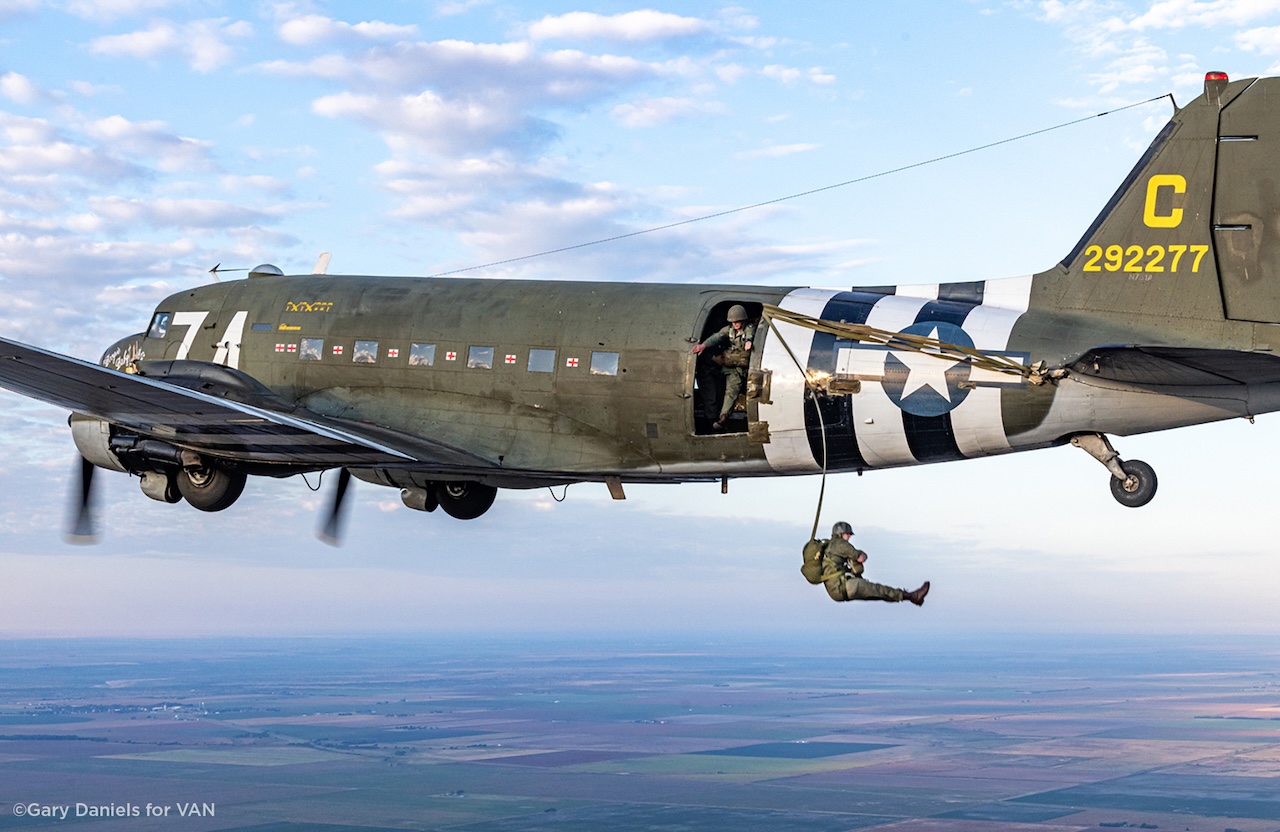
FAAF and the hangars are surrounded by the expansive farmlands of southwestern Oklahoma. Due to the cooperation of local landowners and farmers, ADT is allowed to drop parachutists on various drop zones (DZ) within two miles of the airport, though only on harvested or unplanted fields. This is very efficient for jump operations. The ADT aircraft can be wheels up, climb to 1,500 feet AGL (Above Ground Level), drop their ‘sticks’ (parachutists), and return to base in 20 minutes to load another group of parachutists and repeat. This minimizes time in the air to the DZ, reduces wear and tear on the engines, and keeps fuel costs down for those very thirsty radial engines. Speaking of aircraft, ADT operates two DC-3 variant World War II veteran aircraft, C-47A Boogie Baby and C-49B Wild Kat. They are used as the jump platforms for ADT’s parachute schools each summer and fall.
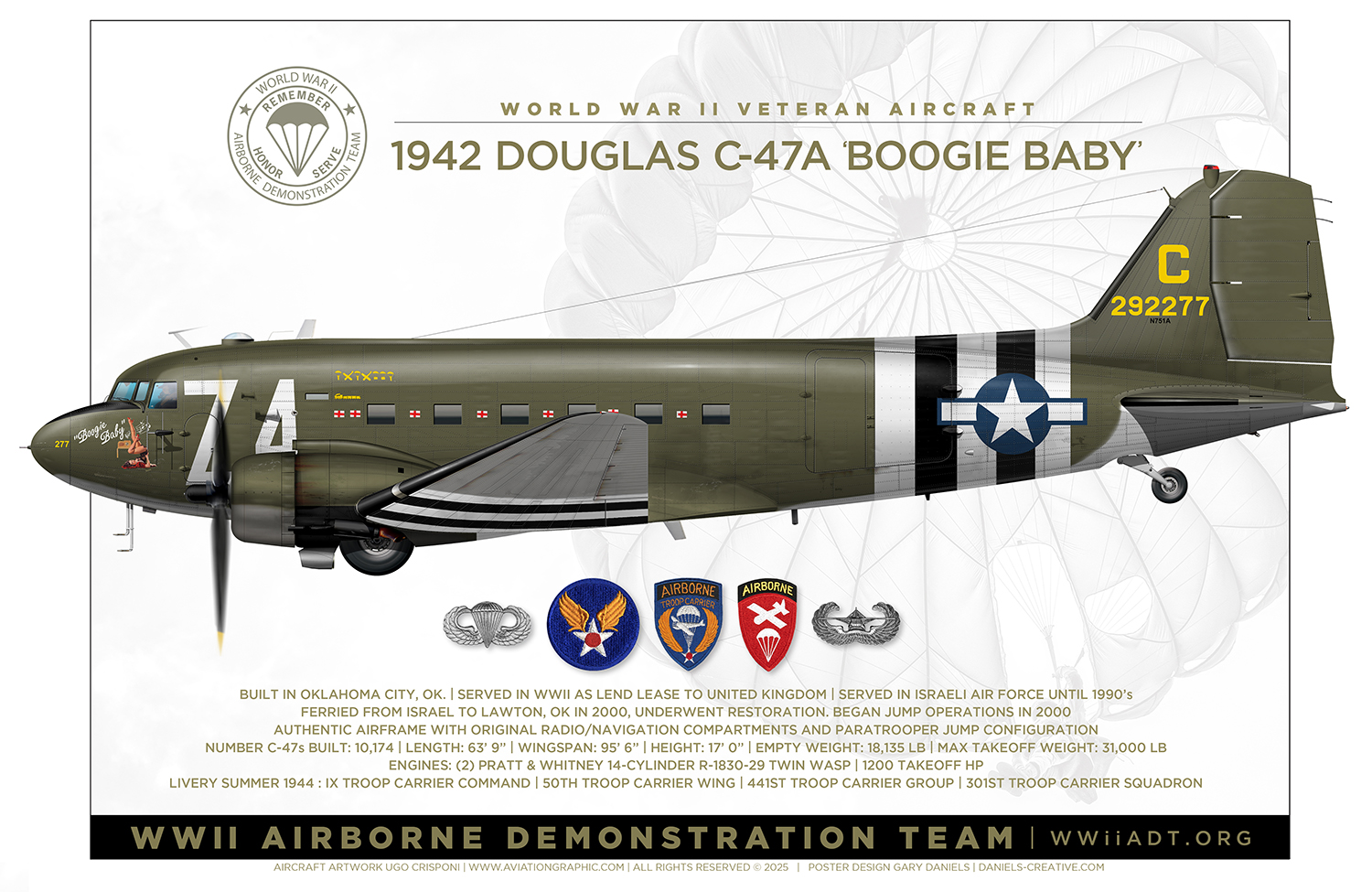
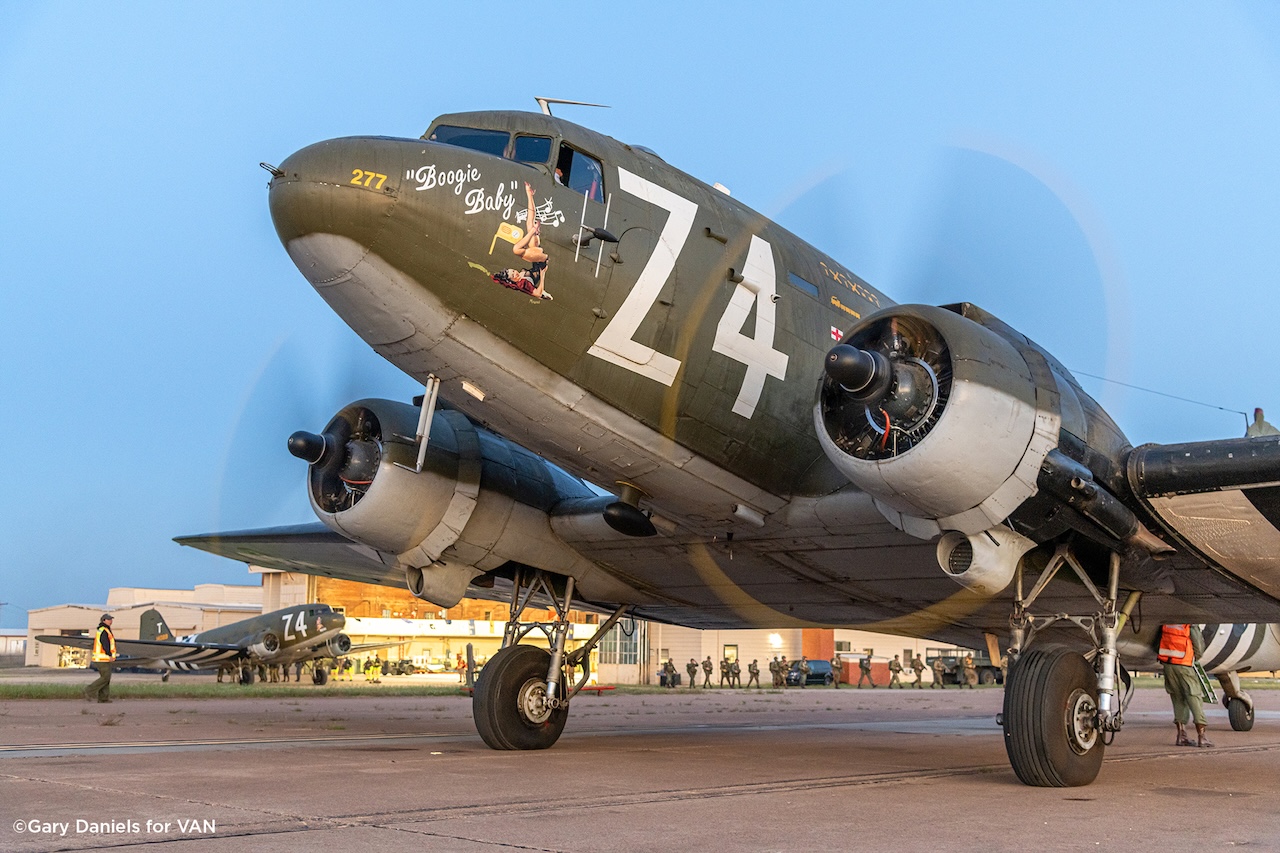
Boogie Baby began jump operations with ADT in 2001. Since then, more than 25,000 parachutists have stepped through her door—possibly more than any other surviving C-47 in the world. Here is her story. Built in 1942 at the Douglas Aircraft Company plant in Oklahoma City, SN 12060 was allocated to the lend-lease program, flying first to Canada from Oklahoma and then on to England in January 1944 to begin service as Royal Air Force (RAF) Dakota FL633. From arrival to the end of the war, FL633 saw continuous and hectic service in Europe, the Mediterranean, the Middle East, North Africa, and the China-Burma-India (CBI) theater. Most notable of her missions were formation training missions for paratroop and glider tow operations during the early spring of 1944 in preparation for the invasion of Europe. Then she was off to the CBI for a short stint flying resupply missions for Chindit forces fighting the Japanese in the dense jungles. FL633 was back in the skies over North Africa by June 1944 flying cargo and passengers. In July, FL633 repositioned to Italy, flying missions back and forth between Italy and North Africa. In early August, FL633 flew a covert mission to Paris carrying members of the French National Committee of Liberation. FL633 also flew missions in support of Operation Dragoon, the invasion of southern France, in mid-August 1944. In November, FL633 flew relief missions to Yugoslavian partisans. During the remainder of the war, FL633 flew cargo and passengers throughout the Mediterranean, North Africa, and the Middle East. With the end of the war, FL633 returned to the United Kingdom and transferred out of the RAF in November 1945.
From 1946 to 1975, the history of 12060 becomes as murky as Turkish coffee. According to available records, the aircraft was sold to a Turkish airline that was buying war-weary C-47s from the United States after the war. But existing images of 12060 shown in Turkish airline liveries do not appear to be 12060, since it is known that the aircraft was never converted to a civilian airliner. Documentation shows that several C-47A/Bs that went to Turkish airlines were transferred to the Turkish Air Force (TuAF). ADT is positive this was the case for 12060, since the aircraft showed no evidence of civilian use and still had a large amount of its wartime hardware on board when ADT received the airframe in 2000. Nevertheless, it appears 12060 was in Turkey until 1969, but its service cannot be accurately confirmed. Until 1975, the information about the aircraft again appears to be erroneous due to it being listed as flying with leasing companies in civilian airline configurations. But it is verifiably known that 12060 was sold to the Israeli Defense Force (IDF) in 1975, serving for twenty-one years and retiring in 1996. It sat on the tarmac at Tel Aviv until 2000. It is interesting to note that it appears 12060 was reconfigured as an electronic countermeasures (ECM) aircraft while with the TuAF or the IDF, based on equipment and large-diameter wiring harnesses remaining in the aircraft when it was retired and sold.
An early ADT supporter, Dr. Bruce O’Brien, was also a pilot and wanted to own and restore a C-47 for team use. While researching, it was discovered that the IDF had several surplus C-47s they were decommissioning. After reviewing the stats of all the aircraft, 12060 was chosen since it had less than 17,000 hours on the airframe and low-time engines. And all the C-47s on the Tel Aviv tarmac were built in California except for 12060, which had been built in Oklahoma City. The sale was completed, and 12060 was prepared for the ferry flight back to the United States in 2000. After leaving the United States in 1943, 12060 returned to Lawton, Oklahoma, on August 5, 2000—57 years later and just 90 miles from where she was built. The 157-day ferry flight from Israel to Oklahoma is a story for another day.
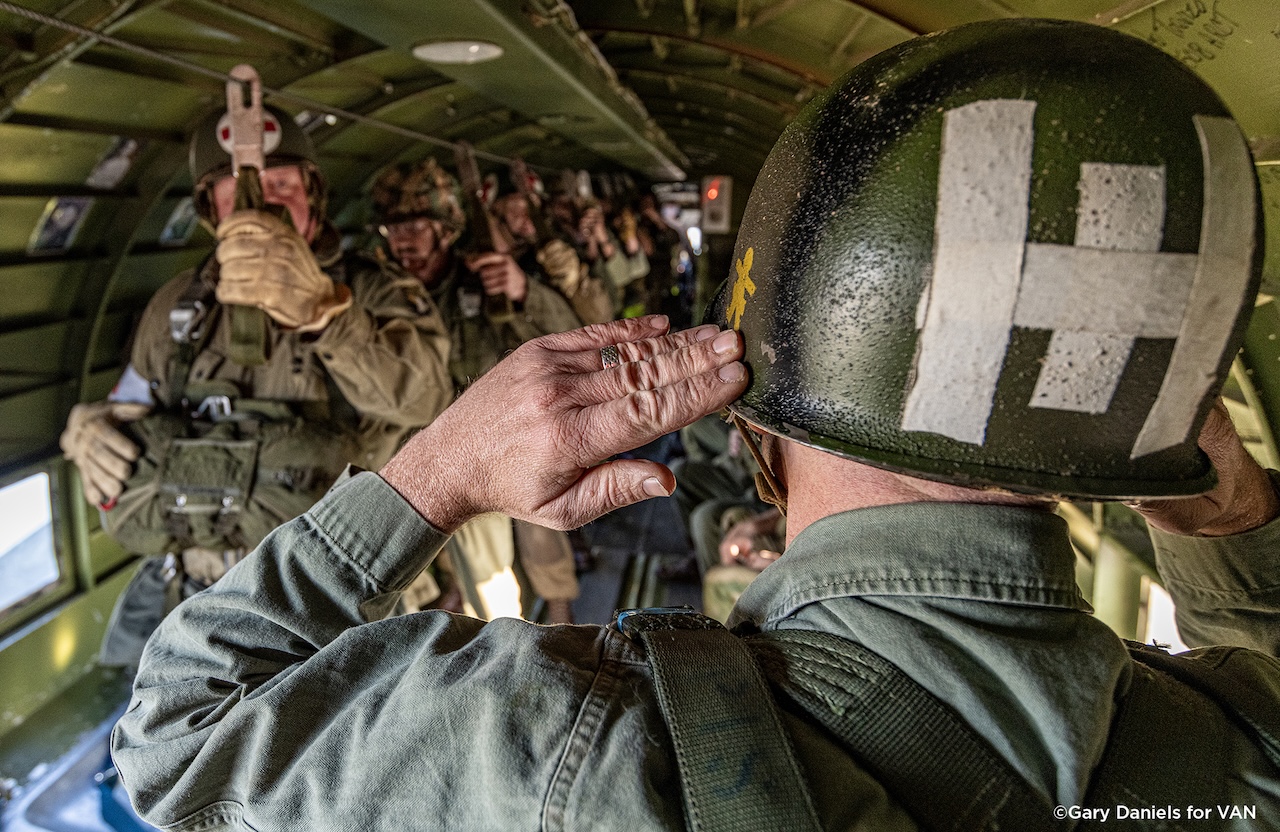
Restoration began quickly, and ADT co-founders Ray Cunningham, owner of Regional Air, and Paul Rasys, Airframe and Powerplant (A&P) maintainer for American Eagle, oversaw the restoration of 12060 for the owner. On initial inspection, it was clear that the aircraft had never had any civilian modifications. The condition was that of a well-used and haggard military C-47. During restoration, the interior fuselage was restored to its wartime jump-capable heritage. The original ‘butt bucket’ paratrooper seating from mid-fuselage forward had been removed at some time since 1946. That space had the remains of seated stations and heavy wiring harnesses, providing evidence that 12060 had once been used as an ECM aircraft. Authentic paratrooper seating was located and purchased from Basler Turbo Conversions to replace the missing forward section, and a new parachute anchor line was installed in the original existing hangars running the length of the fuselage. The desert IDF camouflage was removed, and 12060 was painted in the United States Army Air Force summer 1944 livery of the IX Troop Carrier Command, 50th Troop Carrier Wing, 441st Troop Carrier Group, 301st Troop Carrier Squadron, code Z4, with the USAAF serial number 290227 painted on the vertical tail. Soon after restoration, 12060 was christened Boogie Baby and began flying jump operations for the team in 2001.
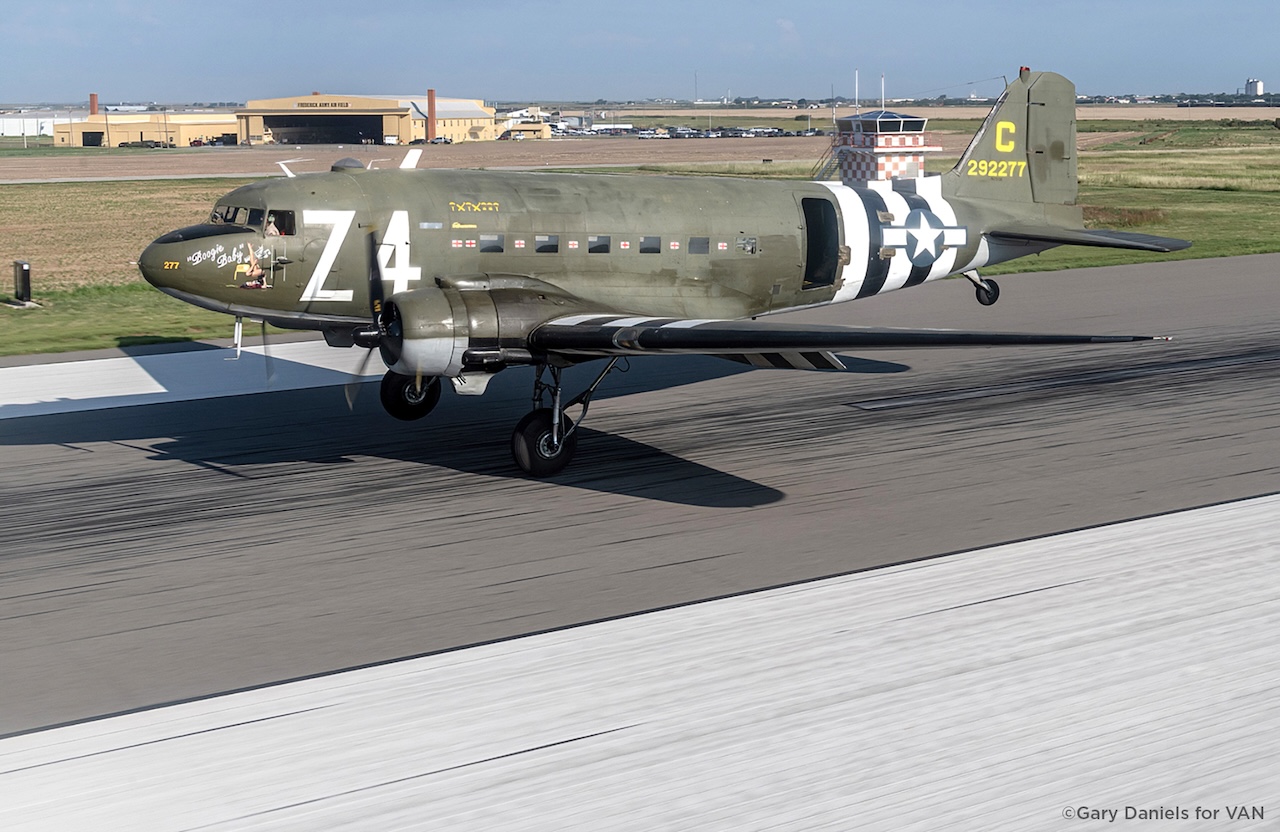
Today, Boogie Baby is one of the most authentic Skytrains flying and is hangared at Frederick Army Air Field (Frederick Regional Airport KFDR) in its historic 84-year-old WWII hangar. During a parachute school cycle, it is not uncommon for Boogie Baby to drop more than 300 parachutists on the ADT drop zones. Since 2001, thousands of veterans, active-duty paratroopers, descendants of paratroopers, and students have jumped from this aircraft. Inside the fuselage, on the surfaces between the ribs, are autographs and photos of the many WWII airborne veterans who have flown in Boogie Baby over the past quarter century. For ADT, Boogie Baby represents something deeper: remembering, honoring, and serving our veterans through the WWII airborne heritage carried forward one jump at a time. Today, Boogie Baby continues her airborne mission envisioned 85 years ago by the original C-47 designers.
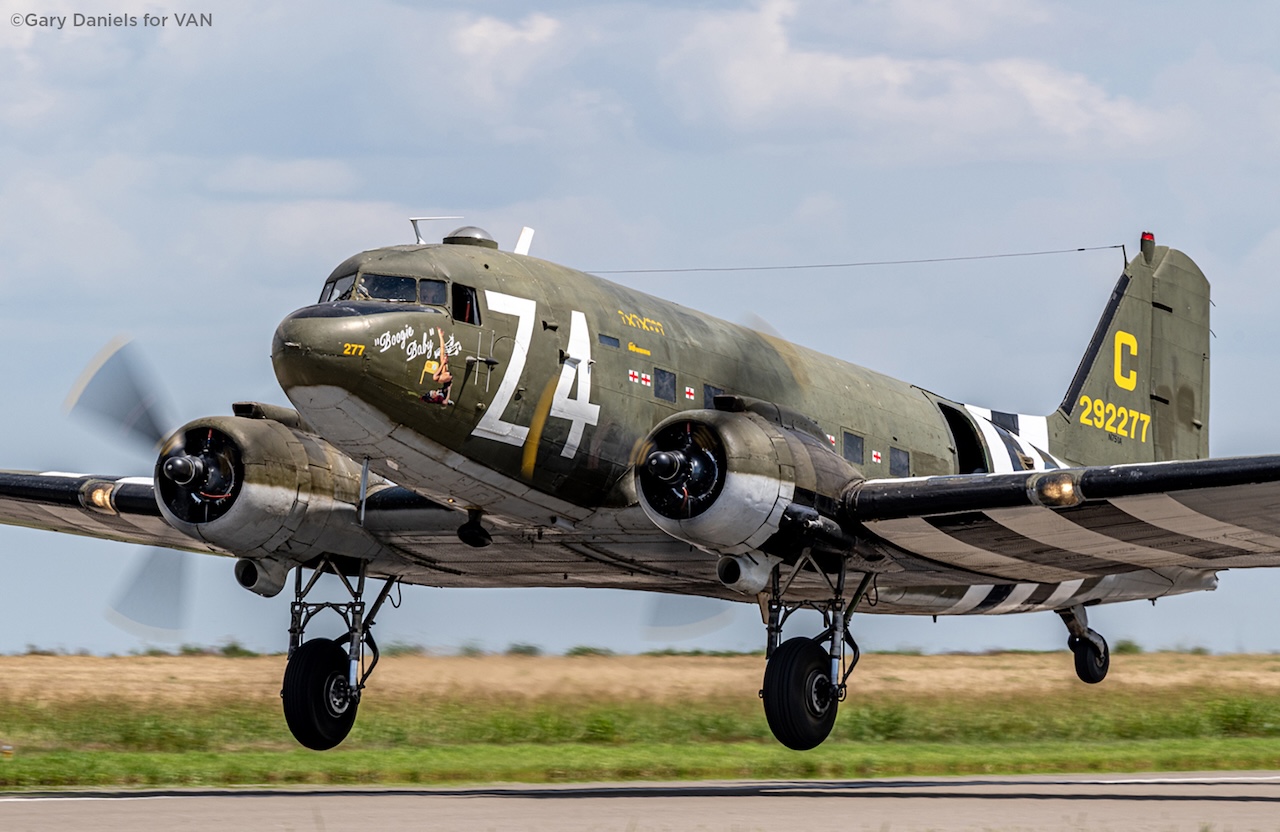
On December 17, 1935, the legendary DC-3 took its maiden test flight. DC-3s are still flying 90 years later. ADT owns a DC-3 that celebrated its 85th birthday on January 24, 2026. Here is her story.
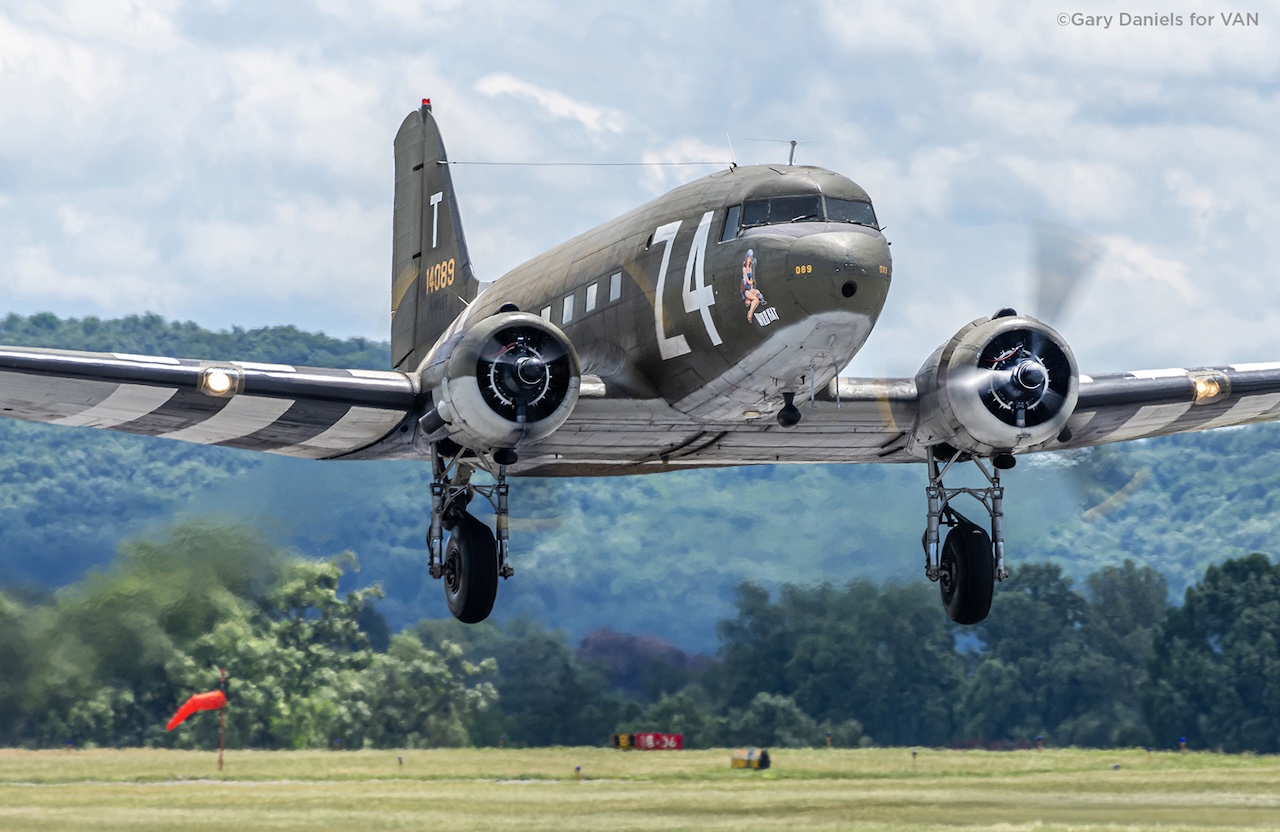
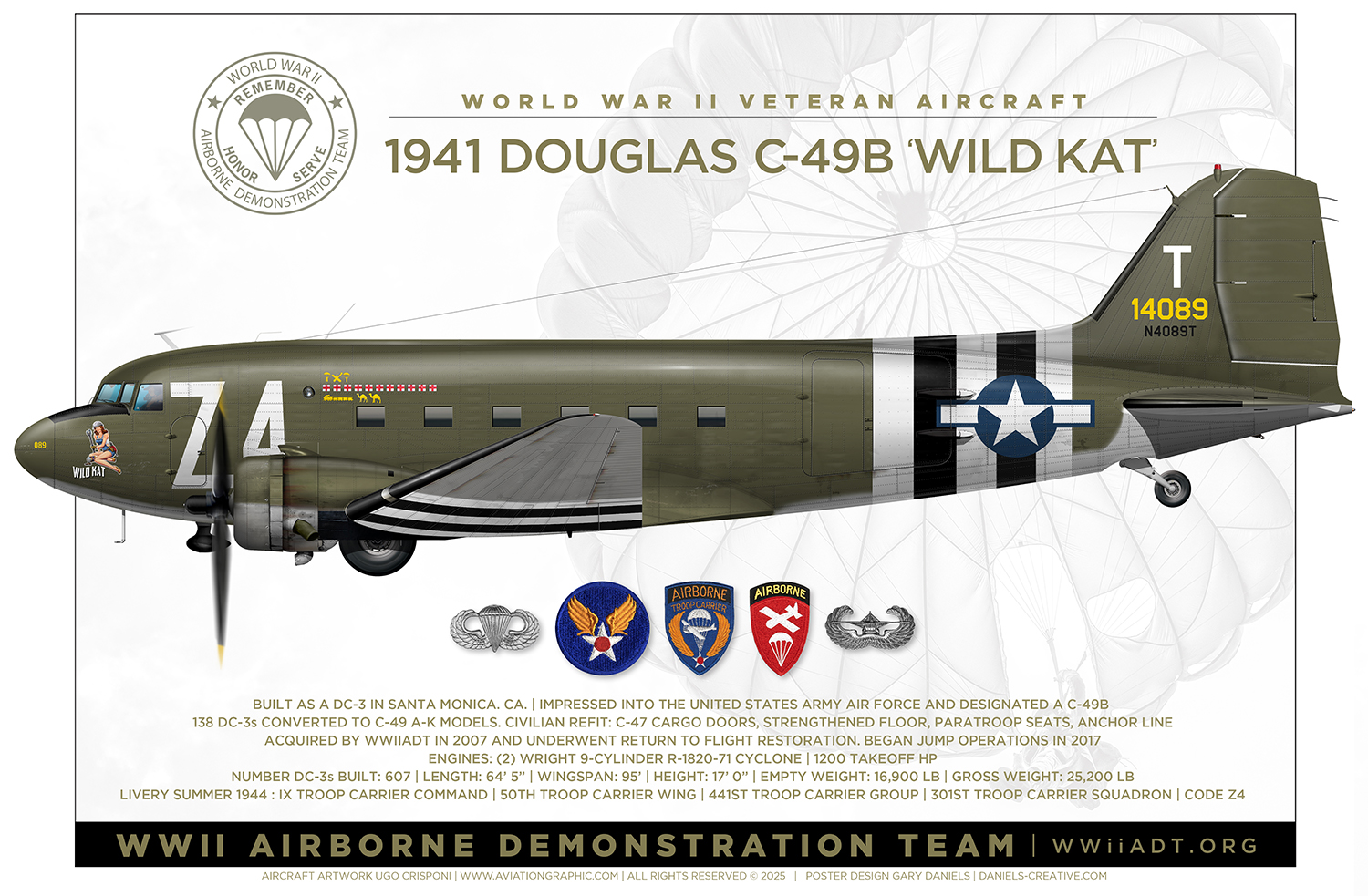
In January 1941, SN 4089 was on the assembly line at the Douglas Aircraft Company plant in Santa Monica, California. She was destined to become Eastern Airlines NC28381 until the United States Army Air Corps (USAAC) stepped in and drafted the aircraft into military service. 4089 was given the military designation C-49B during its service to the country. The 138 DC-3s impressed into service were designated C-49 A–K models. (An item of note: the United States Army Air Corps was reorganized into the United States Army Air Forces in June 1941.)
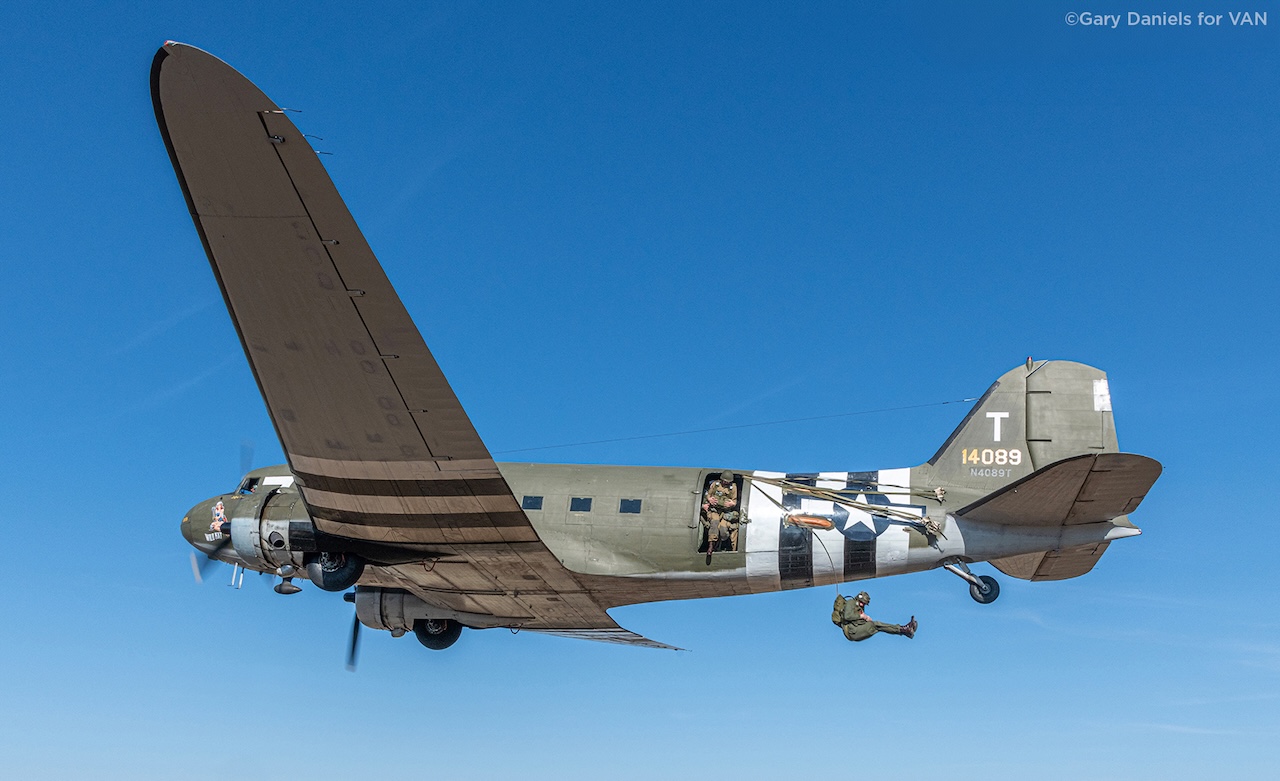
4089’s service to the country included ferrying VIPs, troops, and cargo throughout the United States. In January 1945, the aircraft was returned to Eastern Airlines and restored to an airline passenger configuration, remaining in service with Eastern until 1952. It was sold to North Central Airlines (NCA) and flew passengers until 1958. For the next five years, 4089 flew for an aviation products company before returning to NCA in 1963 to be used as a freighter. At some point, NCA converted 4089 to a cargo transport, stripping out the passenger seating, strengthening the fuselage floor, and adding large C-47 two-panel cargo doors. It remained in service with North Central until 1965. 4089 bounced between multiple owners over the next few years.
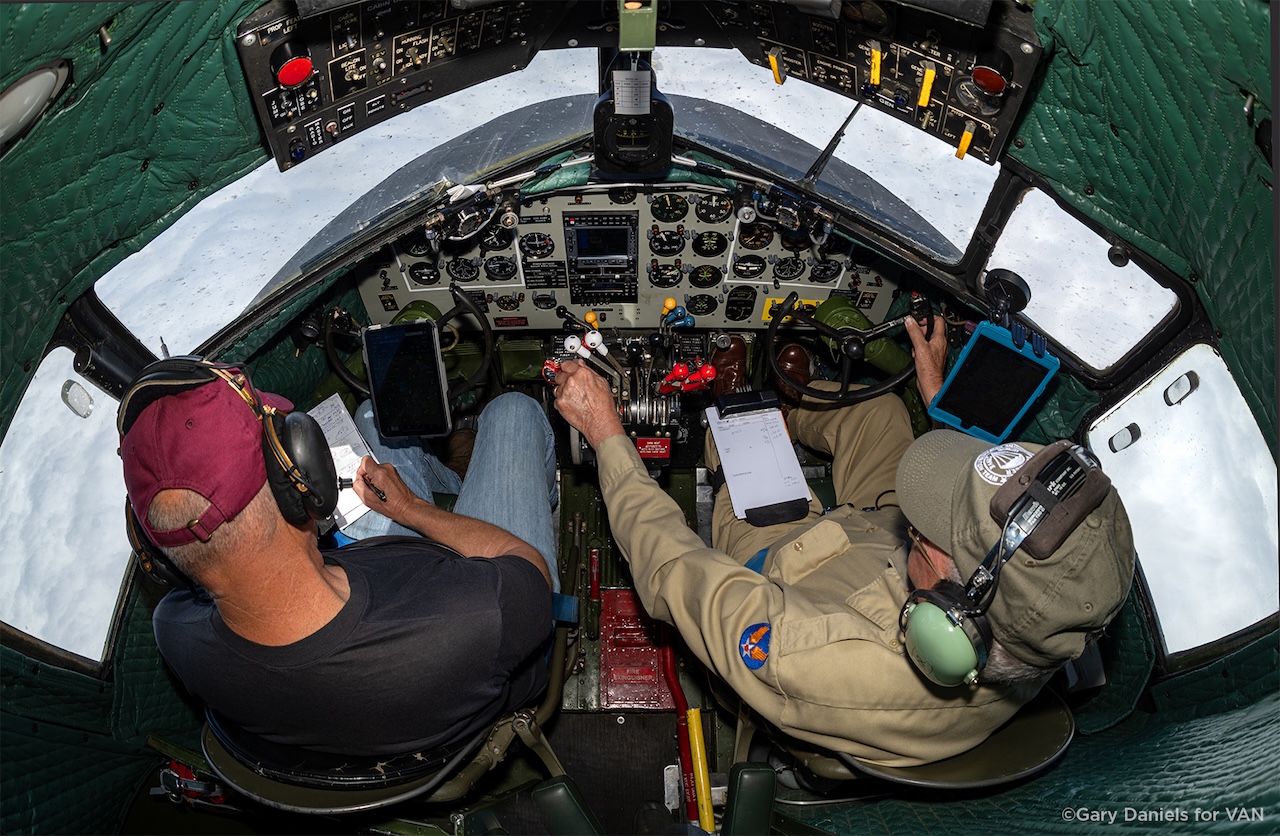
4089 was a television celebrity during the 1976–77 football season. Detroit-based advertising firm Campbell-Ewald created a television commercial for Chevrolet trucks to demonstrate the ruggedness of the chassis. 4089 had the main wheels removed and a truck chassis attached to each of its main landing gear assemblies. The aircraft conducted several touch-and-goes with this ungainly configuration during filming. The 30-second commercial featured Tom T. Hall strumming his guitar and singing, “Tough Airplane, Tough Truck.” In the late 1970s, 4089 was sold to Florida-based Missionair, which operated the aircraft throughout the Caribbean and Latin America for humanitarian missions, transporting food, clothing, and medical relief. After suffering hurricane damage in 2007, 4089 was retired by Missionair.
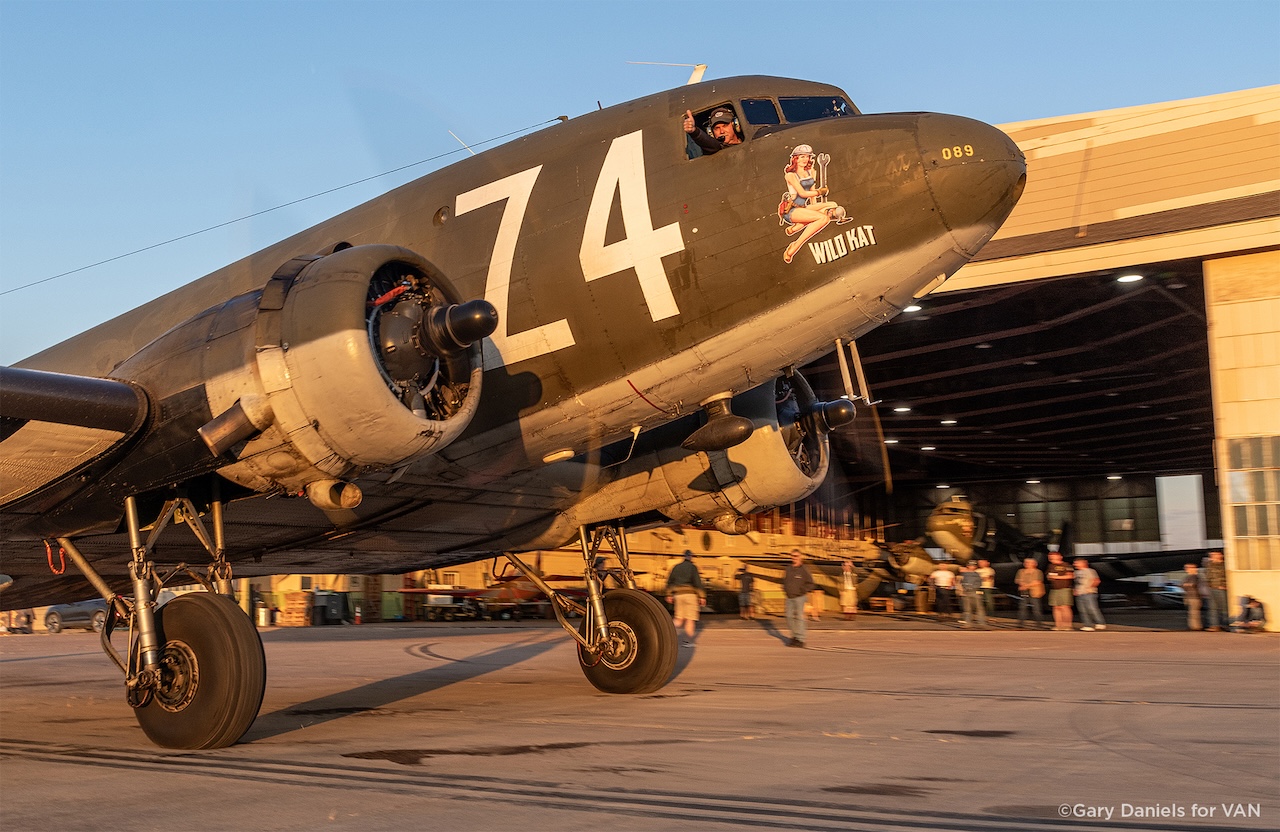
ADT purchased the aircraft that year and repositioned it to their historic hangar in Frederick. The plan was to restore the DC-3 to its C-49 heritage but make it a jump-capable ‘Skytrain’ to support Boogie Baby during ADT’s biannual parachute schools. After several years as a hangar queen, restoration finally began in 2015. In January 2016, 4089 was ready for a ferry flight from Frederick to Tulsa. During the ferry flight, the flight engineer glanced at the aircraft data plate on an interior bulkhead and noticed that they were coincidentally in the air exactly 75 years to the day 4089 had been completed in Santa Monica. Once in Tulsa, the ADT Air Wing spent eighteen months restoring every aspect of the aircraft. The fuselage was reconfigured as a C-47 ‘Skytrain’ with authentic paratrooper seating and an anchor line installed. It was during this time that 4089 was given her name Wild Kat, an homage to Tulsa’s rich oilfield history. She was painted to match Boogie Baby in the same USAAF summer 1944 livery of the IX Troop Carrier Command. Wild Kat returned to flight in 2017 and dropped her first parachutists (ever) onto the ADT drop zones on October 25, 2017.
Today, Wild Kat is one of the oldest DC-3 airframes still flying, with more than 86,600 hours, and is based at Bartlesville’s Frank Phillips Field (KBVO). She makes the trip to the ADT hangar at FAAF in support of the jump operations. Wild Kat has had an avionics upgrade giving her IFR capability. This decision was made so that Wild Kat could participate in aviation events and airshows around the nation.
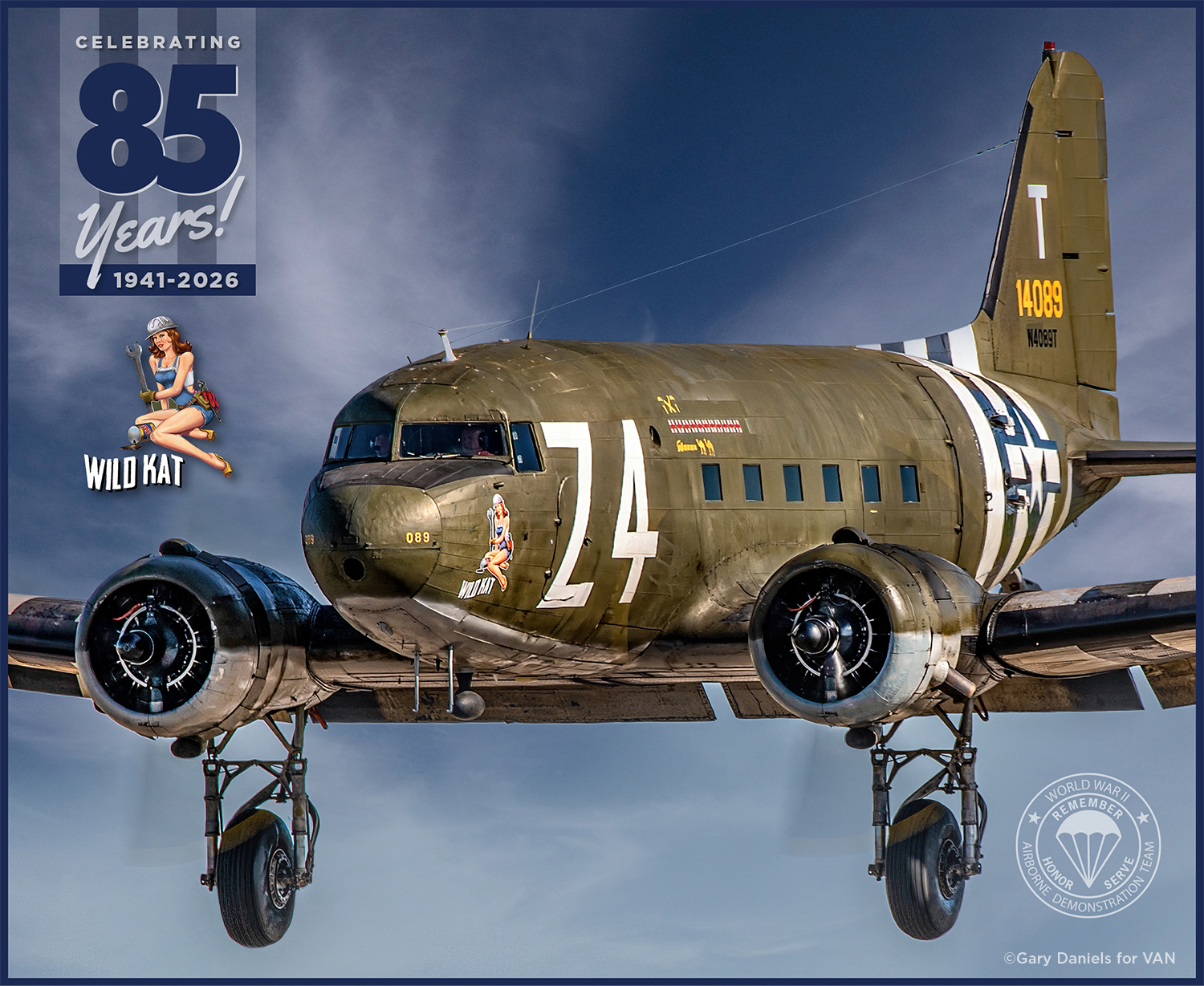
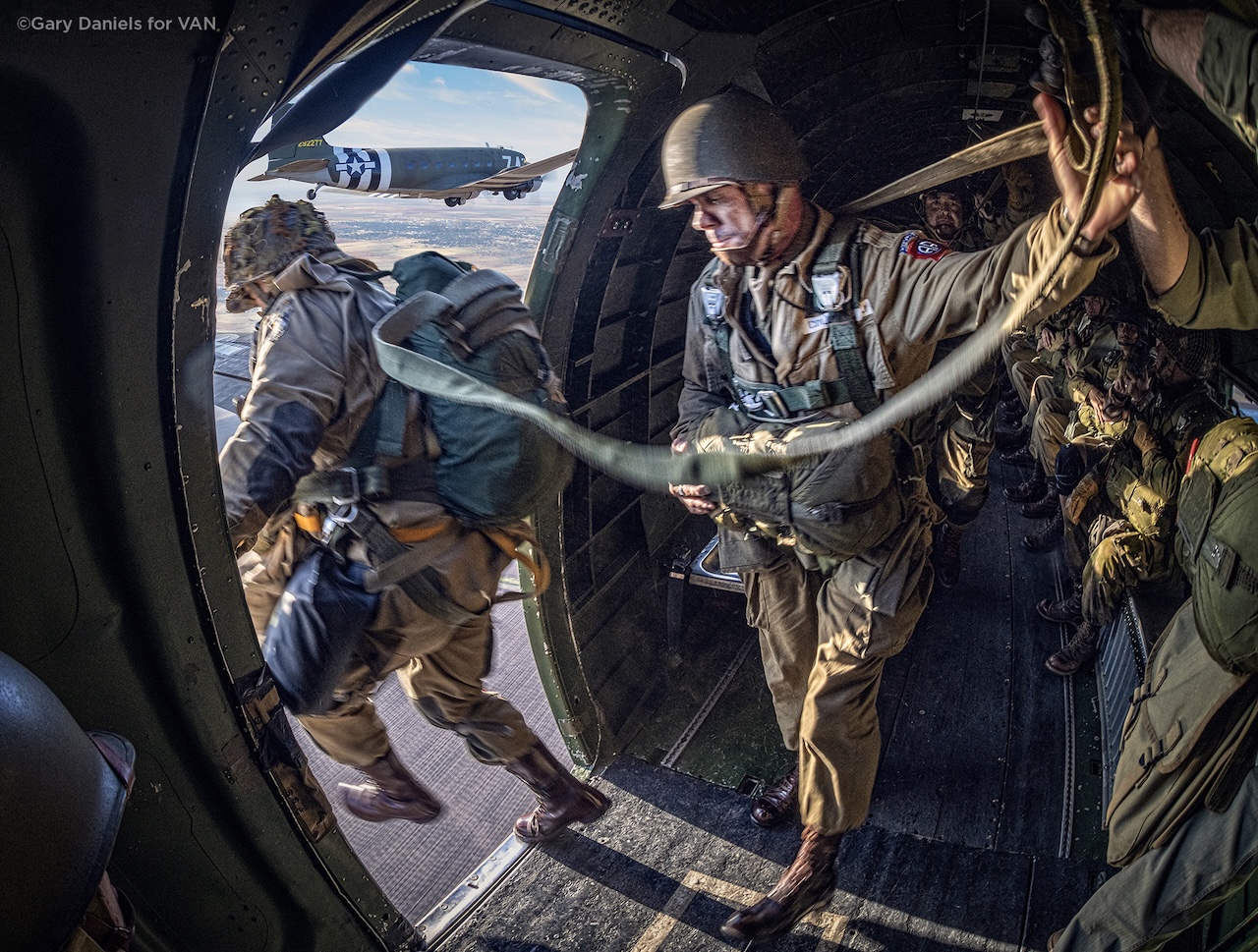
For ADT, the most impactful way to tell the airborne story is for the public to see an airborne demonstration. Witnessing Wild Kat in flight in her WWII livery, hearing the radial rumble of her two Wright 1820 Cyclones, and seeing ‘WWII paratroopers’ exiting with round parachutes deploying and then drifting to the DZ is always a thrill for the airshow audience. ADT members who have logged 35 jumps are eligible, per FAA regulations, to participate in airborne demonstrations at airshows. ADT has developed a separate airshow training and qualification program for those members wanting to jump in airshows. To honor the memory of our airborne veterans, ADT members wear exacting WWII period uniforms, carry authentic equipment, and use round parachutes to lend an air of nostalgia and provide an accurate historical link to WWII for spectators.
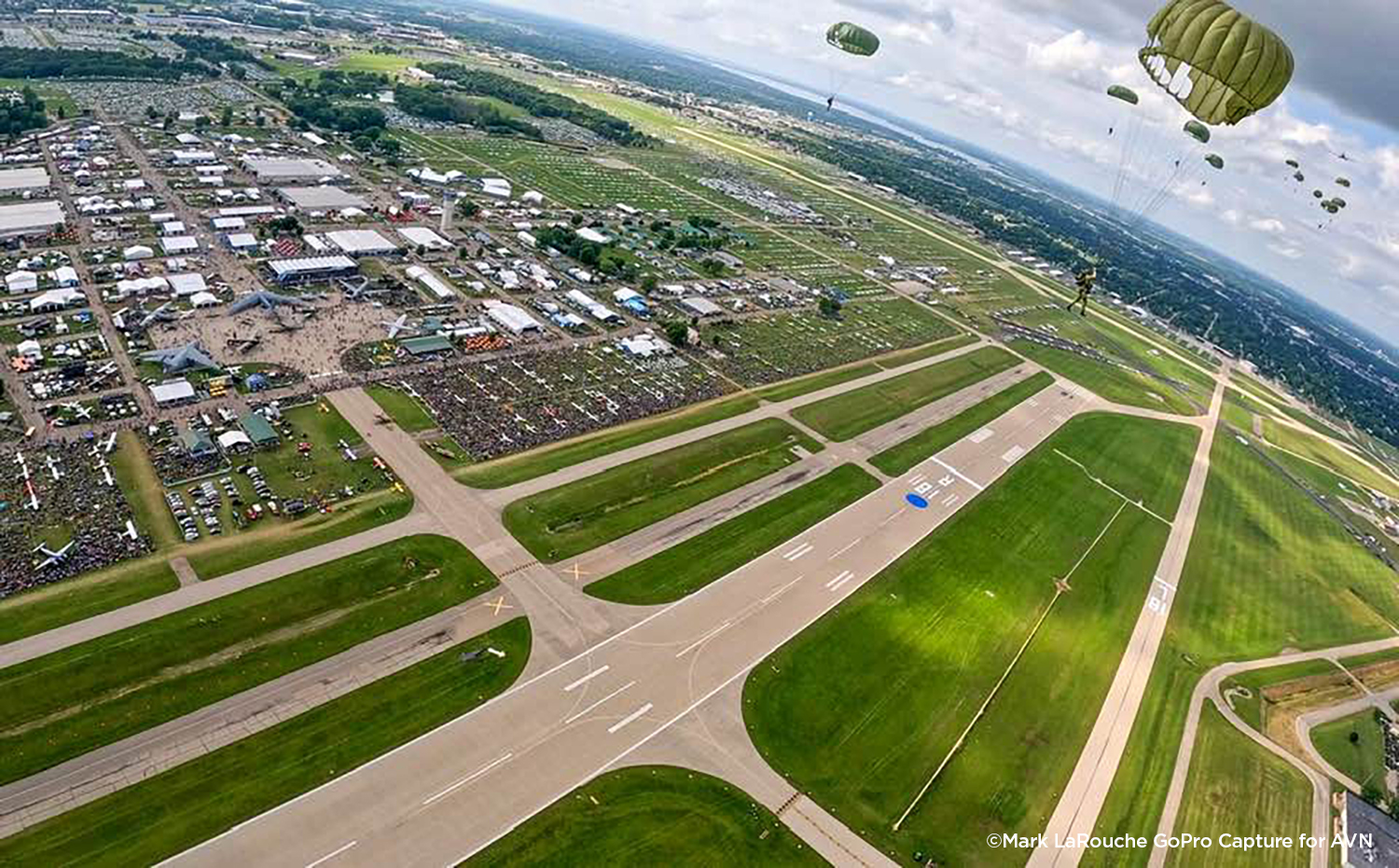
ADT is honored to be the caretaker of two historic American aviation icons. The ADT Air Wing maintains the aircraft with the extraordinary care they deserve. For ADT members and Parachute School students completing the rigorous training, jumping from one of the WWII veteran ‘Skytrains’ is an over-the-top experience. For ADT, its C-47 and C-49 bring history to life every time they lift from the runway. Every parachutist jumping from an ADT ‘Skytrain’ is a salute to our veterans and a reverent remembrance of the brave young men who volunteered to be sky soldiers and step through the door into fabled history.
| If you would like to become a member of the WWII Airborne Demonstration Team and attend jump school, contact [email protected] to find out more. The World War II Airborne Demonstration Team is a 501(c)(3) non-profit organization. To find out more, visit wwiiadt.org. |