
We appreciate the support from readers like you at Foxiz. Through your purchases using the links on our site, you empower us with affiliate commissions.
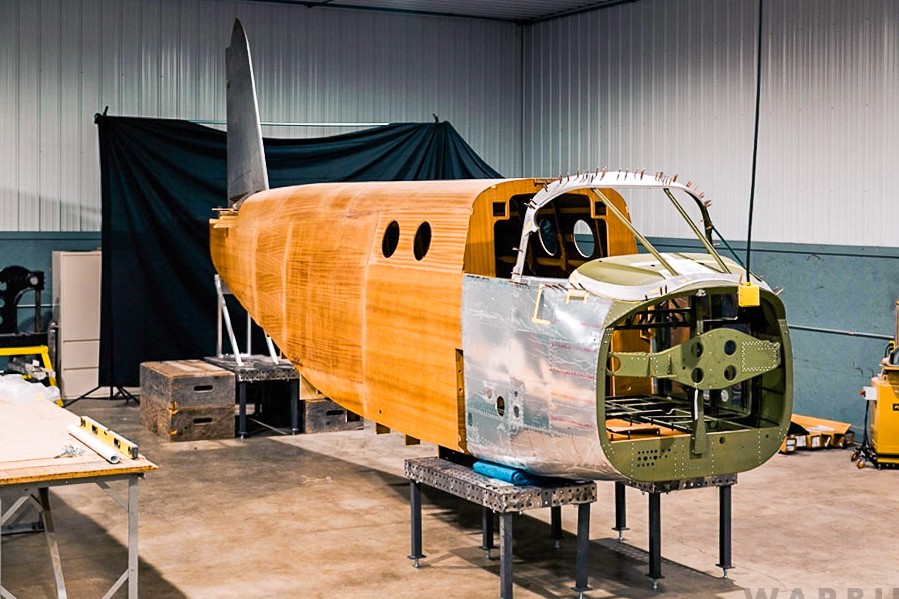
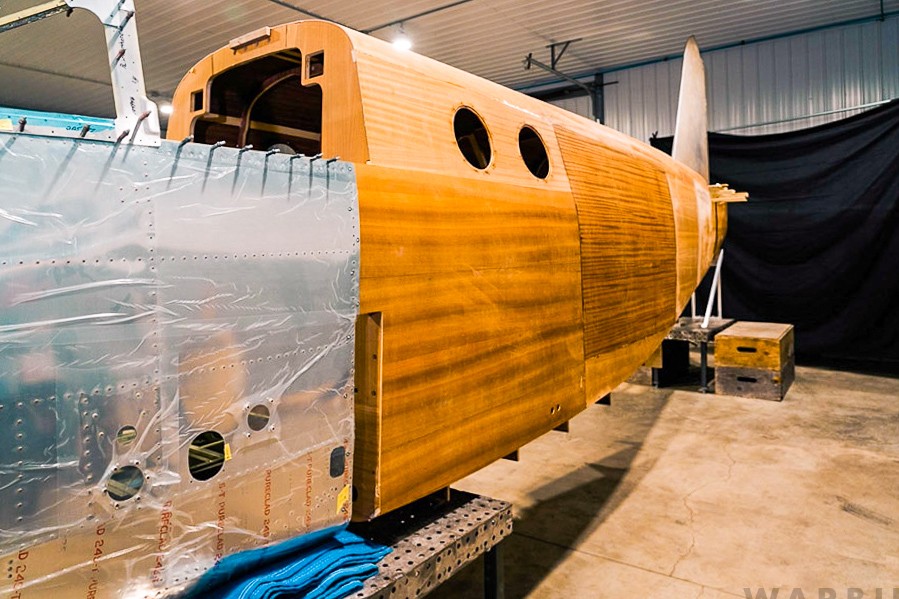
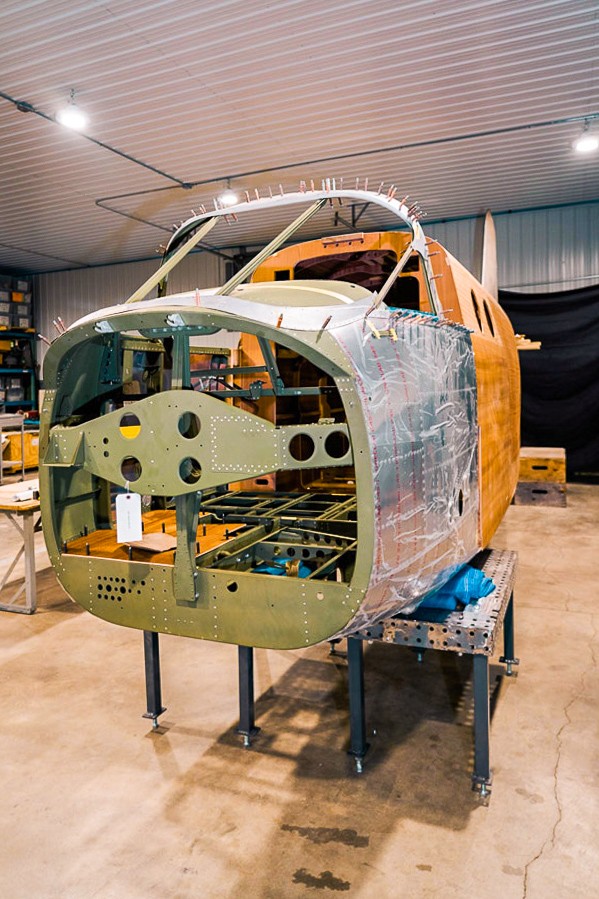
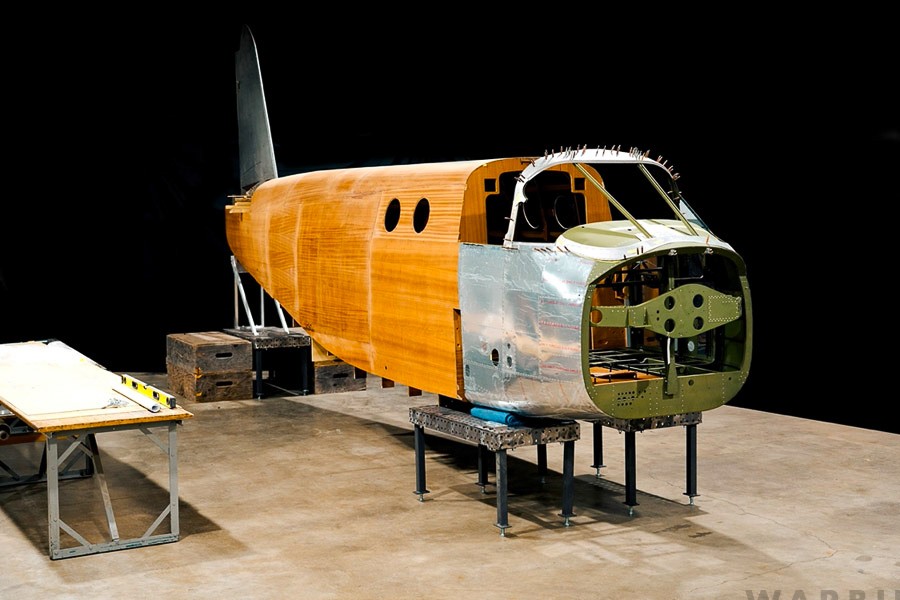
The AT-10 has the aluminum cockpit area and the vertical fin attached and really looks like an AT-10 fuselage now. (photo via AirCorps Aviation)
SHARE
We have periodically presented reports by Chuck Cravens detailing the restoration on an ultra-rare Beechcraft AT-10 Wichita WWII advanced, multi-engine trainer, but it has been almost a year since our last update. As mentioned in the previous articles, the project belongs to the Cadet Air Corps Museum and comprises the remains of several airframes, but will be based upon Wichita 41-27322. The restoration is taking place at the world-renowned AirCorps Aviation in Bemidji, Minnesota, and we now have another update on the progress as it stands so far….
Where Did All the AT-10s Go?
At the end of WWII, the USAAF had thousands of surplus airplanes on its hands. The task of disposing of or selling those planes was enormous. Some could be profitably sold to foreign air forces. Other surplus aircraft were useful in a civilian role. For example, thousands of surplus C-47s would become a mainstay of civilian companies that flew cargo and passengers for many years after the war. Some still are earning their keep with commercial operators to this day.
Other aircraft had less utility as civilian planes. The AT-10, with a limited useful load and fairly high operating cost was one of these. 2,371 AT-10s were produced by Beech and Globe. In 1946, the War Assets Administration listed 1,930 of them for sale at various locations around the country. 80% of the entire production of Wichitas was on the block as surplus. The only AAF plane with more examples on surplus sale listings in 1946 was the Vultee BT-13 (4,280).1
1 William Larkins, Surplus WWII U.S. Aircraft, BAC Publishers, Inc.; 1st edition (December 1, 2005)

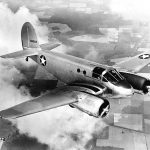
AT-10 production line. USAAF photo. (USAAF photo via AirCorps Aviation)
Many of the AT-10s that were eventually purchased were simply bought for their engines. In 1942 an AT-10 cost the government $42,688, but by the time they were sold as surplus, the price was less than $1,500 and many bought them just for their Lycoming R-680-9 engines that were suitable for use in surplus Stearmans, then finding a ready market as crop dusters. At 295hp, the Lycoming was also a performance upgrade to these PT- 13s which had similar R-680s rated at just 220hp. Most often, the AT-10s engines and other usable parts were removed, while the rest of the wooden airframe was left to rot away, leaving just the non-perishable aluminum components from the cockpits and nacelles.
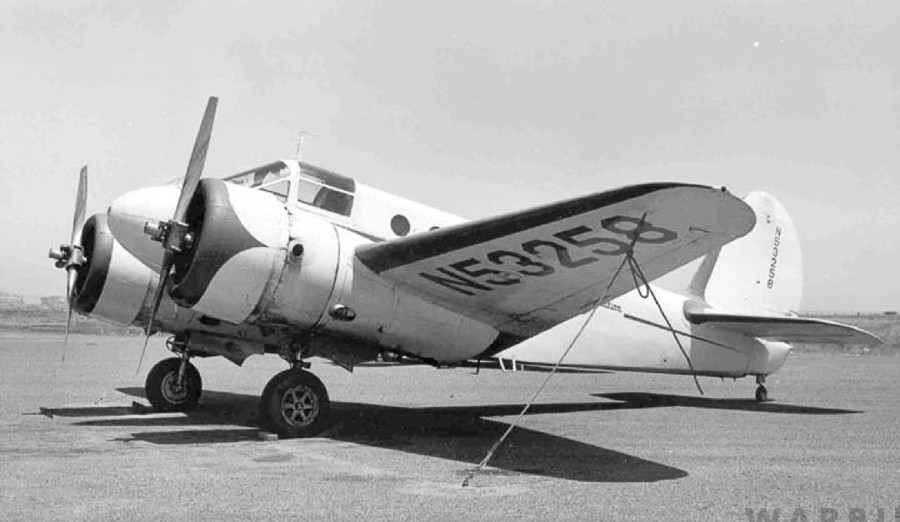
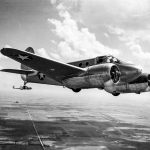
Civilian At-10. (photographer unknown via AirCorps Aviation)
The other significant reason for the lack of surviving Wichitas is that despite the forward fuselage and engine nacelles being made of aluminum, the bulk of the aircraft, even the fuel tanks, was made of plywood. Plywood was a non-strategic material, which made AT-10 construction possible at a time when aluminum was in high demand for combat aircraft, and the material’s lightness contributed greatly to the AT-10’s superior performance. However, plywood doesn’t fare well for long periods outdoors, so the aircraft remaining at the end of WWII quickly succumbed to the elements. Indeed, barely a handful made it onto the civil registry.
Only one intact Wichita remains, and this is on static display at the National Museum of the United States Air Force in Dayton, Ohio. Once completed, AirCorps Aviation’s AT-10 restoration will become the only flying example of an AT-10 in the world.
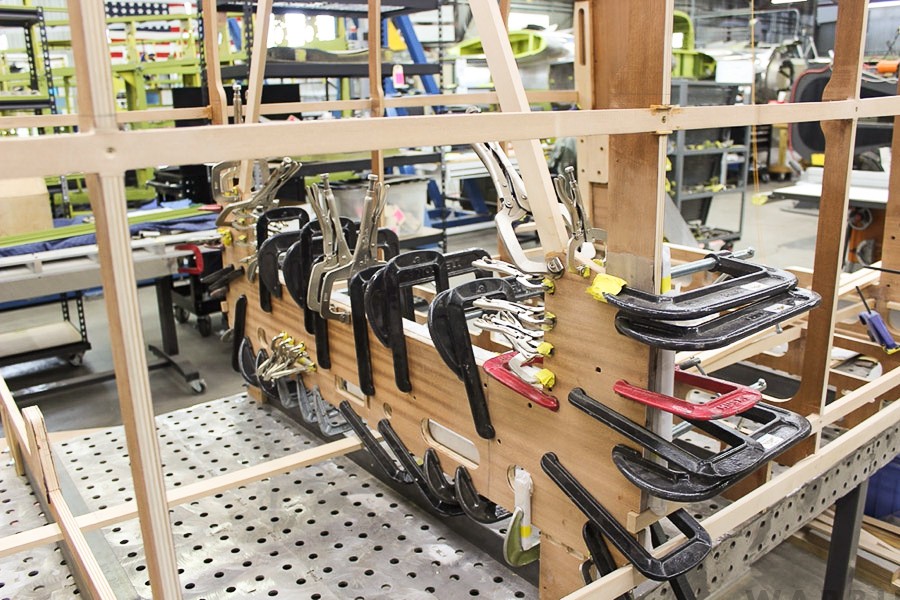
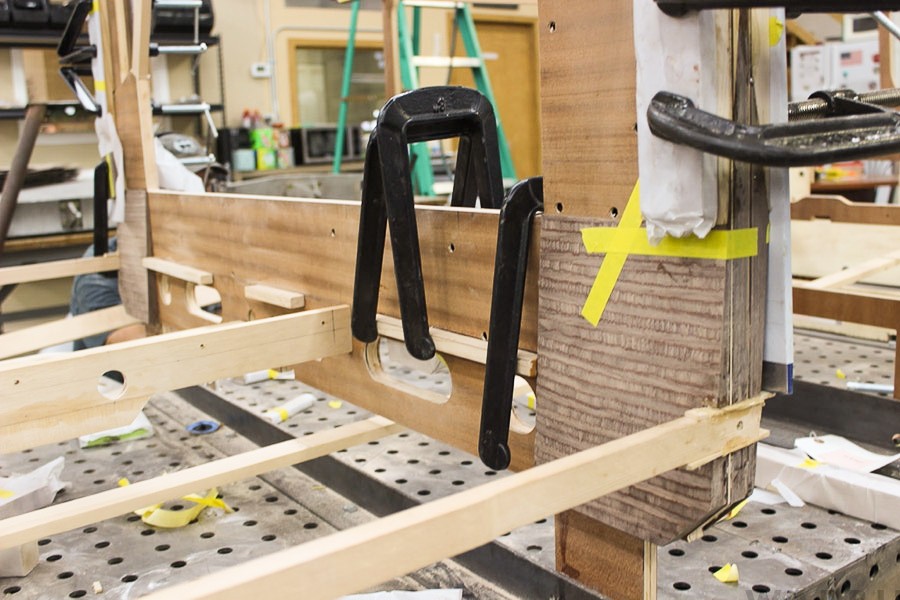
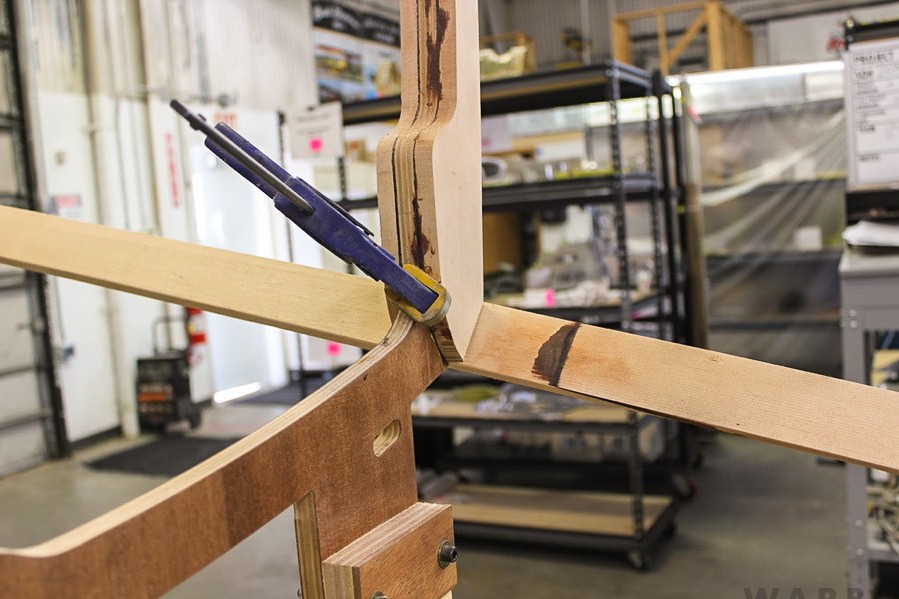
Assembling the fuselage frame required many clamps and creative solutions for applying them as the glue cured. (photo via AirCorps Aviation)
DURAWOOD
“Durawood” is called out in many AT-10 drawings and mentioned in manuals, and figuring out what it was and how to replicate it was one of the AT-10 project’s challenges. After much research, we determined that Durawood was a material composed of many layers of 1/32 inch thick walnut, laminated together with resorcinol glue. Once cured, it is stronger than a block of wood and was used in stress points and where major components were bolted together.
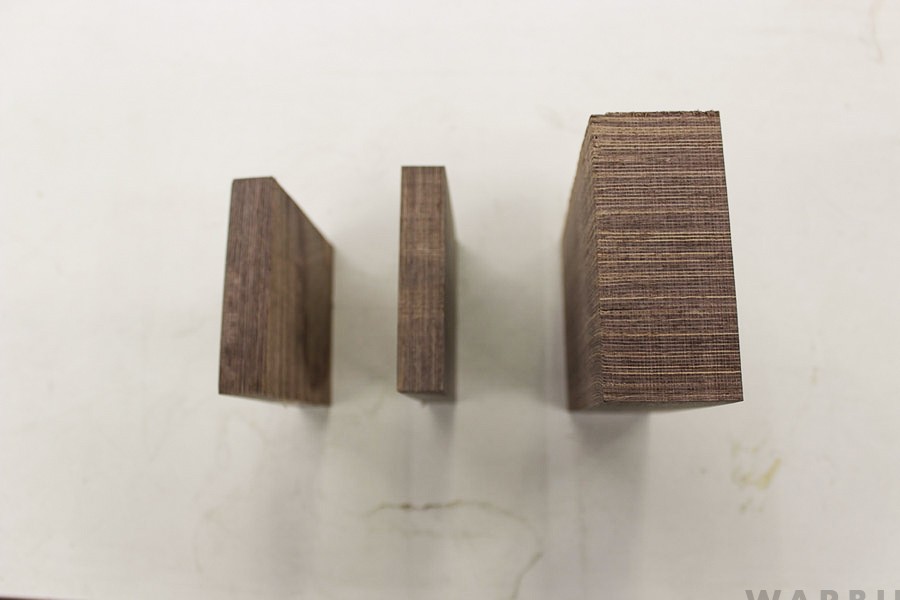
These are examples of Durawood blocks – note the many layers that are laminated together. (photo via AirCorps Aviation)
An example of Durawood in a stress point. Here, the lower corners of this center section of the wing need reinforcing where the spars attach to the fuselage. (photo via AirCorps Aviation)
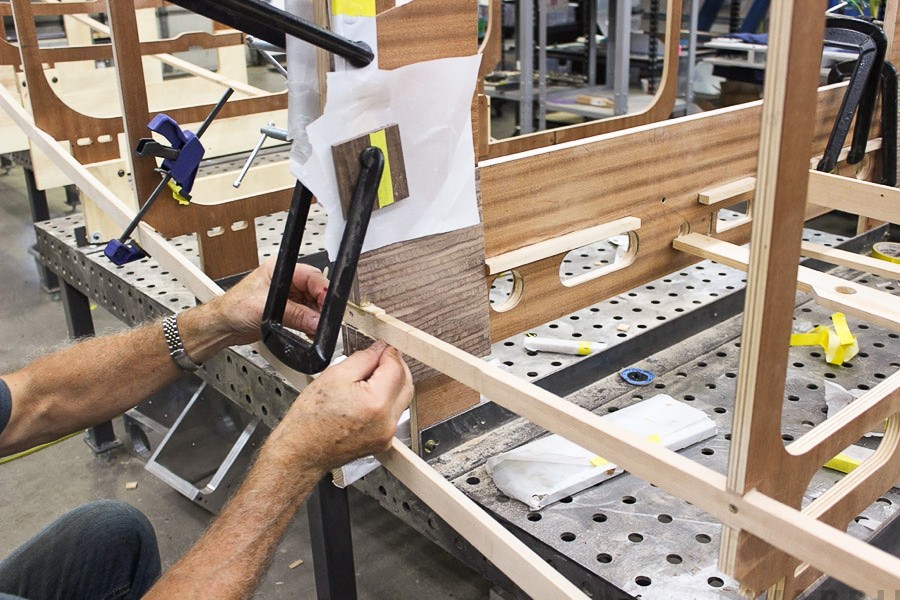
Dave glues and clamps the Durawood in place. (photo via AirCorps Aviation)
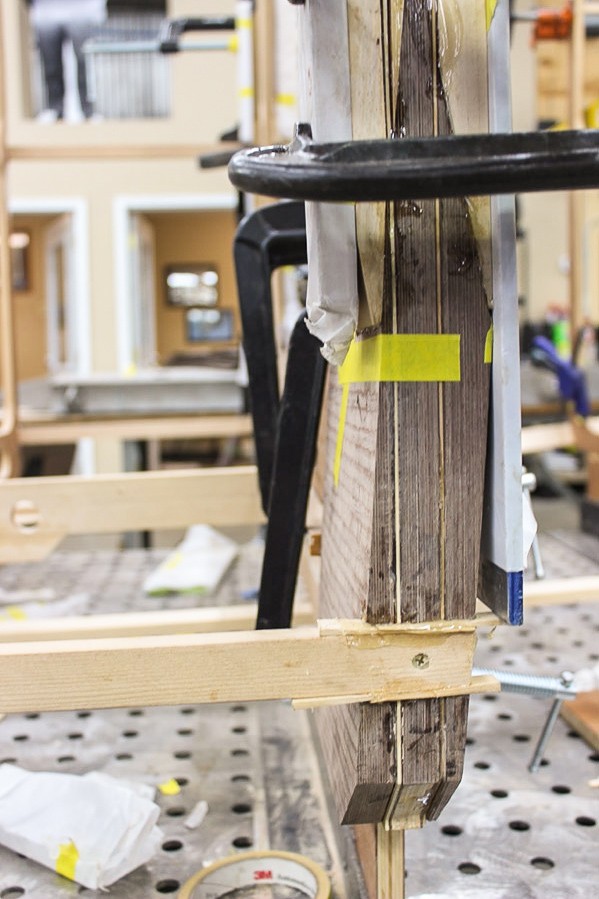
The taper of the forward and rear Durawood plates will allow for the wing’s angle of incidence as the spars are bolted to these reinforcing plates. (photo via AirCorps Aviation)
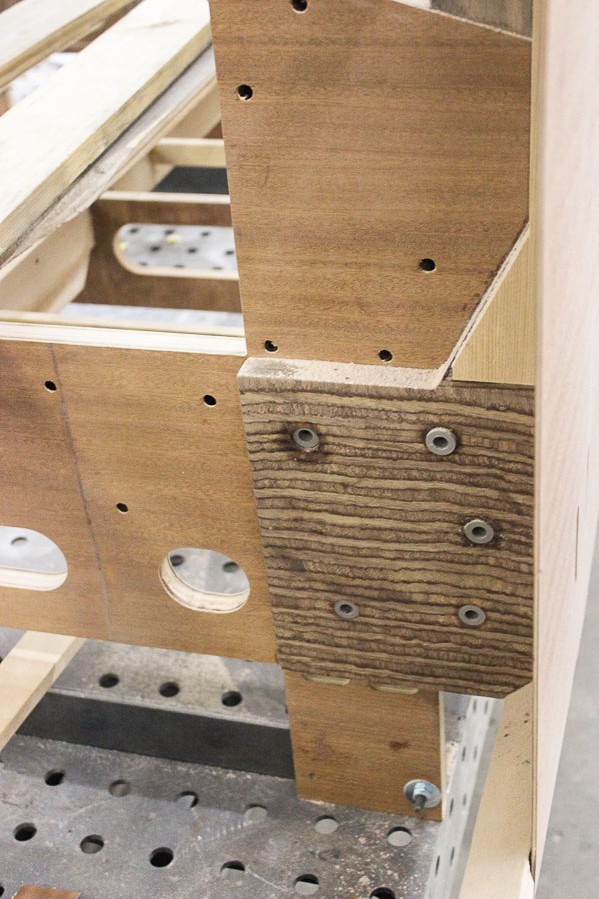
The attach point is finished in this image. The holes for the spar bolts have been drilled and bushed. (photo via AirCorps Aviation)
LONGERONS
After the bulkheads and formers were mounted in the fixtures, the longerons had to be formed and installed. They have some complex tapers and bevels.
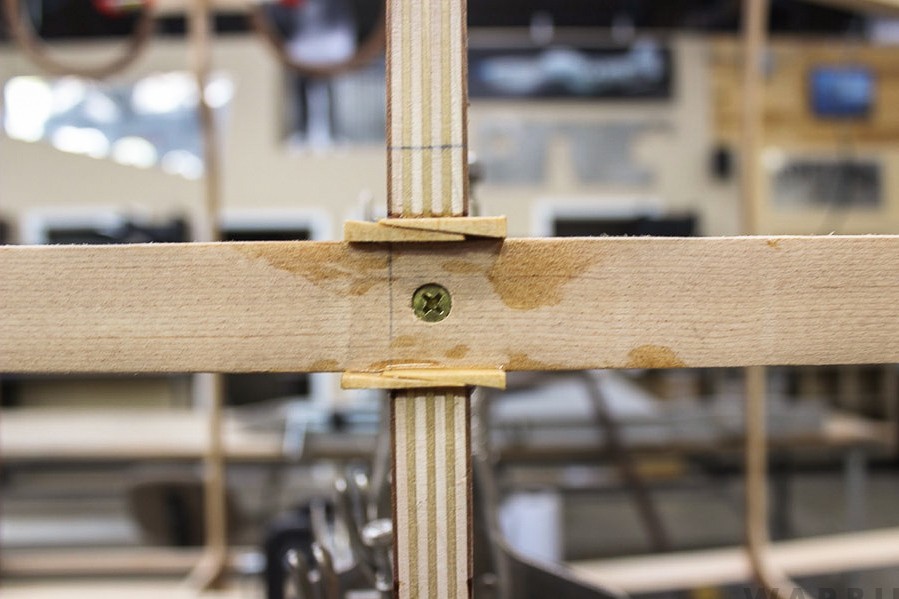
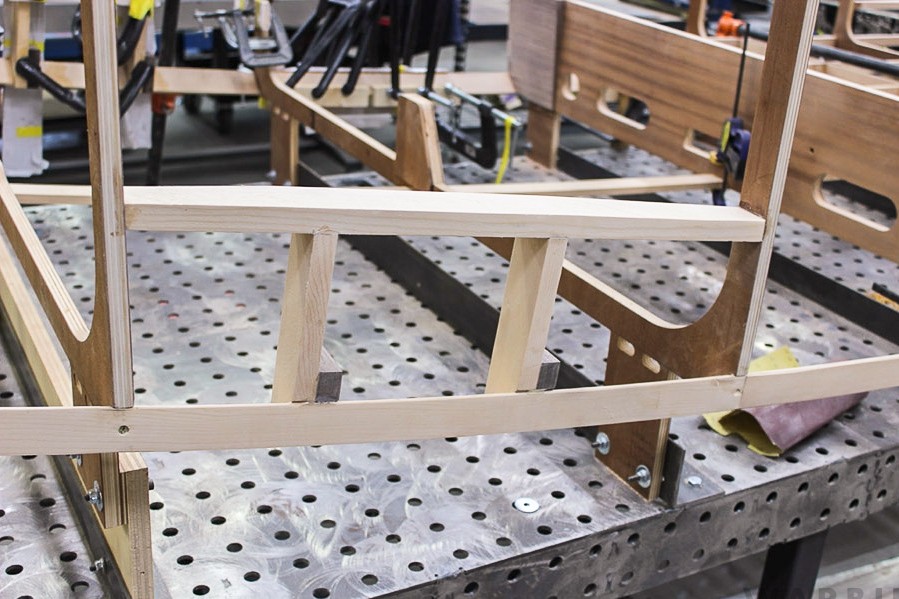
The notches for longerons were cut over-width. They did this so that they could use wedges to precisely adjust the position of the longeron to make it run straight. (photo via AirCorps Aviation)
Once the longeron’s final position established, the wedges are glued in place and trimmed flush with the former and the longeron. (photo via AirCorps Aviation)
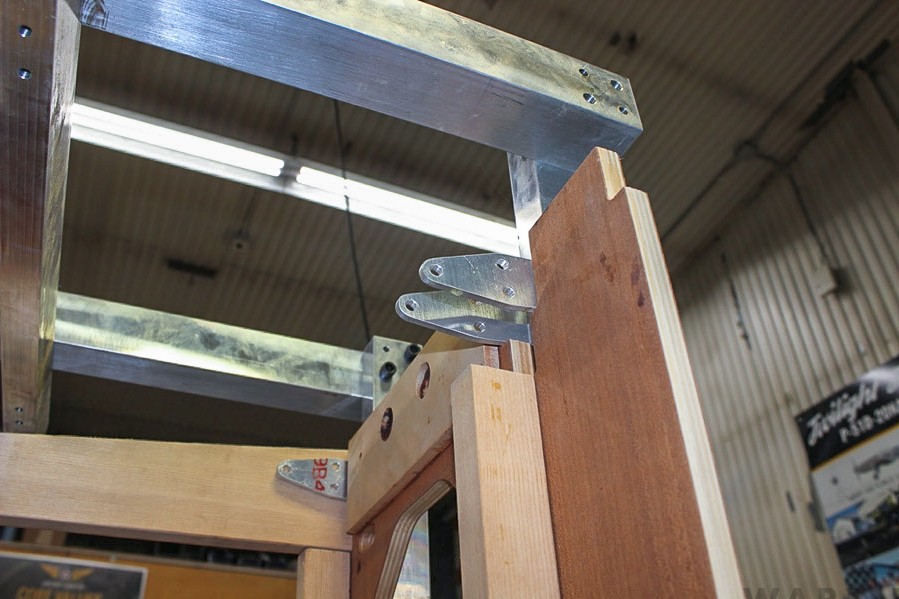
The upper rear of the fuselage has aluminum brackets which connect the tail cone to the main fuselage. (photo via AirCorps Aviation)
This reinforced section of a fuselage former will be drilled to accept the brackets that the lifting tube will mount to. (photo via AirCorps Aviation)
This is the bulkhead just in front of the horizontal stabilizer. (photo via AirCorps Aviation)
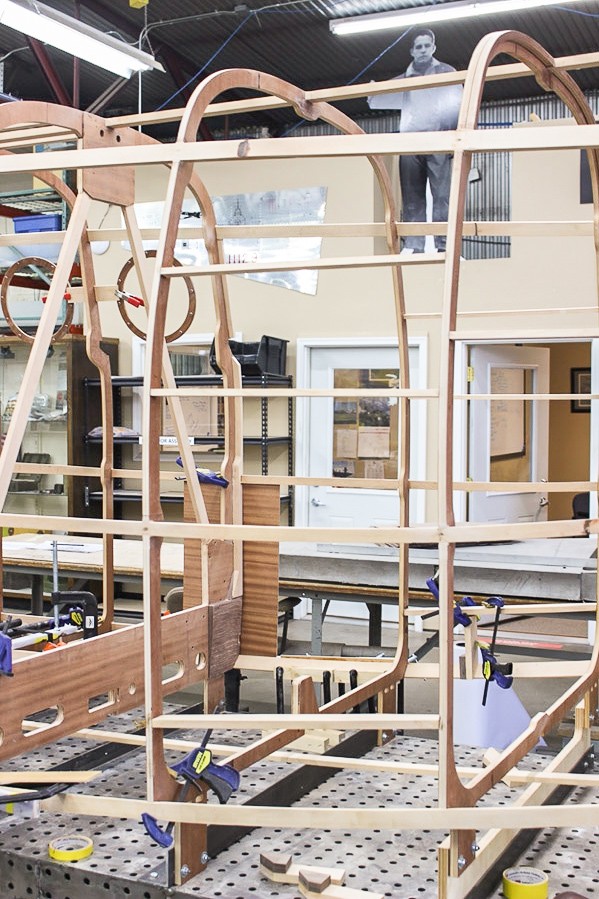
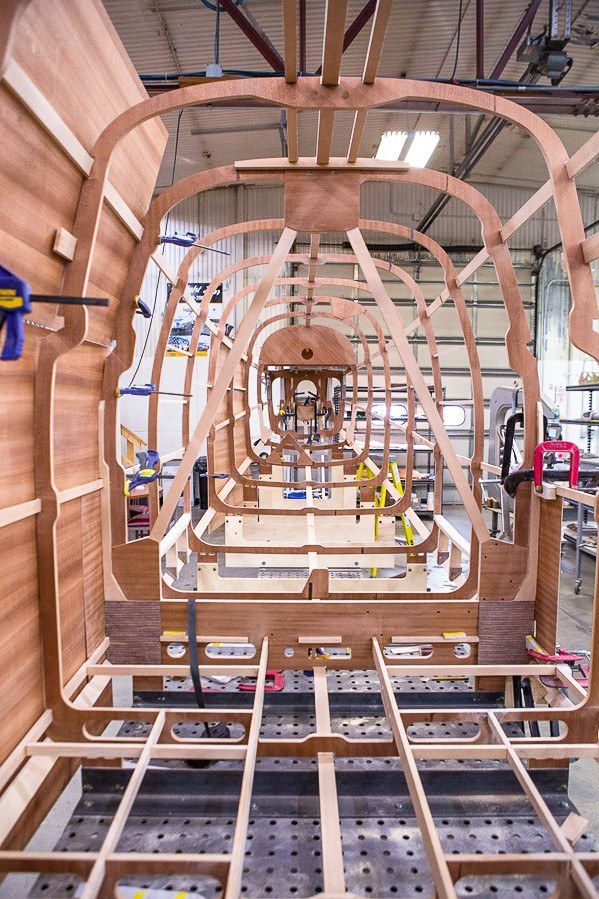
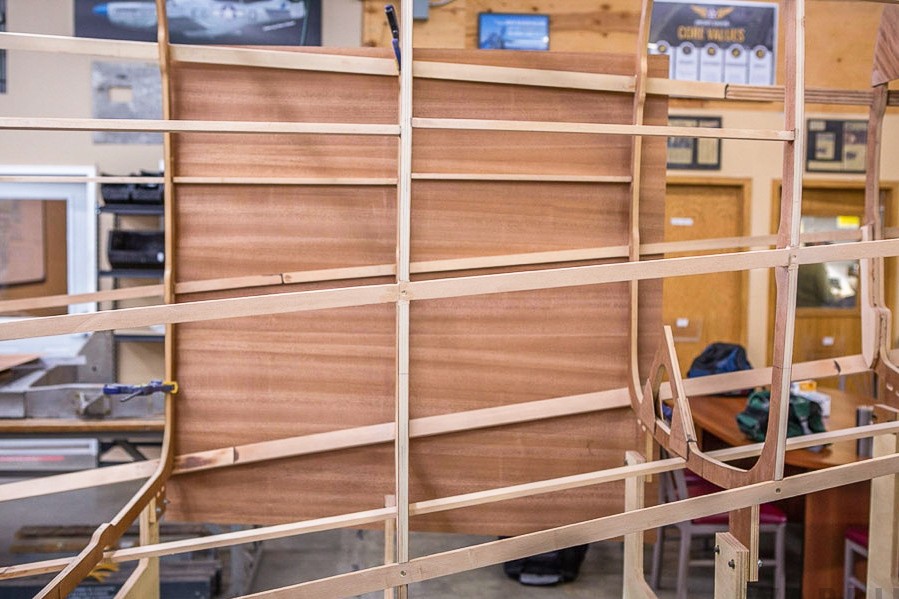
The complex framework of the fuselage is evident in this photo. (photo via AirCorps Aviation)
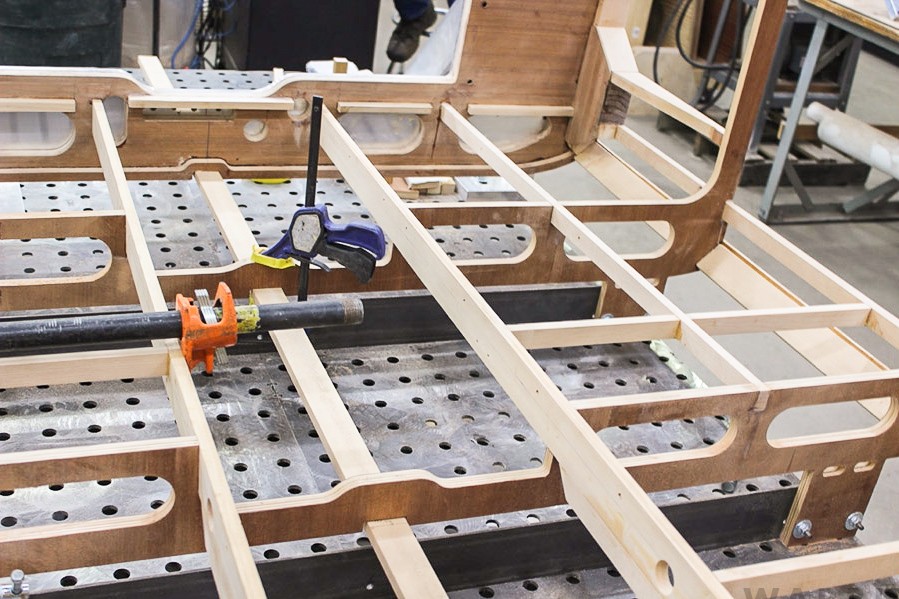
Bar clamps hold parts of the cabin floor framework together. This section will be over the wing, just behind the metal cockpit section. (photo via AirCorps Aviation)
Looking forward over the rear spar bulkhead toward the forward spar bulkhead. (photo via AirCorps Aviation)
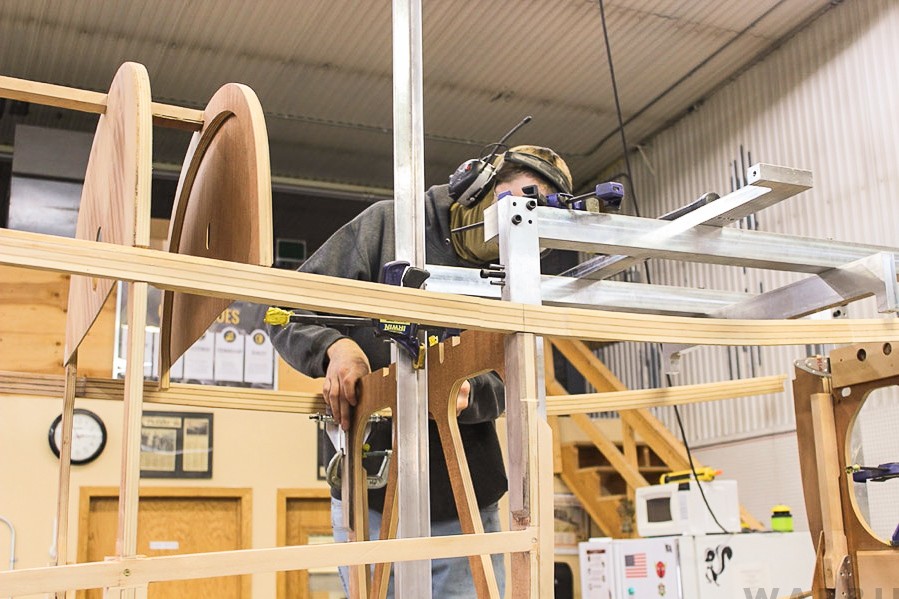
Aaron works on the rear of the fuselage where the horizontal will attach. (photo via AirCorps Aviation)
These are stiffeners for where the step will mount. (photo via AirCorps Aviation)
“PORTHOLE” WINDOWS
One of the identifying characteristics of the AT-10 is the porthole shaped windows just aft of the cockpit.
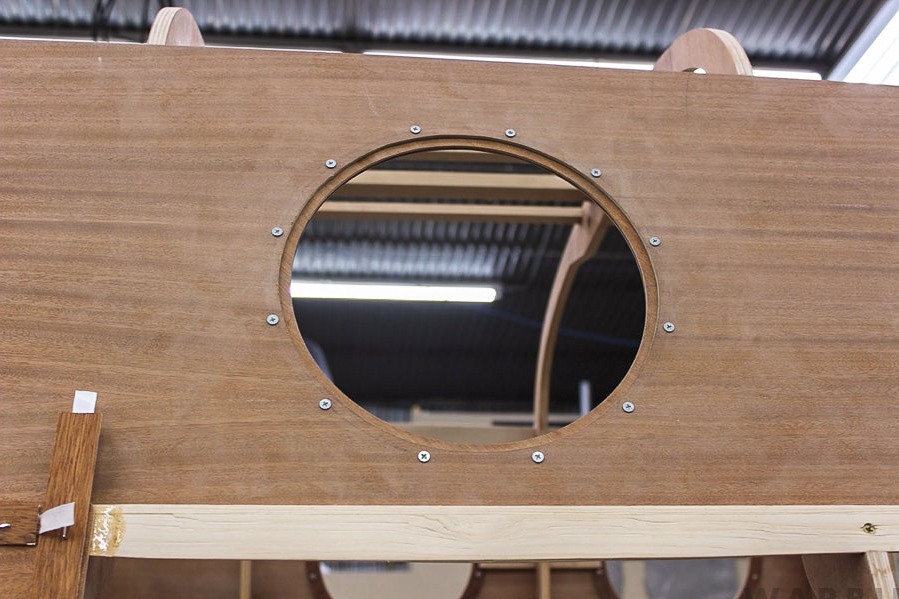
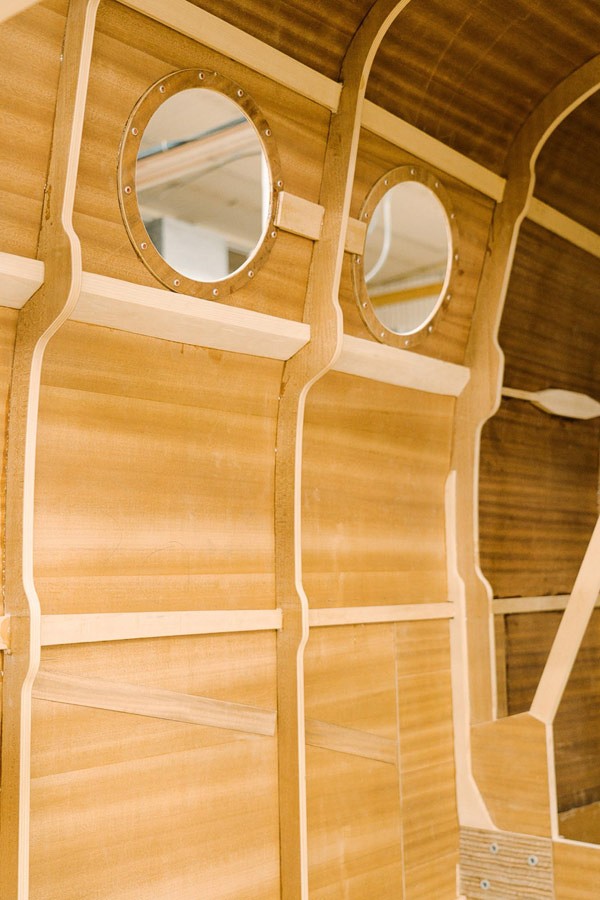
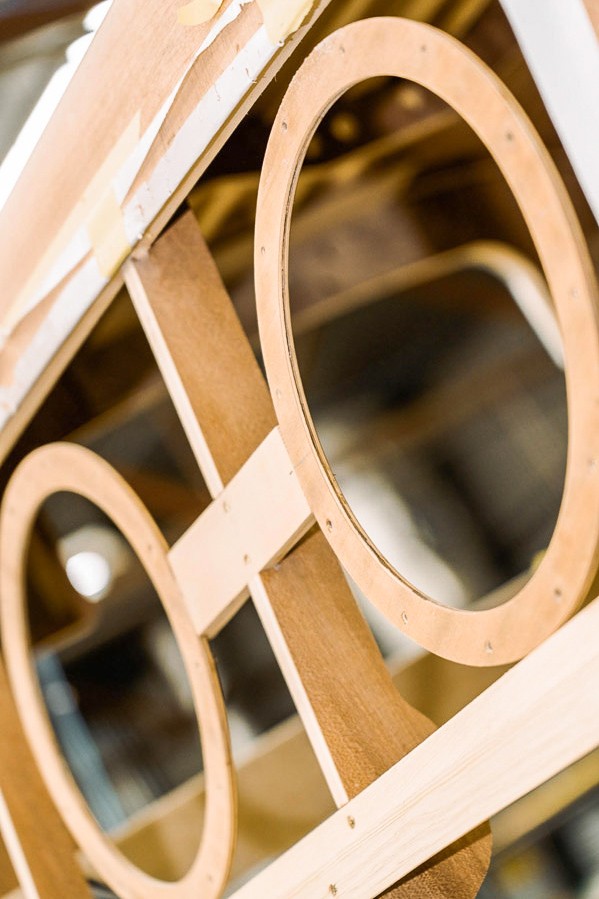
This image shows the detail around the porthole windows. The doubler hole is smaller, leaving a lip for the installation of the window. (photo via AirCorps Aviation)
The window doublers are visible from this interior view. (photo via AirCorps Aviation)
Here the doublers are positioned before the skinning operation. (photo via AirCorps Aviation)
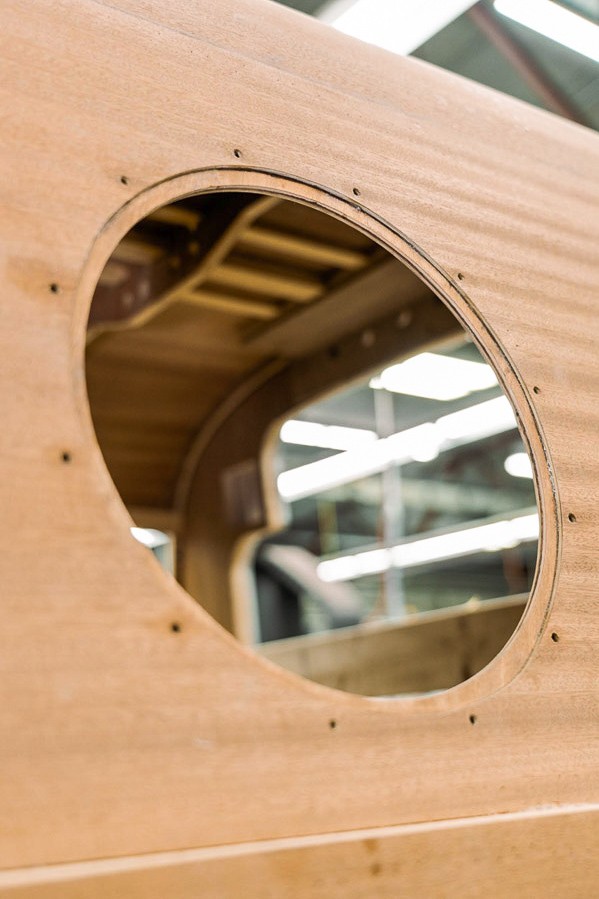
The window opening with the clamping screws removed. (photo via AirCorps Aviation)
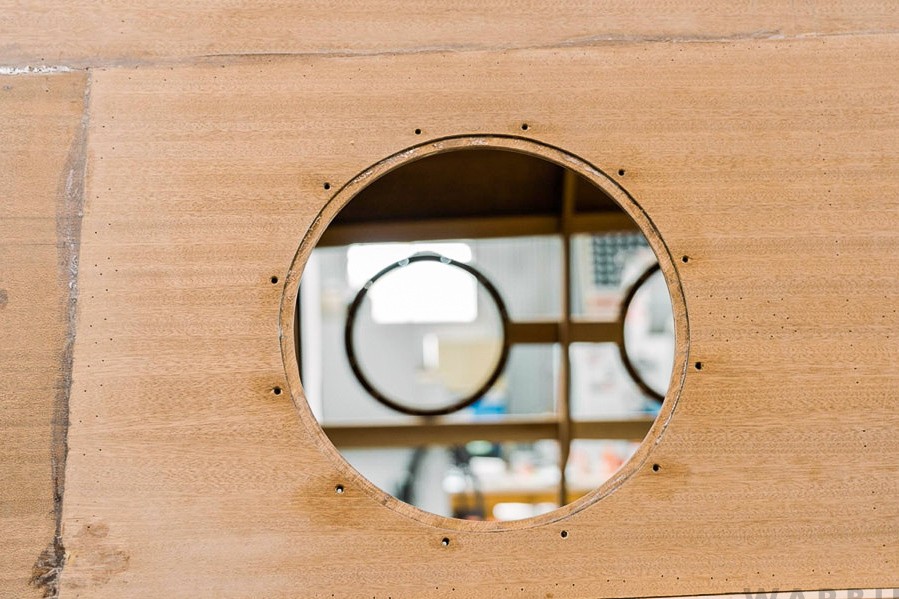
Looking through the opening toward the window doublers on the far side. (photo via AirCorps Aviation)
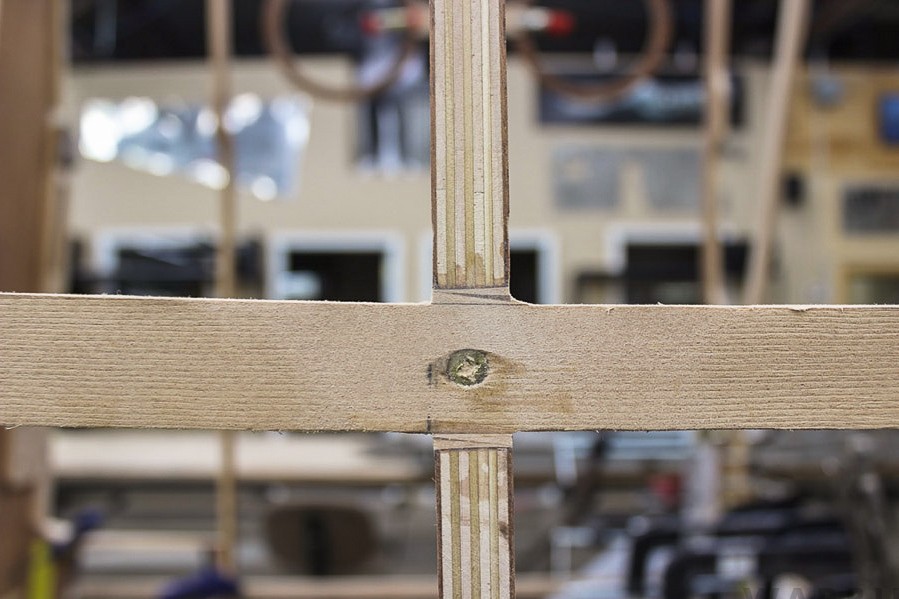
A close up shows the cross piece that holds the doublers in place for later gluing to the skin. (photo via AirCorps Aviation)
SKINNING THE AT-10
The AT-10’s skin is manufactured from 1/8th inch thick, 3-ply mahogany and poplar plywood. In many areas it must be steamed or soaked in ammonia to make it pliable enough to conform to curved fuselage sections.
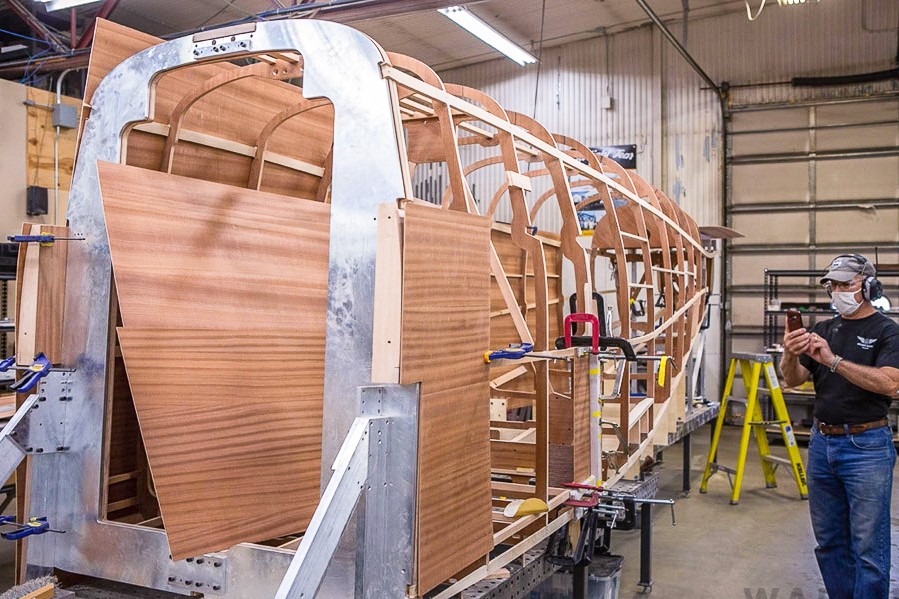
Skin doublers are the first to go on the framework. (photo via AirCorps Aviation)
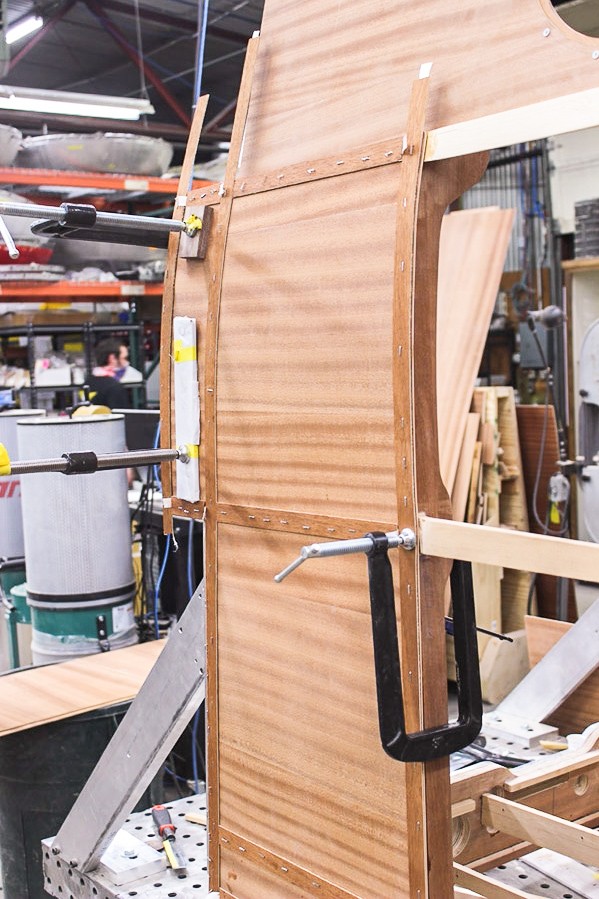
Skin sections are either steamed or, if too large for the steamer, ammonia is used to make them flexible enough to conform to the curved fuselage. When they are glued on, clamping strips are used over the skins to hold them in tight contact with the frames as the glue cures. (photo via AirCorps Aviation)
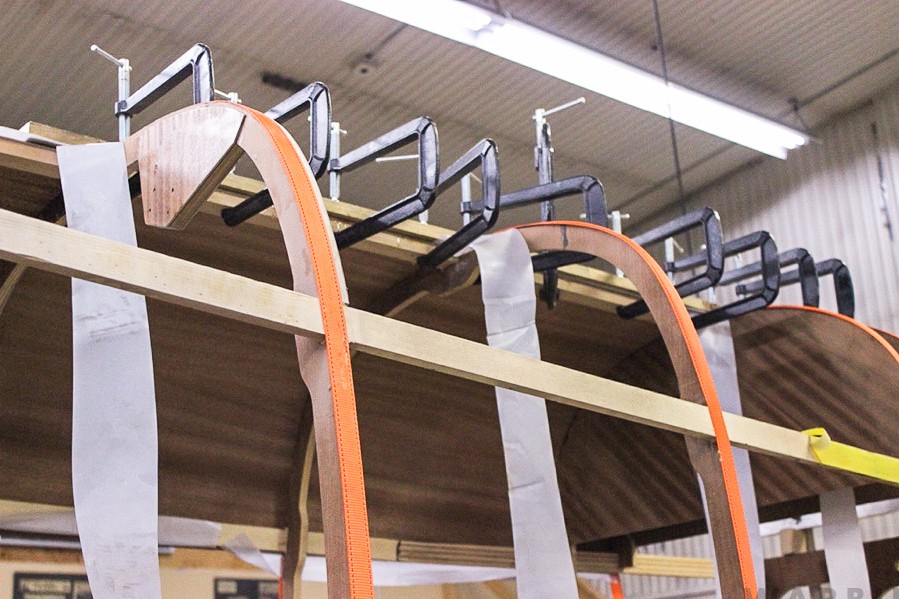
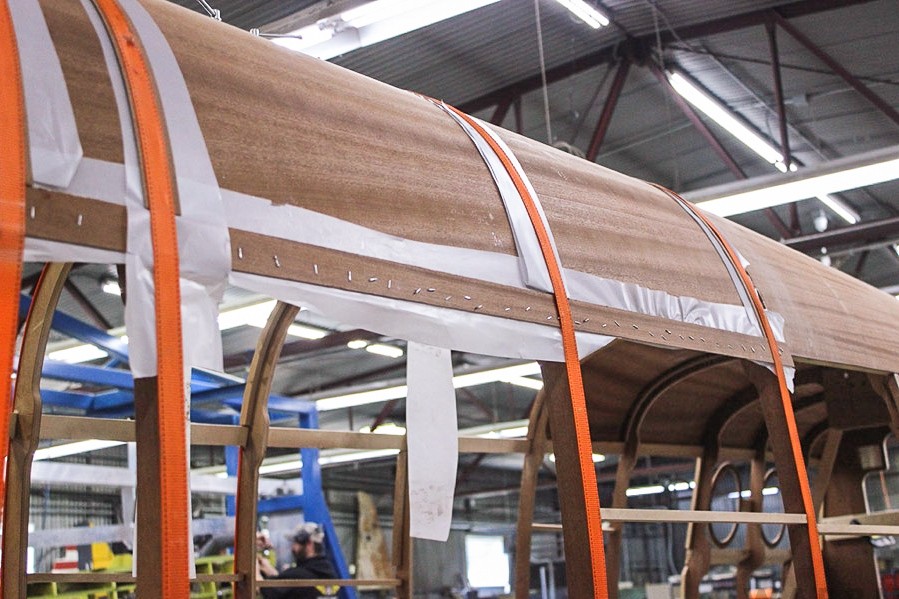
Straps and clamps are also used to hold glued skin sections in place. (photo via AirCorps Aviation)
Here is a good view of the fuselage framework from the front. (photo via AirCorps Aviation)
More skin doublers are mounted. (photo via AirCorps Aviation)
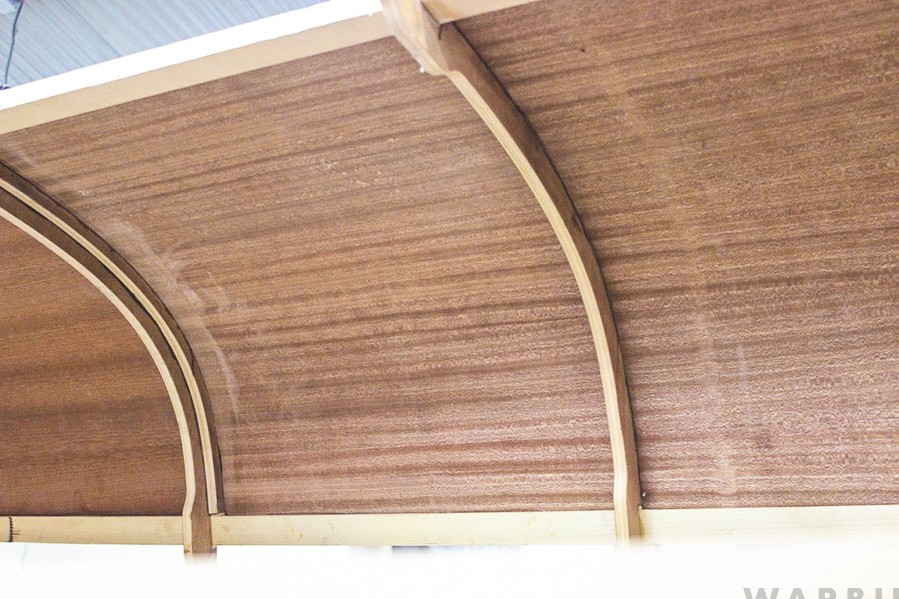
Outer view of the skin section. (photo via AirCorps Aviation)
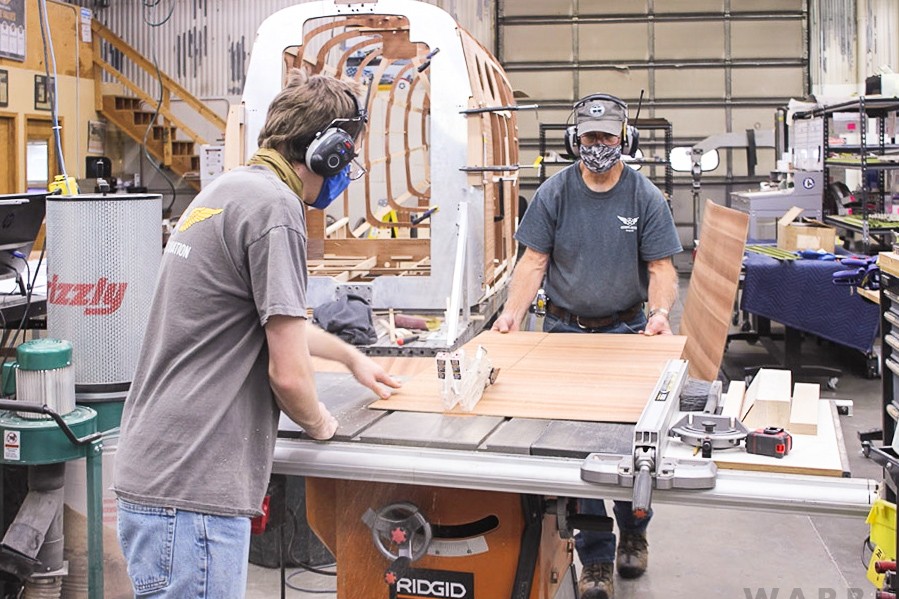
Another section of skin is cut to size. (photo via AirCorps Aviation)
Without streaming, the plywood skins would never conform to this curve without cracking. (photo via AirCorps Aviation)
A cushioning layer of plastic protects the skins from the straps and clamping strips, and keeps the glue from attaching the temporary clamping strips permanently. (photo via AirCorps Aviation)
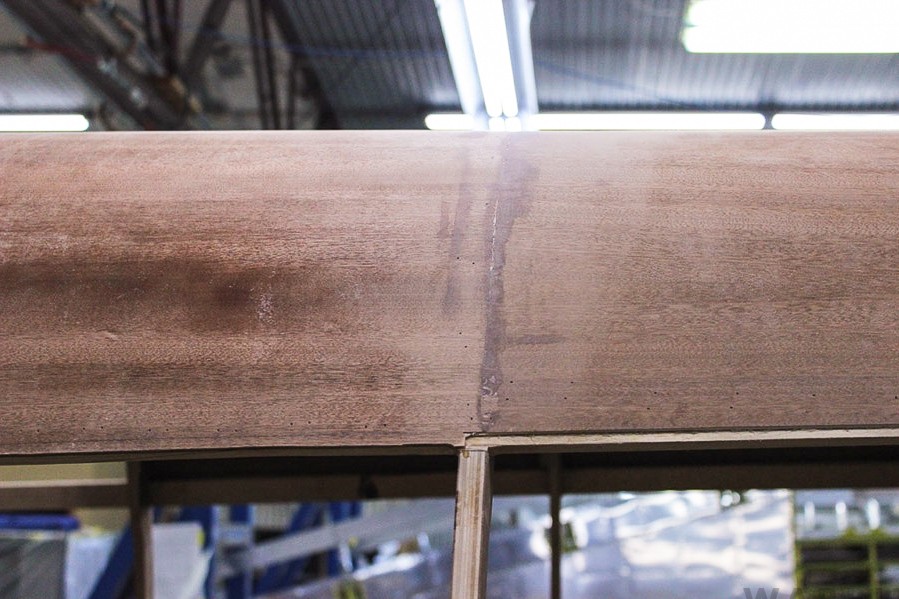
Every seam between skin sections has to be carefully beveled to create a strong scarf joint. (photo via AirCorps Aviation)
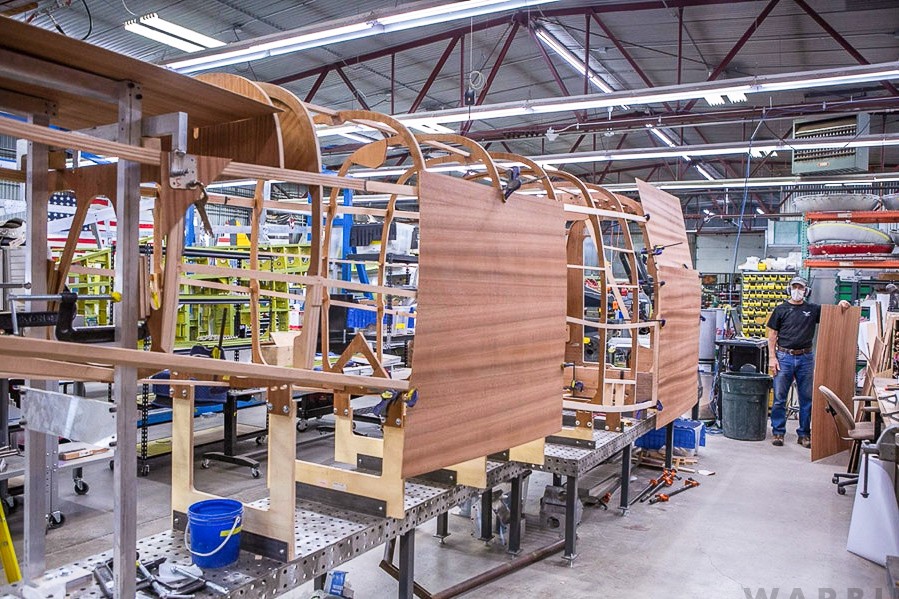
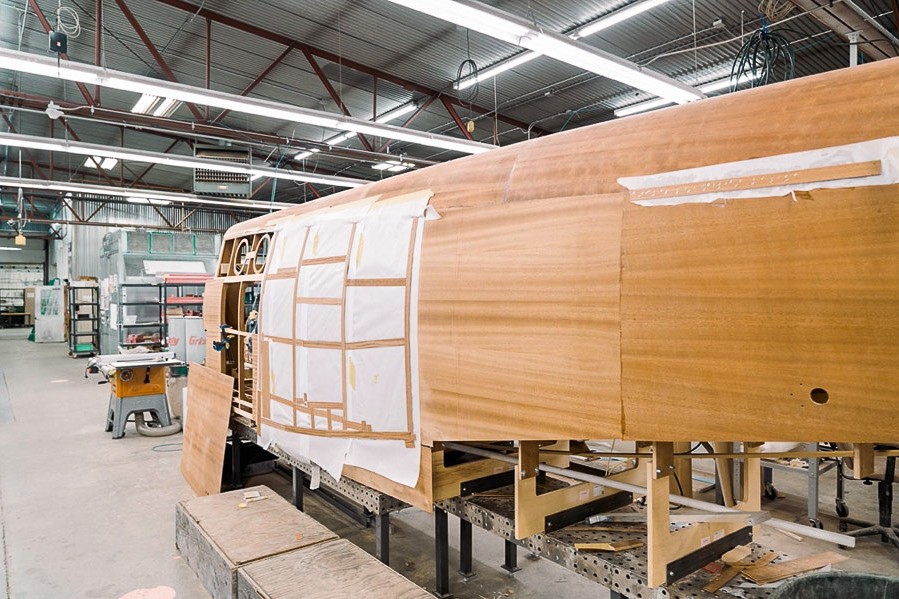
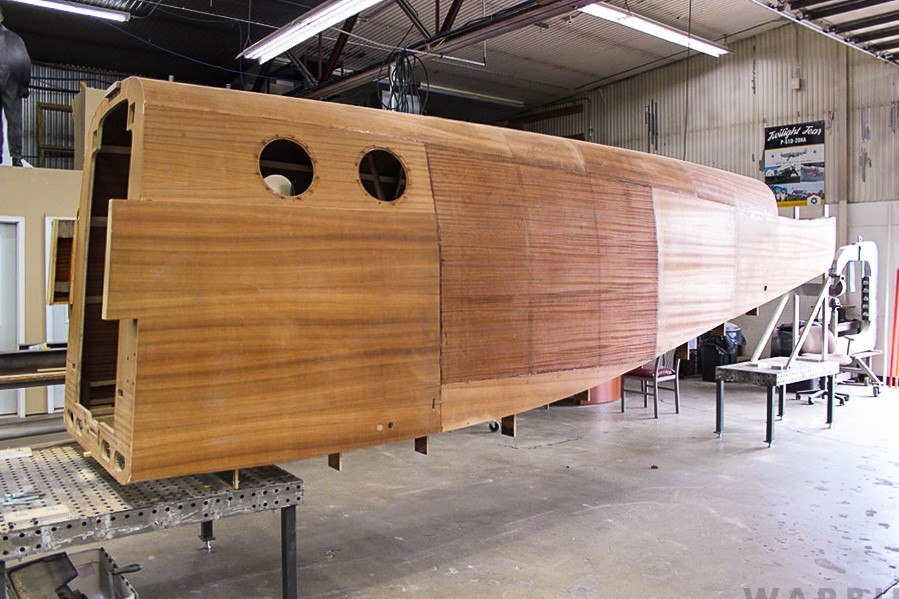
Most of the left side skin has been glued in place. (photo via AirCorps Aviation)
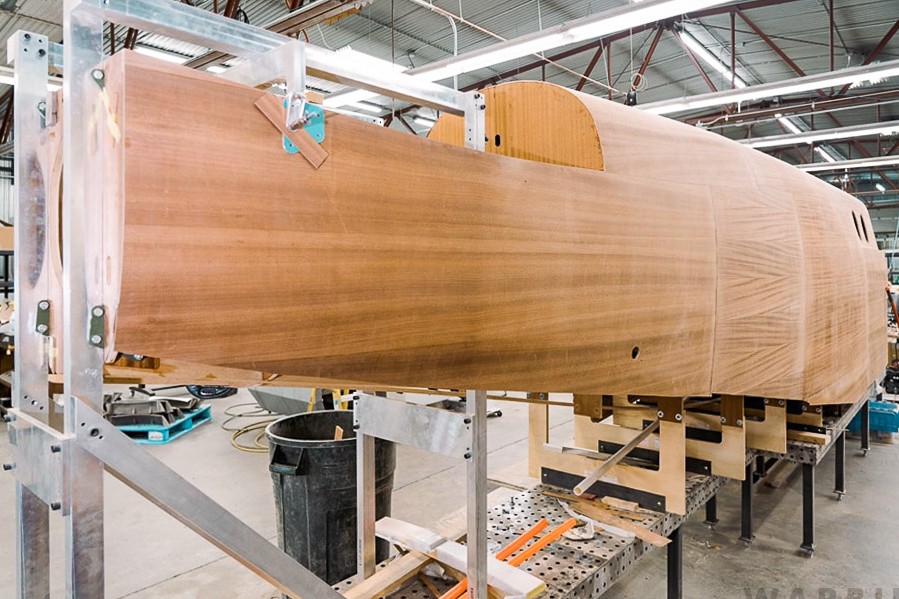
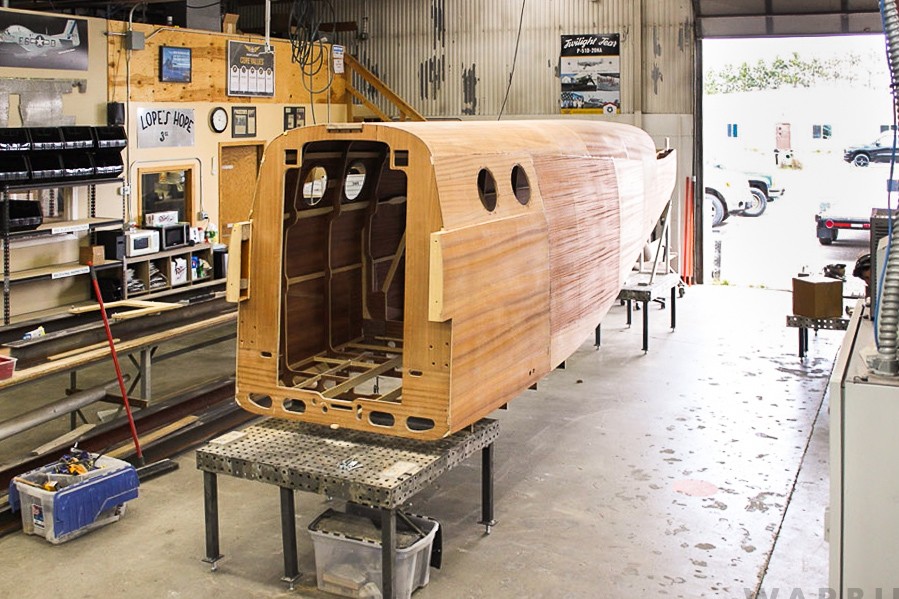
This view from the tail end of the fuselage shows the entire right side of the fuselage after skinning. (photo via AirCorps Aviation)
The right side from the front end. The forward bulkhead attached to the fixture is where the aluminum cockpit section is connected to the wooden fuselage portion. (photo via AirCorps Aviation)
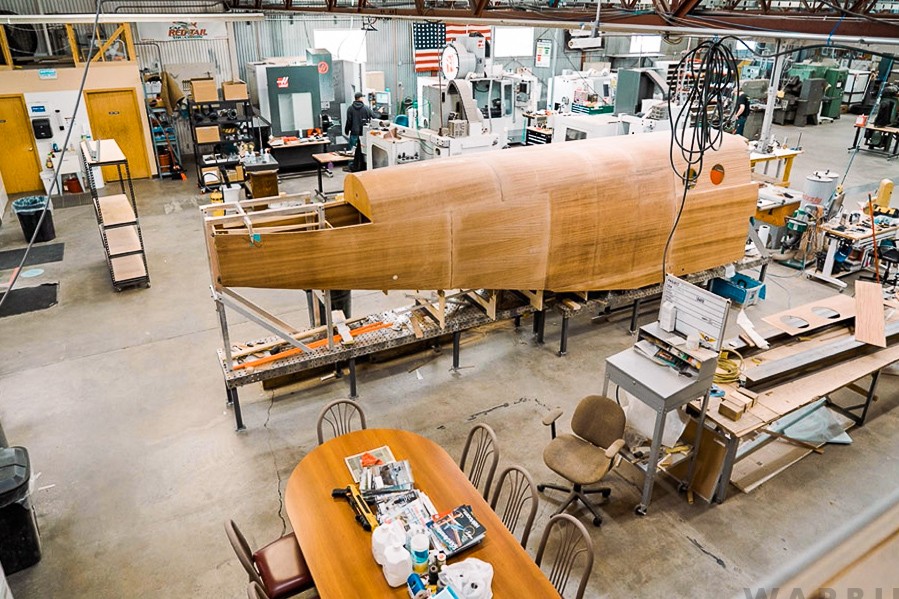
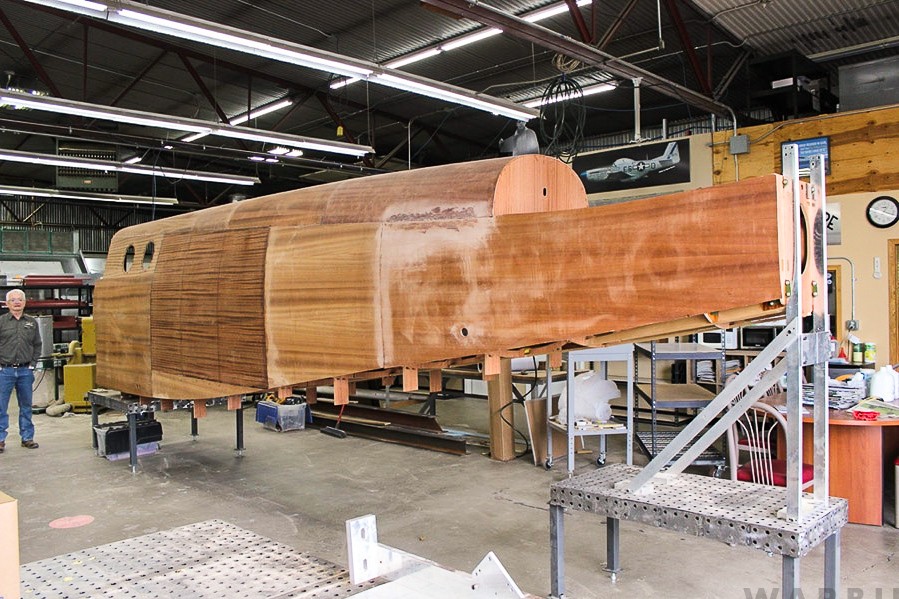
An angle looking down on the restoration shop helps show the relative size of the wooden fuselage. (photo via AirCorps Aviation)
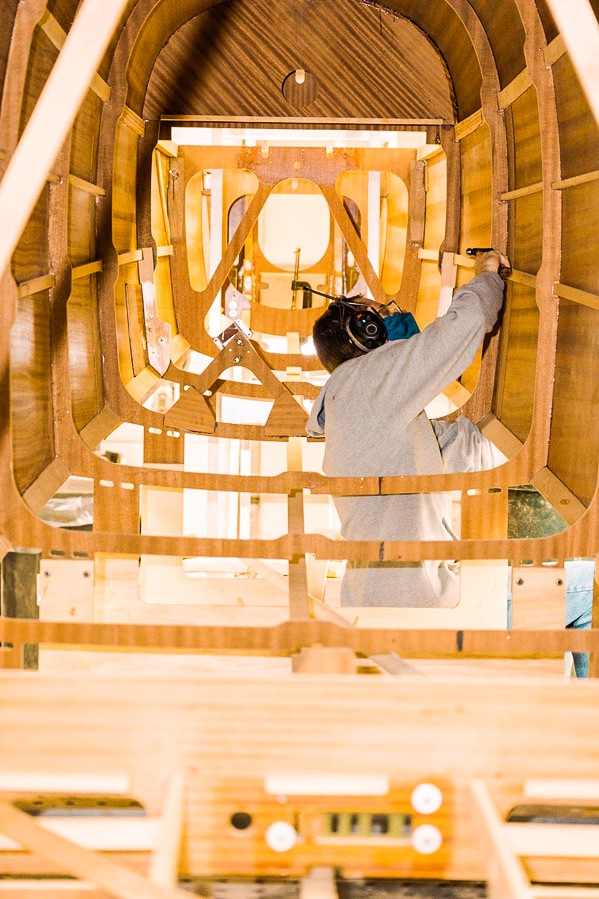
Aaron works from within the fuselage. (photo via AirCorps Aviation)
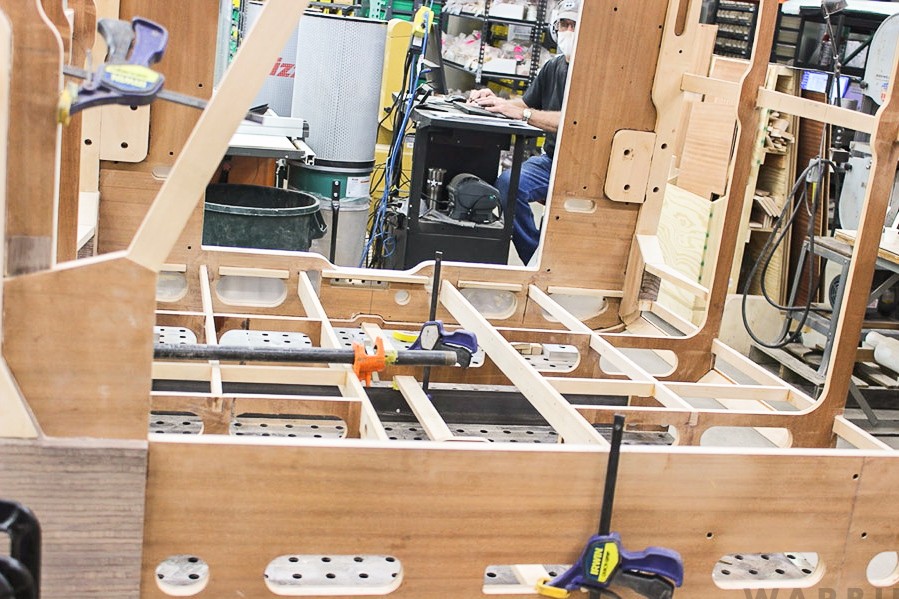
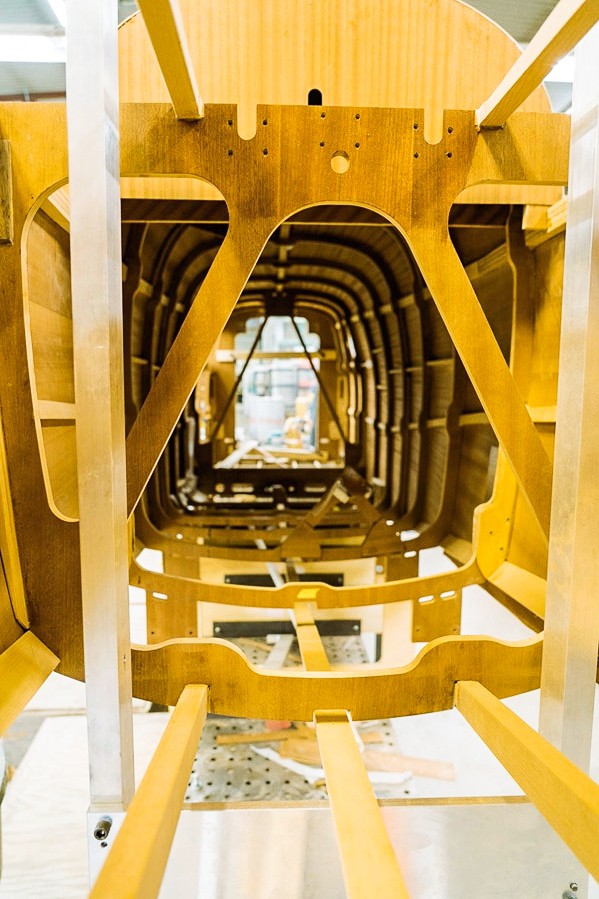
This view is looking forward through the fuselage from the rear. (photo via AirCorps Aviation)
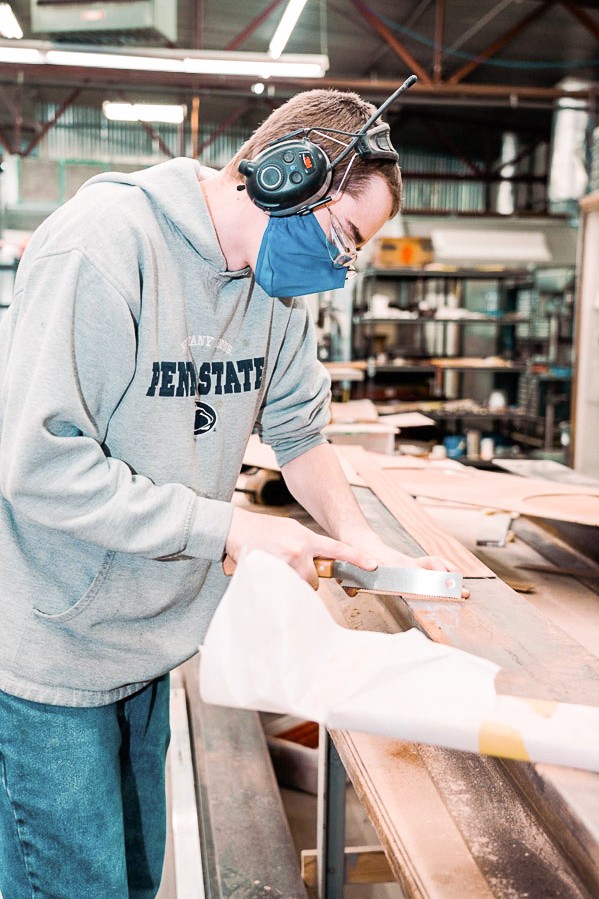
Aaron trims a nailing strip. (photo via AirCorps Aviation)
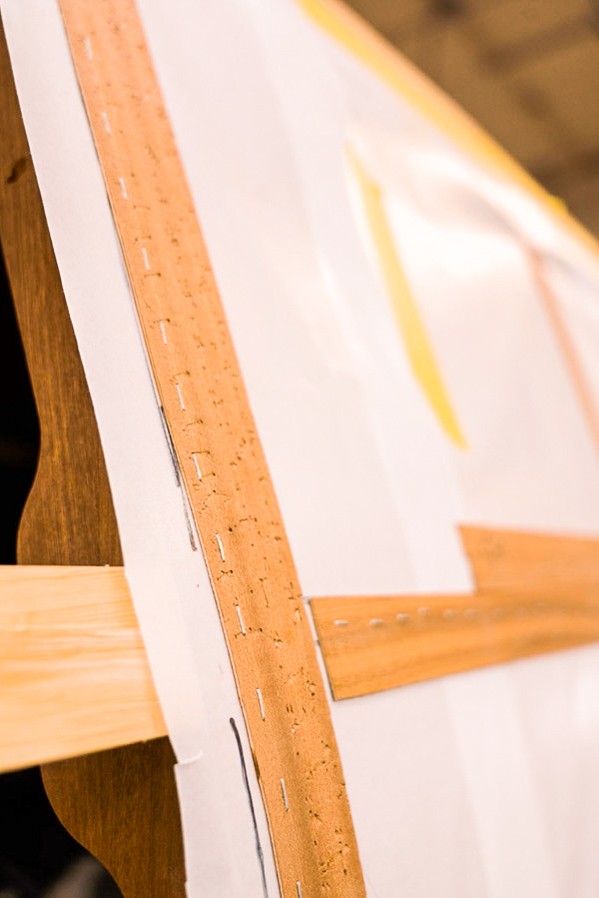
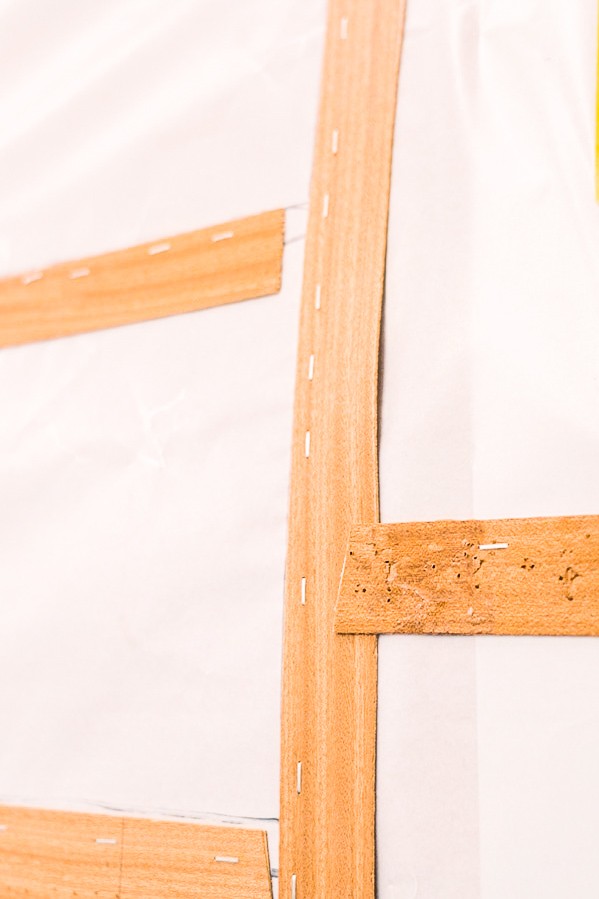
A closeup shows how the strtips of wood are stapled down to hold the skin tight to the bulkheads as it is glued. (photo via AirCorps Aviation)
The plastic under the nailing strips helps to make them easy to remove without damage to the underlying skin. (photo via AirCorps Aviation)
This ledge allows for the cockpit enclosure to be slid back. (photo via AirCorps Aviation)
The fuselage is now detached from most of the fixture. (photo via AirCorps Aviation)
Now removed from the fixture, the fuselage is ready to be moved to a more spacious area in the restoration shop. (photo via AirCorps Aviation)
The AT-10 main fuselage woodwork is very near completion. (photo via AirCorps Aviation)
The next step was to attach the forward cockpit area and the vertical fin to the main wooden fuselage.
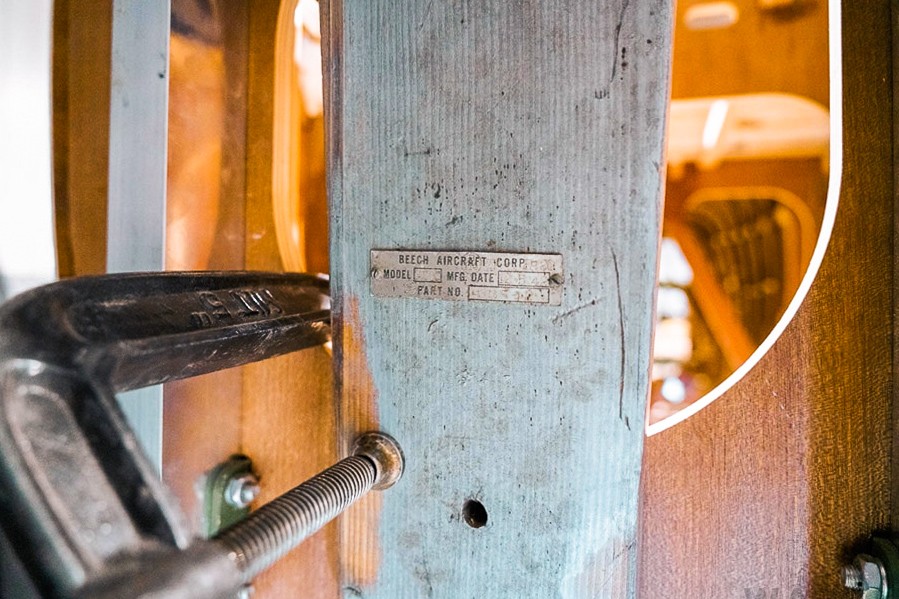
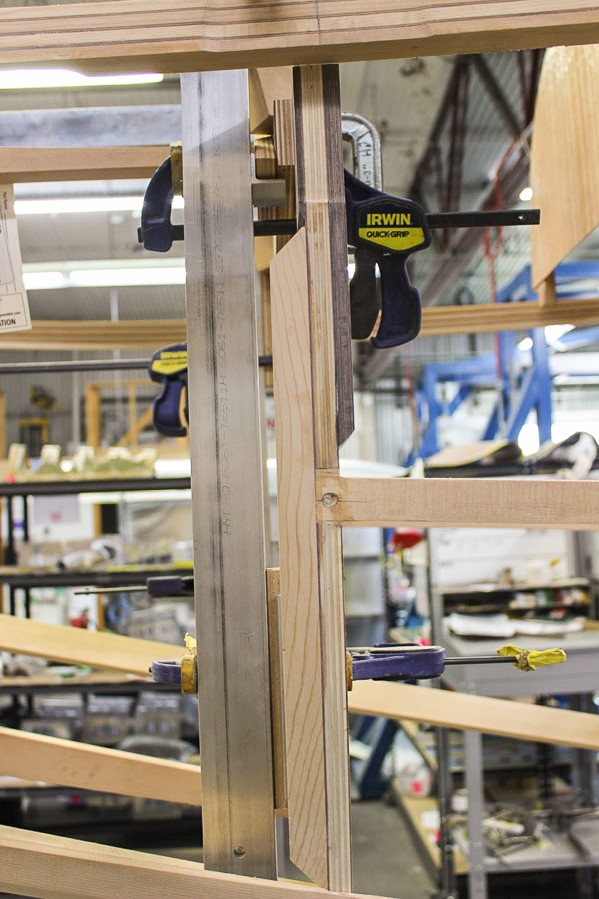
The vertical fin is clamped in place, with the Beech part tag visible. (photo via AirCorps Aviation)
The cockpit section and vertical fin have been attached. (photo via AirCorps Aviation)
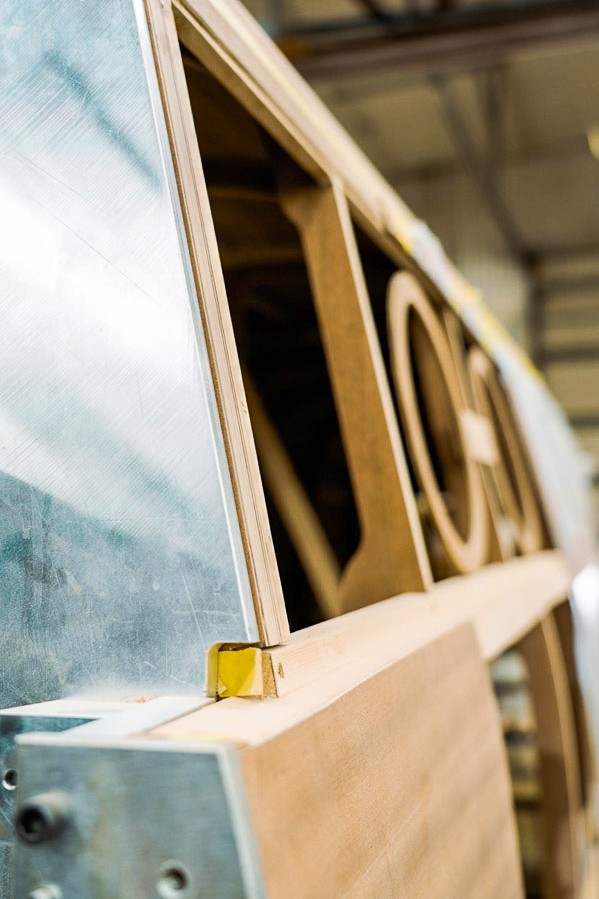
This closer image shows the junction of the wood and aluminum sections of the AT-10 fuselage. (photo via AirCorps Aviation)
The wooden cockpit floor is being fitted in place. (photo via AirCorps Aviation)
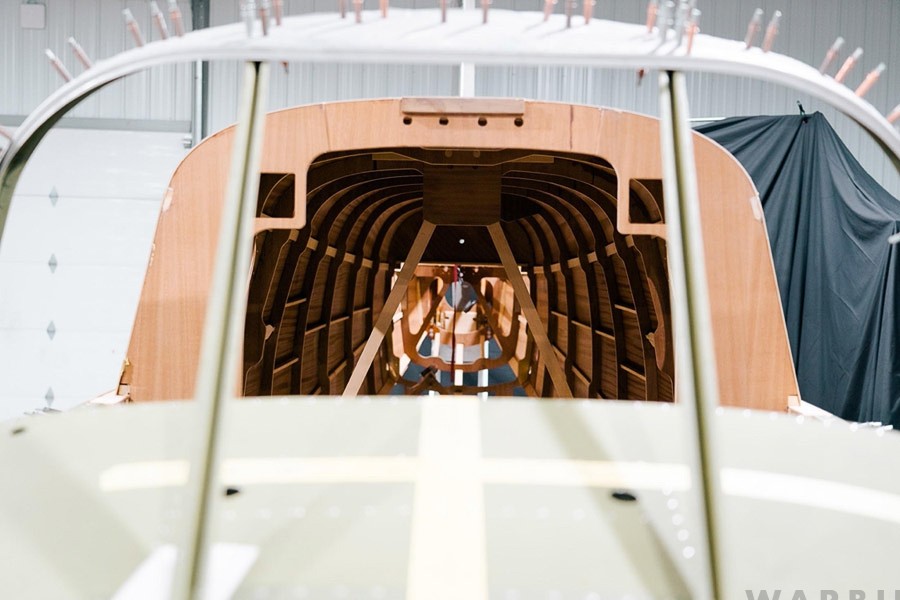
View from the windscreen back through the fuselage. (photo via AirCorps Aviation)
It is great to see such visible progress on this restoration of such an extremely rare and unique piece of history.
WANT TO GET INVOLVED?

We are constantly looking for new technical material related to the AT-10. Due to the rarity of this aircraft, and the relatively low number that were produced, acquiring parts catalogs, maintenance manuals, and other documentation has been much more difficult than with our past restorations. If you have any AT-10 material, or know someone who does, we’d like to hear from you!
And that’s all for this edition of the AT-10 Restoration Report. Many thanks to Chuck Cravens and AirCorps Aviation for this article. Should anyone wish to contribute to the Cadet Air Corps Museum’s efforts, please contact board members Brooks Hurst at 816 244 6927, email at [email protected] or Todd Graves, [email protected]. Contributions are tax deductible.
Richard Mallory Allnutt's aviation passion ignited at the 1974 Farnborough Airshow. Raised in 1970s Britain, he was immersed in WWII aviation lore. Moving to Washington DC, he frequented the Smithsonian’s National Air & Space Museum, meeting aviation legends.
After grad school, Richard worked for Lockheed-Martin but stayed devoted to aviation, volunteering at museums and honing his photography skills. In 2013, he became the founding editor of Warbirds News, now Vintage Aviation News. With around 800 articles written, he focuses on supporting grassroots aviation groups.
Richard values the connections made in the aviation community and is proud to help grow Vintage Aviation News.