






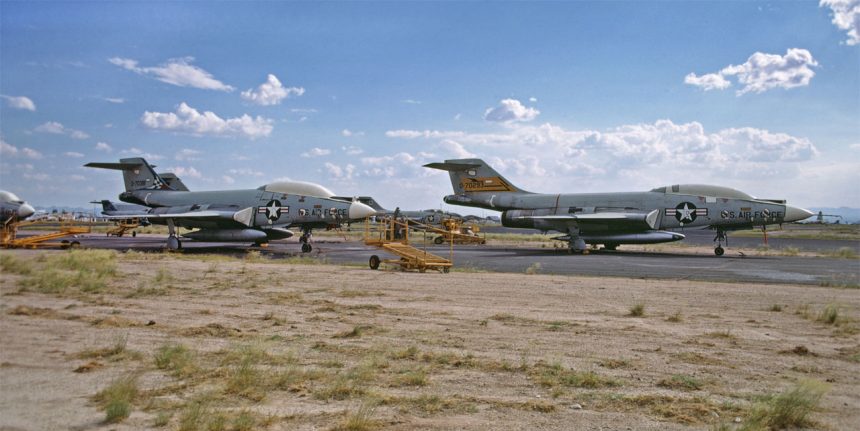

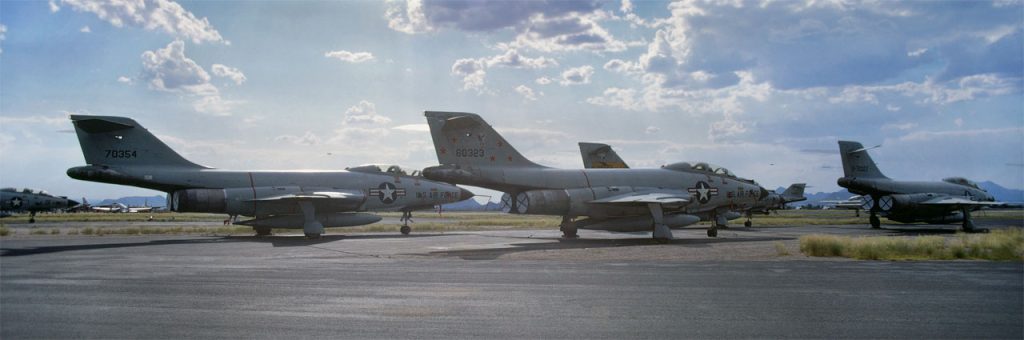
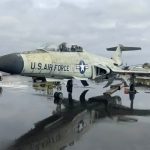
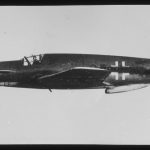
As we continue with the Boneyard Files series, which will showcase some of the retired aircraft resting at Davis-Monthan Air Force Base in Tucson, Arizona, in the late 1960s, through the lens of Neil Aird’s “Monthan Memories” photos, today’s story features the F-101 Voodoo. Initially designed to escort bombers such as the B-29, B-50, and B-36, the work on the F-101 Voodoo began in the 1940s. But with the introduction of high-speed, high-altitude jet bombers such as the B-52, a new bomber escort jet was no longer needed. As a result, the aircraft was provided a new role as an interceptor. The F-101 first flew on September 29, 1954, with the first supersonic nuclear fighter-bomber, designated F-101A, becoming operational in May 1957. An upgraded F-101C, which was a structurally strengthened version of F-101A, became operational in September 1957.
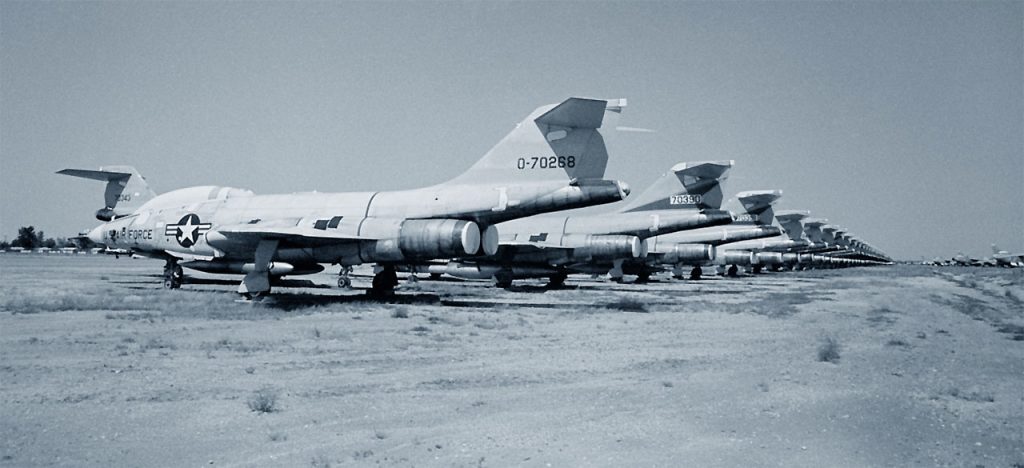
As requirements changed, the aircraft was modified with two seats and the MG-13 Fire Control System, which was designated F-101B. It was termed as one of the best models of the F-101 Voodoo family and first became operational in January 1959. The F-101B also entered service with the Royal Canadian Air Force in 1961. The F-101B was 67.5 feet long, 18 feet high, with a wingspan of 39.8 feet and a wing area of 368 square feet. The empty weight of the aircraft was 28,495 pounds, the gross weight was 45,665 pounds, and the maximum takeoff weight was 52,400 pounds. The aircraft could carry 2,053 gallons of fuel, with provisions for two 450-gallon drop tanks. The F-101B was powered by two Pratt & Whitney J57-P-55 turbojet engines producing 11,900 pounds of dry thrust and 16,900 pounds of thrust with afterburner.
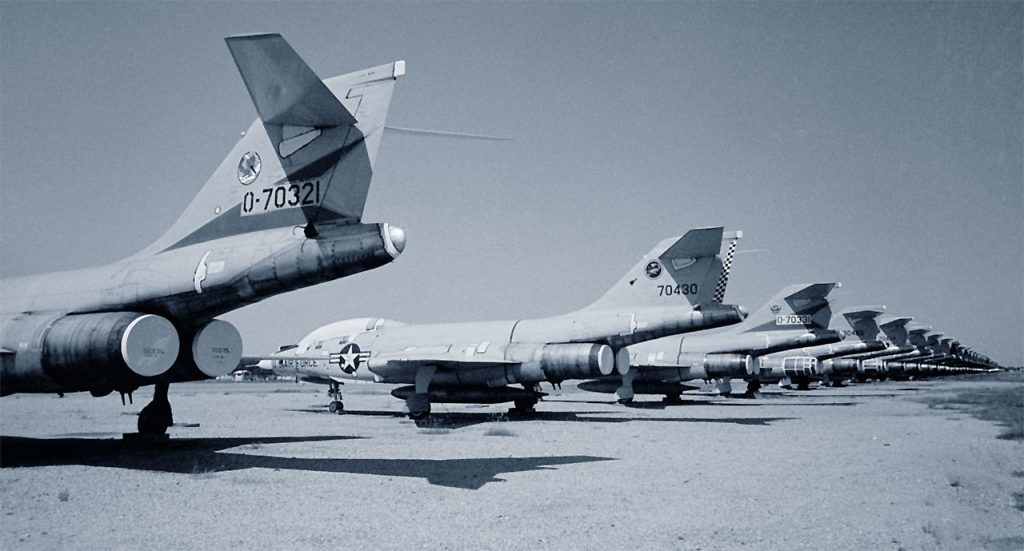
The maximum speed of the aircraft was 1,095 mph, with a cruise speed of 545 mph. The service ceiling was 52,100 feet, and the range was 1,520 miles. Designed to kill Soviet bomber formations, the aircraft could carry two AIR-2A rockets and two AIM-4 guided missiles. The McDonnell Aircraft Corporation had constructed 785 F-101s, including 480 F-101Bs, by the time its production ended in March 1961. During Operation Firewall in December 1957, a JF-101A, a modified testbed F-101A with Pratt & Whitney J57-P-55 turbojet engines of F-101B, set a world speed record of 1,207.6 mph, which a Lockheed F-104 Starfighter broke in May 1958. The US Air Force started phasing out the F-104As in 1966. The F-101B and F-101C also saw very limited usage in combat.
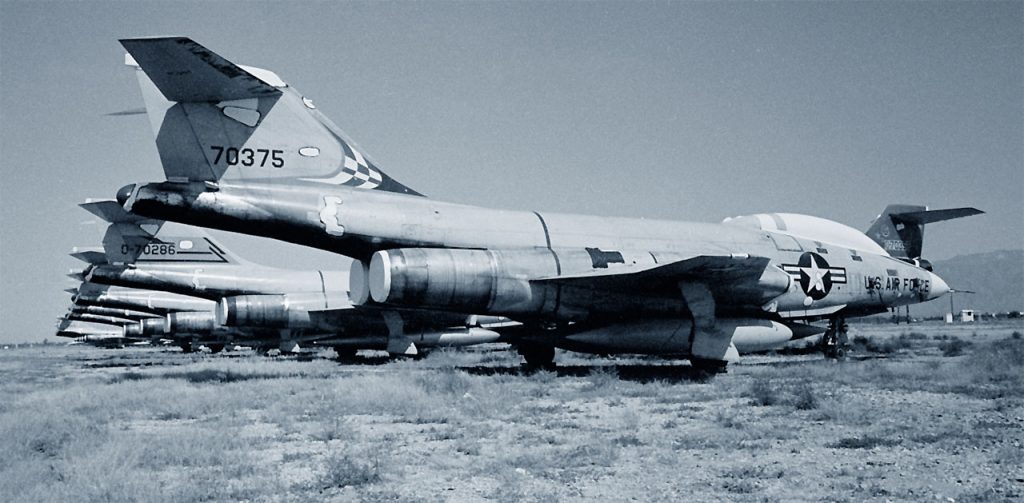
However, a reconnaissance version of the aircraft, designated RF-101, was also built in 1956 and became the world’s first supersonic photo-reconnaissance aircraft. Though the F-101 Voodoo’s primary fighter variants saw limited combat, the RF-101 was widely used first in Operation Sun Run in 1957, during which RF-101 reconnaissance jets set three new transcontinental speed records. On November 27, 1957, an RF-101C aircraft set a record for a round-trip flight between Los Angeles and New York City during Operation Sun Run, which it completed in 6 hours and 46 minutes. It took 3 hours and 36 minutes to fly from New York to Los Angeles and just 3 hours and 7 minutes to fly from Los Angeles to New York.
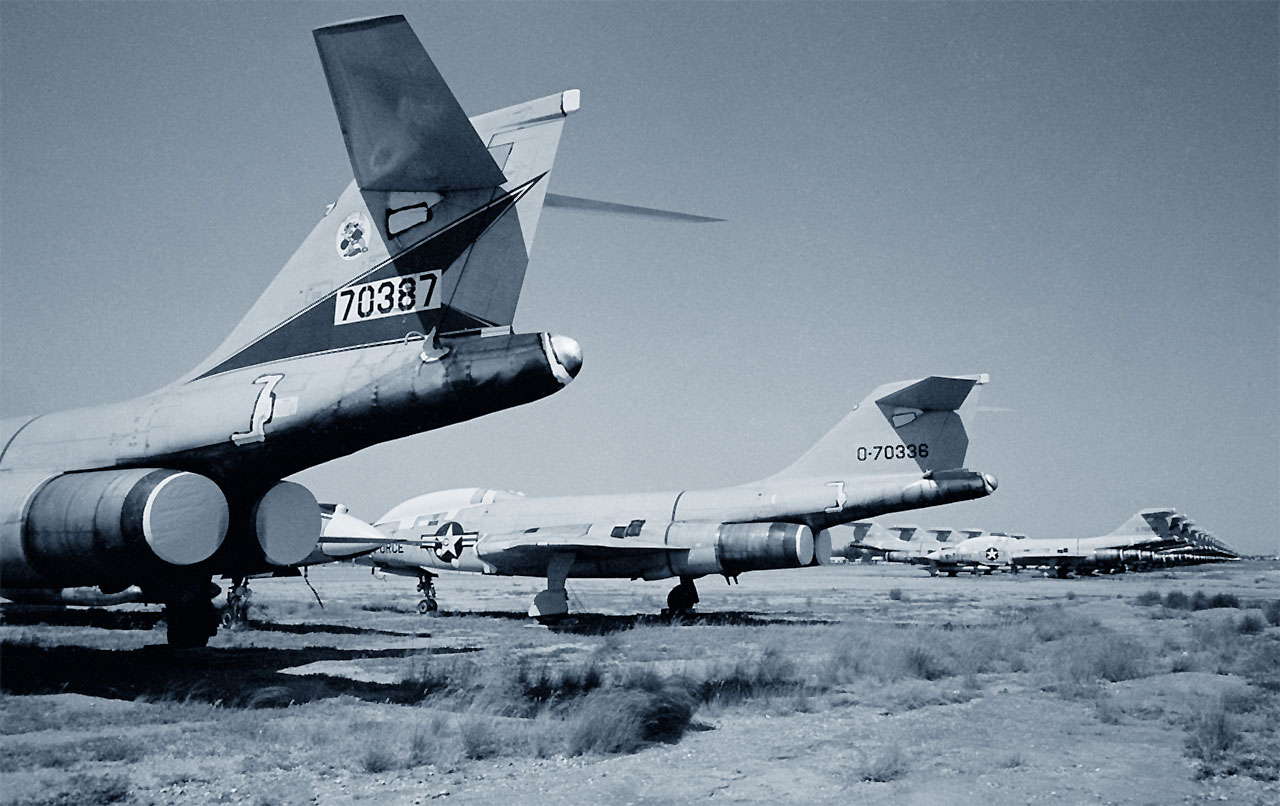
Later, it flew low-altitude reconnaissance during the 1962 Cuban Crisis, and helped confirm that offensive missile sites in Cuba were being dismantled. The RF-101 also served in Laos and Vietnam in the late 1960s. In this theatre, it flew high-speed, low-level missions to photograph enemy supply lines, particularly in South Vietnam, Operation Barrel Roll in southern Laos in 1964, and the Ho Chi Minh Trail, identifying targets for air strikes despite high losses. In one operation, the RF-101s served as pathfinders for F-100 bombers. In addition to 35 RF-101As and 166 RF-101Cs that McDonnell produced, some single- and dual-seat F-101 Voodoos were later converted to the reconnaissance configuration and redesignated RF-101Bs, RF-101Gs, and RF-101Hs. After the retirement, the F-101 Voodoo family was sent to rest at Davis-Monthan Air Force Base, also known as “The Boneyard.” Read more Boneyard Files articles HERE.





I have one of these sitting alongside the road where I work at former Air Force Base in Wilmington Ohio , the bunkers were we store our stuff at were the areas they used to work on the missiles , they still got the Red lettering inside of them nuclear missiles AIR-2A Genie nuclear rocket
The F101 holds 2053 gallons of oil? Might want to double check that.
It’s a typo, it’s fuel…
An interesting sideline the F-101B model performed for many years was a tractor aircraft for tow target missions. In the early 70’s there were a squadron of two flights of 101B’s assigned to the 4756 Weapons Center, Tyndall AFB, FL, (TAFB) with over half having the Tow Reel mod completed on them. These Voodoo’s were modified to have a 2,000 lb RMU 8/A and later RMK-19 Tow Reel installed on its centerline. The Tow Reel carried 50,000 ft of various sized steel stranded cable and operated by a variable pitched blade turbine assembly located at its nose. Several targets were towed wirh this configuration with one being a large gunnery target that was dragged off the runway during takeoffs. A TDU-7 tow target normally used for the Aim 9 was attached to the tow reel and reeled out to apprx 47,000 ft and towed for live fire missions. The target had a propane burner in its tail that provided a 1700 degree signature. Tow Targets were part of the William Tell competitions held at TAFB every other year. I was a Tow Systems Operator at TAFB from 1971 to 76.