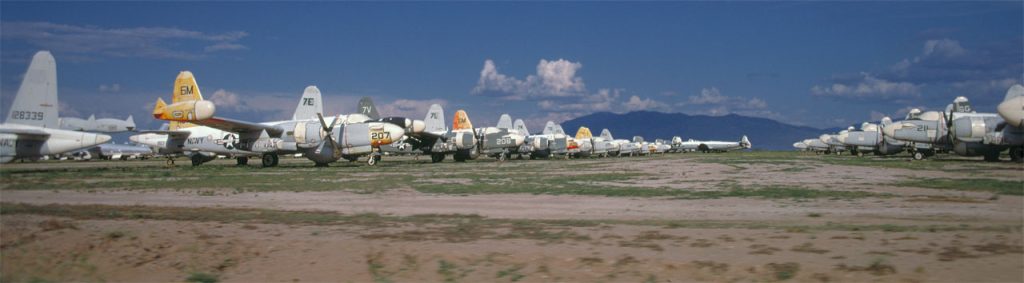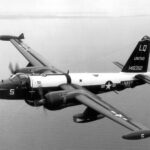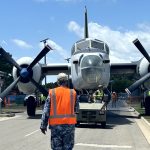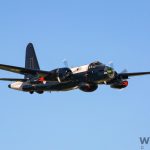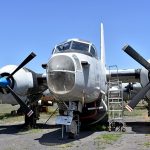
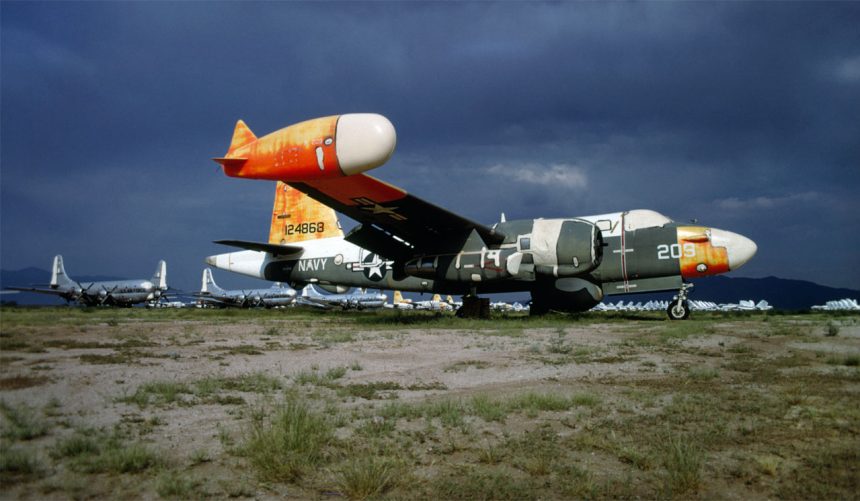

As we initiate the Boneyard Files series, which will showcase some of the retired aircraft resting at US Davis-Monthan Air Force Base in Tucson, Arizona, in the late 1960s, through the lens of Neil Aird’s “Monthan Memories” photos, today’s story features the Lockheed P-2 Neptune. The P-2 Neptune was the first long-range maritime patrol aircraft designed for anti-submarine warfare. Developed during WWII, the aircraft was used worldwide in conflicts such as the Cold War and the Vietnam War. Lockheed initiated work on a new land-based patrol bomber in 1941, but the real push for the program came in April 1944 with a US Navy order for two XP2V-1 prototypes, followed by an order for 15 production P-2 aircraft. The aircraft first flew in May 1945 and entered service in 1947. The aircraft was 91.8 feet long, 29.4 feet high, with a wingspan of 103.10 feet and a wing area of 1,000 square feet. The empty weight of the aircraft was 49,935 pounds, with a maximum takeoff weight of 79,895 pounds.
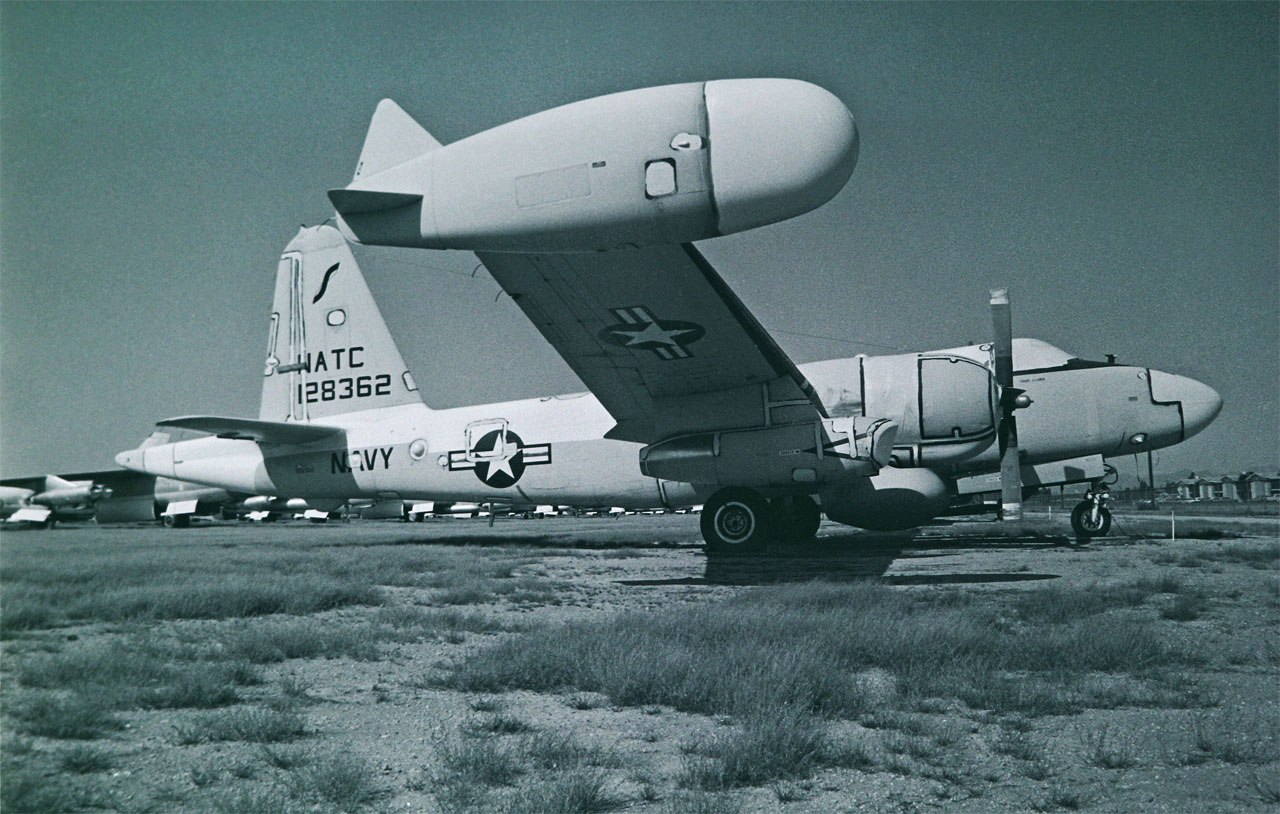
The initial P-2 models had only two Wright R-3350-32W Duplex-Cyclone 18-cylinder air-cooled radial piston engines, each producing 3,700 horsepower. Later, as the jet age arrived, two Westinghouse J34-WE-34 turbojet engines, each producing 3,400 pounds of thrust, were added to the aircraft. It also had two 4-bladed constant-speed propellers. The maximum speed of the aircraft was 363 mph, with a cruise speed of 207 mph. The range was 2,157 miles, and the service ceiling was 22,400 feet. It could carry 2.75-inch rockets in wing-mounted pods, and 8,000 pounds of bombs or torpedoes. Originally designed as a land-based aircraft, the Navy also tested the P-2 Neptune for carrier-based operations using jet-assisted takeoff (JATO) rocket boosters. After WWII ended, the US Navy needed a carrier-based aircraft that could carry nuclear bombs. Initial flights in 1948 attempted to land a P-2 on a carrier, but the effort was unsuccessful, and the Navy had to choose the North American AJ Savage instead.
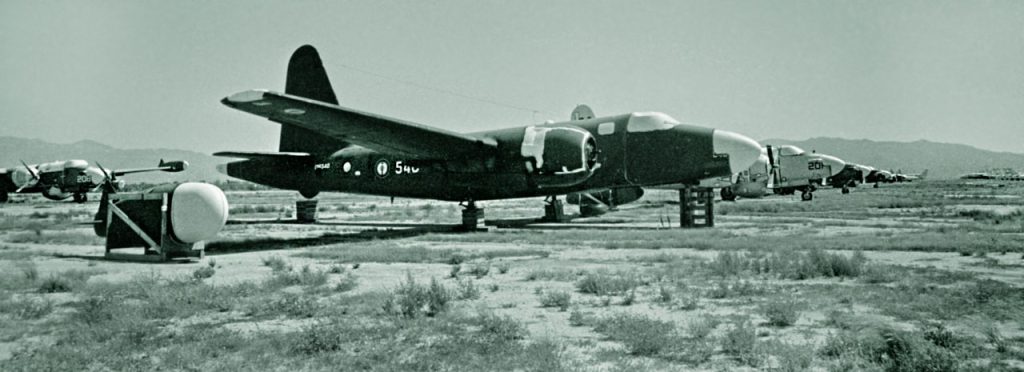
During the 1950s and 1960s, several P-2 Neptunes were used by the US Central Intelligence Agency (CIA) for covert operations. Both the US Army and the US Navy used the P-2 in the Vietnam War as a gunship, electronic surveillance and reconnaissance aircraft, and in its traditional role of maritime patrol. The aircraft were also used to drop electronic sensors to detect enemy logistical movements along the Ho Chi Minh Trail in Laos. It was the primary US marine patrol aircraft during the early phase of the Cold War, before being replaced by the P-3 Orion in the mid-1960s. The P-2 was used as a hunter in the US Navy’s hunter-killer formation to kill submarines. In this formation, one aircraft, the hunter, carried sensors to detect submarines, and another, the killer, carried bombs to destroy them. During the Cold War, it was heavily used as a maritime patrol aircraft, launching sonobuoys; some versions carried the AN/ASQ-8 Magnetic Anomaly Detector, and some were equipped with belly-mounted AN/APS-20 surface-search radar, all of which helped in anti-submarine warfare.
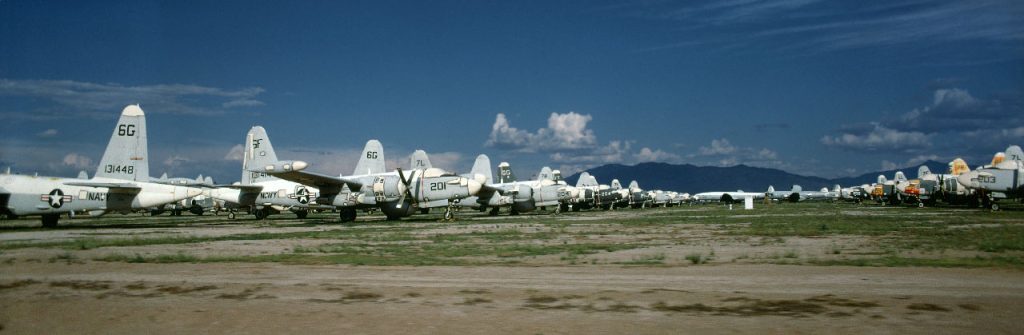
Lockheed built more than 1,000 P-2s, and 82 were built in Japan under license. In addition to the US, 10 other countries used P-2, including Argentina, Australia, Brazil, Canada, Chile, France, Japan, the Netherlands, Portugal, Taiwan, and the UK. The P-2 Neptune was also used in civilian purposes such as aerial firefighting. In its firefighting versions, it could carry up to 3,000 gallons of retardant. In September 1946, a modified P-2, dubbed the “Truculent Turtle,” set a record-breaking endurance flight. It flew nonstop without refueling from Perth, Australia, to Columbus, Ohio, a distance of 11,235 miles, in 55 hours and 17 minutes, a record it held until 1962. To achieve this, the aircraft was fitted with fuel tanks in the bomb bay and aft fuselage, and provision for carrying wing tanks. The flight was a part of a psychological test to examine the absolute limit of aircraft and crews. The aircraft carried a crew consisting of four patrol plane pilots and a baby kangaroo. It took a jet-powered B-52H Stratofortress to break this record, which stood until 1962. After its retirement in the mid-1960s, some P-2 Neptunes were spotted at the US Davis-Monthan Air Force Base, commonly known as “The Boneyard.” Read more Grounded Dreams articles HERE.