






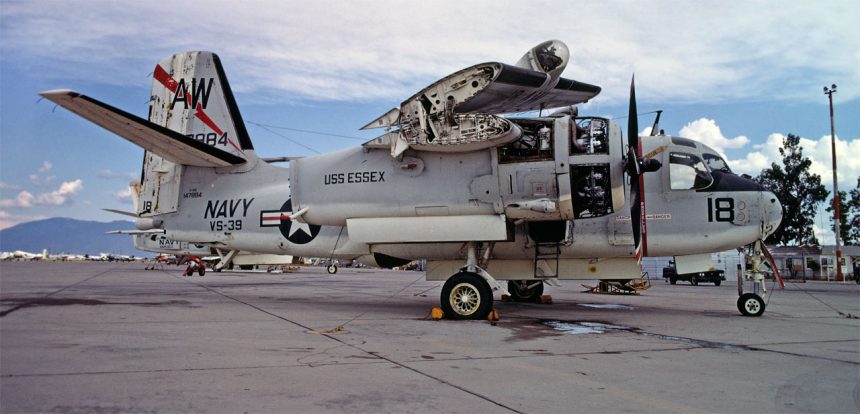

As we continue with the Boneyard Files series, which will showcase some of the retired aircraft resting at US Davis-Monthan Air Force Base in Tucson, Arizona, in the late 1960s, through the lens of Neil Aird’s “Monthan Memories” photos, today’s story features the Grumman S-2 Tracker. After World War II, the US Navy needed an aircraft with anti-submarine capabilities to replace the Grumman AF Guardian. At the time, the Guardian used to fly in pairs of two aircraft in a hunter-killer role. The hunter aircraft carried detection capabilities to spot submarines and pass information to the killer aircraft, which carried weapons to destroy them. However, as a replacement, the Navy wanted a single aircraft to perform both the hunter-killer roles. The service turned to Grumman to develop the new aircraft, and the company designed a large twin-engine high-wing monoplane that could house the equipment needed for both hunter and killer roles. The aircraft was called S2F Tracker, later renamed as S-2 Tracker.
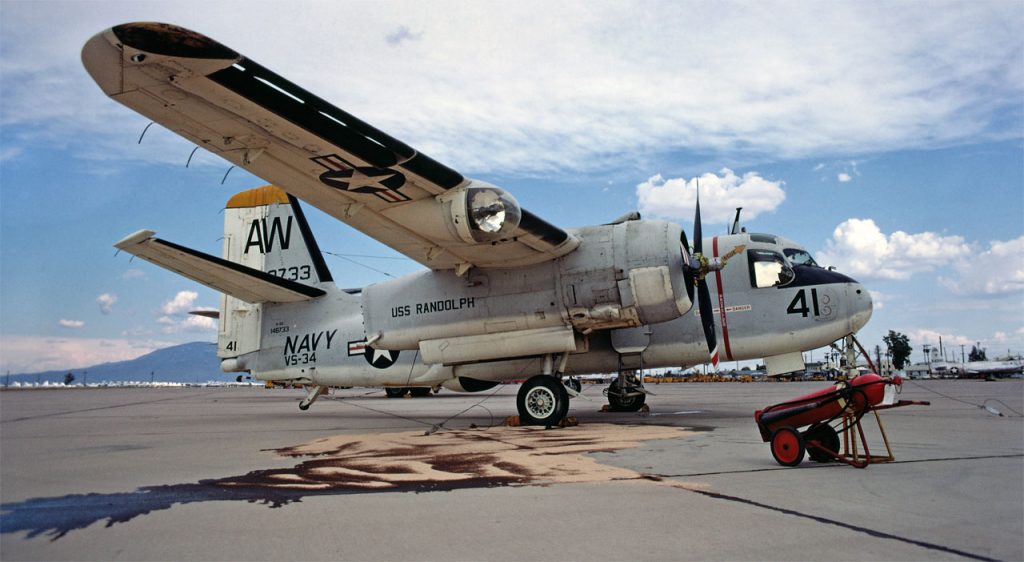
In 1950, the Navy contracted Grumman to build a prototype, which first flew in December 1952. After successful trials, the first production version of the aircraft was rolled out in 1954. In addition to its anti-submarine role, the S-2 Tracker also had an electronic measures version and a cargo version. With a crew of four, the S-2 Tracker was 43.6 feet long, 17.6 feet high, with a wingspan of 72.7 feet and a wing area of 485 square feet. Its empty weight was 18,315 pounds, gross weight was 23,435 pounds, and maximum takeoff weight was 26,147 pounds. The aircraft was powered by two Wright R-1820-82WA 9-cylinder air-cooled radial piston engines, each producing 1,525 horsepower. The maximum speed of the aircraft was 280 mph at sea level with a cruise speed of 150 mph. Its range was 1,350 miles with a service ceiling of 22,000 feet and an endurance of 9 hours. The aircraft could carry 4,800 pounds of torpedoes, bombs, or naval mines in the internal bay and six under-wing hardpoints.
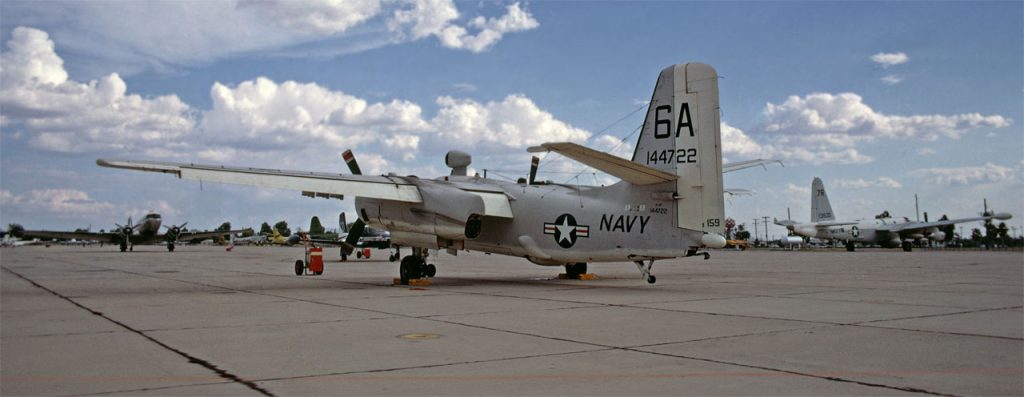
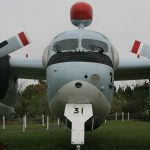
The S-2 Tracker was fitted with a retractable radome to mount the AN/APS-38 radar on the underside and a Magnetic Anomaly Detector (MAD) AN/ASQ-8 on a boom that extended from the rear. Early models of the S-2 Tracker had an Electronic Support Measures (ESM) pod on top, including a smoke particle detector, or “sniffer,” which could detect exhaust particles from diesel-electric submarines, located just behind the front seat area. Later versions of the S-2 removed the sniffer and moved the ESM antennae to four rounded tips on the wings. A searchlight, with a brightness of 70 million candlepower, was mounted on the starboard wing. The engine nacelles were equipped with JEZEBEL sonobuoys, carrying 16 in the early models and 32 in the S-2E/G. Early versions of the Tracker also carried 60 explosive charges that were released from the rear of the fuselage. These charges created sound pulses for semi-active sonar systems using the AN/AQA-3 and, later, the AN/AQA-4 detection sets.
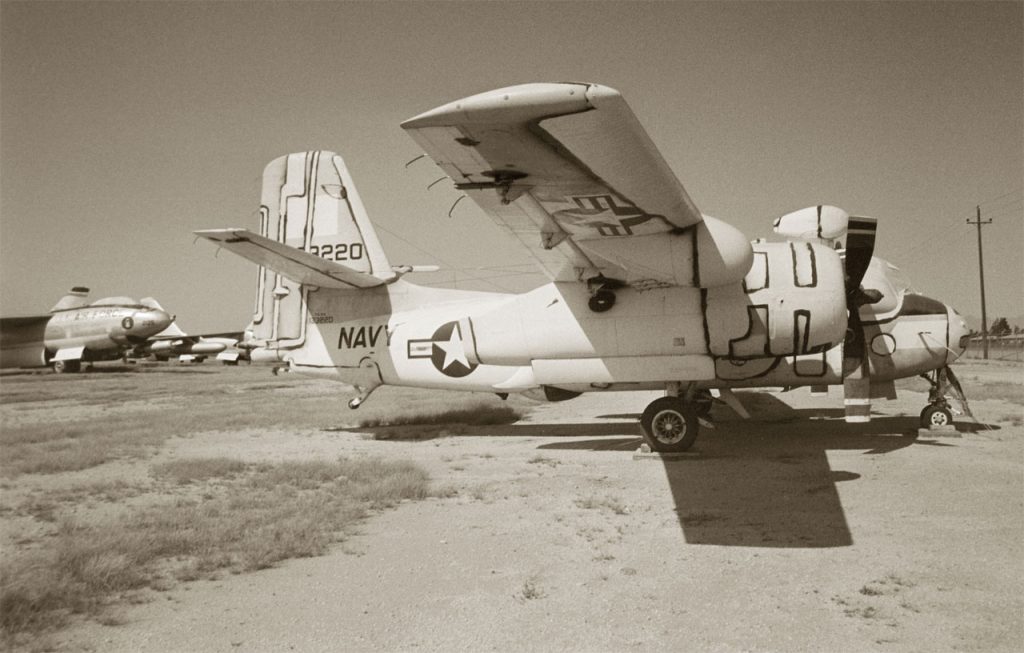
With the introduction of active sonobuoys and the AN/AQA-7 in the S-2G conversion, the explosive charges were removed. Smoke dispensers were attached to the left underside of the nacelles in groups of three. Grumman built a total of 1,284 S-2 Trackers during the aircraft’s production run. In addition to serving with the US Navy, the Trackers were also exported to Canada, Australia, Japan, Turkey, and Taiwan. In the early 1970s, the US Navy replaced Trackers with the Lockheed S-3 Viking. The last S-2 Tracker was in service with the Argentine Navy and was retired in December 2025. The surplus Grumman S-2 Tankers were also used for civilian purposes from the 1970s to 1990s, when Conair Aviation modified retired US and Canadian Trackers into firecats by removing the weapon bay. The California Fire Department also used the S-2 Tankers as its firefighting aircraft. After retirement, some S-2 Trackers were also spotted at Davis-Monthan Air Force Base, also known as “The Boneyard.” Read other Boneyard Files articles HERE.
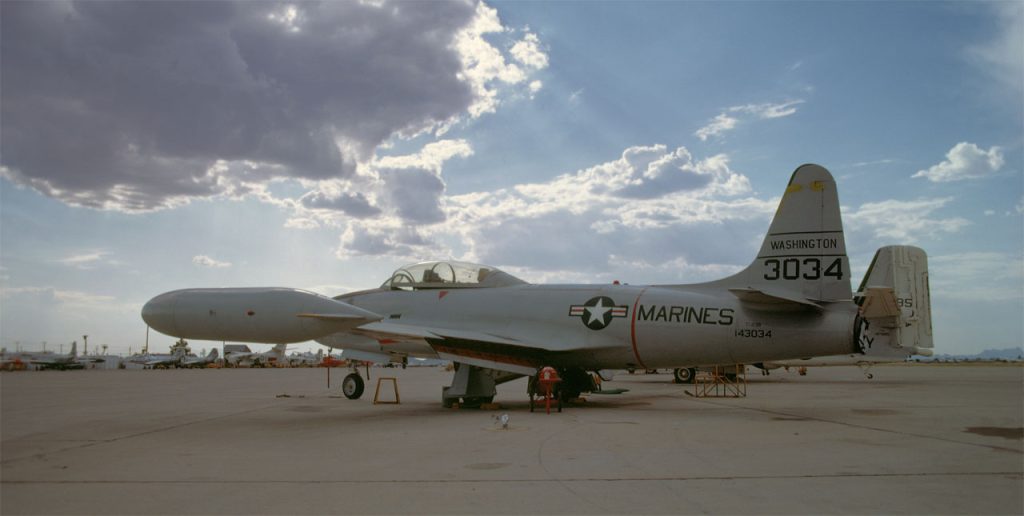
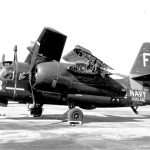



VC-10 in GTMO Bay had a US2B. As the S-3 took over the S-2 was used as a transport and carrier support.