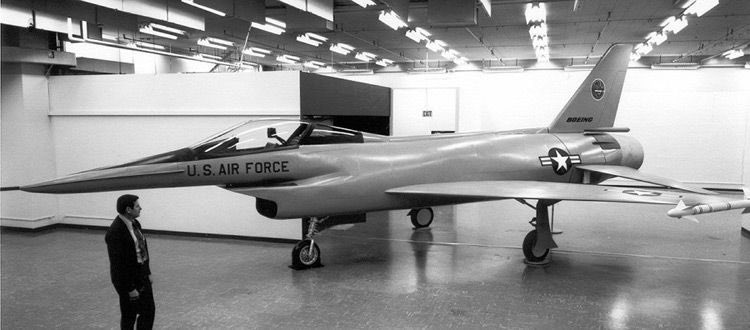


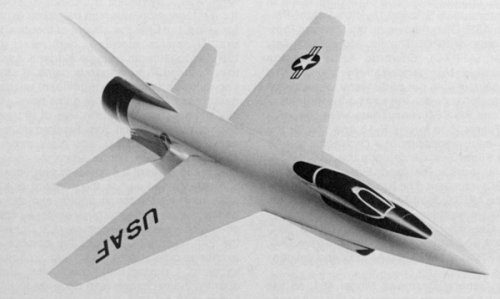
In the late 1960s, the US Air Force was seeking a light, cost-effective fighter jet to complement its heavier F-15 Eagle fighters, as part of lessons learned from the Vietnam War. In the war, it became clear that maneuverability was as important as raw speed, as evidenced by the Soviet MiG-21 fighters and their hit-and-run tactics. In January 1972, the Air Force issued a request for proposals (RFP) to develop a lightweight single-engine fighter capable of achieving supersonic speed with a gross weight under 20,000 pounds. The RFP was issued to nine companies, including Boeing, Lockheed Martin, Northrop, and General Dynamics, among others. As part of the program, Boeing initially developed a concept called the Model 908-618, featuring a canard-delta layout with leading-edge extensions for improved maneuverability at low speeds. But this design was canceled due to aerodynamic issues, and the company adopted a simpler Model 908-909 design.
Design of Model 908-909
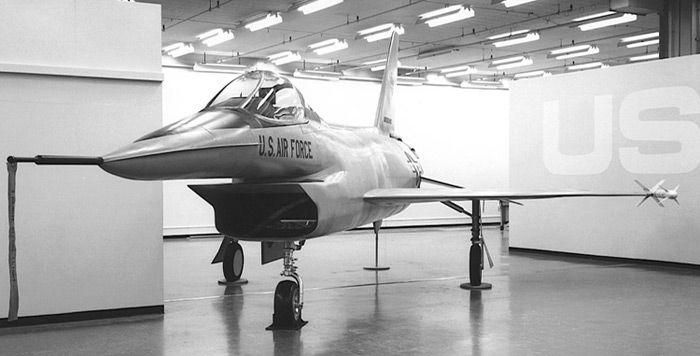
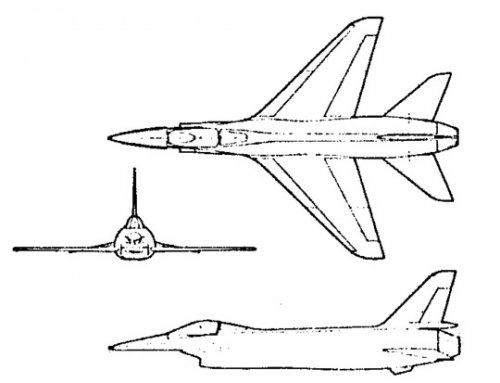
The Model 908-909 had a swept-wing configuration and an extended slender fuselage to accommodate radars and avionics. The aircraft featured a frameless bubble canopy providing 360-degree visibility for pilots and a Pratt & Whitney F100-PW-100 turbofan engine, producing 23,830 lbf of thrust with afterburner. The aircraft’s maximum speed was estimated to be between Mach 1.6 and Mach 2. The single-seat aircraft was 48 feet long, 14 feet high, with a wingspan of 29.3 feet. Its wing area was 240 square feet, and it had an empty weight of 11,700 pounds, with a maximum takeoff weight of slightly less than 20,000 pounds, which was a major requirement for the aircraft. It could carry 4,300 pounds of fuel. To reduce weight, the airframe of Model 908-909 relied on aluminum alloys and composite materials. The engine air intake was placed under the fuselage to reduce drag during high-maneuvering. The aircraft had a conventional tail section to maintain simplicity and reduce surface area, and also had room for a single cannon and either six missiles or 500-pound bombs. Boeing, along with other companies, submitted its Model 908-909 to the US Air Force in February 1972, after which it underwent wing-tunnel testing at NASA’s Langley Research Center. General Dynamics submitted its Model 401, later known as the YF-16, for the competition, with Northrop submitting the P-600, later designated the YF-17, Lockheed submitting the CL-1200, and Vought submitting the V-1100. In March 1972, the US Air Force released the results of wing-tunnel testing, and Boeing’s Model 908-909 ranked first in the Air Force’s Lightweight Fighter program. General Dynamics stood in second place while Northrop stood in third. According to the program terms, the aircraft that needed to be built should cost around $3 million per unit in 1972.
The Cancellation
To assess the aircraft’s cost dynamics, aerodynamics, and stability, Boeing’s 908-909 underwent additional NASA wind-tunnel testing at Langley. The aircraft once again demonstrated strong aerodynamic performance and agility, but according to the US Air Force, it needed several improvements to achieve low-cost, mass production. As a result, in April 1972, Boeing’s Model 908-909 was downgraded to third place, with General Dynamics YF-16 and Northrop YF-17 taking first and second, respectively. Moreover, on April 13, the US Air Force awarded General Dynamics and Northrop to produce two prototypes each of their submissions. After testing in 1974, General Dynamics’ YF-16 won the contract and became the world’s now-familiar F-16 Fighting Falcon. The Northrop YF-17 design, after some modifications, became what the world now knows as the F/A-18 Super Hornet. However, the Model 908-909 did not advance beyond the mockup phase; its concepts, such as a bubble canopy, were adopted in modern aviation, including the F-16. The work on the Model 908-909 also helped Boeing secure one of its major contracts to build the F/A-18, as McDonnell Douglas merged with Boeing in 1997. The Model 908-909 was not a bad design, not a bad idea, not a bad implementation; it just did not get a chance to prove itself in the real world, as military planners believed it would be costly. In the Grounded Dreams series, the Model 908-909 still poses a “what if” question, that if it were allowed to perform in the real world, no one knows it could be one of the world’s most widely used and exported aircraft in the place of the Lockheed Martin F-16 Fighting Falcons, 4,600 of whom has been built and supplied to more than 25 countries. Read more Grounded Dreams articles HERE.