

Before World War II, Imperial Airways operated large flying boats such as the Short Empire and Short S.26 for long-distance travel across the British Empire. However, the war led to the cancellation of these services, prompting the merger of Imperial Airways with British Airways Ltd to form the British Overseas Airways Corporation (BOAC) in 1940, and many flying boats were then used for military purposes. After the war, there was renewed interest in flying boat services. As World War II neared its end, the British Air Ministry sought to develop a new flying boat. In 1943, British aerospace companies Saunders-Roe and Short designed the largest all-metal flying boat of the time, capable of carrying 104 passengers. In 1945, as the British Ministry of Supply sought a long-range flying boat for BOAC’s transatlantic services, Saunders-Roe submitted a bid based on a previous design, using a Bristol Proteus turboprop engine to meet the power requirements. In May 1946, the Ministry chose Saunders-Roe’s bid and ordered three SR.45 Princess flying boats. Development of the SR.45 began soon after; however, the project faced delays and costs that were higher than expected, raising concerns in the House of Commons about its future. The major issues included the design and testing of the airframe and the separate development of the Proteus engine. In 1951, BOAC re-evaluated its need for the Princess flying boat and decided to end its flying boat services. Later that year, they announced the construction of three Princess aircraft for Royal Air Force (RAF) transport use. By March 1952, it was announced that only the first prototype would be completed, while the second and third prototypes would be put on hold until more powerful engines were available.
Design of SR.45 Princess
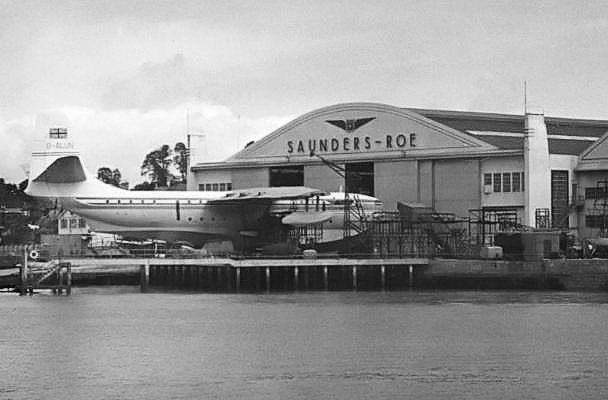
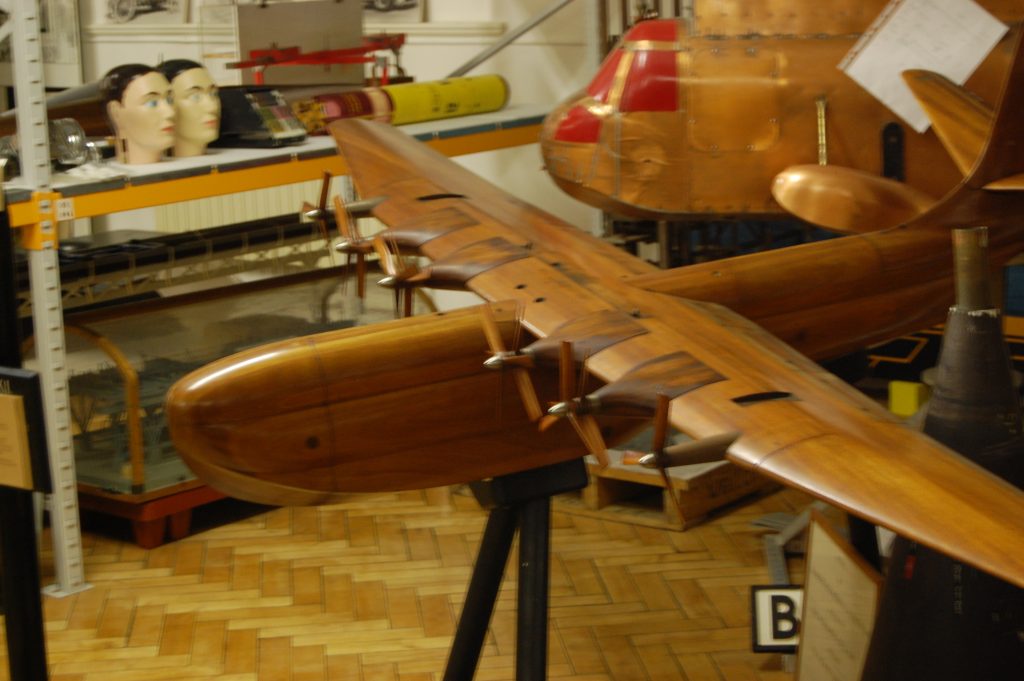
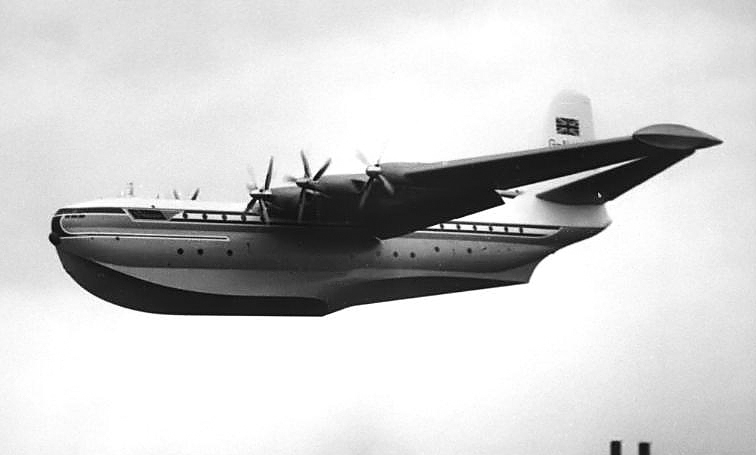
The development of the first prototype was completed by mid-1952. The SR.45 Princess was the largest all-metal flying boat ever built. It had a double-bubble pressurized fuselage that could accommodate up to 105 passengers across two decks. The aircraft was powered by 10 Bristol Proteus turboprop engines, which drove six sets of 4-bladed propellers. Although the initial plans included powered flight controls, the final design used traditional mechanical controls with electrical power-assist units instead. The aircraft had a crew of two pilots, two flight engineers, a radio operator, and one navigator. It was 148 feet long and had a wingspan of nearly 220 feet when the wingtip floats were retracted, and 210 feet when the floats were extended. The aircraft was 56 feet high and had a wing area of 5,019 square feet. Its empty weight was 190,000 pounds, and its gross weight reached 330,000 pounds. The maximum takeoff weight was 345,025 pounds, and it could carry 14,000 imperial gallons (16,813 US gallons) of fuel in four inner wing tanks, making it suitable for long-distance travel. The SR.45 Princess could fly at a maximum speed of 380 mph at 37,000 feet and cruise at 360 mph at 32,500 feet. The aircraft had a range of 5,720 miles and an endurance of up to 15 hours, with a service ceiling of 39,000 feet, and a climb rate of 1,900 feet per minute at 184 mph. The first prototype of the SR.45 Princess flying boat, designated G-ALUN, flew for the first time on August 22, 1952. The initial plan was to debut the aircraft at the 1952 Farnborough Airshow, but it was cancelled due to engine issues. Testing continued into 1953, and the prototype was first displayed at the Farnborough Airshow that year.
The Cancellation
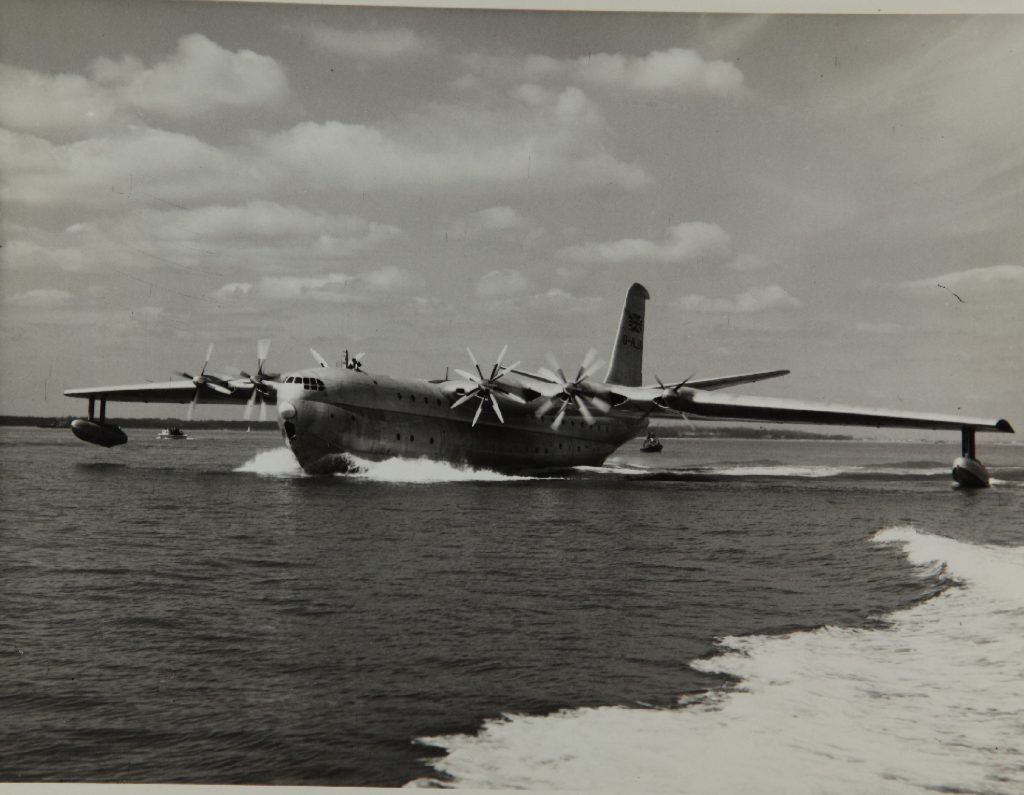
After completing 46 test flights, on May 27, 1954, the Proteus engine was found to be inadequate for the performance needed. In addition, by the mid-1950s, flying boats were becoming less useful because of the emergence of long-paved runways, airports, and land-based jets, which did not have to accommodate the additional weight and drag of the boat hulls. Moreover, these jets were not prone to the corrosion caused by seawater, a major problem faced by flying boats. While two more Princess flying boats were under construction, BOAC decided to focus on land routes using the De Havilland Comet. As a result, the SR.45 Princess flying boat project was cancelled after three prototypes were built, of which only one flew. The three completed aircraft were stored in the hope that a buyer would come forward to revive the program. Several offers to buy the flying boats were made by Aquila Airways and the U.S. Navy before, in 1964, Aero Spacelines bought them to use as heavy-duty freight aircraft for transporting Saturn V rocket components for NASA. But due to maintenance, the flying boats were corroded beyond repair and had to be scrapped in 1967. A luxurious flying boat that had everything for its passengers was cancelled due to rapid policy changes, delays, and engine problems. Like many other aircraft in the Grounded Dreams series, the SR.45 Princess was not a bad design or idea, but arrived too late to become a reality. Read more Grounded Dreams series articles HERE.