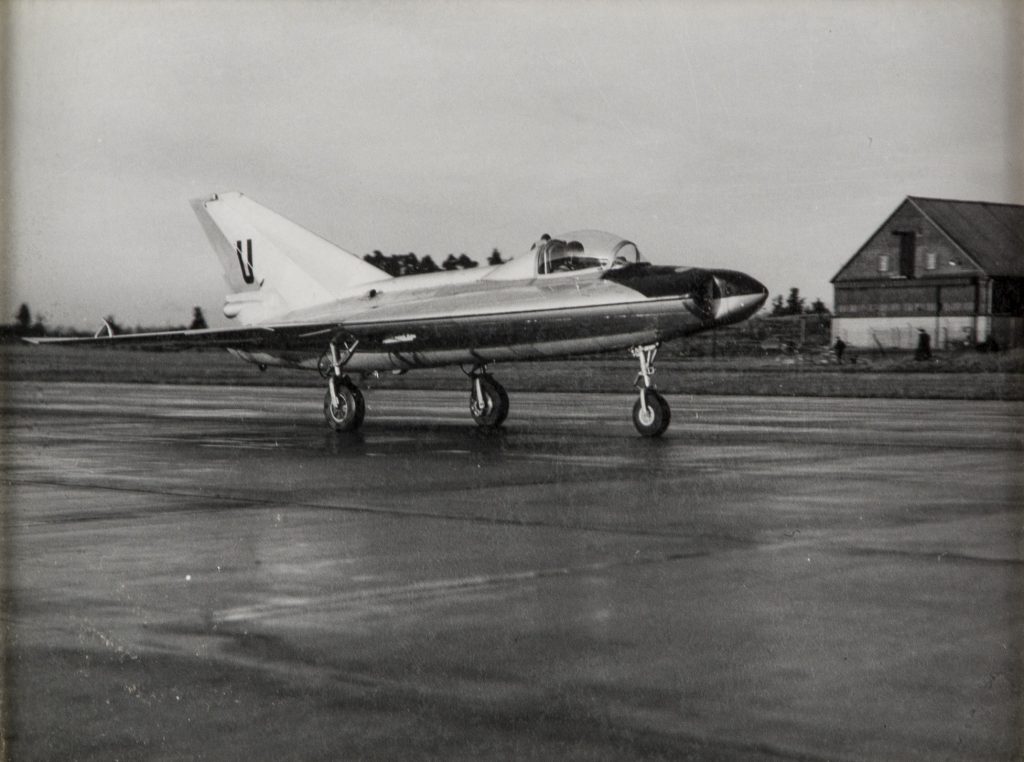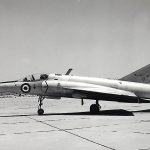
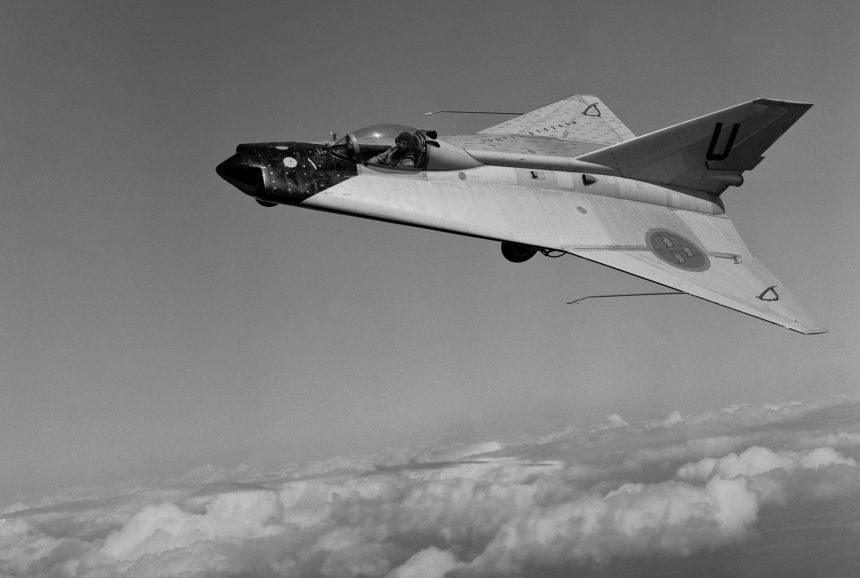

As fighter jet technology developed after World War II, Sweden wanted to develop a supersonic fighter capable of intercepting bombers or engaging in aerial dogfights. In late 1949, the Swedish Air Force invited industry to submit proposals for a fighter capable of Mach 1.4-1.5. Swedish aerospace and defense company SAAB began developing an aircraft to meet the Air Force’s needs. Initially, the company focused on developing a delta-wing aircraft, but it didn’t meet the requirements. An option was to extend the forward fuselage to achieve better aerodynamics, but that would make the aircraft too heavy. So, another option was chosen to develop the aircraft with double delta wings. However, such a design was new and had never been tested by SAAB. Hence, the company, under the leadership of aircraft engineer Erik Bratt, decided to develop a small test aircraft to evaluate the double-delta wing design. The test aircraft, designated Saab 210 and unofficially nicknamed “Lilldraken” (the little dragon), was a research prototype that was about 70% the size of the planned new supersonic fighter, featuring a double-delta wing design.
Saab 210 Lilldraken Design
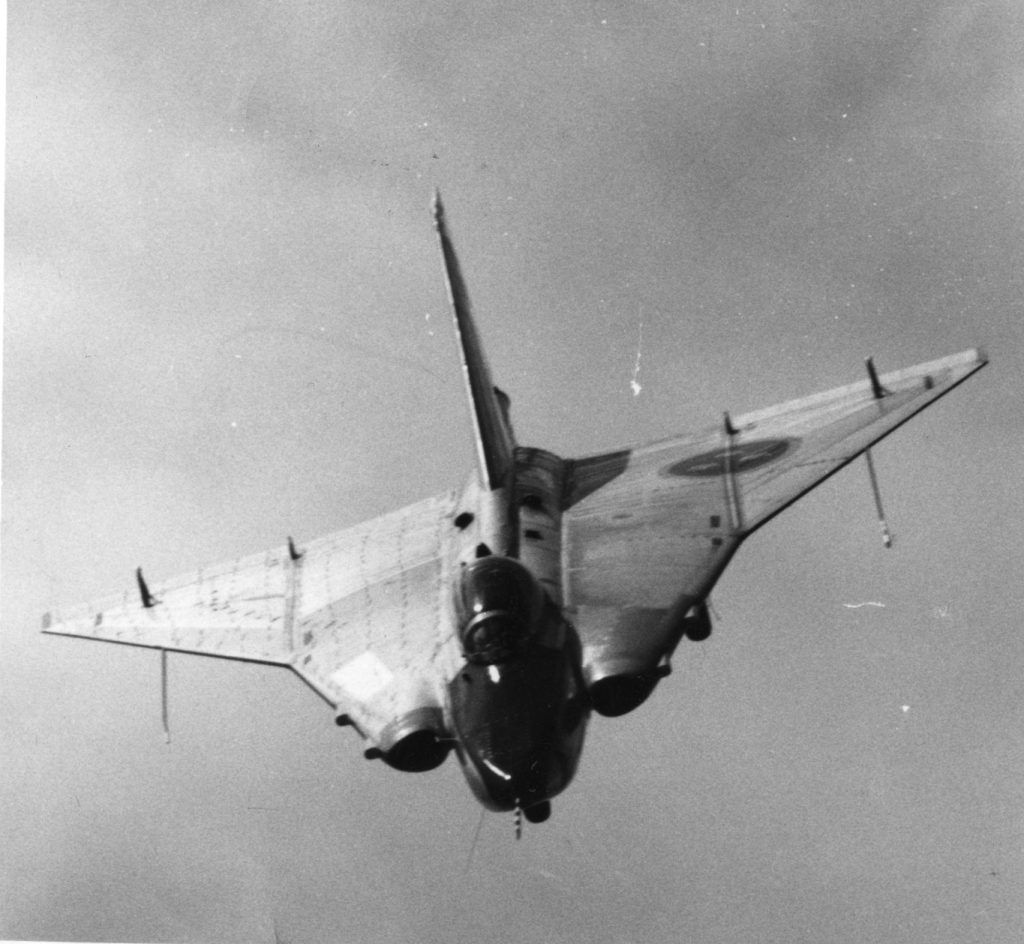
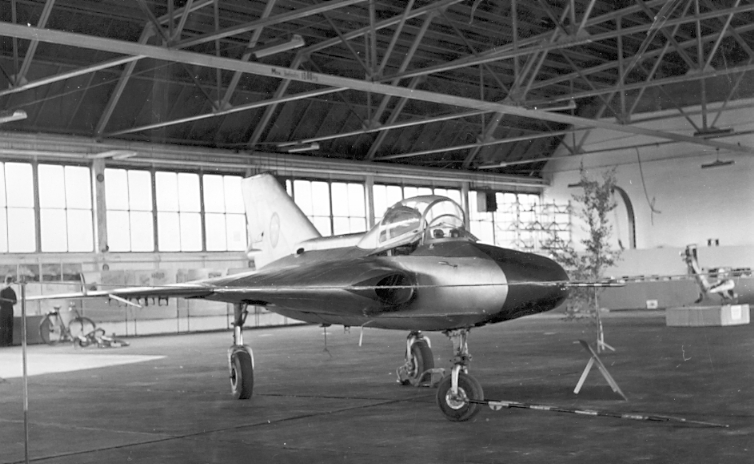
The sub-scale Saab 210 Lilldraken was developed in the early 1950s to study low-speed handling characteristics of the double-delta wing configuration. The aircraft was 20 feet long with a wingspan of 16 feet. It was powered by an Armstrong Siddeley Adder turbojet engine producing 1,050 pounds of thrust. The aircraft had a top speed of 400 mph. The aircraft featured a tailless double-delta wing that reached nearly to the front of the plane. Just behind a small nose, there were air intakes built into the wing roots. The aircraft had a rounded bubble canopy, a swept tail fin, and a semi-retractable tricycle landing gear. The Saab 210 Lilldraken flew for the first time on January 21, 1952, and the team conducted extensive tests on the aircraft before moving to the next phase. In the second phase, the Saab 210 Lilldraken was modified by relocating the air intakes to the sides of the cockpit to improve the pilot’s visibility. A drogue parachute was also equipped on the aircraft. The modified aircraft was called 210B, while the first one was redesignated 210A. Flight testing resumed, and by the end of its last flight on October 25, 1955, the Saab 210 had completed 887 flights in both versions. Flight tests of the Saab 210 Lilldraken validated the wing behaviour and the aircraft’s stability and control, demonstrating that the double-delta wing design was effective at low speeds. In addition to the Armstrong Siddeley engine, the aircraft was tested with the de Havilland Goblin and Rolls-Royce Avon engines to assess the impact of each on the aircraft. The successful flight tests of the Saab 210 Lilldraken, developed for research purposes, later led to the development of the Saab 35 Draken, the program’s primary goal.
Saab 35 Draken
Drawing on lessons from the Saab 210 flight test results, Saab initially built three full-size Draken prototypes. The first prototype conducted its maiden flight on October 25, 1955. In 1956, the aircraft was redesignated J35A and entered mass production. The first flight of this version took place on February 15, 1958. On January 14, 1960, the aircraft, powered by a Rolls-Royce Avon Mk. 48A, reached Mach 2. Saab developed a total of 651 Drakens, which were in service with Sweden, Denmark, Finland, and Austria. Additionally, the United States later acquired a small number of retired Danish Drakens for use as training aircraft. In several instances, the Draken proved better than the iconic Dassault Mirage III. In Denmark, the aircraft competed against the Mirage III and the Northrop F-5 and won in 1968. A famous instance occurred when the J35 competed with the Mirage III for the Swiss Air Force. Although the aircraft was lost to the Mirage III, the procurement proved faulty, forcing the Swiss Air Force commander, the chief of the general staff, and the minister of defence to resign. During the trials, the Saab 35 climbed 20–40% faster than the Mirage III and required 35% less distance to take off. The aircraft was also offered to Belgium, Argentina, Chile, Singapore, Tunisia, Venezuela, and Malaysia, but none purchased it. However, the Draken reached this level just because of its Lilldraken, the Saab 210, which provided sufficient design data to become a legendary fighter. In the Grounded Dreams series, the Saab 210 Lilldraken stands not exactly as a cancelled aircraft, but as the one that provided the aviation world with a pulse it needed after World War II. Read more Grounded Dreams articles HERE.