







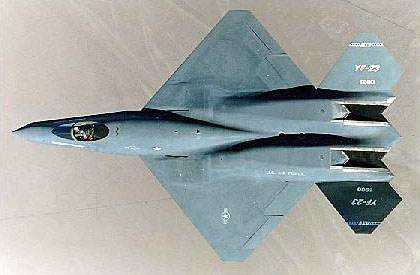
In mid-1981, the US Air Force issued a Request for Information (RFI) to major aircraft companies for the Advanced Tactical Fighter program. The RFI went to nine companies, including Boeing, Fairchild Republic, North American Rockwell, General Dynamics, Lockheed, McDonnell Douglas, Grumman, Vought, and Northrop. Seven of these companies decided to participate, submitting a total of 19 designs. The competition winners were announced on October 31, 1986, and the designs of Lockheed and Northrop were selected. Later, Northrop joined McDonnell Douglas, while Lockheed collaborated with Boeing, and the new aircraft were named YF-22 for Lockheed’s design and YF-23 for Northrop’s design. Along with the airframes, two engine manufacturers competed in the ATF process. Pratt & Whitney introduced their YF-119-PW-100 engine, while General Electric submitted the YF120-GE-100. Each company would power one ATF prototype with its own engine. The first YF-22 and second YF-23 used the GE engines, while the second YF-22 and first YF-23 used Pratt & Whitney engines. Northrop was the first to reveal its prototype at a ceremony at Edwards Air Force Base on June 22, 1990. The company began engine tests the next month, and the YF-23 powered on for the first time on July 7. The Northrop YF-23 completed taxi testing and reached 120 knots during the final high-speed test on August 11.
Design of Northrop YF-23
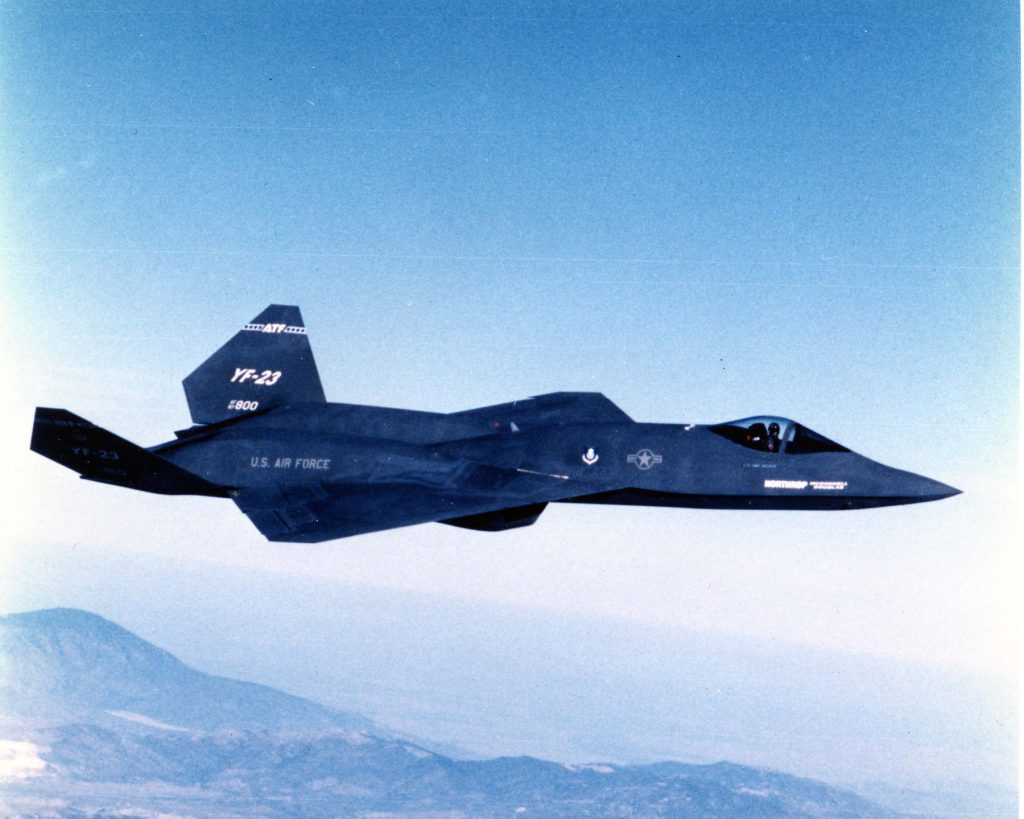
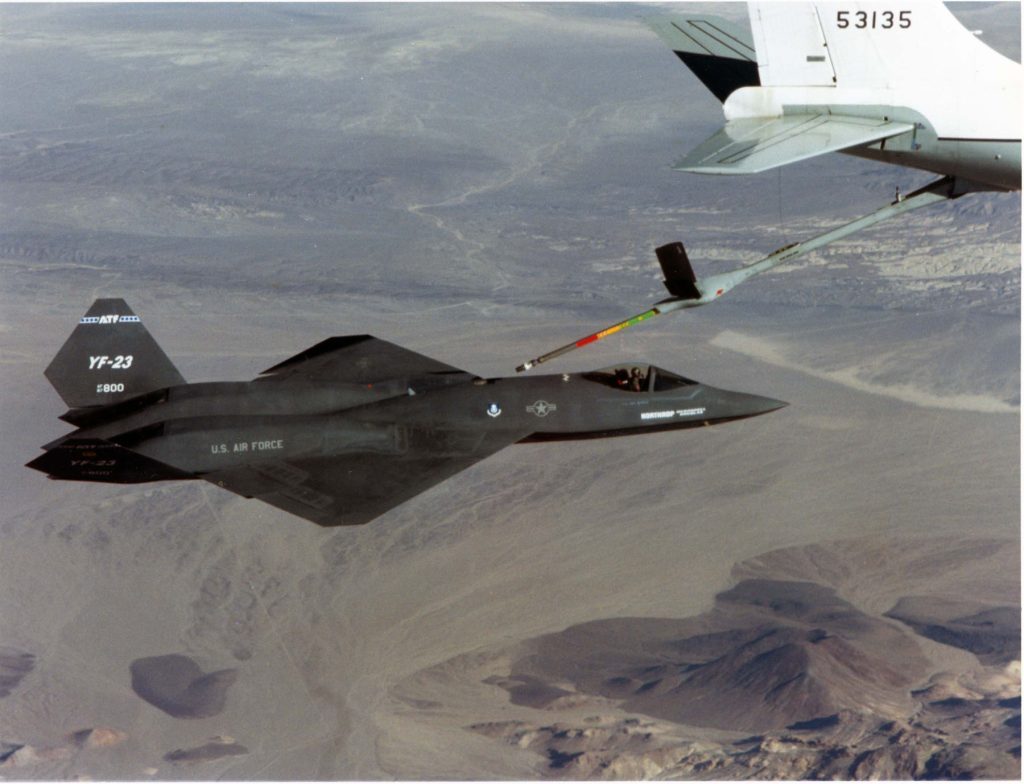
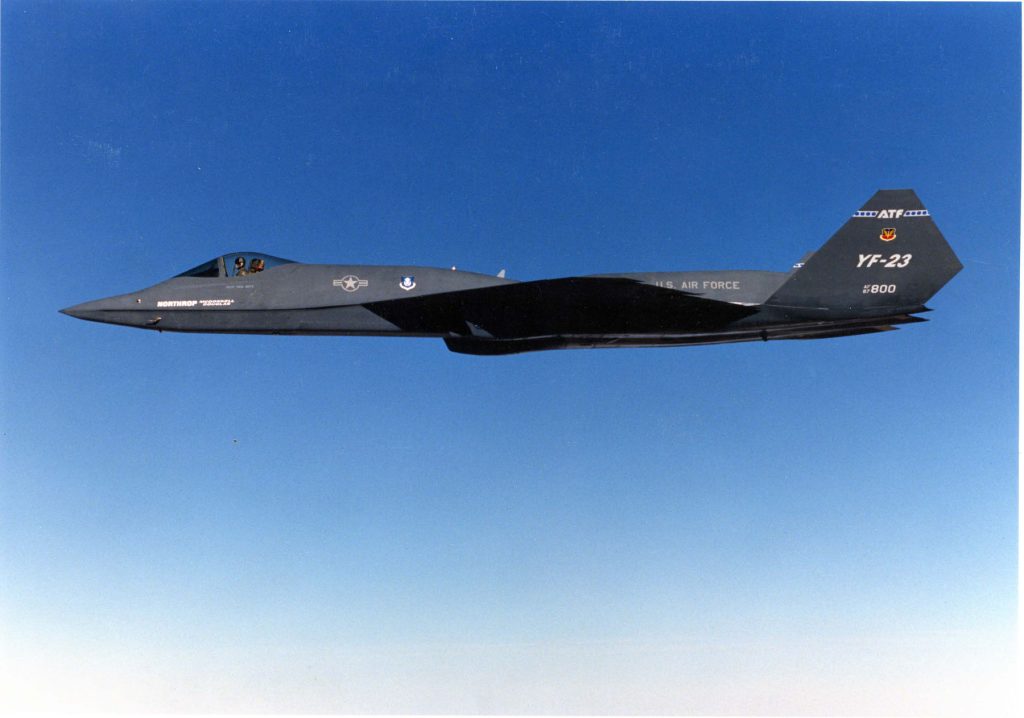
Northrop’s Prototype Air Vehicle (PAV) number 1, unofficially called ‘Black Widow II’, made its first flight on August 27. The aircraft flew for about an hour and performed well. It could climb well, and the F-16 chase plane had to use afterburners to keep up, while the YF-23 used its regular, non-afterburning power. Northrop test pilot Paul Metz noted that the aircraft felt very stable, requiring only small pilot movements to stay close to the chase plane. Lockheed unveiled its YF-22 prototype at a ceremony at Plant 10 in Palmdale, CA, on August 28. The YF-23 was 67.5 feet long, 13.11 feet high, with a wingspan of 43.7 feet and a wing area of 950 square feet. The empty weight of the aircraft was 29,000 pounds, and the gross weight was 64,000 pounds at takeoff. It could be armed with a 20 mm M61 Vulcan cannon, four AIM-120 AMRAAM or AIM-7 Sparrow medium-range air-to-air missiles, and two AIM-9 Sidewinder short-range air-to-air missiles, but these were not installed on PAVs. After the first flight, testing of the Northrop YF-23 increased, and to make the most of the flight time, the YF-23 qualified for air refueling on its fourth flight. While flying behind a KC-135 tanker, the YF-23 spent about three hours connecting and disconnecting at different speeds. On flight number five, test pilot Bill Lowe flew the Northrop YF-23 at supersonic speeds for the first time. Following this, the aircraft tested supercruise speeds up to Mach 1.5. By flight number six, the first four YF-23 pilots completed their training, with the last pilot check done by operational test pilot Con Thueson on flight number 11.
The Tests
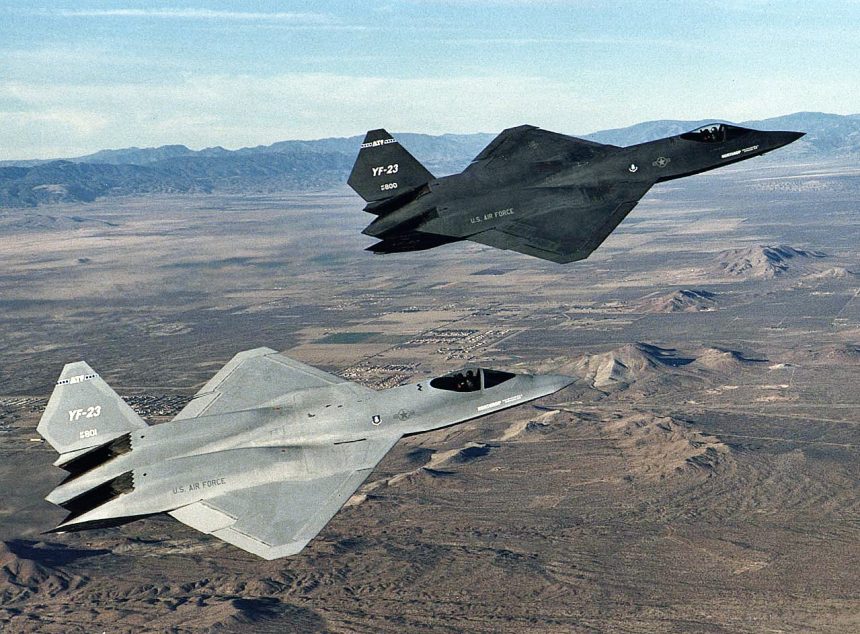
PAV-2 began its flight tests on October 26, 1990, when Jim Sandberg flew the aircraft for the first time. The testing of PAV-1 went smoothly until October 30, when Bill Lowe flew at Mach 1.5 during flight number 16 and experienced a shattered front windscreen. The outer glass cracked, but the inner polycarbonate layer stayed intact, allowing for a safe landing. A similar incident happened with PAV-2 nearly a month later. Early test flights of the PAV-2 had problems. During its second flight, the left engine did not work properly, forcing the plane to land on one engine. On November 21, the third flight nearly ended badly when a blocked air sense line caused the fuel tanks to overpressure. As the aircraft ascended, the internal pressure approached the limits of the fuel tanks. Quick actions from the ground control helped the aircraft land safely before any major damage occurred. After these issues, PAV-2 became a reliable test aircraft. Both prototype planes provided good performance data on their airframes, avionics, and engines. The two prototypes flew together only once during the test program. On November 29, Paul Metz flew PAV-1, and Jim Sandberg flew PAV-2 in formation over the Mojave Desert. PAV-1 concluded its testing the next day with a six-flight surge-and-flutter test, reaching a maximum speed of Mach 1.8. It marked the highest speed reached by PAV-1, which completed its flight test program in just 93 days. After PAV-1 was retired, efforts focused on extending the supercruise capabilities of PAV-2. Although the maximum supercruise speed of PAV-2 has not been publicly shared, it is reported to be much faster than PAV-1. On December 18, PAV-2 flew in formation with the first YF-22 for 15 minutes. It was the only time these two different prototypes flew together.
The Cancellation
The final flight of the program happened on the same day when Ron ‘Taco’ Johnston took PAV-2 on a nearly two-hour test mission. PAV-2’s flight testing lasted only 82 days. From January to April 1991, the Air Force looked at two proposals for the airframe and engine. On April 23, 1991, Secretary of the Air Force Donald Rice announced that the Lockheed F-22 and Pratt & Whitney F119 had won the competition for the ATF production contract. He stated that both aircraft met the ATF requirements, but the USAF had “more confidence” in Lockheed and Pratt & Whitney to manage the program and deliver the weapons system on time and within budget. After the ATF decision, both PAVs, which had all government equipment removed, including usable avionics and engines, were stored outdoors in a small fenced area next to the B-2 test facility at Edwards AFB. They sat in storage for nearly two years before NASA took ownership of both vehicles on December 1, 1993. NASA Dryden Flight Research Center planned to conduct structural tests on the composite airframes, but could not secure funding. As a result, both vehicles remained in outdoor storage at different locations within the center. Eighteen months after receiving the Northrop YF-23s, NASA realized no testing would take place and offered the airframes to museums. PAV-1 was transferred to the National Museum of the United States Air Force and moved to the AFFTC Museum at Edwards AFB in May 1995 for temporary display. In August, PAV-2 was taken apart and sent to the Western Museum of Flight, which was originally in Hawthorne, CA, but later moved to Torrance, CA. In the Grounded Dreams series, the Northrop YF-23 was not a bad aircraft, but it could not gain the confidence of US Air Force officials. Read more Grounded Dreams articles HERE.



Lockheed teamed with Boeing and General Dynamics for the YF-22. Each was responsible for roughly 1/3 of the project. Later, Lockheed bought General Dynamics’ fighter division, which included the F-16 program, and took over 2/3 of the F-22 program. Boeing built the wings and aft fuselage of the F-22, and did most of the avionics and systems integration.
At the entrance to the Pima Air and Space Museum in Tucson, there is a monument called the Beauty of Flight which features three scales models of the F-23 flying abreast.
This article reads like it was generated by AI.
But it’s not.
There is an Air Force F4 on display at Pima County Air Museum with some patches on the side where the engine has a blow out on takeoff in 1967 in Viet Nam. My brother Col John Miller was its pilot at that time and he became a docent at the museum for almost 10 years. Never knew it was his plane till he checked the tail number for plane’s history.
The article quotes Air Force Donald Rice saying : “He stated that both aircraft met the ATF requirements, but the USAF had “more confidence” in Lockheed and Pratt & Whitney to manage the program and deliver the weapons system on time and within budget.” What I get from these statements is it sounds like right from the start Northrop and GE were starting from a disadvantage as whoever was involved in making the final decision already held preconceived notions towards the four companies involved. I don’t wish to dump on the F22 as it’s obviously a great fighter but it’s no secret that many within the community believe the Air Force did not choose the best aircraft, feeling the YF23 was the better overall fighter, having a smaller rader cross section and thus stealthier, had longer range based on a combination of higher fuel capacity and it’s more efficient aerodynamic airframe. The only area where the YF22 beat it, and it wasn’t significant, was in its acrobatic maneuvers with the YF22 being aided by thrust vectoring which could help in close range dog fights but neither of these fighters were truly designed to be in that position utilizing their stealth and first look, first kill raders and weapons. While thrust vectoring allows for some incredible air shows, these fighters were designed to shoot down adversaries out of sight from distances of over 100 miles. With what’s taking in the world and China being our biggest concern, I’d be willing to bet with the aid of hindsight, things may have turned out differently knowing what we know today.