





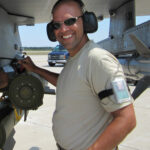

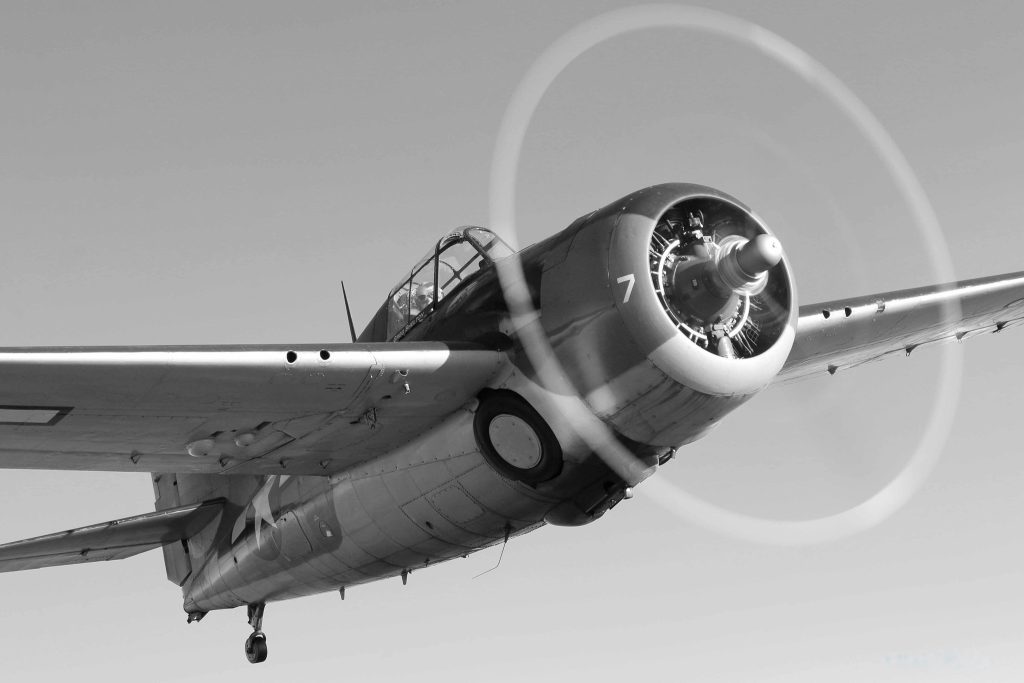
Though he grew up among the cornfields of landlocked Indiana, Mark Roche, an admitted “World War II nerd” with a fascination with the Pacific War, had always wanted to visit the Solomon Islands. The interest was deeply personal: “My Uncle Buck was killed on Makin Island. I was pretty close to my grandma, so the stories about him were all over the place when I was growing up, so I had a longing to go to the Solomon Islands ever since I was a kid. I even had owning a Wildcat on my bucket list! It all just kind of gnawed on me.” Fast forward a few decades, and Mark had become an investment banker and founded two aviation companies. The desire to go to the Solomons remained, and when an opportunity to make the trip presented itself, Mark grabbed it. Among his numerous accomplishments, Mark was also a certified scuba diver. In 2008, he left his investment banking job and had three months before he was to start his new job. He explained the flurry of activity that soon put him on a plane headed for the Pacific, “I had this time off, and I was making pretty decent money, so I decided to go. Once I made the decision, I had to figure out how to get there; I found a travel agent up in Washington State who was connected with some hotels and dive shops on New Georgia Island and on Guadalcanal. Everything was set up in advance, so within five days of deciding to make the trip, I was on my way. When I arrived on Guadalcanal, I got a hop up to Munda where there was a dive shop called Dive Munda.” The shop has changed hands a number of times, but Mark said that regardless of ownership, the shop always did a great job of taking people out to the crash sites off Rendova and Munda.
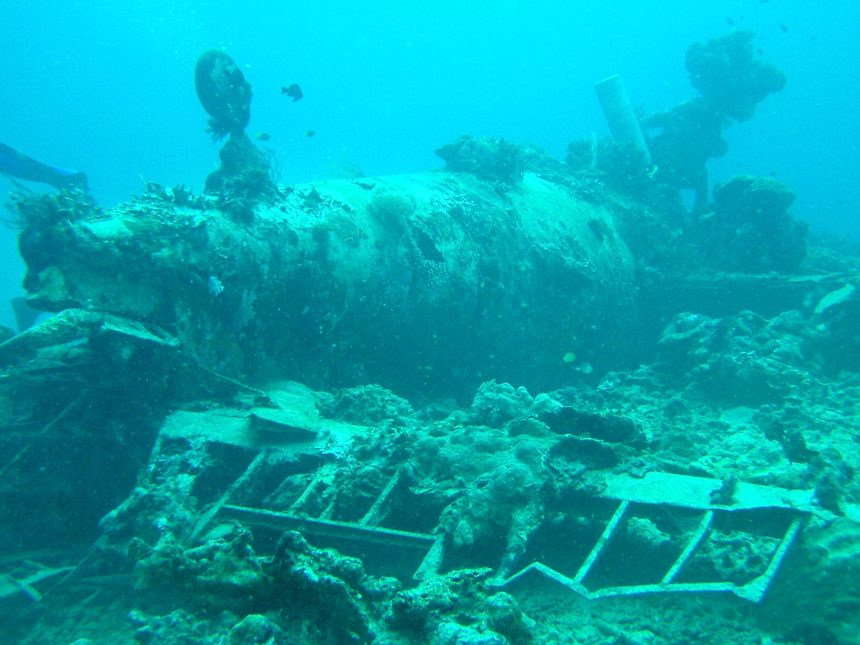
Mark spent a number of days with the same set of guides, and they discussed a wide range of topics including airplanes. While on the latter subject, Mark talked about his SNJs and the warbird training company, Gauntlet Warbirds, which he founded in 2006. Mark tells the story, “They were pretty psyched about seeing the pictures of my airplanes. One day they looked at each other and then looked at me and said, ‘We want to show you something. It’s about an hour boat ride.’ I said, ‘Great. Let’s go.’ On the way out there, they told me they’d found an airplane in the water but didn’t know if it was Japanese or American. They said they hadn’t seen it in a couple years and weren’t even sure if they could find it again. They ended up at a place called Bairoko Harbor where Marines landed in the New Georgia campaign.
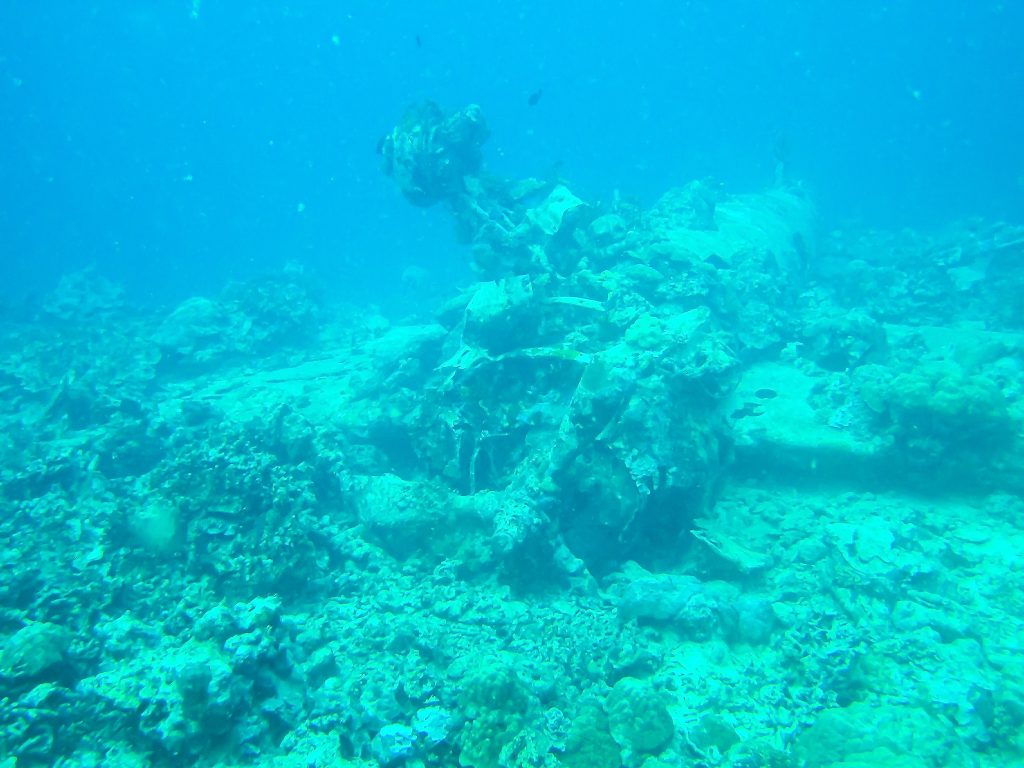
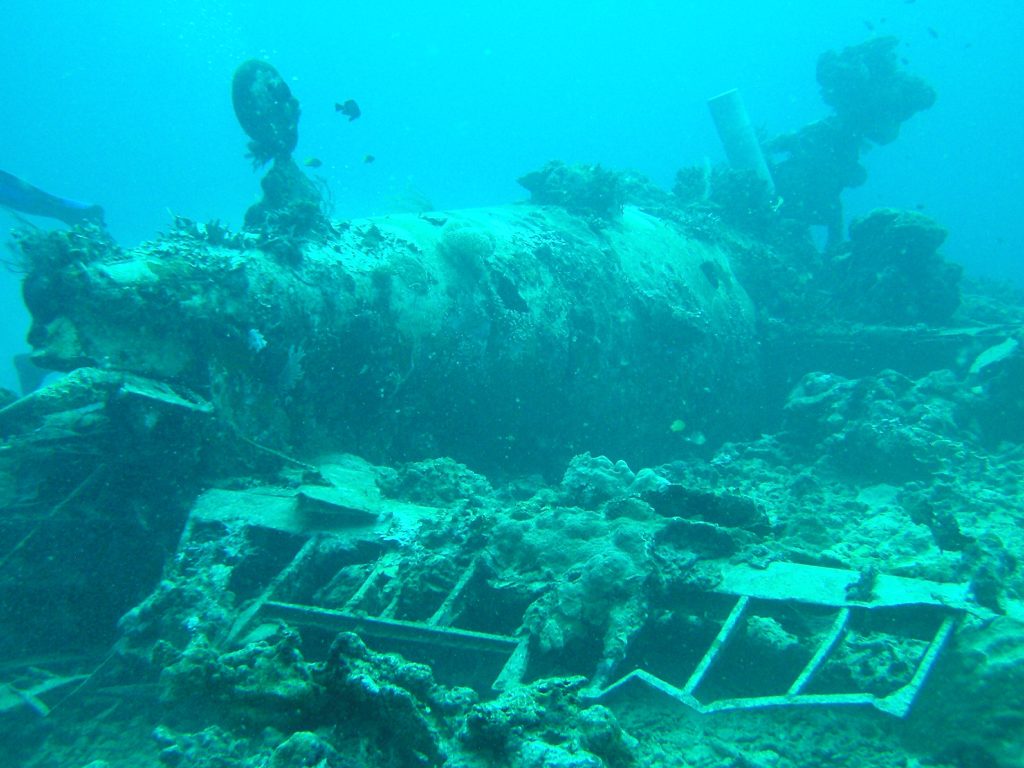
Mark continued, “We’re not even 100 yards offshore when one of the guys went in the water. He swam around for a while, and when he finally found it, we all jumped in and there it was….a fully intact Wildcat, flat on its back. The vertical stabilizer was buried so far in the seabed that the horizontals were almost touching the bottom. Man, I went nuts. There was a rumor that there were remains with this wreck, so I was looking, but didn’t see anything at first. As I was going around the tail cone, something told me to look over my shoulder, which is not easy to do with scuba gear. So, I looked over my shoulder at the left horizontal stabilizer and saw something shiny in the sand. It was hard to make out because it was heavily encrusted, but it turned out to be a snap from a canteen pouch. To the right of that, I was a human rib and then another and then I was following a trail of bones, including long bones, down under the elevator.” Mark said the guides told him they never told tourists about this wreck, since it involved an MIA, so they gathered the bones and bagged them.
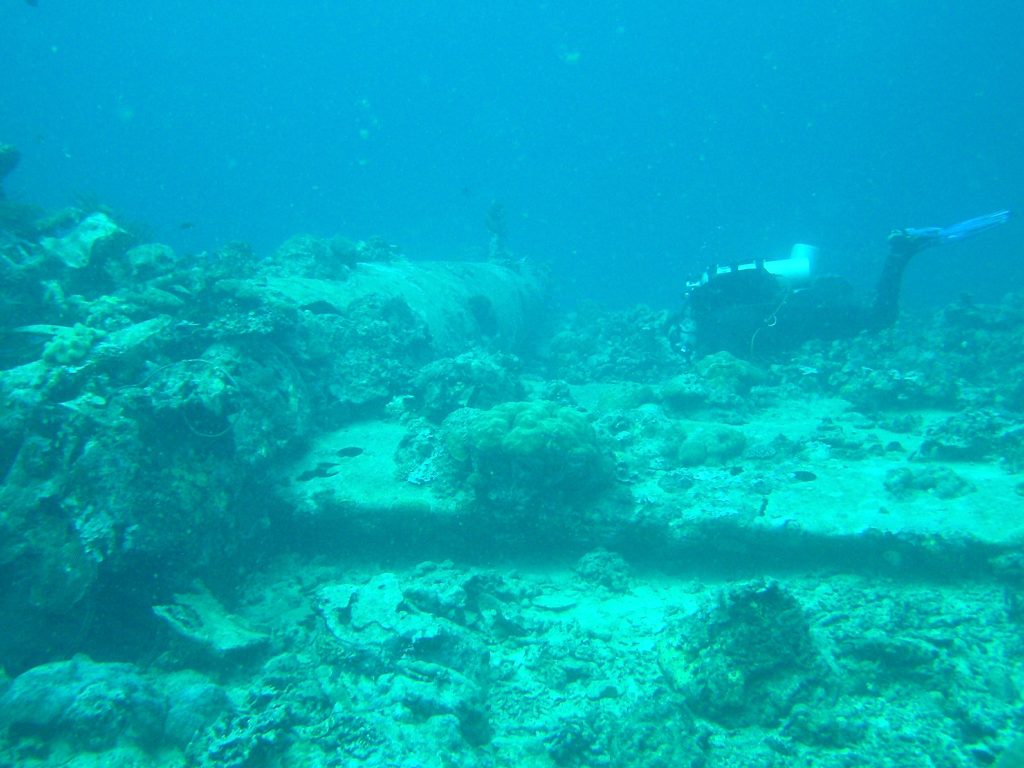
Mark knew that the area was once deep inside Japanese territory and occupied by the Kure 6th Special Naval Landing Force, so when he came back to the surface he ventured up onto the nearby beach, which had heavy mangroves. After a little bit of digging, Mark found empty Japanese rifle cartridges, which led one to believe that the pilot survived the ditching, but was subsequently shot and killed by Japanese soldiers on the shore. The following day was Mark’s last day on New Georgia, so he and the same guides returned to the wreck to see what else they could recover. They found what they thought was vertebrae, the sole of a boot, goggles, and a radio headset. Mark then related how he began the process of turning the remains over to the proper authorities: “I’d made friends with a local Australian federal police officer, Terry, who was assigned to Munda, as part of a joint peacekeeping force because of some civil unrest. That night he and I got online and did a search on what to do if you find an MIA. We found the Joint POW/MIA Accounting Command (JPAC, which was absorbed into the Defense POW/MIA Accounting Agency in 2015), which I had never heard of. We filled out the form online to report a find, but we never heard back, so I left the remains with Terry.
Terry ultimately got the remains to the U.S. Consulate down in Honiara on Guadalcanal, where they remained for months. Mark related, “Fast forward three months, and I still hadn’t heard anything from JPAC, and I was starting to get irritated. I had no way of contacting them. There wasn’t even a phone number on their website! Then I found out there were service branch casualty offices that worked with JPAC to help solve cases, so I called the Navy casualty office in Tennessee. I got an active-duty Army sergeant who had a billet there, and this guy was on it. By the end of that day, I not only had a call from JPAC, but the sergeant gave me the Navy’s entire crash database for all of World War II. From that I compiled a list of 65 Wildcat MIA cases from the Solomon Islands.” Mark got a call from Johnie Webb, a retired Army Lieutenant Colonel and Vietnam Veteran, who began his career at the Defense POW/MIA Accounting Agency (DPAA) in 1994 and retired from the same agency in December 2022 as its Deputy Director for Outreach and Communications Directorate. Johnie made arrangements for the remains to be picked up by a team returning from a field mission. Then everything went dormant for two years.
Mark could not have known it at the time, but it would take nine years to identify the remains. He very well could have been left out of the process, but thanks to a few well-meaning individuals, he was kept in the loop: “In 2010, Johnie arranged for my invitation to a JPAC symposium in San Diego. At the time, they were collaborating with independent groups that were working on their own and raising their own money. There was no such thing as partnership arrangements with outsourced parties,” Mark said. Also in attendance was Pat Scanlon from Project Recover and Ray Emory (1921-2018), a Pearl Harbor survivor who was aboard USS Honolulu (CL-48) on that fateful day. Ray was responsible for pressing the Navy to exhume the unknowns from USS Oklahoma (BB-37). He knew a thing or two about dealing with JPAC, and taught Mark how to deal with the red tape. He also met Larry Gonzalez, an active-duty Navy commander running the Research and Analysis Group, who introduced me to his guy, who was running the Solomon Islands desk. Mark credits both of these men for ensuring he would be involved in the case. The head of the Solomons desk had been at JPAC for 15 years and knew the island group like the back of his hand. He quickly got it down to just Lieutenant Junior Grade (LTJG) Irvin Rink and Ensign (ENS) William Clifton.” For the next three or four years, however, the investigation became painfully slow and frustrating after the case was turned over to JPAC’s Forensic Lab.
The case became about getting family DNA. Working with the Navy Casualty Office, Mark located the families to obtain DNA reference samples, including a living sister of Rink, but she was reluctant to give a DNA sample because “…this was over and done with years ago.” Mark understood her not wanting to open an old wound, but he stayed in touch with a couple other family members and she eventually agreed to provide a DNA sample. Once the Rink/Clifton DNA was in hand, the case should be close to being solved, right? Not quite. At that point Mark ran into “…one of the problems of the old [JPAC] structure. He explained, “They would always leave the DNA testing as the last step in the entire process of identification. They would wait until they performed a full archaeological dig. With limited funds for underwater activities, we had to get in line. I was told that once remains entered the lab, it would take eleven years on average to get an identification.” Given the limited number of personnel and funds, this is not surprising because there are over 71,000 MIAs still remaining from World War II alone. Of those, 65% are from the Pacific, and today DPAA has approximately 1,000 active cases going on at any one time.
The case to identify the remains Mark took “only” nine years because Mark enlisted help from Congress. He explained, “I’d heard about, “congressionals”, which is a letter from a congressman or a senator ordering a DNA test. I happened to be at a French Consulate Legion of Honor award ceremony at Ellington Field, Houston, where I met Jay Guerrero, a World War II buff who worked for Senator (Sen.) John S. Cornyn III. Mark recognized and seized the opportunity to ask for the senator’s help. Jay said he would look into the case. At this point, the case had been stalled for four years. Within weeks, Sen. Cornyn, who had been a Lieutenant Colonel in the Air Force, wrote the letter that had the desired effect. The technicians at JPAC ran the DNA tests and positively identified the remains as those of LTJG Irvin Edmund Rink. Born on July 13, 1918, in Dixon County, Nebraska, Rink was the oldest of six children and was 10 years old when his family moved to a farm near Maize, Kansas. He attended Maize High School and graduated from the University of Kansas class of 1941 with a degree in petroleum geology. While in college, Rink entered the Civilian Pilot Training Program (CPTP), earned his private pilot license, and enlisted in the U.S. Navy Reserves. He later transferred to NAS Corpus Christi, Texas, and commissioned as an Ensign on May 1, 1942.
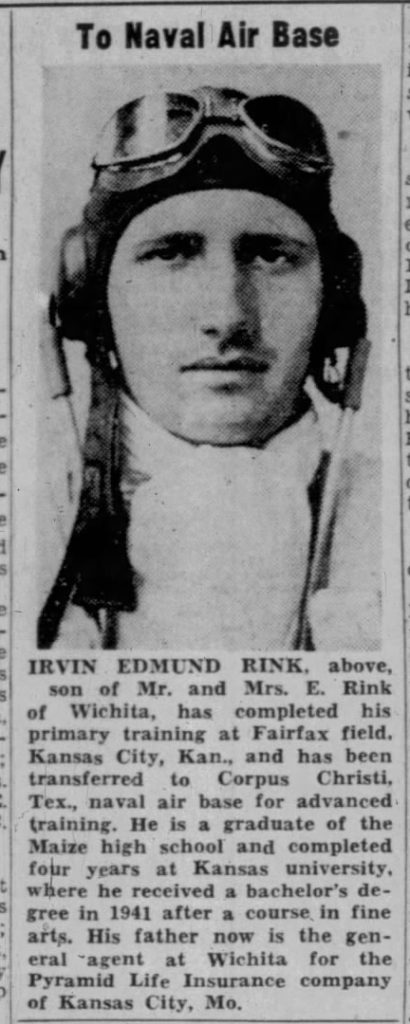
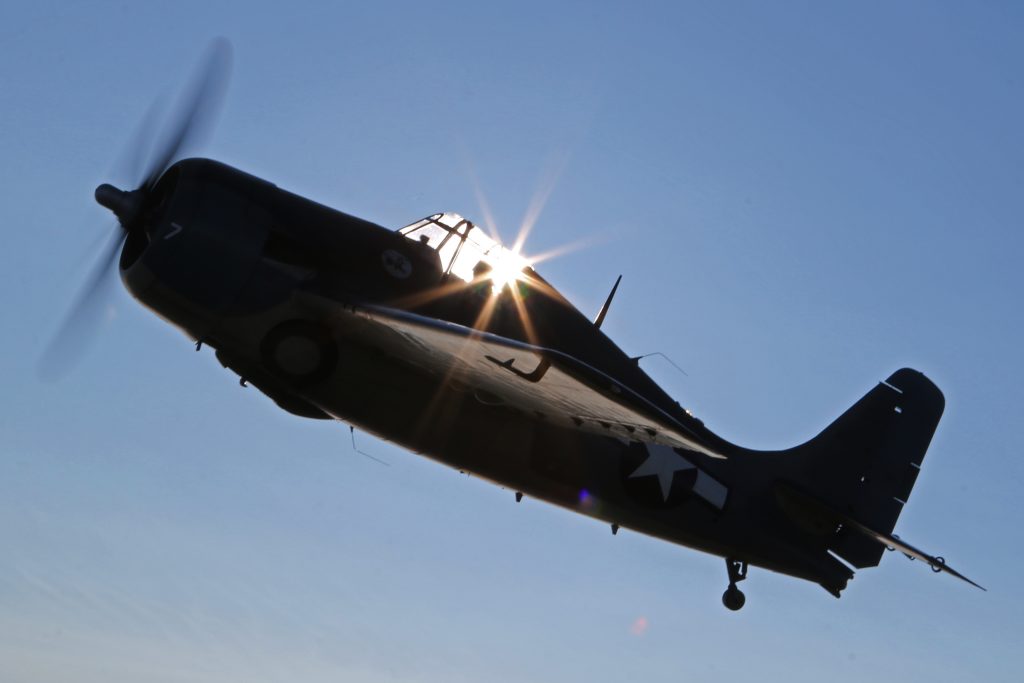
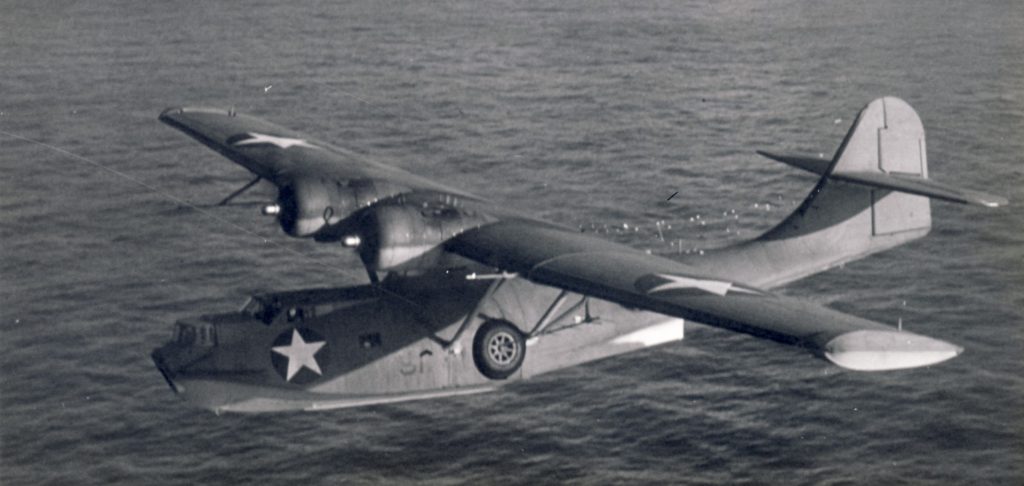
The city of Wichita was proud of its latest son who went off to war. In May 1943, a local newspaper ran a full-page ad for Naval aviation, and it featured Irvin standing on the wing of his Wildcat. He later passed through the city on a recruiting drive for Naval aviation. By that summer, Rink had been promoted to LTJG and assigned to Fighting Squadron Twenty-Seven (VF-27) Kangaroos, aboard USS Suwannee (CVE-27) flying F4F-4 Wildcats. On August 4, 1943, Rink climbed into F4F-4 BuNo 12090 and, along with seven other pilots, launched from a land base to escort a PBY on a rescue mission. Just as the Catalina attempted to land at Enogai Inlet, New Georgia Island, they were jumped by a flight of Japanese fighters. In the ensuing battle, Rink and ENS William T. Clifton, who’d been flying F4F-4 BuNo 12139, disappeared. Whether a search and rescue mission was launched to locate the downed fliers is unknown, but the war moved on, and both men were posthumously awarded the Purple Heart and declared dead on January 8, 1946. Once the remains had been identified, they were ultimately turned over to the Rink family, and on April 16, 2018, nearly 75 years after he disappeared, LTJG Irvin Edmund Rink was laid to rest next to his parents at Maize Cemetery in Maize, Kansas. Mark and his wife were not only in attendance, but Mark was invited to deliver Irvin’s eulogy. “My wife and I spent three days with the Rink family in Wichita,” Mark said. “We had a couple of nice gatherings, which I think were good for the family. Several of the family came to me and said, ‘Because of what you’ve done, I’ve met cousins I didn’t know I had.’ After the war, much of the family went their separate ways; Irvin’s return brought this big German, Kansas farm family back together.” Ironically, Irvin’s sister passed away the night before his remains arrived in Wichita. Mark learned from the Rinks that Irvin’s brother, Vic, was also a Naval Aviator and was nearly killed in a fiery Hellcat accident. Normally, this would be where the story ends, but this case had a positive unintended consequence. Mark explained, “During this case, a unit was created within DPAA called Partnerships and Innovations. The unit was given responsibility for outside contractor relationships to outsource search and recovery of MIAs. Once Irvin’s case was solved in 2017, a few folks at DPAA asked, ‘Why don’t you consider doing partnership work for us?’ They introduced me to Ewan Stevenson, a New Zealander born and raised on Guadalcanal. He’s a real authority on the Solomons and has built his own archival database. He and Matt Wray had a little thing called Sealark Exploration and had been doing their own work in the Solomons. They’d also assisted JPAC on a few cases.” Matt was in the process of retiring from the Royal New Zealand Navy and had considerable experience at subsea mapping in the South Pacific. The trio had a few conference calls, and it didn’t take long for them to realize that between Mark’s business and warbird experience, Ewan’s extensive knowledge of the Solomon Islands, including speaking fluent Pidgin, and Matt’s command experience and knowledge of subsea mapping, they could greatly expand the scope of Sealark’s operations.
They finally met in person in 2019 in Brisbane and spent a few weeks diving around Munda. Mark related, “It was a great experience, and we agreed to form Sealark as a 501(c)(3) because at the time we thought we were going to have to get donations; we figured we had to base out of the U.S. because that’s where you’re going to find donors who are interested in this kind of work. Then all of a sudden, we fell into the situation of being very busy doing contract work for DPAA.” The mission of the reimagined Sealark was that of investigation, rather than recovery. The team would focus on overwater losses in the Solomons and Vanuatu, decide on a target aircraft, present a budget, and DPAA would collaborate and finance the mission. In 2023 and 2024, Sealark launched three missions to locate three aircraft, which they found and recovered remains.
Most recently, DPAA announced the identification of Aviation Radioman 2nd Class Robert Cyr, Jr., who was aboard a PBY that crashed in 1944. Sealark located the aircraft in 2023. Another set of remains from this aircraft is pending identification. Sealark has two additional sets of remains from Solomon Island losses pending identification in DPAA’s lab at Hickam AFB, Hawaii.
Sealark has a huge proprietary database on overwater losses in the Solomons and the New Hebrides. At the same time, DPAA has suffered extensive budget cuts such that there is very limited funding for World War II overwater losses. Sealark is therefore turning to project-based fundraising. The team is targeting a November 2026 Guadalcanal mission to locate a B-24 with multiple MIAs aboard and an SBD Dauntless. The team is reasonably confident of the locations and has budgeted $185,000 for the mission. Mark advises that donations for the mission are tax-deductible and that for large donors, a few spots may be available to accompany the team on the mission. Obviously, much of the work in this field is held in the strictest confidence until remains are identified and families notified. While it rarely makes the news, there are dozens of organizations, from the federal government and university archaeological programs to grassroots teams like Sealark, out there searching for America’s MIAs because for the families the war won’t be over until their loved ones have returned home. For more information about Sealark, visit www.sealark.co.nz.









It’s sad to read that the U.S. Gov.t Dep.ts are out the same mould as British – when Service Men are alive, and useful, they’ll lend an ear to queries.
But when Dead nobody is really interested, unless of Special Interest, and perhaps publicity.
None of which is good for Service Morale … or gaining more new recruits.