






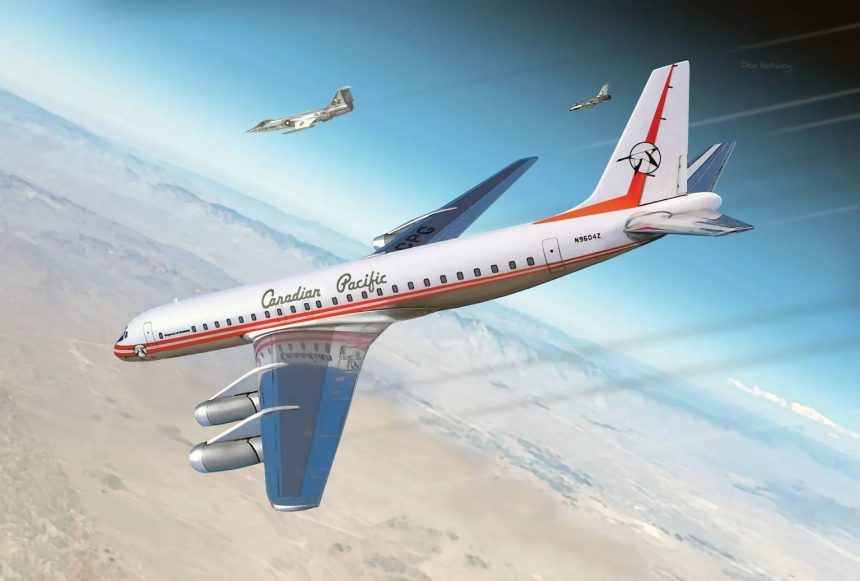


On this day in aviation history, 65 years ago (August 21, 1961), a Douglas DC-8 became the first civilian airliner to exceed the speed of sound. Douglas test pilot William Magruder was at the controls of DC-8-43 N9604Z, accompanied by copilot Paul Patten, flight engineer Joseph Tomich, and flight test engineer Richard H. Edwards. During a test flight over Edwards Air Force Base, California, the four-engine jet reached Mach 1.01 in a controlled dive. The flight was intended to demonstrate the DC-8’s capabilities beyond its normal operating envelope. Magruder climbed the aircraft to approximately 52,000 feet before beginning a half-G pushover. During the descent, the DC-8 encountered buffeting around Mach .96 before accelerating through the sound barrier at approximately 45,000 feet. The aircraft remained at Mach 1.01 for around 16 seconds before beginning its recovery.
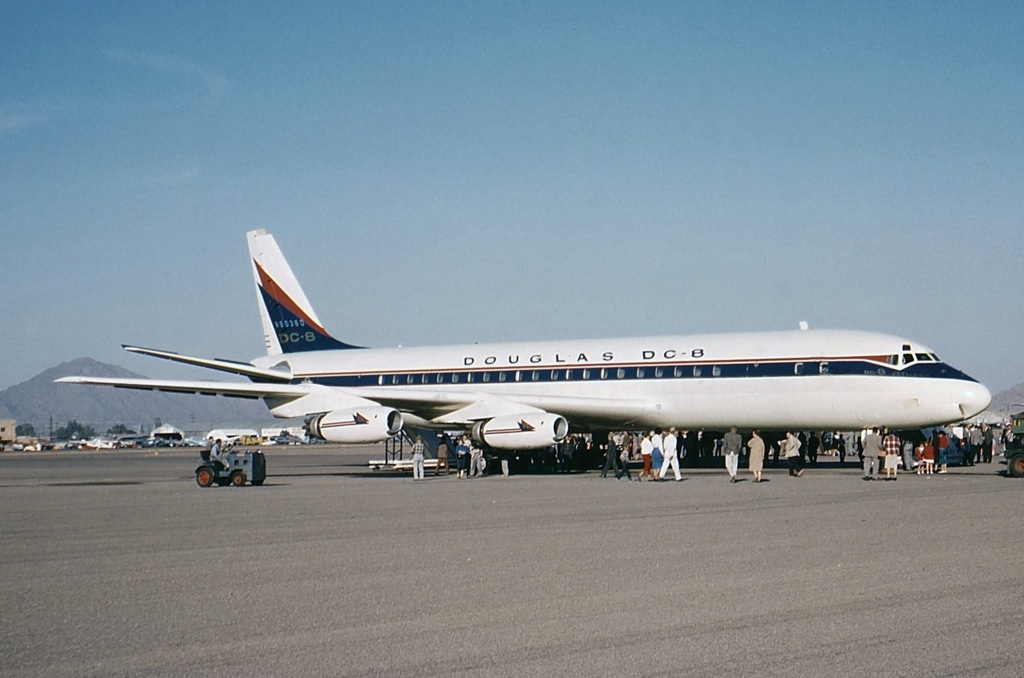
The recovery proved more difficult than expected when the elevator became ineffective, and the stabilizer initially refused to move under aerodynamic load. Magruder responded by increasing the dive slightly, relieving the load and allowing the stabilizer to operate before recovering at approximately 35,000 feet. The historic DC-8 was later delivered to Canadian Pacific Air Lines, where it remained in service for nearly 19 years before being scrapped in 1980. The DC-8-43 measured approximately 150 feet 6 inches in length with a wingspan of 142 feet 5 inches and was powered by four Rolls-Royce Conway turbofan engines. While its normal maximum operating speed remained well below Mach 1, N9604Z reached Mach 1.01 during the 1961 test. The flight remains particularly remarkable because the DC-8 was a conventional subsonic transport, rather than an aircraft specifically designed for supersonic flight.










Nice article. I never knew this about the dc-8. Structurally, the airplane held up just fine but the dive must have been harrowing for those aboard conducting the tests.
Jeeezz. My first time, was the DC 9
Any indication how much negative pitch he needed? I’m guessing it was not significant (less than 10ndegrees).
Ted