






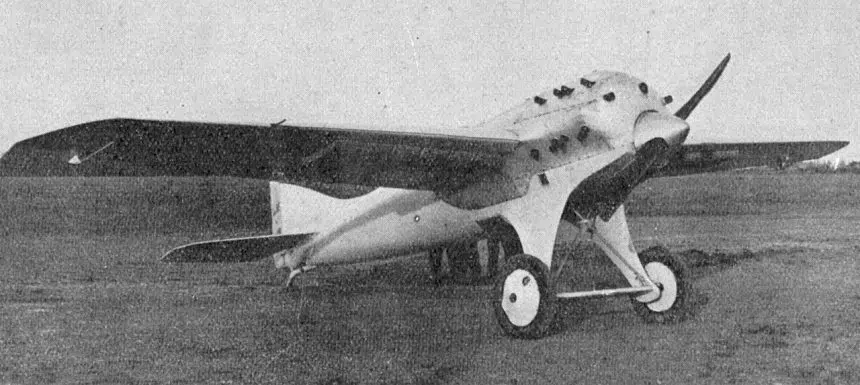


On this day in aviation history, 102 years ago (October 2, 1924), the Bernard SIMB V.2 took flight for the first time. French pilot Florentin Bonnet was at the controls for the aircraft’s maiden flight from Istres, France. Designed by Jean Hubert and built by Société Industrielle des Métaux et du Bois (SIMB), the V.2 was a single-seat racing aircraft developed during an era of intense competition to capture the world airspeed record. The V.2 was originally intended to compete alongside the Bernard V.1 in the 1924 Beaumont Cup, but was completed too late to participate. Following the loss of the V.1, Bernard instead turned its attention toward using the V.2 to challenge the world airspeed record. The streamlined mid-wing monoplane featured polished wooden construction intended to reduce drag and was powered by a Hispano-Suiza W-12 engine.

Following its first flight, the V.2 underwent additional testing and modifications before Bonnet made an attempt on the airspeed record. An initial average of 244 mph established a new French record, but fell short of the world mark. After modifications including a shortened wingspan, improved engine cowling, and metal propeller, Bonnet tried again on December 11, 1924. His average speed of 278 mph was recognized as a new absolute world airspeed record, which stood for nearly three years. The sole V.2 was eventually placed on public display before being scrapped. The Bernard SIMB V.2 measured 22 feet in length with a wingspan of 32 feet 6 inches, and a gross weight of 2,608 pounds. Power came from a 450-horsepower Hispano-Suiza 12Gb W-12 water-cooled piston engine driving a two-bladed propeller. The aircraft was capable of approximately 280 mph, remarkable performance for an aircraft first flown in 1924.











Thank you