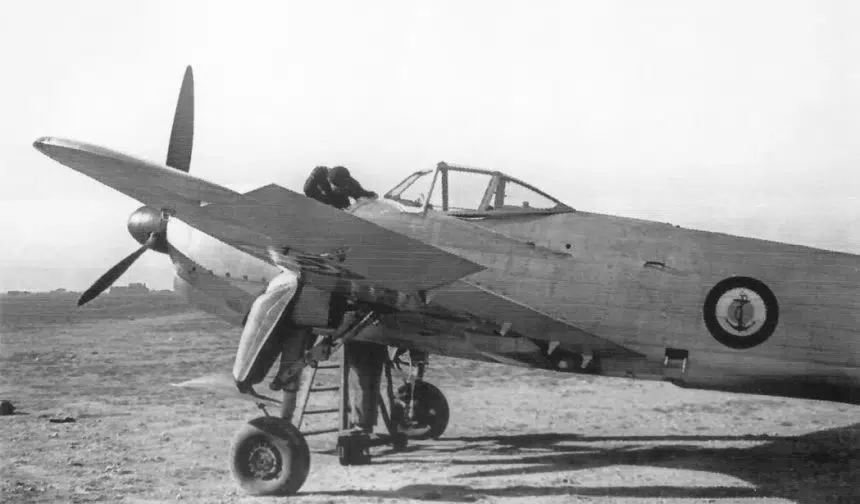

On this day in aviation history, 81 years ago (August 24, 1945), flight trials of the Loire-Nieuport LN.42 began, following a five-year interruption caused by the German occupation of France. Developed from the LN.401 family of French dive bombers, the LN.42 represented an attempt to substantially improve the design’s performance with a more powerful engine and redesigned wing. Development of the LN.42 grew from the shortcomings of the earlier LN.401, which entered French naval service shortly before WWII. The new aircraft eliminated the LN.401’s distinctive inverted gull wing and elevator endplates and was fitted with a considerably more powerful Hispano-Suiza engine. The sole prototype was constructed in 1940 and made several short hops before the fall of France forced development to stop. The aircraft was subsequently hidden from German forces for the duration of the war.

With France liberated and WWII at an end, the LN.42 emerged from hiding and resumed flight testing on August 24, 1945. Trials continued until 1947, but aviation technology had advanced dramatically during the intervening years. The now-obsolete piston-engine dive bomber attracted no further interest, and only the single LN.42 was ever constructed. The LN.42 was powered by a 1,100-horsepower Hispano-Suiza 12Y-51 liquid-cooled V-12 engine, a considerable increase over the 690-horsepower engine of the earlier LN.401. The supplied sources do not provide a complete set of dimensions or performance figures specifically for the LN.42. For comparison, the LN.401 had a wingspan of 45 feet 11 inches, a maximum speed of 240 mph, a range of 750 miles, and a service ceiling of 31,200 feet.