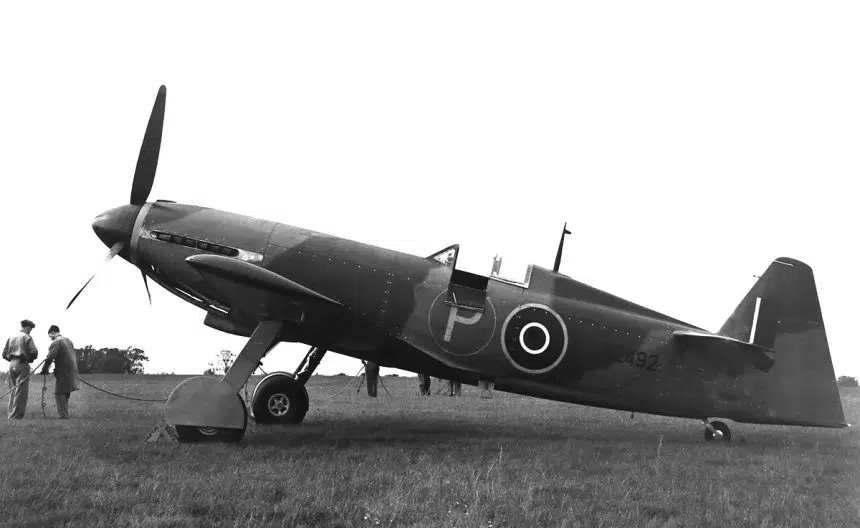

On this day in aviation history, 84 years ago (August 31, 1942), the Martin-Baker MB 3 took flight for the first time. Company co-founder and test pilot Captain Valentine Baker was at the controls of prototype R2492 during the flight from RAF Wing in Buckinghamshire. Designed by James Martin, the MB 3 was an experimental British fighter notable for its exceptional armament of six 20 mm cannons. The MB 3 incorporated lessons learned from Martin-Baker’s earlier MB 1 and MB 2 designs and was developed to meet Air Ministry Specification F.18/39. Power came from a 2,000-horsepower Napier Sabre engine, while the airframe incorporated a strong steel-tube fuselage structure and pneumatically operated landing gear and flaps. Three prototypes were ordered, and initial flight testing showed the MB3 to be highly maneuverable and easy to fly.

Tragically, the program changed course less than two weeks after the first flight. On September 12, 1942, the MB 3 suffered an engine failure shortly after takeoff. Baker attempted a forced landing but struck a tree stump and was killed. The sole prototype was destroyed, and no production order followed. Martin continued developing the concept, eventually producing the advanced MB 5 fighter. Baker’s death also deeply affected Martin and contributed to his later focus on aircrew safety and the development of Martin-Baker ejection seats.

The MB 3 measured 35 feet in length with a wingspan of 35 feet 4 inches and was powered by a 2,000-horsepower Napier Sabre H-24 engine. It could reach approximately 415 mph at 20,000 feet, had a range of 1,100 miles, and a service ceiling of 40,000 feet. Its unusually heavy armament consisted of six wing-mounted 20 mm Hispano Mk.II cannons.