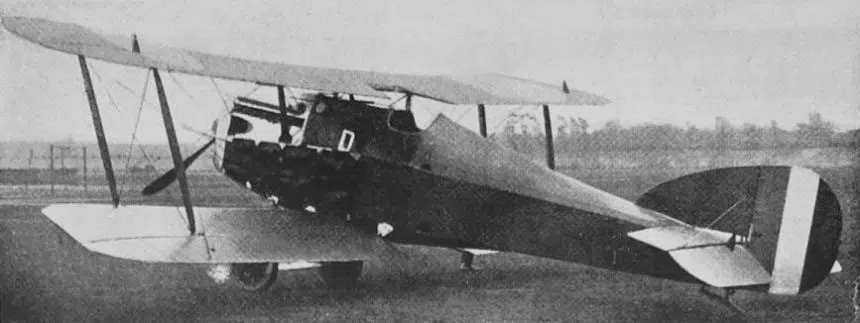

On this day in aviation history, 109 years ago (October 3, 1917), the Martinsyde F.3 took flight for the first time. Designed by George Handasyde and built as a private venture without an official government order, the F.3 was a single-seat British biplane fighter powered by a Rolls-Royce Falcon engine. Though the F.3 itself would see only limited production, its development ultimately led to the successful Martinsyde F.4 Buzzard. The F.3 proved impressive during testing, attaining a maximum speed of 142 mph. Its performance was considered a significant improvement over existing fighters, leading to orders for six pre-production aircraft and 150 production examples late in 1917. Plans for large-scale production soon encountered a problem, however, as available Rolls-Royce Falcon engines were needed for the Bristol F.2 Fighter.

Martinsyde responded by developing the F.3 into the F.4 Buzzard, powered by the more readily available 300-horsepower Hispano-Suiza 8. First flown in June 1918, the Buzzard proved fast, maneuverable, and easy to fly. Orders eventually reached 1,450 aircraft, but the Armistice brought large-scale production plans to an abrupt end. Around 370 Buzzards were ultimately built, with examples serving in numerous countries after WWI. The production F.4 Buzzard measured 25 feet 5.6 inches in length with a wingspan of 32 feet 9.4 inches. Its 300-horsepower Hispano-Suiza 8Fb engine gave the fighter a maximum speed of 146 mph, an endurance of 2.5 hours, and a service ceiling of 24,000 feet. Armament consisted of two synchronized .303-inch Vickers machine guns. One of the fastest fighters developed during WWI, the Buzzard remained in service with Finland as late as 1940.