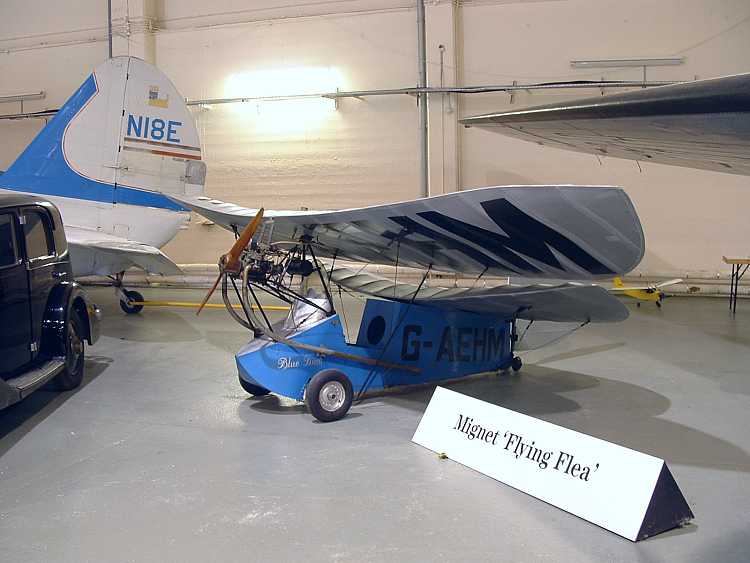


On this day in aviation history, 93 years ago (September 10, 1933), the Pou-du-Ciel, better known in English as the “Flying Flea,” took flight for the first time. French aircraft designer Henri Mignet piloted the unusual homebuilt aircraft near Soissons, France. The HM.14 was created with an ambitious goal: to make powered flight affordable and accessible to ordinary people. Mignet had experimented with numerous homebuilt aircraft since the 1920s before arriving at the HM.14. Instead of a conventional wing and tail, the Flying Flea used two staggered wings, with the forward wing pivoting to control pitch. A large rudder provided both yaw and roll through the aircraft’s strong dihedral, eliminating the need for ailerons or even rudder pedals. Mignet published plans for the HM.14 in 1934, allowing amateur builders to construct the aircraft themselves.

The Flying Flea quickly became an international homebuilding phenomenon, but early examples suffered a serious aerodynamic flaw that could cause an unrecoverable dive. Following several fatal accidents, wind tunnel testing identified the problem, and modifications were developed to correct it. Despite the controversy, Mignet continued refining his concept, and the HM.14 ultimately inspired hundreds of different Flying Flea designs. The original HM.14 had a wingspan of approximately 19 feet 6 inches and measured just 11 feet 6 inches in length. Power came from a 17-horsepower Aubier-Dunne two-stroke motorcycle engine, while gross weight was approximately 450 pounds. The tiny aircraft had a usable speed range of around 25 to 62 mph and carried a single pilot.