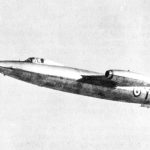



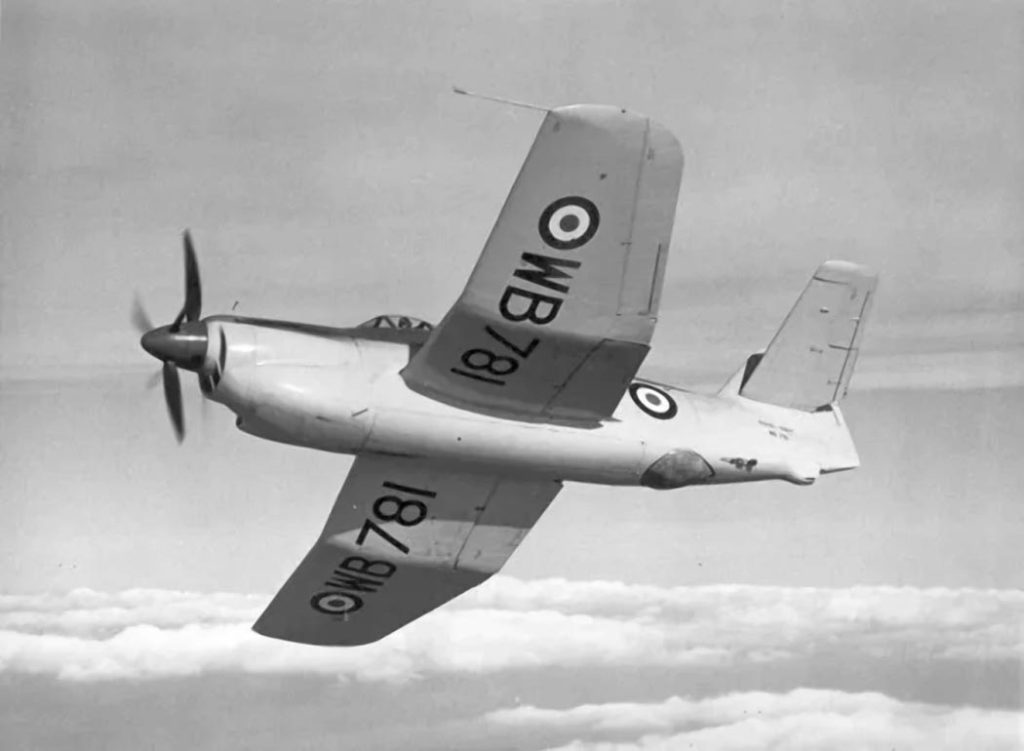
After WWII, the UK Royal Navy needed a modern carrier-borne anti-submarine aircraft. Blackburn Aircraft submitted its B-54 design in response to the Navy’s Specification G.R.17/45. The Blackburn B-54, also called the Y.A.5, was meant to use a new engine called the Napier Coupled Naiad turboprop. This engine featured two Naiad engines driving contra-rotating propellers through a single gearbox. However, the engine was canceled, so the Y.A.5 flew instead as the Y.A.7 with a Rolls-Royce Griffon 56 piston engine, which also drove contra-rotating propellers. The Y.A.7 made its first flight on September 20, 1949, ahead of a competing design by Fairey, the Fairey Gannet.

Design of Blackburn B-54
In 1950, the Royal Navy added a requirement for radar and a radar operator. The Y.A.7 was improved and became the Y.A.8, which first flew on May 3, 1950. This version improved handling and added a third crew position. The Y.A.8 design served as the basis for the B-88 Y.B.1, which first flew on July 19, 1950. The B-88 used an Armstrong Siddeley Double Mamba engine, similar to the original Naiad planned for the Y.A.5. The Blackburn B-54 and B-88 shared the same airframe design. They were large, single-propeller conventional monoplanes. They featured mid-mounted wings with an inverted gull shape and a mid-mounted horizontal tailplane with noticeable upward angles.
The Cancellation
These planes had a simple wing-folding mechanism that split at the gull-wing angle, unlike the Fairey Gannet. The deep fuselage housed the engine(s) and a large weapons bay. The aircraft had tricycle landing gear, and it carried a radar scanner in the rear fuselage within a retractable dome, similar to the Fairey Gannet. The Blackburn B-88 was 42. 8 feet long, 16.9 feet high, with a wingspan of 44.2 feet and a gross weight of 13,091 pounds. It was expected to reach a maximum speed of 320 mph, with bombs or depth charges in the internal weapons bay. However, development took a long time, and the Royal Navy’s Fleet Air Arm (FAA) lost interest. It favored the Fairey Gannet, which had already flown with the Double Mamba engine and completed landing trials, so it entered operational service instead of the Y.A. series. In the Grounded Dreams series, the Blackburn B-54 was a good design, but it couldn’t arrive in time. Read more Grounded Dreams articles HERE.