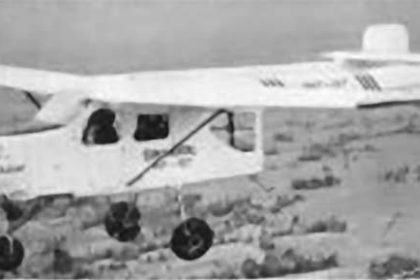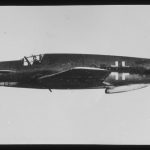



The Philippine Institute of Science and Technology (ISL) developed at least three aircraft prototypes in the early 1950s. The institute sought to explore the possibility of local design and production of aircraft, as well as to experiment with the use of local materials in the construction of such aircraft. One material they focused on was Wobex, which was a type of reinforced woven bamboo. One of those aircraft was the ISL XL-15 Tagak, developed with the Philippine Air Force. It was a single-engine, high-wing plane with a twin-boom design and tricycle landing gear. It allowed easy access to the fuselage through rear doors. The inner sections of the wings had slotted flaps along the trailing edges and maintained a constant width. Towards the tips, the wings tapered and included slotted ailerons. A single lift strut on each side connected the wing to the lower fuselage and had an airfoil shape to increase wing lift.
Design of IST XL-15 Tagak

The IST XL-15 Tagak’s fuselage was made from wood and plywood, framed in a semi-monocoque design and covered with Wobex and plywood. Behind the 185 hp Lycoming flat-six engine, the cabin measured 10 feet 6 inches long toward the back of the pod. It had two front seats under the wing’s leading edge and two more seats behind them. There was also space for stacked stretcher cases. The cabin had two windows on each side, and the rear of the pod, as it projected beyond the trailing edge of the wing, was largely glazed. The two tail booms were made entirely of plywood and were part of the center section of the wing. The booms also included fins with long-chord underside fillets. It had a rectangular tailplane that extended beyond the fins and featured a horn-balanced elevator. The fixed surfaces were made of wood and plywood with Wobex covering, while the control surfaces were covered in fabric.
The Cancellation

The IST XL-15 Tagak was 30 feet long, 9.2 feet high, with a wingspan of 39.4 feet and a wing area of 219.5 square feet. The empty weight of the aircraft was 1,720 pounds, and the gross weight was 2,756 pounds. Its maximum speed was envisioned at 120 mph, with a cruise speed of 98 mph, a range of 419 miles, and a service ceiling of 13,000 feet. Flight testing of the IST XL-15 Tagak started in October 1954. By 1956, the team made some small changes. They increased the size of the rudder and added a shimmy damper to the nosewheel. However, the plan to mass-produce or further develop the IST XL-15 Tagak was canceled due to insufficient demand and a lack of interest and support from the services and the government. Read more Grounded Dreams articles HERE.