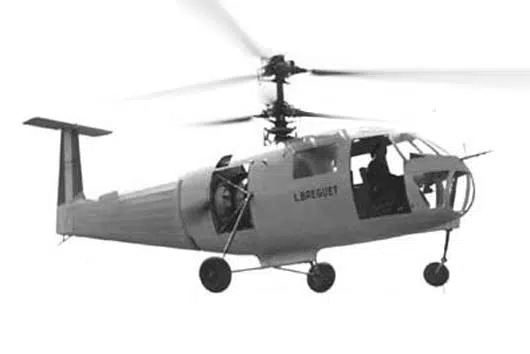


French aircraft designer Louis Breguet developed his first helicopter, the Breguet-Richet Gyroplane, in 1908. However, his 1935 design, the Gyroplane Laboratoire, was more successful. This helicopter had two main rotors turning in opposite directions, but no tail rotor. In 1947, the French Gyroplane Society asked Breguet to design a helicopter for carrying several passengers. He continued development of his earlier G.34 project with the two-seat Breguet G.11E, or Société Francaises du Gyroplane (SFG) G.11E. The G.11E was a bigger aircraft with the same three-blade twin-rotor layout as the Gyroplane Laboratoire. It was powered by a 240-horsepower Potez 9E nine-cylinder radial engine mounted in the middle of the aircraft, beneath the rotor shafts. The rotors had tapered tube spars and ribs. They were covered with dural on the leading edges and an alloy on the rest. The rotors were attached with flapping hinges and included dampers to reduce drag.
The G.11E

The pilot could change the pitch of the rotors through the control column with the aid of swashplates. The pedals helped the pilot adjust torque and control yaw by altering the collective pitch of each rotor. A mechanical governor prevented rapid rotor acceleration; in emergencies, the pilot could increase pitch only as far as the governor allowed. The G.11E had a tapered, oval fuselage. The front section used a light alloy and a monocoque design, with a well-designed cockpit and two sliding doors for access. The rear fuselage used a steel-tube structure covered in fabric and featured a tall T-tail. The tail had a one-piece moving tailplane that adjusted the cyclic pitch through the control column to prevent pitch oscillations that occur once per revolution. The undercarriage had a wide track, with main wheels attached to horizontal V-struts from the bottom of the fuselage, plus a single bracing strut on each side to the mid-fuselage.
The Breguet G.111

The first flight took place on May 21, 1949. Testing showed the G.11E didn’t have enough power, so the Potez engine was replaced with a larger nine-cylinder radial engine, the Pratt & Whitney Wasp Junior, which produced 450 hp. The aircraft was redesignated Breguet G.111 and underwent some redesigns. The rotor diameter was increased by 3.3 feet, and the fuselage was lengthened by 1.7 feet to add two more seats, allowing it to carry four passengers. Both the empty weight and maximum weight increased to 3,254 lb. The Breguet G.111 began flight tests in 1951, but SFG did not finish them because it went bankrupt the following year, leading to the cancellation of the Breguet G.111. The Breguet G.111 could have been of use. But the struggling aviation economy wouldn’t let it prove itself. Read more Grounded Dreams articles HERE.