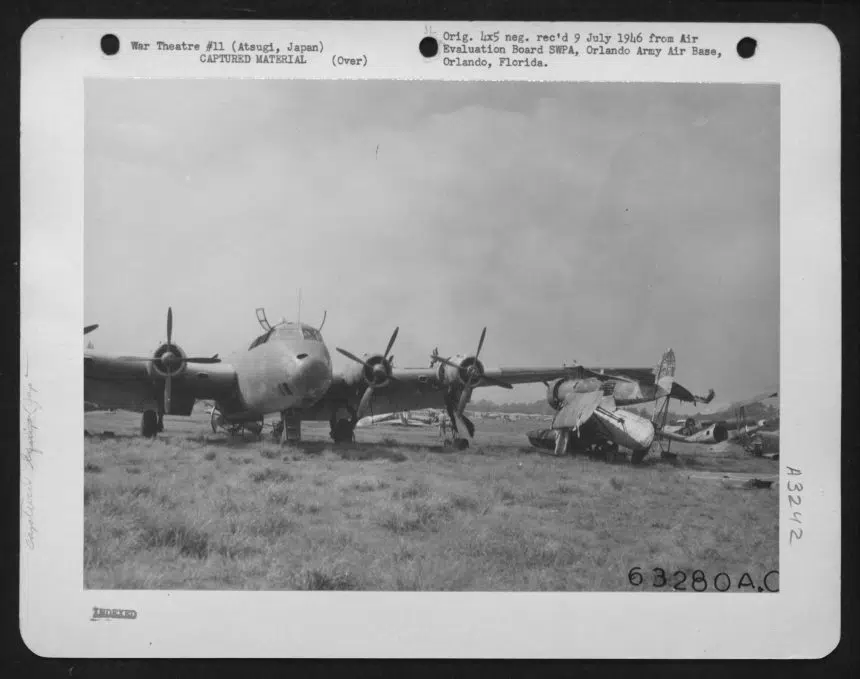


In the late 1930s, the Imperial Japanese Navy sought to develop a long-range bomber capable of carrying heavy loads, including bombs or torpedoes, for at least 3,500 miles. To meet its needs, the Navy realized it needed a four-engine aircraft. Because Japanese manufacturers had little experience building such large, complex planes, the Navy looked for an existing foreign model to base its new design on. The service chose the American Douglas DC-4E airliner. In 1939, the Navy bought the only prototype of this airliner, which American airlines had previously rejected. The service secretly gave it to Nippon Koku K.K. (Japan Airlines Co.), which then handed it over to the Nakajima Aircraft Company for disassembly and inspection. The design from this study, designated Nakajima G5N Shinzan, was an all-metal, mid-wing monoplane.
Design of Nakajima G5N Shinzan

The Nakajima G5N Shinzan was powered by four 1,530-hp Mitsubishi MK4B Kasei 12 radial engines and had fabric-covered control surfaces. It had a long lower bomb bay, a fully glazed nose, and twin tail fins instead of the three rudders of the DC-4E. It retained the DC-4E’s original wing shape, engine arrangement, and retractable tricycle landing gear. For defense, it had two 20 mm Type 99 Model 1 autocannons, one in a power-operated turret on top and one in a tail turret. It also included hand-operated 7.7 mm Type 92 machine guns mounted in the nose, bottom, and side positions. The seven-crewed Nakajima G5N Shinzan was 101.9 feet long, 28.10 feet high, with a wingspan of 138.2 feet and a wing area of 2,172 square feet. It could carry 8,800 pounds of freight or bombs. Its empty weight was 44,313 pounds, its gross weight was 62,060 pounds, and its maximum takeoff weight was 70,548 pounds.
The Cancellation

The Nakajima G5N Shinzan was envisioned to attain a maximum speed of 260 mph, with a cruise speed of 173 mph, a range of 2,650 miles, and a service ceiling of 24,440 feet. The first prototype of the Nakajima G5N Shinzan made its first flight on April 8, 1941. However, its overall performance was disappointing. This was due to its heavy weight, the weak Kasei engines, and the complex design. To improve the project, four additional planes were made with 1,870 hp Nakajima NK7A Mamori 11 engines and renamed G5N2. Although these Nakajima engines were more powerful than the Kasei 12s, they were unreliable. Along with the increased weight of the aircraft, this led to the end of further development. Four out of six completed Shinzans were used as long-range Navy transports. They were given the name G5N2-L Shinzan-Kai Transport. The Allies called the aircraft “Liz” because they thought it would be used as a bomber. Read more Grounded Dreams articles HERE.