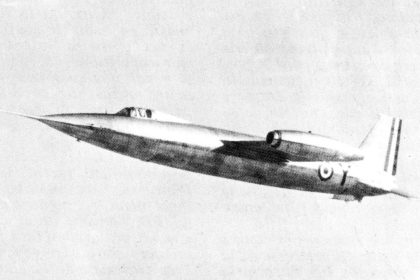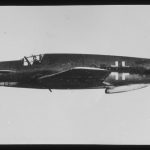
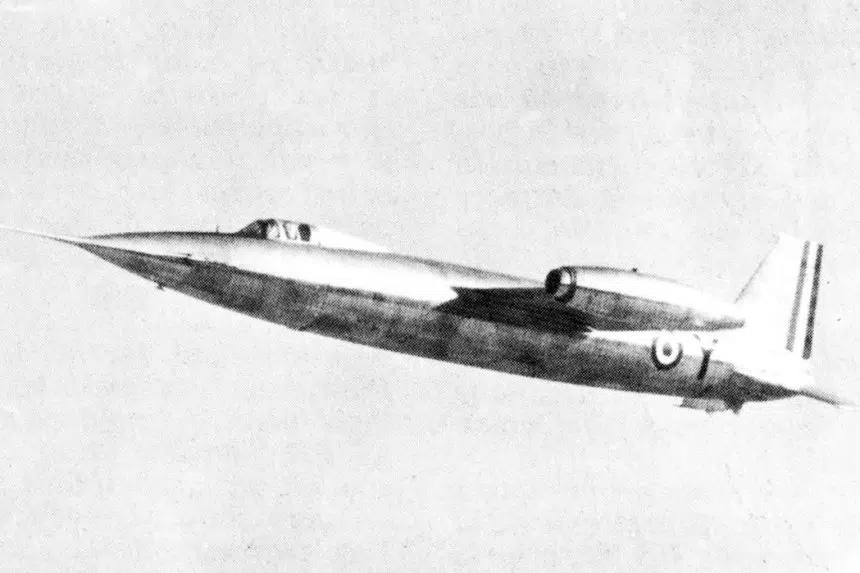


After WWII, France wanted to rebuild its military, especially the French Air Force, with a main focus on developing advanced military aircraft, particularly rocket-powered technology. In 1944, France established a new company, Société d’Etudes pour la Propulsion par Réaction (SEPR), to develop rocket engines. In 1948, the Air Staff asked SNCASO to start studying the design of rocket-powered interceptors with additional turbojet engines. By October, SNCASO began its design studies. One design by aircraft designer Lucien Servanty was particularly liked, designated SNCASO SO.9000 Trident. It featured a shoulder-wing monoplane that could reach supersonic speeds using a single SEPR rocket engine in the fuselage, along with wingtip-mounted turbojets. The setup used both engine types for fast climbs and high-altitude interception, while the turbojets alone would be used for returning to base. Servanty convinced the Air Force to support a design study and create a mockup on July 7, 1950. The aircraft was first tested without the rocket engine, using just the turbojet engines to check its low-speed handling. The second prototype Trident I made its first flight on September 1, 1953. But the plane couldn’t gain altitude and crashed shortly after takeoff, hitting a utility pole. Test flights for the Trident I prototype resumed on January 16, 1954, with Charles Goujon as pilot. During its sixth rocket-powered flight on October 26, the rocket failed during takeoff, but the plane managed to return safely to the runway. The incident showed that the Trident needed more power from its turbojets. As a result, the aircraft was grounded until it received more powerful 1,654 lbf Dassault MD.30 Viper engines, which are a licensed version of the British Armstrong Siddeley Viper. The aircraft flew for the first time with these new engines in March 1955. With these engines, it could exceed Mach 1 during a shallow dive, even without the added thrust from the rocket motor.
The SNCASO SO.9000 Trident

In April 1956, the decision was made to stop flight testing the remaining Trident I aircraft. Over an 18-month flight test program, the Trident I completed more than 100 flights. It reached a top speed of Mach 1.8 and an altitude of 65,000 feet. During this time, 24 of the flights used the rocket engine. The French Air Force was impressed by the Trident’s performance and wanted to use an improved model in their operations. In 1954, the French ordered two prototype SO.9050 Trident IIs. These prototypes mainly differed from earlier models by using a stronger rocket. The new two-chamber SEPR 631 rocket provided 6,600 lbf of thrust, replacing the older SEPR 431. Other changes included removing the ailerons, reducing the wings, enlarging the cockpit, moving the speed brakes from the wings to the fuselage, and lengthening the landing gear to fit a large air-to-air missile beneath the fuselage. The first aircraft flew for the first time on July 19, 1955, but only with its turbojets. It made its first rocket-powered flight on December 21. The second prototype took to the skies on January 4, 1956, but was destroyed three days later when the turbojet fuel pump failed and the engines lost power. SNCASO built a third prototype to develop a surface-to-air missile based on the Trident. However, the Air Force purchased this prototype to replace the destroyed aircraft, and it made its first flight on March 30. On February 16, 1956, the first prototype reached a speed of Mach 1.7 while carrying a model of the Matra 052 missile. It later achieved a speed of Mach 1.96 without the missile at an altitude of 62,664 feet. On May 21, 1957, the aircraft exploded in mid-air during a practice flight for the Paris Air Show. It was likely due to a dangerous mix of Furaline and nitric acid, which exploded and killed the pilot. The third prototype continued to fly until it belly-landed on September 19.
The Cancellation

In May 1956, the French Air Force ordered six pre-production Trident II aircraft. The service later signed a second contract for four more, but cancelled it on October 24, 1957, due to budget cuts. The pre-production aircraft were different from the first three prototypes. It replaced the original MD.30 engines with two Turbomeca Gabizo turbojets, each producing 2,430 lbf of thrust. The pre-production models also had a redesigned nose for fire-control radar and a hardpoint under the fuselage for a Matra R.511 air-to-air missile. The first pre-production aircraft flew for the first time on May 3, 1957. To prevent the program’s cancellation, SNACSO tried to set new records in 1958. On April 4, the first pre-production aircraft set a record for reaching 49,213 feet in 2 minutes and 37 seconds. On January 17, the third pre-production aircraft unofficially reached 74,800 feet, then set an official altitude record of 79,452 feet on May 2, just before the program ended on April 26. The Air Force scrapped the last three incomplete airframes, but continued flight testing until late in the year. This testing allowed the Trident II to achieve various unofficial records. It reached a maximum speed of Mach 1.97 on July 23, flew to 85,302 feet on October 6, which was the highest altitude for a turbojet, and climbed to 49,000 feet in 2 minutes and 15 seconds on July 8. The Air Force did not publicise these achievements to avoid upsetting anyone after choosing the Dassault Mirage III as its new interceptor. In the Grounded Dreams series, France cancelled the SNCASO SO.9050 Trident II project because it had many problems, including high fuel consumption, complex mechanics, and deadly prototype accidents compared to the Mirage III. Read more Grounded Dreams articles HERE.