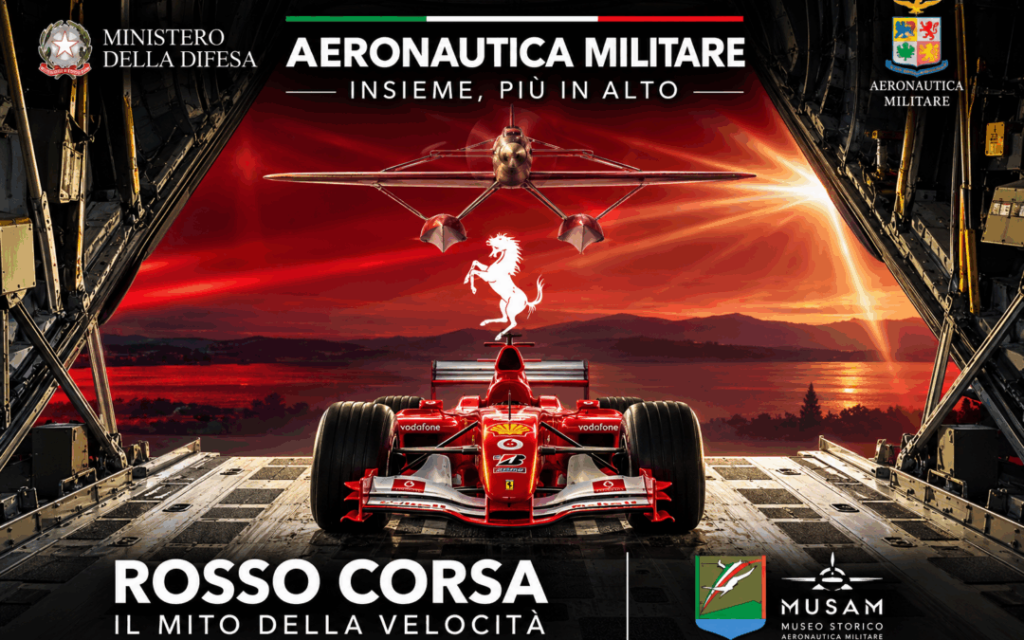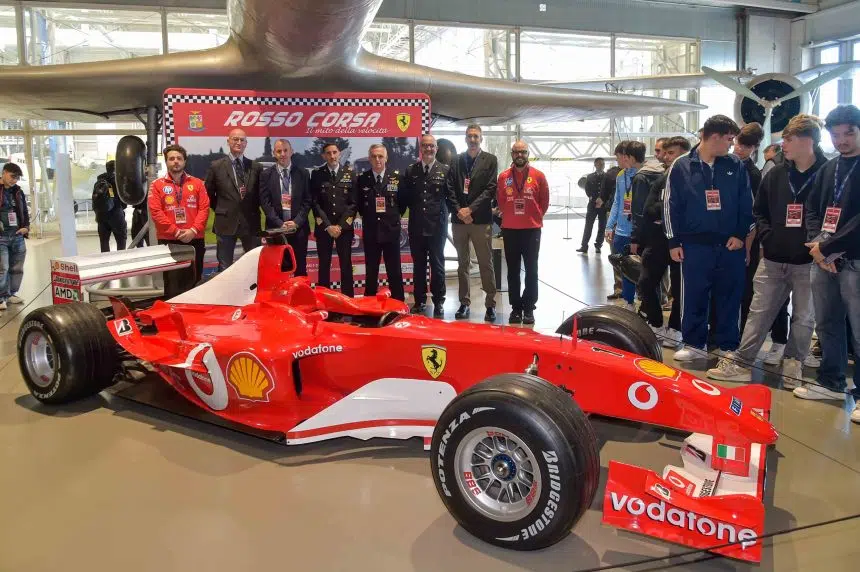

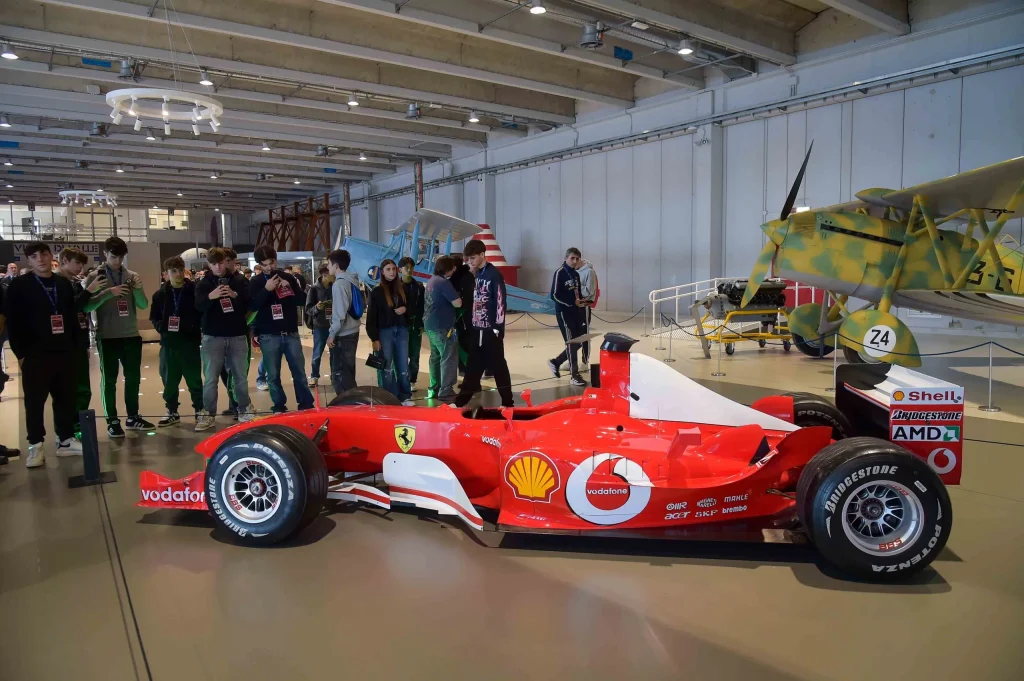
A Formula One racing car has joined the historic aircraft at the Italian Air Force Museum in Vigna di Valle, Italy, as part of an exhibition exploring the pursuit of speed. Running through November 15, 2026, Rosso Corsa – Il Mito della Velocità brings together aviation, motor racing, and sport, with Michael Schumacher’s Ferrari F2003-GA among its principal attractions. Organized with the Ferrari Museum in Maranello and the Centro Studi Militari Aerospaziali, the exhibition opened on October 23. The Ferrari provides a connection to one of the most memorable encounters between motor racing and military aviation. On December 11, 2003, Schumacher brought an F2003-GA to Grosseto Air Base for an acceleration contest against a Eurofighter Typhoon. Test pilot and astronaut Maurizio Cheli flew the fighter, bringing two very different approaches to high performance together on the same airfield. The 2026 exhibition revisits that encounter through the presence of the Ferrari alongside the museum’s aviation collection.
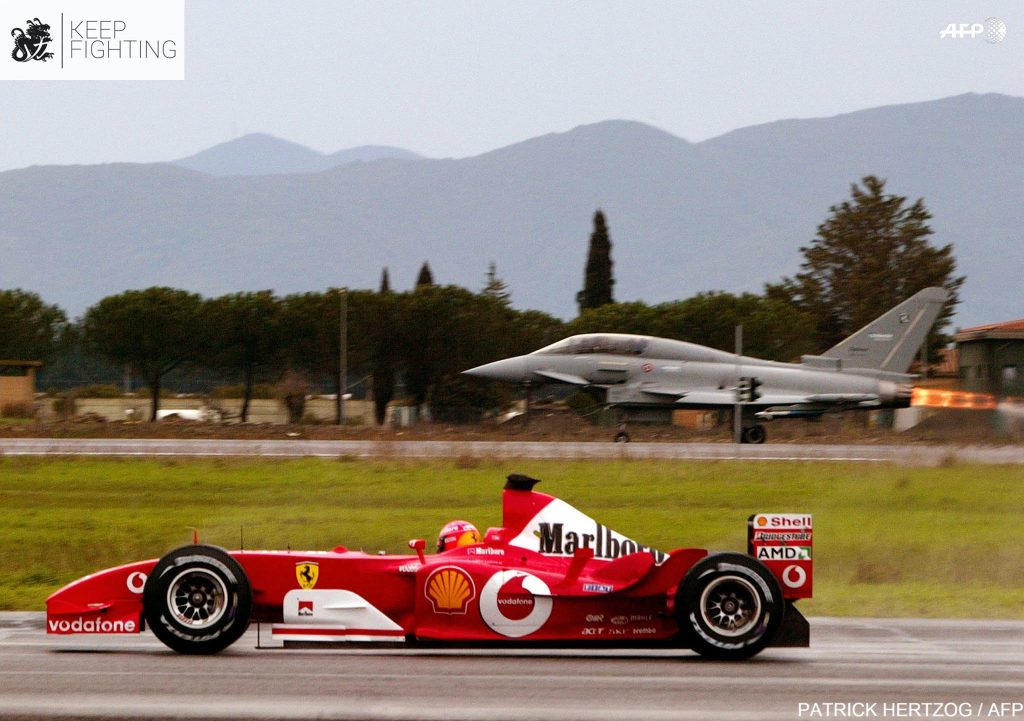
(Image credit: Aeronautica Militare)
For historic aviation enthusiasts, however, the exhibition’s opening date carries particular significance. On October 23, 1934, Francesco Agello flew the Macchi-Castoldi M.C.72 to an average speed of 709.202 kilometers per hour—approximately 440.68 mph—at Desenzano del Garda. Powered by a Fiat AS.6 engine producing approximately 3,000 horsepower, the Italian racing seaplane established a record that remains unbeaten for piston-powered seaplanes. Preserved at Vigna di Valle, the record-setting M.C.72 provides a direct link to that achievement. Its survival allows visitors to examine the machine behind the statistics: an aircraft developed during an era when international racing and record attempts pushed engine performance and airframe design forward. The museum celebrated the flight’s 90th anniversary during the first Rosso Corsa event in 2024. That edition featured a Ferrari associated with Gilles Villeneuve’s November 1981 contest against an Italian Air Force F-104 Starfighter at Istrana.

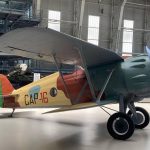
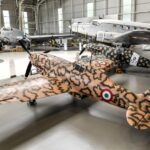
This year’s route extends across 14 stops within the museum. Aircraft and artifacts highlighted along the way include Schneider Trophy racing seaplanes, the Campini-Caproni CC.2, the Savoia-Marchetti S.79 Sparviero, the Aerfer Sagittario, the de Havilland Vampire, the F-104 Starfighter, and the Eurofighter Typhoon. Flying equipment and sporting memorabilia broaden the exhibition beyond the machines themselves. Ferrari’s place in this setting also reflects a connection that predates its Formula One success. The company’s prancing horse originated with Francesco Baracca, the Italian WWI fighter ace who carried the emblem on his aircraft. Baracca’s mother subsequently encouraged Enzo Ferrari to adopt it as a good-luck symbol, establishing an enduring link between Italian aviation and motor racing.
(Image credit: Aeronautica Militare)
Education formed a central part of the opening program, which welcomed approximately 200 students. Activities included workshops conducted by the Ferrari Museum and the aviation museum’s maintenance and restoration staff. The latter presented an instructional Alfa Romeo 126 engine, a type used in the S.79, giving students an opportunity to explore the engineering behind the museum’s exhibits. Rosso Corsa – Il Mito della Velocità continues at the Museo Storico dell’Aeronautica Militare, on Lake Bracciano near Rome, through November 15. A related static modeling exhibition, Dalla carta allo spazio, takes place at Magazzino 22 on October 31 and November 1, with free admission from 10 a.m. to 6 p.m. Visitors should consult the Italian Air Force’s official website for museum access information.