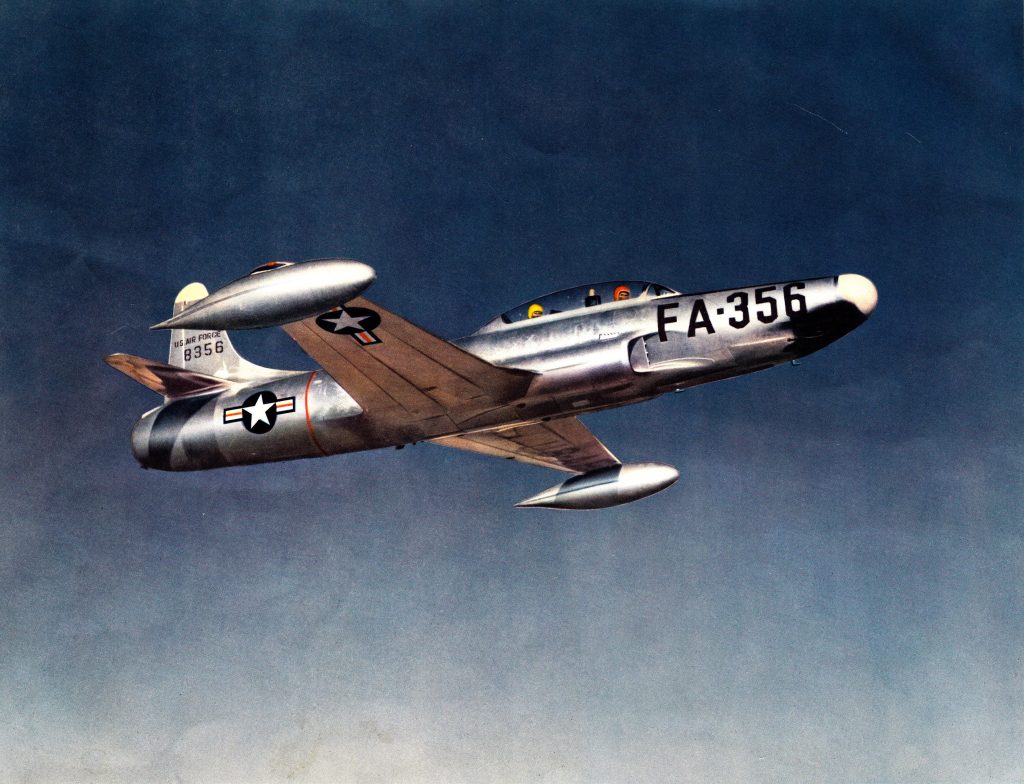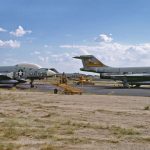
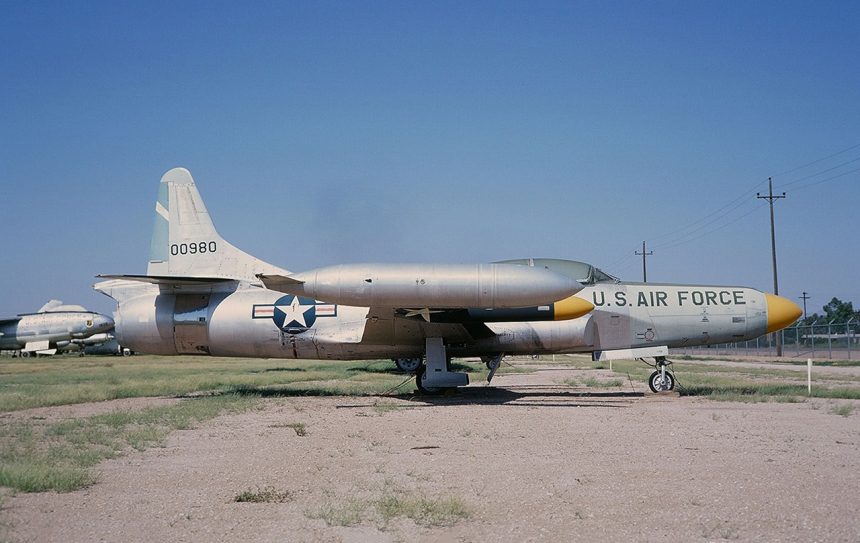

As we continue the Boneyard Files series, which showcases some of the retired aircraft resting at Davis-Monthan Air Force Base in Tucson, Arizona, in the late 1960s, today’s story features the Lockheed F-94 Starfire through the lens of Neil Aird’s “Monthan Memories” photos. In the late 1940s, the US Air Force realized that it lacked all-weather jet interceptor capability to counter Soviet bombers. As a result, it tasked Lockheed with building a jet-powered interceptor that could be operational day and night, in all weather conditions. Lockheed developed a jet based on its T-33 Shooting Star trainer aircraft, naming it the F-94 Starfire. It became America’s first all-weather jet interceptor and the first US production jet to feature an afterburner. The Lockheed F-94 Starfire prototype flew for the first time in 1949. It had a large radar in the nose that helped the observer in the rear seat find enemy aircraft at night or in bad weather. The pilot would then position the Starfire for an attack based on the observer’s radar information. By December 1949, the US Air Force had ordered 368 Lockheed F-94 Starfire aircraft. The initial production model of the Lockheed F-94 Starfire, designated F-94A, entered service with the US Air Force in May 1950. Subsequently, two more models, the F-94B and F-94C, were also produced.
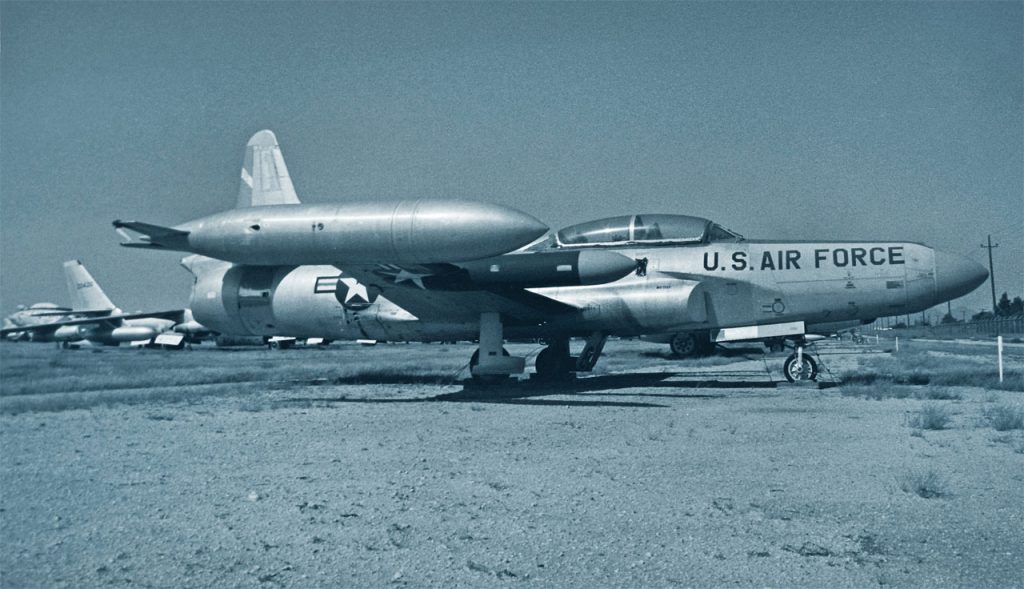
The F-94A was 40 feet long, 12.2 feet high, with a wingspan of 38.9 feet. It was powered by an Allison J33 engine, which produced 6,000 pounds of thrust. thrust with afterburner. The weight of the aircraft was 15,330 pounds, with a maximum speed of 630 mph and a range of 930 miles. The aircraft was equipped with four .50-caliber machine guns. A total of 110 F-94As were produced out of 853 total built, with 356 F-94Bs and 387 F-94Cs. The F-94B entered service in January 1951 and was identical to the F-94A, with some modifications to the Allison J33 engine and the cockpit. It also featured an upgraded Instrument Landing System. The most famous and only version to receive the “Starfire” tag was F-94C. The F-94C was initially designed as a new aircraft, F-97, but later officials decided to call it a new version of the Lockheed F-94 Starfire family. It first flew on January 18, 1950. It had several improvements, including a stronger engine, single-point refueling, a new wing design, a sweptback horizontal stabilizer, better fire-control and navigation systems, and, later, mid-wing rocket pods. The F-94C carried a total of 48 2.75-in. Folding Fin Air Rockets, with 24 in the nose, arranged in a circle around the radome, protected by retractable doors, and an additional 24 in the wing pods if they were installed. The F-94C did not carry any guns. It was powered by a Pratt & Whitney J48-P-5 engine that produced 8,750 pounds of thrust with afterburner. The aircraft was 44.6 feet long, 14.11 feet high, with a wingspan of 37.4 feet. It weighed 24,000 pounds and had a maximum speed of 640 mph, with a cruising speed of 476 mph. The range of the aircraft was 1,275 miles, and the service ceiling was 51,800 feet.
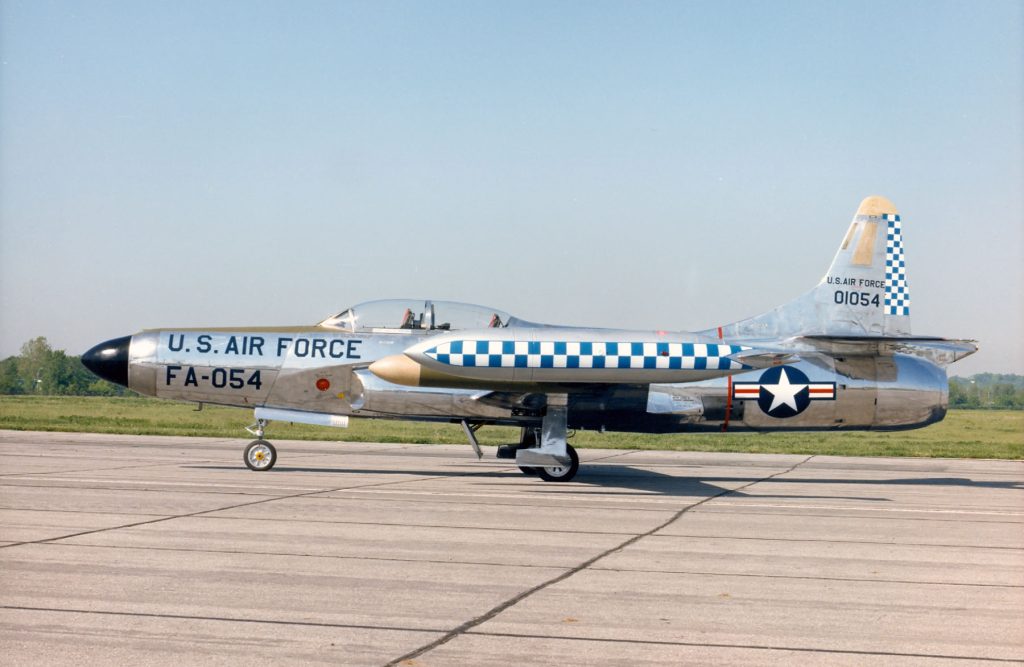
A single-seat fighter-bomber version of the Lockheed F-94 Starfire was also proposed, which was armed with eight machine guns, bombs, and rockets. A prototype was built, but it was not accepted for production. Later, this prototype was used to test the 20 mm M61 Vulcan cannon, which was then used on the Lockheed F-104 Starfighter and other combat aircraft. In the 1950s, the Lockheed F-94 Starfire primarily protected the United States against Soviet bombers, serving with the US Air Force and the Air National Guard (ANG). During the Korean War, the US Air Force replaced the older F-82 Twin Mustang with the F-94 Starfire because it was more advanced. In 1951, Lockheed F-94 Starfires started patrolling Japanese airspace. The following year, they flew night missions to escort bombers and defend airspace from bases in Korea. Starting in mid-1954, the US Air Force gradually replaced the F-94A/B models with the Northrop F-89C/D Scorpion and the North American F-86D Sabre interceptors. The retired aircraft were mostly given to ANG units, which used them to replace the F-80C Shooting Stars and F-51D/H Mustangs. Before entering ANG service, the F-94As were upgraded to F-94B standards. By the late 1950s, F-94Cs also entered ANG service, replacing earlier models. At one time, 22 ANG Fighter-Interceptor squadrons flew the Starfires. The last F-94C left active duty in November 1957, with the 319th Fighter-Interceptor Squadron at Bunker Hill Air Force Base being the last to operate them. The final F-94Cs were retired by the 179th Fighter-Interceptor Squadron in Minnesota during the summer of 1959. After their retirement, the Lockheed F-94 Starfires were transferred to Davis-Monthan Air Force Base, commonly known as “The Boneyard.” Read more Boneyard Files series articles HERE.