






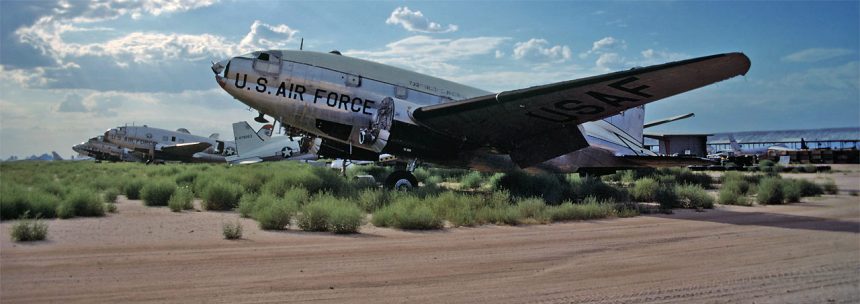

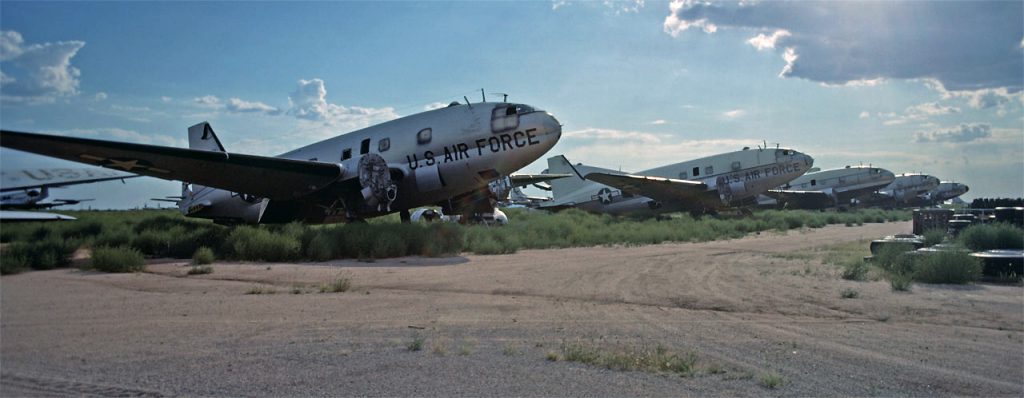
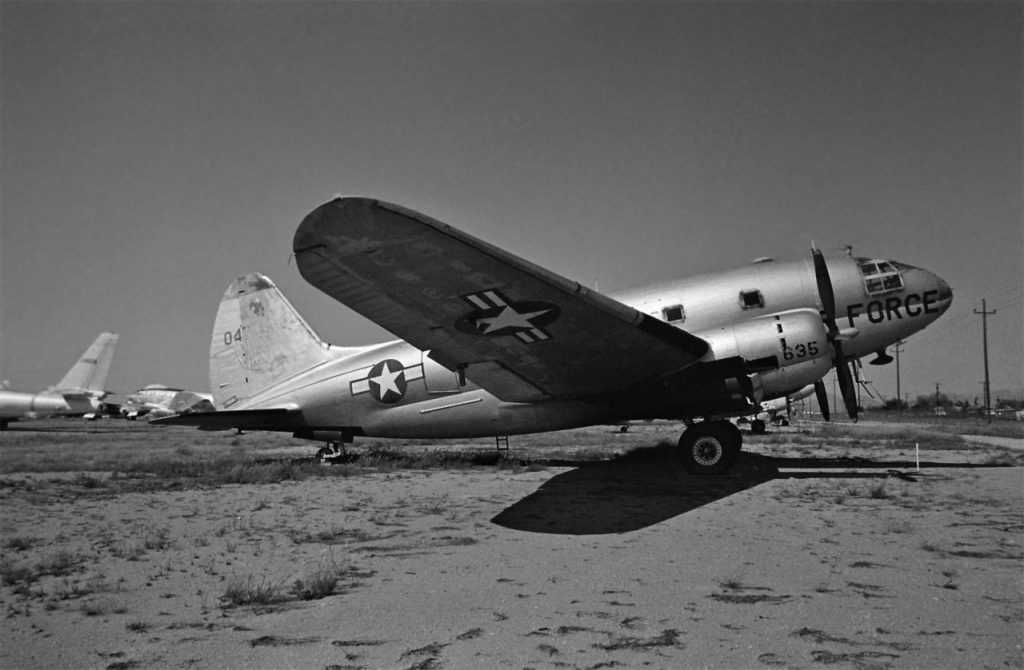
As we continue the Boneyard Files series, which showcases some of the retired aircraft resting at Davis-Monthan Air Force Base in Tucson, Arizona, in the late 1960s, today’s story features the Curtiss C-46 Commando through the lens of Neil Aird’s “Monthan Memories” photos. The Curtiss C-46 Commando was developed from the new commercial aircraft design, the CW-20, which first flew in March 1940. The US Army Air Forces (USAAF) received its first C-46 planes in July 1942 for the Air Transport Command and the Troop Carrier Command. During WWII, the USAAF accepted 3,144 C-46s to transport cargo and troops and to tow gliders. It also served with the US Navy and Marine Corps, designated the R5C. The Curtiss C-46 Commando was the largest and heaviest twin-engine aircraft used by the USAAF. It had a unique fuselage shape, a strong cargo floor, a large cargo door on the left rear side, a reinforced cargo floor, 40 folding seats, and high-altitude engines. It could carry 15,000 pounds of cargo, a heavier load than the C-47, and reach higher altitudes.
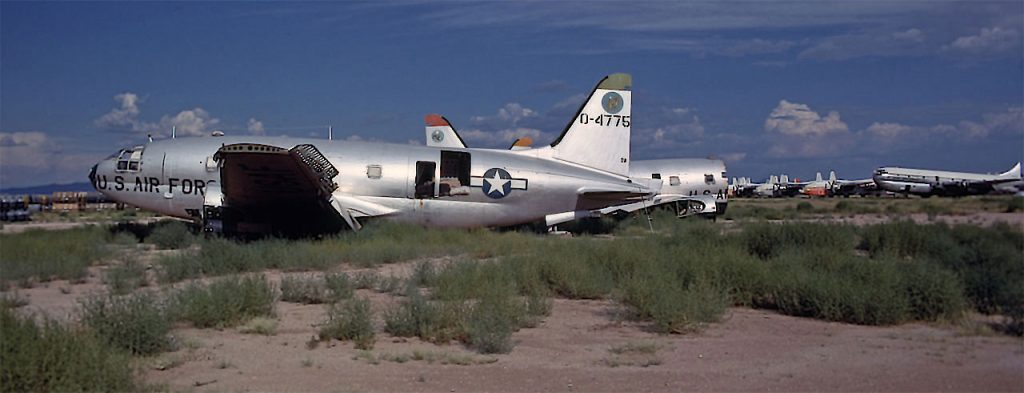
The Curtiss C-46 Commando was 76.4 feet long, 21.9 feet high, with a wingspan of 108 feet and a wing area of 1,360 square feet. Its empty weight was 30,669 pounds, and the gross weight was 45,000 pounds. The aircraft was powered by two Pratt & Whitney R-2800-51 Double Wasp 18-cylinder air-cooled radial piston engines, each producing 2,000 horsepower. The engines supplied power to two four-bladed Curtiss Electric constant-speed propellers. The maximum speed of the Curtiss C-46 Commando was 270 mph at 15,000 feet, with a cruise speed of 173 mph. Its range was 3,150 miles at 173 mph, and 1,000 miles at 237 mph. The service ceiling was 24,500 feet, and it could climb 10,000 feet in about 17 minutes. The Curtiss C-46 Commando played an important, though often overlooked, role in defeating Japan during WWII. The aircraft’s ability to carry cargo helped keep China in the fight when it looked like it might collapse. China had been battling Japan since September 1931, after Japan invaded Manchuria. By spring 1942, Japan had cut off China’s land supply routes and had either captured or blocked its coast.
Establishing an air route from India was the only way to get much-needed supplies to China. However, such a journey was long and dangerous, as pilots had to fly cargo through the Himalayas, a mountain range known as ‘the Hump’. Pilots often faced terrible weather with winds over 125 mph and poor visibility due to what is called a ‘granite cloud.’ The route over the Hump was sometimes nicknamed the Aluminum Trail because of the many crashed planes. In April 1943, the first Commandos began their service over the Hump. Among the cargo planes available at that time, the C-47, C-54, C-87, and C-109 were important, but the Curtiss C-46 Commando proved to be most useful in the operation. The Commando carried more cargo than the well-known C-47 and performed better at higher altitudes. In addition, several Curtiss C-46 Commando planes were part of Operation Matterhorn for the strategic bombing of Japanese targets by B-29 Superfortress bombers.
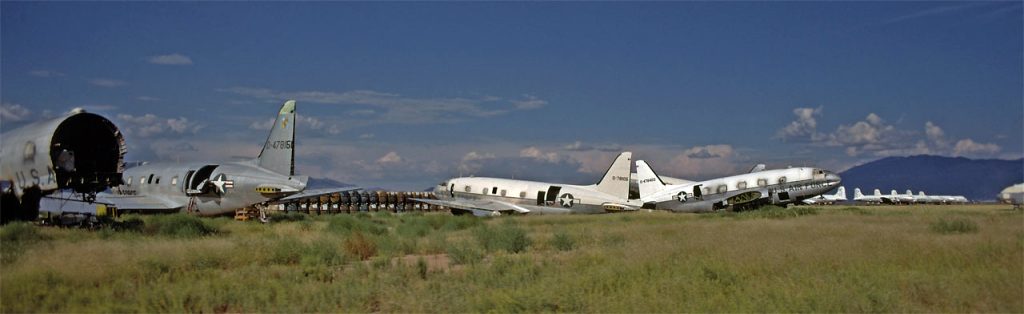
As a part of the operation, approximately 400 B-29s operated from airfields in India and China. However, for such a large operation, the B-29 planes required a large amount of fuel, replacement engines, munitions, and spare parts, which the Curtiss C-46 Commandos delivered. The United States Marine Corps also used the C-46’s large cargo capacity during their island-hopping campaign across the Pacific, flying 160 of them. Additionally, the Curtiss C-46 Commandos dropped paratroopers in the European Theatre during Operation Varsity towards the end of WWII, helping the Allies cross the Rhine River into Germany. The Curtiss C-46 Commando saw its final service during the Korean War, after which it was retired and sent to the Davis-Monthan Air Force Base, commonly known as “The Boneyard.” Read more Boneyard Files series articles HERE.



For those living in the northeast, a Curtis Commando aircraft can be seen outside the Glen Curtis Museum in Hammondsport NY. The museum is a must see for anyone interested in the early days of aviation, as well as the various other ventures Mr. Curtis was involved in. (Motorcycles, aviation engines, travel trailers, etc) It also has a great display of vintage aircraft and flying boats, early planes of the Experimental Aircraft Association, ( supported by Alexander Graham Bell), and early women in aviation. It even has a fantastic doll house exhibit.
Truly a must see museum.
Thanks for your article on this great classic aircraft! I always enjoy driving past the beautiful C-46 Commando displayed at Blackbird Airpark in Palmdale, CA. Your article didn’t mention that several C-46s – including the Marine/Navy R5C version were employed in 1948 and 1949 during the Berlin Airlift. There are very few still remaining in active service – but Buffalo Airways in Canada still uses two for their freight service between Hay River and Yellowknife in the Northwest Territory.
I flew many times on C-46’s when I was in Alaska with the Air Force, circa 1965-1967. Most of them belonged to WEIN Air Alaska. There is one parked next to the terminal at Fairbanks International Airport.
My father loved those planes. He was stationed in Chuba India and “flew a desk” for the Army Air corps.
I always thought they looked bloated when compared to C-47s but they now impress me with their capabilities.
The way you highlighted the Curtiss C-46 Commando’s role in the “Hump” operations is really nice, especially how it handled extreme altitude, payload, and unpredictable conditions. Curtiss C-46 Commando often gets overshadowed, but its operational complexity was on another level.
In our operations at Cosmic NSN, we see similar challenges when dealing with legacy systems that still need to perform under demanding environments—capacity is one thing, but consistency under stress is what really defines reliability.
One angle worth adding is how maintenance and field adaptability played a huge role in keeping these aircraft mission-ready in such unforgiving conditions.
I believe Buffalo Airways in Yellowknife, North West Territory is still hauling cargo with a Commando.
Great article on the Curtiss C-46 Commando—really highlights how long-term aircraft preservation depends heavily on dependable hardware and structural integrity. From a fastener and hardware distribution perspective, it’s always interesting seeing how legacy airframes reflect the importance of quality components over time. In my work at Hardware Superior, we see the same principles apply across demanding applications where reliability at the smallest part level drives overall performance.
Articles like this remind people that aviation history is not just about aircraft design, but also about the logistics, engineering, electrical systems, and maintenance support that kept these legendary platforms operational in some of the toughest conditions imaginable.
The Curtiss C-46 Commando truly represents an era where reliability and field adaptability mattered more than anything else. In the NSN & electrical side of aviation, we still appreciate how aircraft like this depended on durable components, proper sustainment, and skilled technical support to stay mission ready.
At Aerospace Aces, conversations around legacy aircraft systems and long-term aviation support come up often, so this article genuinely felt relatable from a professional perspective. Really appreciate the depth and respect you gave to such an important aircraft in aviation history.
Exceptional work on this article. The Curtiss C-46 Commando is one of those aircraft that truly represents the backbone of wartime aviation logistics, yet it often doesn’t receive the recognition it deserves. Your attention to the aircraft’s operational history, engineering capability, and long-term legacy really resonated with me. In the Aviation, NSN, and electronic parts field, we regularly see how historic platforms like the C-46 continue to influence modern sustainment, restoration, and component sourcing practices. At Emergent Aviation, conversations around legacy airframes and mission-ready support systems are always appreciated because they connect directly with the preservation of aviation history and operational reliability. Outstanding research and storytelling throughout this piece.
Excellent piece on the Curtiss C-46 Commando—far too often overshadowed by the C-47 despite its extraordinary contribution to wartime logistics. What stood out to me was the emphasis on the aircraft’s role over “The Hump,” where payload capacity and high-altitude performance were not just operational advantages, but mission-critical necessities. The C-46’s ability to sustain supply chains under extreme environmental and maintenance pressures is a reminder that military aviation success has always depended as much on logistics resilience as frontline capability. The historical connection to Davis-Monthan’s boneyard also adds an important preservation angle for those of us who value legacy airframes and the engineering behind them. Working in the defense supply ecosystem at Spares Universe, stories like this resonate because they highlight how sustainment, parts traceability, and platform support remain central to aerospace readiness—even decades after an aircraft leaves active service. A truly insightful and well-researched article.
Excellent piece, Kapil. What stands out is how accurately you captured the C-46’s operational significance beyond the usual “Hump” narrative. The emphasis on payload efficiency, high-altitude performance, and the logistical burden of sustaining B-29 operations really highlights why the Commando was such a strategic asset despite its maintenance challenges. Too often the C-47 gets all the attention, while the C-46’s contribution to theater-level air mobility and sustainment is underappreciated.
From an aerospace and defense sourcing perspective, aircraft like the Commando are also a reminder of how wartime logistics, supply-chain resilience, and maintainability often determine operational success as much as frontline combat capability. That connection between engineering, sustainment, and mission readiness came through very clearly in your article. The archival imagery from Davis-Monthan added real historical weight as well.